Some thoughts on Jimmy Kimmel

I’m in the process of actively moving and close to a breaking point, stress-wise. So if today’s post doesn’t feel as polished as others, I ask you to bear with me.

I woke up today to the news that Jimmy Kimmel Live has been cancelled. And this is very scary. It comes after learning that Stephen Colbert’s show was cancelled. Kimmel’s end appears to be swifter. While Colbert will still be on the air until May, Kimmel’s show seems to be gone as of now.

I could be wrong. Please let me know in the comments.

I can only imagine that Seth Meyers is counting the days until his show is pulled.

Now, I’m not scared so much for Kimmel and Colbert themselves. They’re both wealthy men who will, I’m sure, bounce back from this just fine. Colbert just won an Emmy, for God’s sake. I’m sure they’ll find another platform.

What scares me is this. If this is what’s happening to the popular, visible, wealthy white men who are standing up to Trump, what is happening to the people like us? People with little blogs and little voices? How many of those voices have been silenced without us even noticing?

This is the eventuality that writers have been warning about for years. As news media is controlled by fewer and fewer companies, our access to it becomes easier to lose. It’s the same thing that happened as publishing companies began to buy each other up. This led to more gatekeepers, more control over what books were coming out, and worse treatment of writers. Because where were we going to go?

It’s been happening for decades, and now we’re truly seeing the results. We’re seeing how easy it is for one small, petty man to quiet voices he doesn’t like.

Let’s talk about Trump. And let’s talk about the staggering hypocrisy from the right.

See, the First Amendment is the first for a reason. I’m not sure why so many people today seem to want to hop right over that one and defend the second so quickly. But clearly that’s what’s happening.

“Congress shall make no law respecting an establishment of religion, or prohibiting the free exercise thereof; or abridging the freedom of speech, or of the press; or the right of the people peaceably to assemble, and to petition the Government for a redress of grievances”

But Nicole, you might say, no one’s taking away the First Amendment rights of late-night show hosts. They are perfectly free to say whatever they want. And that’s true. They’ll probably have very popular podcasts. Freedom of Speech doesn’t guarantee freedom of reach.

But you don’t have to remove Freedom of Speech if you can just silence everyone who disagrees with you. If you strangle every avenue they have to be heard. Sure, we can say whatever we want. But if no one can hear us, it doesn’t really matter.

I’d also like to point out that removing voices from large platforms corrodes the already shaky trust we have in our news media. It’s hard to know who to trust when the established voices aren’t established anymore. It’s also just easier to trust the word of someone who has a whole team of writers, fact checkers and editors behind them.

When someone on a late-night or news show tells you something, it isn’t just them talking. And this goes for everyone in the media. Rachel Maddow has a team of writers. And that helps us trust in what they’re saying more.

All this is being done intentionally so that we the people don’t know what’s happening. To let information and misinformation combine until we don’t know which way is up. And it’s working.

Fortunately, there are things we can do.

We can verify sources on social media before we share things. Don’t be part of the problem. Don’t share news unless it’s from a reputable source.

Of course, for that we need to know who the reputable sources are. I always trust the Associated Press, personally. I tend to trust late-night people, John Stewart, John Oliver, and Some More News.

Trust what you’re seeing with your own eyes. We can look around and see that climate change is impacting us. We can see that the economy is struggling. We can see prices going up and wages remaining stagnant. We can see police violence and racism on the rise. We can see women’s rights and LGBTQ+ rights being stripped away. Don’t let someone tell you that you’re not seeing what’s right in front of you.

More than anything, don’t allow yourself to be bogged down with despair. Don’t let fear cripple you. Take care of yourself, and take action. It’s the same advice I give every time I talk about politics. Vote. Go to protests if it’s safe for you to do so. Write politicians. Write physical mail and send it. Support your local libraries, local schools, and local food pantries.

After I’m moved, I’ll be doing a series about media literacy and disaster preparation. Until then, stay safe and stay informed.

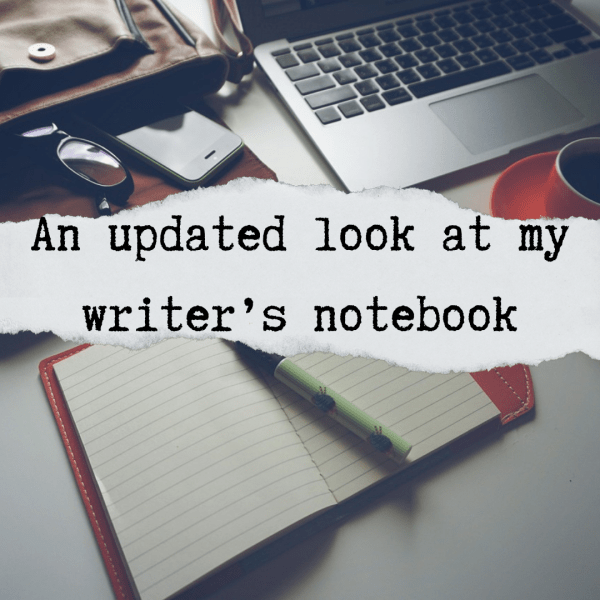
An updated look at my writer’s notebook

A writer’s notebook is the most important tool you can have. I will not be humoring arguments regarding this. Nothing is more essential. Nothing will make you a better writer than keeping a writer’s notebook. Not that special pen. Not the latest writing software. Not the craft book that everyone is talking about. The best way to become a better writer is by writing. And to that end, nothing is more important than a writer’s notebook.

I always consider this notebook to be like a visual artist’s sketchbook. It’s full of practices, studies, and first attempts. My friends who draw and paint usually have pages full of hands, feet, buildings, and plants. It becomes almost like a journal in both senses of the word. A memory-keeping journal and a practice journal. If you don’t have a writer’s notebook already, start one today. Don’t worry, I’m here to help you.

How to pick one

First, let’s talk about the physical thing. This is going to be a very personal decision, but here are some things to consider.

Price, unfortunately, must be considered. A simple spiral notebook can be had for less than a dollar at Walmart. A more sturdy composition notebook can be had for a few dollars. I used to write in a lot of those. And if you’re going to run through the pages quickly, an affordable option is essential.

For me, the quality of the book matters. I need my notebook to go everywhere with me. So it’s got to have a hard cover. I am personally offended by wide ruled pages, so my notebook has to have college rule. I usually end up with Moleskine knockoffs. And since I love stickers, there are usually quite a few on the cover.

This one cost me about seven dollars at Rite Aid.

Can you keep a writer’s notebook on your phone or pc? Sure, if that works for you. But I find that my notebook is best when I have it opened next to me. If that’s the note app on your phone for you, awesome. The best writer’s notebook is the one you use.

What to keep in it

Each writer’s notebook is going to be a little different. We are all our own brand of strange, of course. And what I consider essential might well be a waste of your time. But here’s a short collection of ideas to get you started.

Freewriting pages are a must for me. I need a place to just dump out my brain daily. And this is often when I get my best blog post ideas.

I’m forever struggling with character names. So when I hear a unique name, I write it down in my name bank. This saves me from rummaging through baby name websites for inspiration. (I end up getting diaper ads after that.)

Story ideas come at some of the most inopportune times. I wish I could stop whatever I’m doing and write, but that’s just not realistic. So when I get story and poetry ideas, I write them on a dedicated page of my writer’s notebook. Then, when I have the time, I have a list of story or poem ideas right at my fingertips.

Speaking of poetry, which I do a lot for someone who doesn’t publish poetry, I write poetry in my writer’s notebook. Haiku, rhyming poems, lyrical prose. I enjoy doing this, even though I don’t usually share it. Most of it lives in my notebook, as all it needed was to exist.

I also keep short story and chapter outlines. As well as little snippets of things I observe or think of during the day. Maybe someone said something funny or profound, or just really dumb, and I want to remember it.

Another thing I keep that I highly recommend is reading notes for whatever book I’m reading. Lines that stick out to me. Things I liked about the book. Things I hated about the book. Anything like that.

Finally, I do a lot of brainstorming in my writer’s notebook. Just figuring out what might happen in a story or blog post. Getting a feel for what the piece should look like.

How often should you use it

Here’s the real magic of a writer’s notebook. It’s not going to do shit for you if you’re not writing in it.

I would recommend writing in your writer’s notebook daily. Multiple times a day, if I’m being honest. I usually do freewriting in the morning, try to squeeze in a writing exercise in the afternoon, and capture whatever random thoughts come about during the day. The point is that every day, multiple times a day, I am putting pen to paper and building this writer’s notebook into something that can inspire me. Something that can make me a better writer.

So now it’s your turn. Do you keep a writer’s notebook? What do you keep in it? Let us know in the comments.

Paper Beats World is a labor of love. If you love what I do here, please consider liking and sharing this post and leaving a comment. You can also support me financially on Ko-fi.

Spooky season is coming, and it’s time for some creepy reads. Check out my horror novel Quiet Apocalypse, about a witch trapped in her apartment during a dark winter storm with a demon devoted to ending the world.

Or check out my horror short, The Man In The Woods. A man tries desperately to protect his granddaughter from the mysterious man in the woods. But his fear only grows when a new housing complex is built too close to the woods.

Discussing Long Quiet Highway

Published in 1993, Long Quiet Highway is the fifth book by Natalie Goldberg. Just in case you don’t know, she is the iconic writing teacher and author of Writing Down The Bones, among other amazing books about writing. This one, though, is not technically a book about writing. It’s a memoir. But, like all of her work, it sent me right to my notebook.

So today, let’s talk about Long Quiet Highway. How it’s different from her other books, and what I learned from it.

Long Quiet Highway starts with the story of Natalie as a child. Her parents were immigrants. She grew up in New York before they moved to the suburbs.

Natalie describes her childhood as being cloistered. Dull. To me, it feels cloying. Safe, fun, and full of little pleasures. Her parents clearly loved her and supported her. But there was little art in her life. There was little to wake her up, to make her feel alive.

This is used as an introduction to a teacher who woke her up. That encouraged her to listen to the rain. To experience it.

As an adult, Natalie taught high school. Or, maybe middle school. I’m honestly not sure which, and I don’t think it matters. While she was teaching the same bland curriculum she herself had learned, she felt lost and dull. Asleep. That’s when she decided to quit her job and join a Zen commune.

Because I guess that’s a thing you can do?!

For years, Natalie learned meditation and Zen from several teachers. Until she met one that changed her life, Katagiri Roshi.

He’s changed mine as well. But we’ll get to that.

The focus on the subject is solid

Through the book, it can feel like the story sort of rambles. One minute, Natalie’s talking about a train ride she took with a friend. The next she’s talking about learning Zen. Then we’re at a diner ordering a soda.

It’s only when we step back and look at the story as a whole that it makes sense. That we realize that every step was going in the right direction, we just couldn’t see the end of the path yet.

This was a fantastic way of memoir writing. Rather than going in strict chronological order, we skip around. It allows us to become completely immersed in the true subject of the story without even realizing it.

Even when she’s not talking about writing, she’s always talking about writing

I mentioned earlier that Long Quiet Highway is not a book about writing. It is about Natalie’s life. But here’s the thing. Natalie’s life is about writing. She writes passionately. She teaches writing. She exudes writing. This woman writes like the rest of us check social media. So when she talks about her life, she is talking about her writing.

In this way, much can be learned about the habit of writing from this book. Write when you’re happy. Write when you’re sad. Write when you don’t think you can possibly get yourself up off the ground. Fuck it, write from the ground, then. Write when you feel inspired and when you feel dull. Write when you’d much rather be eating chocolate.

Just keep your hand moving.

This is the best advice I’ve ever gotten about writing. Don’t worry about it being good, at least not at first. A lot of your first draft is going to be shit, no matter how many books you’ve written and how many you will write. Trust me, I speak from experience. I have published 12 books, and my rough drafts are still terrible. Hell, my second drafts are also bad. It’s only by the third draft that the story becomes anything I might consider letting someone else see.

And that’s okay. The purpose of a first draft is simply to exist. So if you’re still trying to complete your first piece, but you’re worried it isn’t good enough, it is. Just keep your hand moving.

Her work makes me want to live

I’ve mentioned before that reading Natalie Goldberg always makes me want to write more. More than that, it makes me want to live more. To do more things and to do them deeply.

Never before have I experienced a person who so deeply experiences every part of their life. She talks in such detail about going to get a croissant. Of riding the train.

Goldberg’s work makes me want to sit outside and feel the sun. To write about the rain, the people arguing in the parking lot outside of my window, and the cupcake I bought at a festival.

She also makes me want to travel. To go out and explore the world. To take a long trip alone or just a different route home.

The legacy of a teacher

Finally, I want to talk about how teachers can touch the lives of people they will never meet.

I am not a Buddhist. I am not a Zen student. I practice meditation, but more in a witchy way than a Zen way. And I certainly never met the famous teacher Katagiri Roshi.

And yet he has touched my life in a profound way. Because Natalie Goldberg was his student. And she wouldn’t have written Writing Down The Bones if it hadn’t been for his teachings.

Because of this, Goldberg was able to touch my life. I have learned so much from her work, and I continue to do so. Someday I want to actually work with her, attend one of her workshops. But for now, I have her words, and am one of the many students she’s inspired.

And Natalie is only one of Katagiri’s students. His kind, supportive teachings have touched countless lives.

I highly recommend reading Long Quiet Highway. As well as any of Natalie’s books. If you want to be a writer, or get into mediation, or just experience life more, this book will help you do that.

It will help you wake up.

Paper Beats World is a labor of love. If you love what I do here, please consider liking and sharing this post and leaving a comment. You can also support me financially on Ko-fi.

Spooky season is coming, and it’s time for some creepy reads. Check out my horror novel Quiet Apocalypse, about a witch trapped in her apartment during a dark winter storm with a demon devoted to ending the world.

Or check out my horror short, The Man In The Woods. A man tries desperately to protect his granddaughter from the mysterious man in the woods. But his fear only grows when a new housing complex is built too close to the woods.

Eleven years together

I’ve spent a lot of time trying to figure out what I want to say today. On the one hand, it’s a great day. Paper Beats World has been around for eleven years. That’s longer than Stephen Colbert’s been hosting The Late Show. (If you wonder how I feel about him getting cancelled, go watch John Stewart’s response. That about sums up my feelings.)

I’ve written at least three posts a month for eleven years. And that’s an accomplishment. I should be proud. I should be grateful. I should be celebrating.

I am grateful. I can’t believe I’ve found a community of people who want to talk about writing with me. I can’t believe I’ve been yapping away here about writing and reading for this long, and you’re still here.

Thank you for that. From the bottom of my heart, thank you.

All that being said, this has been a hard year. It’s been a living nightmare. As many of you already know, my husband had a stroke in December. And he is getting better. He’s healing. But it’s been a long journey, and there are still so many challenges ahead of us.

This is to say nothing of the challenges we’re facing as Americans. Like the startling rise of fascism, poverty rising, and the ever-present threat of shootings in places that should be sacred.

Are we feeling great again, yet?

All of this is to say that 2025 has been another hard year in a series of hard fucking years. And through all of it, a couple of things have kept me going. Animals on Instagram, the loving support of my friends and family, and art.

Art has kept me alive. Has given me reasons to smile. Has helped heal my husband’s broken brain. Has given us something to bond over together.

Let’s start with music. I have experienced so many new good songs this year. Some that inspire me to dance. Some to sing along at the top of my lungs. Some that remind me that I’m not crazy to be angry. I’m not alone in being angry. I’m not alone in being scared.

You can listen to my ever-changing playlist here if you want. Or, just look at my weird music taste and laugh about it.

Then, of course, there have been books. So many new books by authors I love have come out. Witchcraft for Wayward Girls, The Bewitching, Sunrise on the Reaping, Never Flinch, and most recently Dead Husband Cookbook. These were all fantastic books that brought so much joy into my life.

I’ve discovered new authors, like Marcus Kliewer and Josh Malerman. And I’ve read some older books I’ve never gotten around to, like Horrorstor and Long Quiet Highway.

Books have even helped my husband. We’ve been reading one of his favorites, Out of This Furnace, together. And I can see his speech improving every day.

Stories are once again saving me.

So I’ll stick around. I’ll keep writing. It might be slower than before. I might not always post on Friday at six in the morning. But I’m going to keep trying. Because in this ever-darkening world, we need all the light we can get. And all of you, coming here every week to hopefully get a smile or some good advice from me, you’re one thing that brings a hell of a lot of light into my life.

There are better days ahead. Stay tuned with me.

I’m a Christian Witch. Here’s how it impacts my writing

Writers have a weird job. We sit down and make up things that never happened, then write them down on paper to entertain people. We might try to tell some truths about things along the way, but mostly we’re playing pretend on the page.

That’s a weird thing to do, when you think about it. Which is maybe why everyone wants to psychoanalyze writers. Especially horror writers, I’ve noticed. It’s almost like people think you’re weird if you make up stories about people getting brutally ripped apart by otherworldly creatures or psychos in masks.

What’s wrong with people?

However, it’s true that a writer’s life and beliefs will inevitably influence their writing. Of course it will. No matter what you do, your personality bleeds through on the page. What you love, what you hate. What you hope for and what you’re afraid of.

Now, I’m not saying that Paul Tremblay has murdered anyone. No more than I’ve ever battled a demon while trapped by an ice storm. But I am saying that my personal beliefs do make their way onto the page. Sometimes it’s on purpose, but sometimes it’s not.

Let’s discuss.

If you don’t already know, I am a Christian. But not in a red hat, everyone’s going to burn in hell except me, way. I’m a bit more classic Christian. Feed the poor, care for the sick, love your neighbor, and flip over tables if need be.

I’m also a witch. Yes, you can do both. No, it’s not common, but it happens.

I’ve been fascinated by witchcraft since I was a kid. Charmed, The Craft, Practical Magic. I especially loved Willow from Buffy. I loved that she gained all this amazing power just from studying! Willow wasn’t born into witchcraft. This isn’t a legacy or a superpower for her. She chose it, studied like hell, and became as powerful as the Slayer.

So it’s no wonder that, once I finally started exploring witchcraft, I wanted my characters to explore it as well. I even included some actual spells I actually wrote in Quiet Apocalypse. In this way, I grounded the story in a bit of reality.

Yes, I actually do mean realistic. Because as a witch, I do believe in ghosts. But I also believe that ghosts aren’t the only thing that can get into your home and mess your life up.

However, I don’t usually believe in the chain rattling, blood coming from the walls, apparition sort of ghosts. No, the spirits I’ve encountered are a bit darker. A bit more clever.

My witchcraft experiences have encouraged me to write more about that sort of haunting. It’s less dramatic, but feels more real. At least, to those of us unfortunate enough to experience it.

Finally, both witchcraft and Christianity have made me see my writing as a sacred thing. A gift that I can use to make the world a better place. Or, at least make my life better.

Writing can be shadow work. I used it that way in Quiet Apocalypse. Writing can be a manifestation. Writing can illicit emotions or make people see the world in a different way.

Writing can change the world. At the very least, it can brighten someone’s life. I don’t ever take that for granted.

Witchcraft and magic have touched all of my writing. Woven is largely about the difference between religion and faith, and standing out in a world that wants to force you to fit in. Quiet Apocalypse is about the darker sides of magic fighting the light. And the thing is, this isn’t something I plan or don’t plan. It happens in the rough draft, and I decide to go with it.

That, I think, is the real moral of today’s story. Let the things that move you into your writing. Let the things that shape you into your writing. I could have written this exact same post about living in a Western PA steel town. Or growing up in a single-parent, single-child household. Or being a horror fan. All of these things shape who I am. So, of course, they shape the art I make.

Who you are should shape the art you make. And the good news is that this isn’t something you have to learn. Just let it come out.

Paper Beats World is a labor of love. If you love what I do here, please consider liking and sharing this post and leaving a comment. You can also support me financially on Ko-fi.

Spooky season is coming, and it’s time for some creepy reads. Check out my horror novel Quiet Apocalypse, about a witch trapped in her apartment during a dark winter storm with a demon devoted to ending the world.

Or check out my horror short, The Man In The Woods. A man tries desperately to protect his granddaughter from the mysterious man in the woods. But his fear only grows when a new housing complex is built too close to the woods.

Why The Dead Husband Cookbook Works

I will do my best to avoid food puns in this post. But I might not be able to help it. Sometimes they’re just too tasty.

See, we’re starting already.

Released on the fifth of this month, The Dead Husband Cookbook is the latest novel from Danielle Valentine. If you’re just joining us, she’s written three novels so far that I’ve absolutely devoured.

Wow, two so far.

The Dead Husband Cookbook is about two women. One, Thea, an editor who’s hanging onto her career by a thread. She committed the ultimate sin of, gasp, revealing an author she was working for to be a predator. But she’s given a chance to redeem herself when a celebrity chef, Maria Capello, asks for her specifically to edit her brand new memoir. The memoir, which might, after years of speculation, put to rest the rumors of how her husband died.

So let’s break it down, like a good recipe. Let’s talk about what went into The Dead Husband Cookbook and why it works.

I loved the recipes

Through the book, we’re treated to some of Maria’s recipes. Now, I’m not as deeply into cooking as I am some other things, but I do enjoy it. I like a simple recipe full of things I can recognize and easily get at Walmart. I like making a recipe with the tools already in my kitchen.

I have managed to not buy an immersion blender for thirty-nine years, and I’d like to keep it that way.

All of these recipes are like that. Well, maybe not the one for duck. I’ve never seen duck at a grocery store here in Western PA. But then, I’ve never looked for one.

I got the e-book version of this book, just to make sure I can hang onto the recipes and try them. This made me feel immersed in the story. I, like Thea, will try my hand at making Maria Capello’s meatballs. Mine probably won’t taste the same either.

But it’s these little details that make reading a book not a passive experience. You get to become part of the story in a small way. That’s fun.

This feels like a book within a book

I am always a sucker for stories with additional documents in them. Journal entries, a VHS someone found tucked behind the guest room dresser, old medical records. And in this case, a manuscript that Thea is editing. As a reader, it breaks up the flow of the story in a good way. We feel like we have as well found something illicit. Something we’re not supposed to read or see, but now we’ve got our hands on it.

As a writer, this is also fun. It’s a way to experiment with different writing styles and formats. Even with different voices, as the pov of found content is different from our main characters. This leaves you open to all sorts of fun experimentation. And if the writer’s having fun, the reader will too. And Valentine was having fun when she was writing Maria.

Maria is creepy as hell, but not for the normal reasons

I loved the character, Maria. As someone who’s spent way too much time in medical waiting rooms, I’m familiar with the celebrity chefs she’s based on. The Pioneer Woman, Martha Stewart, The Barefoot Contessa, Rachel Ray. They all give off this air of near perfection. Like Maria, they appear smiling, joyful, endlessly energetic and endlessly working to feed others. I am a rabid feminist and I still sort of want to be that. I want to be the woman who saunters into a gorgeous, well-lit kitchen and throws together a fabulous meal without getting a single stain on my expensive blouse.

But I think we all know that these women are performing. They’re acting. And under that character, they’re real people. People with a whole range of human emotions and access to many sharp knives.

Maria isn’t scary in the way the killers from Never Flinch or Mexican Gothic are. She’s more like President Snow. She has the power, the money, and the know-how to destroy anyone she wants. She also has the will to do so. And she’ll sleep well that night.

Thea is very relatable

Unlike Maria, Thea is a relatable character. She’s struggling in a very Millennial way, trying to care for her family and her mother. She doesn’t know how to talk about what she needs to other people. She doesn’t know how to stand up to anyone at the start of the book.

But she’ll stand up for other people.

I also loved how much of a mom Thea is. Early in the book, she notes that Maria’s granddaughter has impeccable table manners. She’s not impressed, she’s concerned. That kid sat at the table and ate with a fork without spilling or interrupting seven times with incomprehensible questions? Nope, doesn’t pass the vibe check.

I also loved her constant irritation at having no internet connection. Look, I can’t do my work without the internet either. I have three tabs open just to write this post. She’s not irritated because she can’t scroll through Instagram before bed. She needs to be in communication with the people who depend on her and do research, damn it! Let the woman access Zoom.

The tension is thick

I was nervous as soon as Thea stepped into Maria’s house. It felt like she was stepping into a killing bottle. A well-appointed one, an expensive one, but a killing bottle nonetheless.

It started when they took her phone. Then her keys. Then she couldn’t get out through the Wi-Fi.

I don’t think we realize sometimes how accustomed we’ve come to being able to communicate with others. We can casually chat with people all over the world. I haven’t seen my best friend face-to-face since December. We talk all day long.

As soon as Thea arrives, though, she can’t contact anyone. Not just anyone. She can’t communicate with her boss, who is looking for an excuse to fire her. She can’t communicate with her team, who are waiting to make crucial publishing decisions on a short deadline. She can’t communicate with her husband and daughter.

Setting aside the horror part of this horror story, that is an anxious situation. Not being able to reach people who might need us, who usually do need us, is stressful.

As always, horror works best when it’s grounded in reality. Most of us will not be trapped in a killer chef’s house. All of us have felt stressed out because someone might need us, and can’t reach us. So when that layer of physical danger is layered over this emotion that we are familiar with, it feels so much more real.

I adored The Dead Husband Cookbook. Aside from everything else, it was a grown-up horror. It was a scary story that felt real to adult experiences. It relied on real fears and anger that real adults feel. All in all, it’s another hit from an author who hasn’t missed yet.

So now I want to hear from you. Did you read The Dead Husband Cookbook? Let us know what you think in the comments. And if there’s a book you want me to pick apart to see why it works, let me know that as well.

Paper Beats World is a labor of love. If you love what I do here, please consider liking and sharing this post and leaving a comment. You can also support me financially on Ko-fi.

Spooky season is coming, and it’s time for some creepy reads. Check out my horror novel Quiet Apocalypse, about a witch trapped in her apartment during a dark winter storm with a demon devoted to ending the world.

Or check out my horror short, The Man In The Woods. A man tries desperately to protect his granddaughter from the mysterious man in the woods. But his fear only grows when a new housing complex is built too close to the woods.

Why I read so many books at a time

If you follow me on Goodreads, and you should, you might notice two things. One, I am seven books behind on my reading goal for the year. And two, I am currently reading (checks notes) four books.

Four different books.

This is not uncommon for me. I’m usually in the middle of at least two books at a time. Part of this is because of my Gemini nature. I am often in wildly different moods throughout the day, and some of those moods call for different reading experiences. Sometimes I’m just being fickle and can’t settle on one story. Sometimes I pick up a second book because the primary one isn’t doing it for me, but I’m not ready to admit that yet. And yes, sometimes it’s because a shiny new release comes out and my TBR just cannot compete.

All that being said, I have good reasons to read several books at a time as well. And, as some of these reasons might apply to you too, I thought I’d share them with you today. So if you’ve ever been made to feel guilty for having too many bookmarks in too many books, keep reading.

Some books I only want to read a little of each day

One of the four books I’m reading right now is Power of The Psalms by Anna Riva. It’s a lovely book that includes all 150 Biblical Psalms, and some magic to work with each one. Every morning, I read a single psalm to start my day. I don’t want to read more than that, as I’d like to think about this psalm throughout the day.

You might have any number of books you do this with. Spiritual devotionals, poetry books. Anything that you don’t want to consume huge chunks of at a time.

Some books come with activities

I enjoy reading witchcraft books. I also enjoy reading writing books. Sometimes I get lucky and find books that talk about both, like The Magical Writing Grimoire, Poetry as Spellcasting or Inspiring Creativity.

Books like this often have exercises. Meditations, writing prompts and rituals. And books like this don’t do much good if you don’t do the exercises. And I don’t know about you, but I often read in places where I can’t write. Much less light a candle and start mixing herbs. Sometimes I’m just too tired to do a writing exercise.

Now, I could just keep reading from there. But I know myself better than that. I will for sure not come back and do that exercise, no matter how sure I am that I will.

I won’t.

But if I mark the page and come back to the book after I do the ritual, then I’m good. This might mean that I put a book down for a few hours. Or until I have a quiet moment to write or light a candle. Or, if we’re talking about a witchcraft book, I might have to wait for a specific moon cycle. While I’m waiting, I might well have time to read. So, I’ll need to switch to another book.

Some books I read with others

Right now, I’m reading Out of This Furnace with the darling husband. It’s a fun activity, reading a book with someone else.

There are many reasons you might do this. Maybe you’re reading to a child, or a disabled loved one like me. Maybe you’re reading a book in tandem with a friend, and you don’t want to get too far ahead of them. Reading might not seem like a social activity. But it can be. And if you’re read voraciously (or try to), you might need a backup book you aren’t sharing with anyone else.

Some books I read specifically to review

Now, I don’t work as a professional critic anymore. At least, not right now. But when I did, I was often reading a book specifically to review it. Even now, I have a list of books I want to read so that I can talk about them on here.

When you make books a part of your job, sometimes you’ve got to read books you might not want to. Sometimes it’s an ARC. Sometimes it’s a contractual thing. Sometimes a book just pissed you off so badly that you need to tell the world.

Even if you’re reading a book to review and it’s good, and most of them are good, it’s work to review a book. You aren’t just reading. You’ve got to take notes and consider things like theme and cultural significance. I wrote a whole two-part post about what it takes to review things instead of just reading or watching them. And yes, it’s fun work. But it’s work.

Some books are too emotional to binge

There are some books that just throw you. Some books trigger you when you frankly don’t expect to be triggered. This has happened to me several times.

Sometimes it’s okay. I can handle a little emotional damage. But depending on the sort of damage, and the theme of said damage, and where I am emotionally, sometimes I’m just not able to keep reading.

And that’s okay. If a topic is too heavy, you can put it down and come back to it later. Or, maybe you know the story you’re reading is triggering you, and you’re having a bad day. It’s perfectly fine to say that this is too much, and you’ll come back to the story another time. Maybe it’ll be tomorrow. Maybe a week from now. Maybe a year. But it’s okay to tuck that rough story back in your TBR pile for another time.

Some books I read just for pleasure

This is the biggest thing I want you to take away from this post. Reading is fun. And yes, we might often find ourselves reading books for other reasons than pleasure. I didn’t even get into students who have to read assigned books, or people guilted into reading a book by their best friend.

But it’s okay to read something just because you like it. Hell, given the state of the world, a good book might be exactly what you need to save your sanity on any given day.

A book is not a meal. You don’t have to finish your vegetables before you have dessert.

Paper Beats World is a labor of love. If you love what I do here, please consider liking and sharing this post and leaving a comment. You can also support me financially on Ko-fi.

Spooky season is coming, and it’s time for some creepy reads. Check out my horror novel Quiet Apocalypse, about a witch trapped in her apartment during a dark winter storm with a demon devoted to ending the world.

Or check out my horror short, The Man In The Woods. A man tries desperately to protect his granddaughter from the mysterious man in the woods. But his fear only grows when a new housing complex is built too close to the woods.

Why The Bewitching Works

Released on July 15th, The Bewitching is the latest book from Sylvia Moreno-Garcia. If you don’t know who that is, where have you been?

It’s the story of three women battling dark entities and evil workings. A story that spans decades and miles to tie Mexican witchcraft with New England witchcraft. It’s about blood, greed, and power.

In this book, we meet Alba, a restless young woman who wants to escape her family’s farm with her dashing uncle. We also meet her great-granddaughter, Minerva, a college student suffering from burnout while working on her thesis. Finally, and my personal favorite, we meet Beatrice Tremblay, a young writer in love with her college roommate who mysteriously vanishes one cold, dark winter night.

I loved every second of it. So let’s take the story apart and talk about why The Bewitching works.

Every time I talk about Moreno-Garcia, I have to talk about her settings. When reading one of her stories, you can feel the places her characters live in. In Alba’s parts, we walk on a family-run Mexican farm, plucking chickens and sewing patches on rowdy children’s clothes. When we’re with Beatrice, we can feel the constrained and manicured lives of female college students during the Great Depression. Minerva’s parts feel like a campus town in the summer. All but abandoned.

We see this and feel this because each character feels these things. It’s in the small bits of internal monologue. An itchy collar on a dress. Meeting your dance date in the lobby of your dorm. The trees rustling, the sunlight turned green coming through their leaves.

It’s the smallest details, told matter-of-factly, that make this possible. The characters talk about what they’re experiencing with their senses as though we must know what that feels like. And we do.

A major theme in Moreno-Garcia’s books is romance. Love stories. In Bewitching, the theme is more about lost love. More than that, losing the opportunity for love. The almost romance that will never be. That sort of thing.

This is something I think most of us have felt. The unrequited crush. The relationship was just never timed right. Or the love that was taken from us by the tragedy of one sort or another.

This makes the pain of the characters relatable. And it’s something I don’t think we see enough of in fiction.

There are plenty of meet-cutes. (Bleh). Plenty of slow burn, will they won’t they sort of stories. Even plenty of loves taken too soon. But they got to the love part first.

Losing someone who was never really yours is a different sort of pain. It’s strange, still trying to shift through feelings that were never fully grown. Strange to explain to people why you feel how you feel. Because it’s not the loss of a life or a loved one. It’s the loss of what could have been, and now never will. This is something that is explored in heartbreaking detail in this book.

Finally, I have to talk about the witchcraft in The Bewitching. Because, just in case you didn’t know, I’m a practitioner. There’s a lit spell candle on my desk as I write this.

Much like in Silver Nitrate, another book by the same author, the witchcraft in this book makes sense. I loved the practitioners in Alba’s village, selling protections and trinkets. It feels real. I loved Ginny’s automatic writing being used to contact her mother. I loved the cryptic warnings and tarot cards. And I especially loved the explicit explanation of intent in this book. Because I can tell you from experience, intent is the most important thing in witchcraft. No spell works without it. But I have worked magic with nothing but my intent and words on a page. Candles, crystals and herbs are all well and good. Iron and bowls of blessed water are lovely. But nothing matters more than intent.

I’ve mentioned before that Sylvia Moreno-Garcia is either a practitioner or did all the right research. Either way, the witchcraft in The Bewitching gets this witch’s seal of approval.

If you haven’t read The Bewitching yet, go do it. If you have read it and loved it as much as I did, you have great taste. I recommend reading Lucy Undying by Kiersten White, Mexican Gothic by Sylvia Moreno-Garcia, The Hacienda by Isabel Canas, or Quiet Apocalypse by me. Each one has a witchy or historical vibe that will certainly keep you up at night.

Now I want to hear from you. Did you read The Bewitching? If so, what did you think of it? Let us know in the comments. And if there’s a book or movie you want me to pick apart to see why it works, let me know that as well.

Paper Beats World is a labor of love. If you love what I do here, please consider liking and sharing this post and leaving a comment. You can also support me financially on Ko-fi.

Spooky season is coming, and it’s time for some creepy reads. Check out my horror novel Quiet Apocalypse, about a witch trapped in her apartment during a dark winter storm with a demon devoted to ending the world.

Or check out my horror short, The Man In The Woods. A man tries desperately to protect his granddaughter from the mysterious man in the woods. But his fear only grows when a new housing complex is built too close to the woods.

Some things are supposed to take time

I love a cup of coffee.

Yes, I am a cliche. I’m a writer and a Millennial woman. Of course my veins are full of espresso instead of red blood cells.

I make it each morning in a French press, one of the slowest and low-tech ways to possibly make coffee. I start with Cafe Bustelo grounds and a pinch of salt. (Listen to me. I said a pinch!) Then I put in a bit of cinnamon. I boil water in a kettle I’ve had for years, dressing and feeding the pets while I wait for it to sing. Then I pour the water into the press and give it four minutes to steep. The whole process takes an average of fifteen minutes.

It is the best coffee I’ve ever had. And it’s not the only thing I make that takes time. I make eight-hour roasts and garlic confit. While I have quite a strong relationship with my microwave, my favorite things take time.

Writing takes time. Writing books takes time. Sometimes, far more time than we, as writers, want it to. Publish or perish seems to be the name of the game, especially in the indie writing world. I feel like I’ve always got to have something new coming out. There’s a never-ending pressure.

Oh my God, it is such horrific pressure. When you make your passion your career, it’s a special kind of hell. One completely of our own making. Because it’s not just about creating anymore. It’s not just about writing anymore. It’s about building a backlog. About building a career.

This pressure has been killing me this year. Squeezing me until I can’t breathe, but I sure can be wracked with sobs. I published my latest novel in May of last year. And, I’m sorry to say, I will probably not be publishing anything until at least 2027.

That might be a miracle.

I’ve been writing. Not as much as I want to. But I’ve written two rough drafts for the final book in the Station 86 series.

I’ve written two rough drafts and thrown them out. Because they were just, just terrible.

Some things are supposed to take time.

Right now, I’m writing the third draft of a dark fantasy book. One that I hope to get an agent for, so I haven’t talked much about it. I have worked on this book for years now, in between drafts of Station 86 and AA. It is a passion project. I love it. I hope that someday soon you’ll get a chance to love it as well.

No one is waiting for this story. Well, the universe might be waiting for it. But I don’t have a handful of fans waiting for it. I do have a handful of fans waiting for the last Station 86 book.

I hope.

So when I work on the Station 86 book, the stress is there. The pressure is there. Time is ticking away, and every day means Station 86 fans might forget, give up, or simply move on.

This is the fear that’s been nipping at my heels. While I frankly have enough fear keeping me up at night. But for my sake, and the sake of my writing, I am trying to let go of this fear. It doesn’t serve me.

Writing takes time. Good writing takes time. And sometimes it takes walking away and taking a break to come back with the passion and creativity a project deserves.

I told you that to tell you this. If you’re a fan of Station 86, stick with me. This series is so very important to me, and I’m going to keep working on it until I give it the ending it deserves.

If you’re a writer who feels like you’re not moving fast enough, take heart. Good writing takes the time it takes. You’re not early or late.

And fans will wait. I know it’s hard to believe. To listen to faith over fear. But consider how long you’ve waited for the next book in a beloved series. Tamora Pierce published Tempest and Slaughter in 2018. The sequel is maybe coming out this year, but we don’t have a concrete release date yet. That hasn’t stopped me from checking monthly for updates.

I have a list of authors I check on upcoming releases for each month. That list includes Grady Hedrix, Stephen King, Danielle Valentine, Sylvia Moreno Garcia, Kirsten White, Paul Trembley,Tamora Pierce, Natalie Goldberg and Marcus Kliewer.

Some of those authors publish books yearly. Some don’t. I still check because their work is important to me. So if I’m willing to check for their work, why wouldn’t I think others might check for mine?

Why wouldn’t someone check for yours?

Like a good cup of coffee or a soul-nourishing roast, stories take time. Let yourself have the time you need. No matter how much time that is.

And yes, I promise that the last Station 86 book is coming.

Paper Beats World is a labor of love. If you love what we do here, you can support us by liking and sharing this post. You can also support us financially on Ko-fi.

Spooky season is coming, and Quiet Apocalypse is the cold, dark treat you need right now. Check it out here.

When is the best time to make plans?

It’s the end of July. August creeps up to us with soft feet, barely making a sound as Summer clings on. Fall starts to ever so slowly make herself known.

This time of year brings out the poet in me.

August brings with it back the back-to-school season. This is often a time used for making plans and goals by people whose lives revolve around a school schedule.

For someone like me, who only knows if school is in or out if the yellow buses are making their rounds, this isn’t a time of year I start doing a lot of planning or goal setting. I set goals at the start of the year, breaking them down and modifying them by quarter.

Then sometimes something happens that makes me throw the whole damn plan out and start over. More on that soon.

There are many schools of thought as to when the best time for goal setting is. And as someone who really, really likes her planners, I love this. I love just about any excuse to sit down at my desk with my calendar and bullet journal, and dream on paper about what I can accomplish in a given period. It’s magical. There is my dream, my goal out in front of me. Now let me lay myself mile markers. Let me prepare so that I can bring this dream to life.

So today, I thought it would be fun to take a look at some of the most popular times to set goals and make plans. Let’s look at the pros and cons of each. And we’ll end with what I think is the very best time for goal setting.

New Years

Let’s get the obvious one out of the way first. New Year’s Day, New Year’s Resolutions.

I love this one, personally. Generally, December 26th every year is spent in the pages of my brand new planner, making goals and plans for the year to come.

There’s a lot of social momentum in this. Many of us are surrounded by people who are also making goals for the year. And it’s inspiring to have everyone on this same page, the first blank page in a book of 365.

But there’s a downside to this. First off, most people who set New Year’s Resolutions don’t keep them. So if you’re following that crowd, it might well lead you right back where you were. And you don’t like it there. That’s why you were trying to leave it.

There’s also a lot of pressure at this time of year to make goals. Which isn’t always a good thing. It’s also not a great time of the year for things like seasonal depression. Or, I don’t know, taking up running if you live somewhere where it’s still snowing.

So if you love planning in January like I do, awesome! If not, it’s okay to hit snooze on the whole thing.

Spring

Funny story, the new year used to be thought of as a Spring activity. Which makes a lot of sense to me. The weather’s starting to warm up, lots of cute things are having cute babies. And my seasonal depression has started to melt into Original Flavor depression.

Spring can be a great time for goal setting. Not everyone is doing it, so you don’t feel all of that social pressure. And if your goals include things that require you to go outside of your house, that’s a much more pleasant experience.

Of course, if your goal is to spend more time writing or learning a new skill, Spring might be a fucking awful time for that. After all, what’s more miserable than trying to sit at your computer while the birds are chirping and the iced coffees are calling. So plan your planning accordingly.

The start of a new school year

If you’re a teacher, a student, or have a student living in your house, this is a great time of year to make goals. Your routine just got a lot more structured. Or, at least, the structure changed. You’ve got different responsibilities, and often a lot more of them.

Even if you don’t have anyone schoolbound in your life, the start of a new school year can be a fun time to plan. All the good stationery is out in the stores. And there’s a sense of something starting. Something changing.

Back to school is also really busy. And for some people, this might well be the worst time to start making goals. It’s awfully hard to find some quiet time to make plans when you’re figuring out schedules, making carpool agreements, and being guilted into volunteering for school activities. It might be better to have plans and goals in place before the madness starts, not while you’re already getting used to packing lunches and coordinating football practice again.

Quarterly

There’s an argument to be made that making plans for a whole year at a time is maybe not the best way to handle things. And the older I get, the more this makes sense to me. Things change. Things we don’t see coming just come right on anyway without our consent.

For instance, I didn’t know in January that I was going to be caring for a husband recovering from a stroke and moving my house.

Making plans for three months can be easier. While the unexpected might still knock you on your ass, it won’t mess up your year-long plans. Because you didn’t have any.

Quarterly goals are also smaller than yearly goals. At least they’d better be. And this can feel far more attainable. It’s much less intimidating to break down goals. Consider writing a book.

After all, that’s what we’re originally here to talk about.

Writing a book is a massive, intimidating goal. Most of us can’t write a book in a year. Especially when we have so many other obligations. So it’s easy to look at that massive goal, that massive task, and feel overwhelmed.

Kind of like looking at a house that needs packing and feeling overwhelmed.

But if we break down everything into what can be done in three months, that feels more manageable. I can’t write a book in three months. But I can write a rough draft. Or I can commit to writing every week for a certain amount of time.

Anything is easier if we break it down.

There’s only one real downside to this goal-setting method. You might find yourself forgetting the bigger picture. Seeing the trees and not the forest.

In short, you might start to think small.

Thinking small for a while is great. Especially if it helps you get started. But we shouldn’t be thinking small long-term. There are too many big, beautiful things that we can do. And we should give ourselves the space to do them.

Right now

This is the best time to make a goal. Today, right now. As soon as you’re done reading this.

Sit down and write down one big amazing thing you want to do. Now, write down the steps you need to do that thing. Then, start doing it.

It’s just that easy and just that hard.

You want to write a book? Make a plan, and start brainstorming today. You want to start your own company? Great! Make a plan today. You want to get healthy, adopt a dog, buy a house. Figure out what you have to do, step by step, and start doing it.

We all have things we want to do with our lives. And we don’t have to wait for the start of a year, a quarter, a month, or a new school year to start making our goals real. We can start right now, on a random Friday or Tuesday. Right now is perfect. Go get started.

So now it’s your turn. When do you do your best goal setting? Let us know in the comments.

Paper Beats World is a labor of love. If you love what we do here, you can support us by liking and sharing this post. You can also support us financially on Ko-fi.

Falling From Grace is going wide! Click here to see all the places to get it.

A WordPress.com Website.

Up ↑