Music is a wonderful thing. I thrive on it. I’ve got playlists for different moods, seasons, days of the week. I use music to help me clean, calm me down, or pump me up. Recently I’ve fallen in love with lo-fi and ambient music for reading and, of course, writing.
This, of course, is our topic for today. What do you listen to when you write?
I can’t write in silence. It’s too loud. Neither can I write with any music that has lyrics. I’ve learned I can’t even listen to instrumental versions of songs that I know normally have lyrics, because I’ll just fit them in myself and get distracted by that.
I was not born knowing this information about myself. Nobody is. This is one of many reasons it’s important to understand ourselves as creatives and as people in general.
Understanding how you react to music, or just sounds, can help you be more productive, sleep better, and overall be happier throughout your day. So it’s worth taking some time to learn this about yourself.
To do this, I suggest three exercises.
Listen to music and journal how you feel
Yes, my answer to everything is journaling. But this is a fun exercise you can do just about anywhere. I’m not suggesting a long freewriting session, though some songs might inspire that. I’m saying to jot down a few words or sentences that come to mind.
You can also do this the opposite way. Write a list of songs that make you feel excited. Or that make you feel brave, nostalgic, or safe.
Freewrite while listening to different music
This is another fun one. Listen to some music and free write while you’re doing it. Then, see what you’ve written. Does lo-fi help you write romance? Does rock music bring out battle scenes? How does the soundtrack from Wicked work for you?
Try to free-write without judgment, and see what comes. You’ll probably find that some genres work better with some writing than others.
Try listening to something brand new
This is a great exercise if you’re feeling stuck with your writing. Find a genre or music style you’ve never listened to, and try to write with it. Or some other sort of background sound. Ambient noise videos abound on YouTube. You can listen to the sounds of a coffee shop, a library, or even a train station. I love fireplace videos. Recently I’ve been listening to videos of vintage music played in another room. Here’s a link if you don’t know what I’m talking about.
So that’s it for today. I hope these exercises help you learn a little about yourself and what kind of music makes your creative brain happiest. And for those of you participating in Nanowrimo next week, I wish you the best of luck. I’ll be right there with you.
We are back to our back-to-basics series, after a bit of a delay. I did mention this was going to be a delayed series.
But, as they say, timing is everything.
With that awkward segue out of the way, we’re talking about time today. As in, when you write and how often you write.
I’ve never been a big fan of the advice to write every day. While it sounds terrific in theory, it’s unrealistic. We’re all adults here. However, if you’re not, you still have responsibilities.
We are writers. But we’re also humans trying to survive in late-stage capitalism. We have to fit writing in where we can when we can. And that’s just not going to happen every day.
Don’t despair, though. I manage to finish a book or podcast season a year, most years.
So today let’s consider when we can fit writing in, when the best time to do it is, and how we can make the most of the moments we have.
Let’s start with some questions to figure out where you are, time-wise. First, when is your best time of day, energy-wise? This is basic advice, yes, but it’s worth knowing about yourself.
Me, I’m a morning person. The later it gets to the day, the less likely I’m going to get anything done. So getting up early to write before I go to work works best for me.
If you would rather stick needles in your eyes than get up a minute earlier than you have to, this isn’t your best bet.
I wouldn’t spend a lot of time fighting your internal clock if you didn’t have to. I’ve tried to write in the afternoons, after work, and it just doesn’t work as well for me. I’m tired, I’m irritated, and this is the time of the day when my family needs the most from me. Dinner needs made, Oliver needs walking, the cats need attention. This is also the time the darling husband and I tell each other about our day and all the cool things we saw on social media. To think that I’d be able to write during all that is madness. To think that I’d want to write after all that is settled and dinner is done is also madness.
So know your internal timing and honor it as much as you can.
This brings me to our next step. Before you can decide when you’re going to write, you need a crystal clear understanding of when you cannot write.
You want to start with a blank weekly calendar. I like a Google calendar, but a paper one will work just as well.
I start by putting in my work schedule. Not because it’s the most important but because it’s the thing I can’t control. These hours I am working, and I cannot plan to do anything else.
Next, I put in my family time and self-care time. This includes when I need to sleep, cook, and clean my space up a little. I’m a pretty spiritual person, so I also like to add in times I’m going to spend doing rituals, spells, or studying.
This might feel like writing, my art, is coming in fourth place.
And sadly, it is. Writing is vital to me, but I have to make money to survive. I have to take care of myself and the people (pets) that I care about.
That being said, making time for my writing is a priority. And as such, I schedule time for it.
So what if you write out your schedule and you don’t think you’ve got any time at all for writing? I get that, schedules can get tight fast. But I am sure that everyone can find some time most days to write.
If you’re sure you don’t have time to write, start by tracking your time for a week or two. Myriad apps will help you with this, or you can just keep track on paper.
Keep track of how you spend your time, without judgment. There is no reason to beat yourself up. This is your time and you get to choose how to spend it.
Once you have an idea of how you spend your time, you can see where you can cut out some space for writing. Maybe you find that you’re puttering a lot in the morning, so streamlining your morning routine might help. Maybe you’re spending too much time cleaning at the end of the day.
This is the first place I’d start cutting, by the way. If you let them, household chores can consume every second of your free time. There is always another chore, another task, another project. Don’t let yourself get sucked in.
While you will likely find a few half hours or even hours that you can spend on writing, you’ll likely also find minutes.
Likely you won’t find these while mapping out your time, but by living out your day.
Waiting for other people’s doctor’s appointments are my most common times like this. But I also travel by bus, so there’s lots of time there.
But, you might ask, what can you possibly get done in these snatched moments? Well, not a lot individually. But when you count them all up a the end of the day, week, or month, you’ll be surprised how much you can accomplish.
Finally, I want to give you the best advice I’ve ever found.
Be firm and flexible.
Here’s what I mean by this. If you have looked at your schedule and you’ve found time to write, write then. Tell the people in your life that this is your writing time, and that you are not available to do anything else during that time.
Take it seriously, and require the people who love you to take it seriously.
But understand that God laughs when men make plans. You’re going to have days when that writing session isn’t going to happen, no matter how respectful anyone is about it. You’ll get sick, pets will get sick, kids will get sick. You’ll have to pick up overtime because your gas is about to be shut off. Your water heater will explode, or the septic system will start backing up into your basement.
On the flip side, make yourself ready for unexpected moments of writing time. Maybe you didn’t realize you were going to have to wait twenty minutes to see your doctor. You didn’t know your car was going to break down. In short, you now have time you didn’t
Be prepared! Take a notebook with you wherever you go. If you prefer to type, take a tablet or laptop with you.
Because we are artists. We are creatives. And sometimes to make our art happen, we have to get creative.
So that’s it for this week. I hope that you’re finding time to write right now, as we get closer to the holidays. Let us know in the comments when you write.
Now, it’s time to start casting characters. For me, characters are always the most interesting part of any story. I want to know about the people.
I have for you two lists of questions. The first is for your main character or characters. I almost always have two main characters, but you can have just one or a full ensemble cast.
Main character questions
What is their full name and nickname?
What do they look like?
Why is this their story to tell?
What do they want at the start of the story?
What are they afraid of?
What don’t they like about themselves?
How are they going to change?
Do they fit into their world as it is?
How is the world going to change because of them?
Next, we’re going to consider our secondary characters and villains. A story’s main character shouldn’t be the only interesting person in the cast.
Your main character also shouldn’t have main character syndrome. Which is to say, they should be aware that the world doesn’t revolve around them. The rest of the cast should also be aware of this.
And don’t skip planning your villain. In fact, this might be the most important character. A good villain makes a story. Consider the Borg, Magnito, Ursula, Voldemort, The Other Mother, and Beetlejuice. These characters were way more interesting than their heroes.
Secondary characters and villains
What is their full name and nickname?
What do they look like?
Why are they the main characters in their own story?
What do they contribute to this story?
What do they want at the start of the story?
What are they afraid of?
What don’t they like about themselves?
How are they going to change?
Do they fit into their world as it is?
How is the world going to change because of them?
Join us again next week for week four of Preptober. And don’t forget, you can download the Preptober Planner now on my Ko-fi shop.
It’s week two of Preptober, and time to start writing. How exciting is that?
This week our focus is world-building. I’ve compiled a list of questions to help you figure out your world and how people live in it.
But what if your story is set in the real world? You probably still want to fill this out. Things like food, clothing and culture vary wildly depending on where you’re from. And it never hurts to get things down on paper.
Besides, thinking of these details will help you step into the world of your story. It’ll get you thinking of those intimate details.
What is the weather like?
This is pretty straightforward, but no less important. There’s a reason one of the first things I do in the morning is check the weather.
Does it rain a lot? Is it sunny? Is this a place where the weather impacts travel and crops? Does any of this have anything to do with your story?
What do people wear?
Clothing tells us so much about a person. What do people usually wear in your world? Cloaks, jeans, sweaters? Are mink coats the style, or Foster Grants?
What do people eat?
This might largely be impacted by the first question, and where your story is taking place. An ocean-side city is going to eat a lot of fish. A more rural land is going to have a lot of farm food, like chicken and corn.
What’s the popular entertainment?
This is always a fun thing to consider. What are people doing to entertain themselves? Are plays popular entertainment? Do people gather at the local tavern to hear music? Or is this a more modern story where people prefer to stay home and stream a movie? No judgment.
Is there a magical structure? What are the rules?
Here’s where things get fun. What kind of magic exists in your world, if any? What rules does the magic have? What are its limitations? Because of course, magic isn’t fun when it doesn’t have limitations.
What is their technology like?
Even if you’re writing a fantasy novel, there’s still technology. It’s just that it’s going to look wildly different depending on when in time your story takes place. Do they have smartphones or water wheel power generators? Or, if you’re writing steampunk, maybe a fantastic combination of both?
What political structure do they have?
Politics might be frustrating, but it’s something that impacts us all. Whether it’s going to impact your story or not, you should know what political structure is. Even if it’s just a local sheriff and a disinterested mayor.
What cool element exists in this world that isn’t in ours, and how does that impact everyone?
Yes, this applies to every story, even if it’s set in the real world. This doesn’t have to be magical. It doesn’t have to be fantastic pieces of technology. Though of course, that’s fine if it is.
This can be an old mill, a fantastic coffee shop, or a stretch of road that has the habit of moving around on certain nights of the year.
With Nanowrimo right around the corner, I thought it might be nice to do a series getting back to some real bare-bone basics of living a writing life.
Then I realized I’m going to be doing a ton of Preptober content this month, and Banned Books Week is next week. Then of course there’s all the holiday content coming up. So while I’m still doing this series, it might be a little scattered.
But it will be here, damn it!
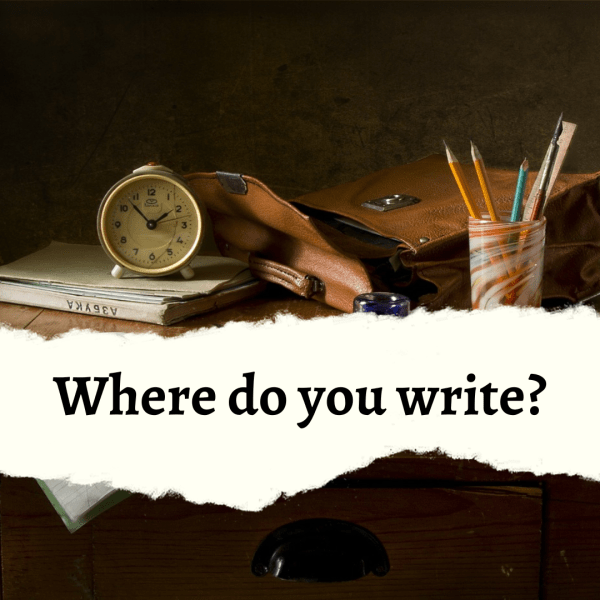
Today, I want to start with a question. Where do you write?
I’ve been blessed to always have a desk of my own. Even as a kid, I had a table in my bedroom. Today I have a whole office in our home, small as it is. I do work from home for my day job, so unfortunately it isn’t just a writing desk. But it is a desk of my own in a room of my own.
While this is a blessing, it’s not a necessity. I wrote books long before I had a whole office when my desk was crammed into a living room or my bedroom. I wrote books while I was working outside of my home. And even though I’ve always had a desk, I’ve written lots of my books while I wasn’t anywhere near it.
I’ve written in diners, laundromats, coffee shops, doctor’s waiting rooms, hospital rooms and libraries. I’ve written at bus stops, rest stops, haircut places, fast food joints. I’ve written in break rooms, under trees in the grass and on the couch in front of the TV. About the only place I don’t write (except maybe some journaling) is in bed because somewhere I heard it’s not good to work in bed because it trains your brain that this isn’t a place to rest.
Flexibility is crucial if you’re going to be a working writer. Unless you are very lucky, you are just not going to have the amount of quiet alone time in your home at your desk to put the number of words on the page that you want.
While it’s great, and necessary, to be flexible, it also doesn’t hurt to put some intention into your writing space. I have always tried to keep a physical space where I can (ideally) write in peace at home. But I’ve also kept a bag packed with things that allow me to create a writing space anywhere I am.
Crafting both of those things requires the same questions to be answered. And of course, your ideal writing space is going to look quite different than mine. So here are some practical considerations to help you create a place where writing is a pleasure.
Consider what you’re writing
Writing a blog post or review is different for me than writing a novel. Editing again is different. I almost never write posts in coffee shops because I’m so used to writing prose there.
How does a certain place make you feel? Does the library bring out your childish side? Do you feel more professional working at your desk? Do you think best at the kitchen table after everyone else is in bed?
If you’re unsure, try this exercise. Attempt a fifteen to twenty-minute freewriting session at several places you tend to write in.
How did you feel writing in each of these places? Does one place feel safer? Does another place feel like you ought to be doing your Math homework instead?
I can’t explain it, except that some places have certain vibes that lend themselves to certain activities. Maybe it’s the lighting. Maybe it’s the background sounds. Maybe it’s something in our past that makes us associate a place with a feeling.
Consider your tools
Different writing projects require different things of us. When I’m rough drafting, I just need my notebook and my outline. And a pen, of course. This is probably the easiest draft to take everywhere.
The second draft requires my laptop, the first draft, and several colored pens. Again, this can all be tossed into a bag and taken to most places.
Outlining is a whole other thing. This requires index cards, post-it notes, pens, markers, three virgin sacrifices and a mandrake root.
And coffee.
This isn’t an activity I would try anywhere but my house, because it’s such a mess and requires so much space.
The point is that you should consider what you’re going to need to accomplish a project. Do you need space, quiet, coffee? Is a good internet connection vital (when I write a review) or forbidden (when I’m writing prose?)
These are all things to consider when you’re planning where you’ll be writing. Even in your own home. Maybe your writing desk doesn’t have the space for a certain project. Maybe your place has internet dead spots. Maybe one spot in the house seems to invite tabby battles.
Think about it before, and you won’t have to think about it when you’re writing.
Consider your preferences
Everyone has likes and dislikes. And while we can’t always have everything we want, we can usually have some of it.
Consider what sort of chair you’d like. What sort of lighting do you like? Do you enjoy having a candle burning when you work? Are there certain reference books or things you like to have around for inspiration?
What kind of pens do you like? Do you prefer paper or PC? Maybe you’re an absolute weirdo perfectly valid person deserving of love who writes on their phone.
Do not let anyone tell you what you should like. Writing is, after all, art. You should choose the tools you use for your art all by yourself. And hopefully, you’re going to be spending a lot of time writing. You should be as comfortable as possible while you do that.
So that’s it. If you’re a new writer, I hope this post helps you create a space in your home and out to write. If you’ve been a writer for a while, I hope this post inspires you to update where you’re writing if it needs it.
Next week is the start of Preptober, so get excited for some extra content. Banned Books Week also begins next week. We’ll be seeing a lot of each other in the next month is what I’m trying to say.
A few months ago, I was talking with a writer friend of mine. Camp Nano was coming up, and so our discussion turned to the big event in November. Eventually the discussion came to the Preptober Planner that I created last year. She mentioned something about the character creation page.
Those of you who bought last years Preptober Planner might remember that there wasn’t a character creation page included. Which of course got me thinking. Why wasn’t there a character creation page? Or a world building page?
Since I overdo things, this line of questions made me rethink my entire outlook on Preptober. And thus, the planner as well.
I am thrilled to announce today the new and improved 2023 Preptober Planner. And with it, a completely new Preptober game plan that will go into more detail than ever before.
I’ll also be doing some extra posts in October, to walk you through the new program week by week. As I intend to start a new Station 86 novel this November, we’ll all be working through it together.
Yes, this will be book six. Yes, book five will be launching soon. Thank you all for your patience. I’m hoping the space between book five and book six won’t be as bloody long.
The path to success is planning. Writing a novel takes a lot of planning. Let’s do it together.
It’s no surprise to anyone who follows me on Instagram that I’m a bit planner obsessed. I’ve talked before about my love of bullet journals, and Notion. Being highly organized is the only way I can keep up with all my projects and responsibilities, and still keep my plants, pets and darling husband alive.
It’s been a while since I’ve done an updated walk through of the planners I use. At this point, there are four books that I consider essential. So I thought I’d go through them with you today.
This is the system that works for me, and it works for me in part because I like planners. I like having all four of these. Honestly, you could probably get your system down to two books. And I will discuss how as well. But for me, this works too well to tinker with it.
My planner
Let’s start with a good yearly planner. I personally use the Magic of I astrology planner because, well, I’m a witch. I like the planetary information is right there for me to see, and I love that the 12 Sabbats are included with the rest of the holidays. This isn’t a sponsored post, and I’m honestly not even trying to sell you on this specific planner.
The point is that this planner works for me and the way I live my life. There’s lots of space on each day for me to write out everything I need. The pages are thick and take everything but Sharpies without ghosting. And I like that there’s a menstrual cycle tracker built in.
(As a side note for people who menstrate, you should not be using any sort of period tracker app if you live in America. That information can be accessed and used against you in a court of law. I don’t think I need to go into any more detail as to why.)
Here’s a list of the things I keep track of in my yearly planner.
My work schedule for my day job.
Contest and writing deadlines.
Birthdays and holidays, like a normal person.
Launch dates for tv shows, podcasts, books and other content I review.
Scheduling days off and self care events.
Doctor and vet appointments.
Finally, I write a list of gratitude into the remaining space each day. It’s part of my morning routine, and has been for some time. Starting out each day by reflecting on the good things that happened the day before has helped me through some truly dark times.
Now some people can, and do, keep all of these things in their bullet journal. But I really like the ability to plan in detail for a full year. I also like the extra room for gratitude journaling. If I had to, I could put those in a bullet journal, though. It would likely mean I go through journals faster, but it could be done.
My bullet journal
If I had to just have one planner, do away with all others, this would be the one.
A lot has been said about bullet journaling, both here and on the internet in general. I’m a huge fan of this system. I like that it can be anything I need it to be. It’s held book notes, launch plans, cleaning schedules, plant care notes, holiday plans. Literally anything that can be organized can fit in a bullet journal.
Personally, I keep the following pages in my bullet journal right now.
Year at a glance calendar.
A reading log.
Grocery list.
Quarterly, monthly and daily to do lists.
Mood tracker
Habit tracker
Social media tracker
Monthly business tracker
My daily tarot pulls
Monthly memory pages
A list of shows and movies we want to watch
If you want to learn more about bullet journaling, honestly there’s no end to the resources you can find online.
My sketchbook
This is something I used to keep in my bullet journal. But honestly, I had to move it to its own book. And every creative should have a sketchbook.
This is a book I use for outlining and planning creative content. I write notes on reviews, my morning pages, freewriting, outlining chapters, brainstorming, random thoughts, a haiku about that bird I saw. This is a notebook I reach for several times through my day, and it should be. Any sort of creative project I do starts in this sketchbook. As such, it’s a mess. But a good mess.
Every creative should have a sketchbook. And everybody’s sketchbook is going to look totally different. And that’s beautiful.
My money bullet journal
This is a recent addition to my collection. Yes, I do keep an entire separate bullet journal for money. Because money is complicated and I’m learning. This isn’t something I’ve done in the past, and it’s not something I’m likely to do forever. But right now, as I’m learning more about money and trying to handle it better, I need this extra space.
In my money bullet journal I keep the following pages.
My monthly budget
My debt payoff plan
My savings plan
A list of minor debts I need to pay off, aside from the big ones
A list of big ticket purchases I want to save for
A page for weekly money checkins
Yearly, quarterly and monthly money goals
A list of things I want to save for eventually
A page to celebrate money wins
A page to keep track of my bill due dates each month.
Notes from the financial books I’m reading
A net worth tracker by month
Finally, a holiday money tracker since I’m starting to make Christmas and Yule gifts this month.
If you want me to do a full post about how and why I’m using a money bullet journal, let me know in the comments.
So that’s it for my notebooks. Now, it’s your turn. What notebooks and planners do you use? Are you partial to a pre-purchased planner, or a bullet journal fanatic? Let us know in the comments.
Don’t forget, Season two of AA premiers next Tuesday the 15th with the first two episodes. And you can binge the whole first season now on Haunted MTL.
And you can check out my Ko-fi shop for writing planners and exclusive short stories.
You’ve heard, I’m sure, of morning pages. It’s a habit started, as far as I can tell, from a book called The Artist’s Way by Julia Cameron. I don’t know anything about this person or this book. But I do know that morning pages, the act of writing three freewriting pages right when you get up is a good habit to have. And it’s one that I’ve been working hard to develop.
This isn’t to say it’s always easy. I’ve had a hell of a time getting this habit in place. See, I have this problem where if I don’t see a direct, tangible benefit to something, I don’t do it. So these three pages in the morning were a struggle for me because they didn’t give me a clear reward. If I write three pages of blog posts, I can then share them with you all. If I write three pages in a novel or short story, then I’m three pages closer to a finished document.
Hell, if I spend the same amount of time on dishes, I would then have clean dishes.
Now, some of you might say that writing is its own reward. As a professional writer, I should just take the time to write for writing’s sake.
Okay, but that doesn’t help motivate me. It just makes me feel like I’m somehow failing as an artist. It also kind of ignores the fact that I’ve produced nine novels, two seasons of a horror/sci-fi podcast and nine years of writing advice content. Say what you will about me, but clearly, I enjoy writing.
And I wouldn’t still be doing Morning Pages if they weren’t giving me something. I’ve written some lovely prose poetry during those times. I come across good blog post ideas or story breakthroughs. There are lots of mornings when I walk away from those pages with something good I can then share with the world.
And most mornings, that doesn’t happen at all. But there are still real, tangible reasons to come to the page every morning for Morning Pages. Even if all you write about is how bored you are or how pissed off you are at your manager at work. Here are my reasons.
It still builds the habit
Yesterday all I wrote about during my morning pages was a weird dream I had. The day before I just bitched about money worries. But I still came to the page this morning. I still didn’t write anything clever or sharable.
Seems like I could skip a day. But honestly, that’s a terrible idea. Because even if you’re not doing much of anything, you’re still building that habit.
Every morning that you come to the page, you are training yourself to come there again. We’ve all heard that it takes 21 days to form a habit. I don’t know if it’s true or not. But I do know that every day you create that habit, you make it stronger. So show up to keep the habit going, because it’s going to make it easier as you go along.
It gives you room to write garbage
You can use the Morning Pages to get your bad writing out. We all know there’s just a certain amount of bad writing we all need to do. If we can let these Morning Pages be that bad writing, then it’s out of your system.
I’m lying, of course. You don’t have to write badly to get better. It’s just very possible that you’re going to write badly. And if you can let yourself do that, then you’ll eventually start writing well.
It gives you a space to do some shadow work
Shadow work is kind of a witchy thing, but don’t let it scare you. It’s just spicy therapy. Shadow work is facing the parts of yourself that you don’t like, and working through them.
Most of the time, I do shadow work on purpose. I’ll get a piece of paper, light a candle and draw a circle for protection. This can also be seen as giving myself specific cues to let my brain know that now is when we are going to safely unpack big emotions. When I’m done writing about these things, I like to burn the paper to release the energy. If you like, this is a way to symbolically tell myself that now we are done exploring these emotions for now and I don’t have to carry them with me for the rest of my day.
Sometimes, though, I wake up with something digging at me. Money worries, bad dream hangovers, fights. Or you know, just the fact that people are starving and dying of preventable illnesses and the whole world is literally on fire.
Some mornings start bad, is what I’m saying.
When that happens, Morning Pages give me the chance to get all that anger or sadness out in sort of an unplanned shadow session. Once that pain and anger are out, the day becomes easier. Or at least, possible. The day becomes possible.
Your writing might surpriseyou
Finally, it’s important to keep in mind that you do not know what’s going to come out of your morning pages until you sit down and write them. Maybe this will be a boring morning when you write about the fly on the windowsill or how much you don’t want to go to work or how you’re worried that the washing machine is making that weird sound again.
But maybe this morning you write a cool poem. Or you get an idea for a short story or blog post. Maybe you’ll figure out the solution to something that’s been bothering you about your WIP.
If you’re doing morning pages right, you’re not going to know what’s coming until it comes.
So please, if you’re not doing Morning Pages, consider them. And if you are but it feels pointless, keep going. I promise you, it’s not pointless. No writing is ever wasted.
Paper Beats World is a labor of love. If you love what you see here, please consider checking out our Ko-fi shop.
We’ve come now to the last part of our tarot storytelling journey. And our Fool has been through a lot. And it’s going to get worse before it gets better, I’m afraid. But we’ll get through it together, don’t worry.
(In case you missed them, here are links to parts one, two and three.)
The Tower
Let me start by saying that this is honestly my least favorite card in the whole tarot deck. And I don’t know how this happened, but the tower card in my deck has a stain at the bottom. Which just makes perfect sense.
The Tower represents the moment when everything goes wrong for our heroes. When everything comes tumbling down. It is the lowest point.
This is when Scar is in charge of Pride Rock. This is when Obi-Wan Kenobi is killed. It is a dark night of the soul for your Fool.
The Star
After every dark night of the soul, there’s a moment of hope. There is a light at the end of the tunnel.
That’s the Star card. It’s not the happy ending, not yet. Not by a long shot. But it’s a sign that our story might have a happy ending after all.
My favorite example of this is in an episode of Avatar the Last Airbender. Aang is furious that a forest has been destroyed. To cheer him up, Katara throws an acorn at him. She explains that the acorns will grow eventually into trees. The trees will grow back, and the animals will come home.
This is the Star card. It’s not the moment when the forest is renewed. It’s the acorn that will someday be a tree.
The Moon
The Moon is one of the more confusing cards, in my opinion. We see a dog and a wolf howling at the moon, while a lobster comes out of the water.
Why the hell is there a lobster? Because lobsters represent an emotional knowing of things.
Let’s get back to the dog and the wolf, though. They’re freaking out because they know something is coming.
They don’t know how they know. They don’t know what’s coming. But they know something is coming.
This is the moment when our Fool just knows that something is coming for them. Call it a premonition. Call it an educated guess. Call it foreshadowing because of course you as the author know what’s coming for them already. But whatever it is, your Fool can feel it like a wolf feels an earthquake before it comes.
The Sun
Now we come to the best part of the story. The part where our Fool wins the day. The sun has risen, and the journey is almost at its end.
This is the moment when our Fool has defeated their foe or reached their destination. It’s Frodo and Sam destroying the One Ring. It’s Aang defeating the Fire Lord. It’s The World Turned Upside Down in Hamilton.
We won.
This could also be called the climax of your story. But remember, the climax and the ending aren’t the same thing. We’re almost there, though.
Judgement
After the battle is over, there are consequences. Even for our most honest and well-meaning fool. All actions have consequences.
Okay, that sounds terrible. And sometimes it is.
This is the moment when Mulan has to face the Emperor. It’s when you have to bury those lost in battle. It’s when the Blues Brothers have to go back to jail.
But it’s not all bad. At least, it had better not be all bad or that would be a shitty ending to your story. This is the moment when your Fool is praised for saving whoever it is they saved. It’s when they get all the good things that are coming to them.
I like to think of a scene in American Gods. An elderly woman passes away, and the Egyptian God Anubis comes for her. He weighs her heart against the weight of a feather and judges her. After letting her sweat for a minute, he judges her well and takes her to a beautiful afterlife.
I’m not saying your Fool has to die. But their story is at its end, and it’s time for them to be judged.
The World
Even if you did decide to kill your Fool, the world keeps spinning. And you probably have characters that still exist in your world. So, what is their life going to look like now?
Where do we go from here? How has the journey changed the world, the people, the community?
You don’t need to go on for pages and pages, of course. But the events in your story had an impact. We should see a little bit of what that impact is.
To end this on a happy note, I’ll compare this to the very end of The Lion King. Simba and Nala watch proudly as Rafiki holds up their newborn child for the whole kingdom to see. We know nothing about the baby, or what kind of life they’re going to lead. But we know that the world is going to keep spinning. And there are more adventures to come.
I hope you’ve enjoyed this tarot storytelling adventure. Please let me know in the comments if you have a favorite card, or if you’ll be trying this method of outlining for yourself.
We’re back with part three of storytelling with tarot cards. So far we’ve set the scene with our main character, our Fool. We’ve met other characters. Their lover, their Emperor, their Hermit. They’ve found their strength and their chariot.
Our Fool is going to need those things because today we’re getting into some of the heavier cards.
(By the way, if you missed part one or two, you can find them here. You can also find my long-winded disclaimer that this series is meant to teach storytelling, not tarot. I am not qualified to teach tarot.)
Justice
The Justice card always reminds me of Vulcans. If I were to make a Star Trek tarot deck, I’d put Tuvok on the Justice card.
(Yes, I know there are Star Trek decks. No, I don’t know if Tuvok is included.)
Justice is about getting what we deserve, based purely on facts with no emotional involvement.
This is a great time in our Fool’s story if they’ve dotted all their I’s and crossed all their T’s. But what kind of story would that be? It’s far more likely that our Fool has, well, acted the fool in some way or another. Some way that is going to come back and bite them on their ass.
The best comparison I can think of this is the Beast in Beauty and the Beast. He was cruel to a helpless woman, and for that, all of his household was punished. He fucked around and everybody found out.
There was no emotion here. There was no compassion for Mrs. Potts, Lumiere, Cogsworth, or even little Chip. The witch didn’t consider those emotional considerations. She simply handed out Justice.
Where in your story will your Fool find Justice smacking them in the face?
The Hanged Man
Through tarot, we find so many biblical symbols. The Hanged Man is a strong example.
The Hanged Man stands for wisdom through suffering. Enlightenment through hardships. This is Gandalf the Grey dying and coming back as Gandalf the White. It’s Aslan dying on the Stone Table and coming back stronger. It’s Oden hanging from the Tree of Life. And, if you’re into Jesus like me, it’s His sacrifice on the cross and coming back as more than a man.
American Gods by Neil Gaiman did this the best, I think. When Shadow spends all night tied to a tree and dies, only to come back stronger. Only to come back as a demigod himself.
This is likely a moment later in your story. When your Fool has to go through something terribly hard to gain the strength to become the hero.
Death
I learned most of what I know about tarot from a book called Kitchen Table Tarot by Melissa Cynova. As Death is so often a misunderstood card, I would like to quote Cynova regarding it.
“Death means change. Death means change. Death means change. Death means change. Death means change.”
The Death card means that change is coming whether we want it to or not. It’s the death of a friendship, a job, a circumstance. Maybe it’s a change for the good, maybe for the worse. Either way, there’s no stopping this change.
Sometimes, in a story, it can mean death. Like when Dumbledore dies in Harry Potter. This changes the entire world that Harry lives in.
What happens in your Fool’s story that changes their whole lives?
Temperance
I love the Temperance card. It’s about peaceful balance. Not tragic, unfeeling balance like Thanos. But a simple, karmic balance. It’s getting out of the world what you put in.
This is a moment in your Fool’s journey when something they’ve done is coming back to them. Usually something good. Maybe they helped someone out earlier in the story, and they show up with something needed now. Maybe they picked up some innocuous bottle earlier in the story, and it turns out to be Fai repellent when we’re being attacked by the Fai.
I’d consider this a bit of luck, one way or another. It’s like in Stranger Things when Dustin falls in love with a girl who just happens to have the correct mathematical equation needed.
The Devil
Alright, I know this is the card that gets people in a bit of a tizzy. But the Devil card is honestly misunderstood.
It does not, in any way, mean anything about worshiping the Devil.
The Devil card is temptation. It’s us humans doing ourselves in with our favored vices. And your Fool for sure has vices.
Maybe your Fool has a drinking problem. Or an anger problem. Maybe they’re the kind of dumbass who can’t stop telling on themselves. Maybe they can’t control their spending or their gambling.
My favorite example of this comes from Hamilton. That’s right, you knew I had to reference that at some point. When Hamilton is stressed, he defaults to his vice. His vice happens to be Miss Maria Reynolds.
We all self-sabotage. It makes sense that your Fool will do so too.
That’s it for this time. I hope you’re having as much fun with this series as I am.
We’ve just got one more post to go. Let me know if there’s a care you think I got wrong or if you’ve got an alternate interpretation in the comments. And I’ll see you next week.
Recent Comments