My local bookstore closed

For my entire life, there’s been a bookstore on my local Main Street. It was called Book Nook. And, being who I am and doing what I do, I loved that place.

It had old-fashioned wood-paneled walls. Shelves that smelled more like an old library than a shop. As a child, my favorite part of the store was the spinning rack of bookmarks.

Did anyone else have this weird bookmark obsession as a child? Fancy bookmarks were everything I wanted in this world. These days I just use any nearby scrap of paper. That’s a little sad.

Man, that place never changed. I used to beg my mom to take me there anytime we were on Main Street. At the time, Main Street was a place we were a lot. She worked at several different restaurants over the years. We lived in three different apartments tucked above stores. There was a little five and dime where I marveled at the fancy pens that looked like crystal. We ate at Burger Hut and the Hot Dog Shoppe. We used to have Woolworths until it burned down when I was a child, but I remember sitting at the counter and having milkshakes.

I remember the fire, too. The way the smoke coughed upwards in the sky and terrified me. I worried that it would come for us as well. I think I’m still a little afraid of that.

The five and dime is gone. The Woolworths is gone. Any number of other little shops are gone. The Unicorn Gift Shop, several antique stores whose names I’ve forgotten, a frozen yogurt place. There used to be a classy little bar where I watched presidential debates during the first Obama campaign, drinking Long Island ice teas with the campaign director in my town. Now it’s the classy little wine bar where I go to enjoy a glass of chocolate-flavored wine and read. Life moves on, tearing itself down, burning itself out, building new days and lives and stores upon the memories and ashes.

But not Book Nook. Man, that place never changes.

As a kid, I went there to buy Goosebumps and Babysitters Club books, series I loved equally. As a young woman, I waited outside the door for them to open the day the last Harry Potter book came out. The storekeeper there that morning was both confused and, I think, annoyed to have some overly excited woman in her early twenties waiting at her door. Apparently, this was a new experience for her.

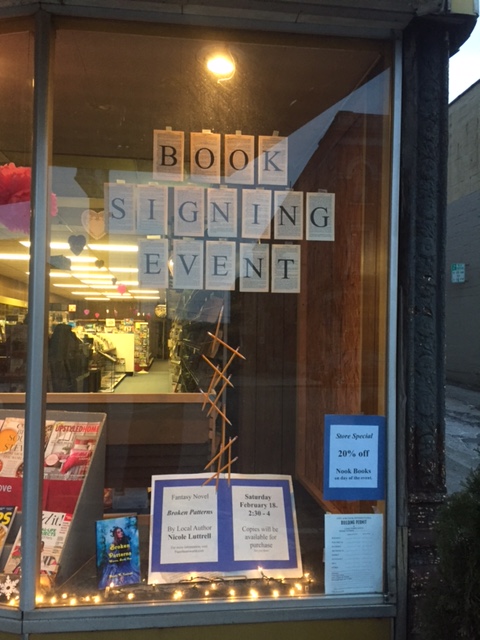
I had my first book signing there when Broken Patterns came out. A copy of the book sat in the front window for months. They even hung up a poster from Starting Chains.

For months. To the point that it faded.

That place never changed.

That was a great experience. A young mom came in, clearly with just barely enough money to get her daughter a book. I gave her a copy of mine and she was thrilled.

I hope she’s doing alright.

I’d pop in from time to time. Sometimes I’d find great things. The author’s extended version of The Stand and American Gods. I impulsively bought some hardcover books that I still love to this day. Strange The Dreamer and An Absolutely Remarkable Thing.

But I didn’t get the sequel to either book there. They never seemed to get them in.

As other stores came and went, Book Nook stayed. Its new releases dwindled. Its stationary options did too, until they went away entirely. So did the bookmarks.

There were no cute impulse buys at the counter. The same counter with the same register that had always been there. Instead, there was a display of lottery tickets. And they clearly made money from the lottery tickets. Once during a book signing, I watched an elderly woman come in and proceed to purchase a scratch-off ticket. She scratched it with no joy, then bought another and another. She kept going for quite some time, scratching tickets with absolutely no emotion on her face.

It became a place that wasn’t fun to be in. Where I rarely if ever found new books I was interested in reading. The hours were erratic, so even if there was something there I wanted, I had a hard time coming in.

And it never changed.

Earlier this year, I received an email from the manager, telling me they were going to close and that I needed to come pick up my books.

Losing my local bookstore has left me with mixed emotions. They survived so much, hanging on through decades of Amazon encroachment and even the pandemic. But they never, ever changed. They never grew with the times. They did nothing to offer readers and buyers a better experience. They simply existed.

And now, they don’t.

I do not blame the store entirely. But neither do I blame competition entirely. Neither do I blame consumers entirely. But all three share a bit of the blame.

Myself included.

I could have been more patient and asked them to order the books I wanted. I could have scheduled more events there, even though the reason I stopped was that no one showed up to them.

But in the end, the issue lies with all three. We should shop small when we can. Big corporations should stop using such predatory practices. They won’t, but they should. And small businesses should put in the effort to grow and change with the times.

In the end, though, I don’t write this to blame anyone. I write this to mourn. No matter the reasons, my local bookstore is closing. The store I shopped in as a child is gone. And I hate that. So I just wanted to hold space for it today.

I don’t remember who said this, or even where I first heard it. But someone somewhere said that every piece of writing is a love letter or a eulogy. This was both.

If you love what we do here, you can show your support by liking, sharing or subscribing. You can also support Paper Beats World financially on Ko-fi.

Broken Patterns is going wide on April 25th. You can preorder it now by clicking on the image below.

My thoughts after Pathfinders Writing Collective’s March Madness

I got an email on Monday that maybe you got too. It was from the Nanowrimo organization, explaining that they are shutting down.

I have mixed feelings about this. I posted months ago about why I was stepping away from Nanowrimo. But it’s an organization that inspired millions of writers over the years. It gave me the inspiration and courage to write my first published novel.

This one. Available now on Amazon and going wide as of April 25th.

And yet, I also feel we are seeing the writing community’s response to AI writing. We will not support any organization that gives quarter and comfort to AI platforms that steal our work and produce flat and soulless stories flooding our markets.

There is one part of the letter that I agree with, though. Interim executive director Kilby Blades said, “Many alternatives to NaNoWriMo popped up this year, and people did find each other.”

And this is true. We found each other. And this past month I participated in a writing challenge that does just this. The Pathfinding Writers Collective March Madness event. And it was a fantastic experience. Even though my team lost. If we’re being fair, I personally lost twice.

Let me explain.

My personal goal for the month was to write for 31 hours in March. One hour a day. And that sounds easy until we remember that I’m caring for a husband who had a hemorrhagic stroke. He needs an incredible amount of hands-on care. So there were a lot of days where an hour of writing was a delightful daydream.

But this was still an incredible success for me. Let me explain.

I still wrote more than I had been writing

As mentioned, this is a busy season of my life. And for much of February my writing took a back seat. Hell, it wasn’t even in the back seat. It wasn’t in the trunk. It was in the attached trailer behind the damn car. Most days I couldn’t even think of looking at my writing.

But in March, I wrote twenty days out of thirty-one. I made the time. I tried to write an hour, but sometimes made only 15 minutes. Sometimes I only made 10. But that’s still more than what I had been doing. I didn’t make a ton of progress, but I made more than the month before.

There was this incentive, you know. This desire to make sure I had some numbers to put on the board, even if it was a small number. Because any number, any number at all, was better than zero.

I kind of love time-based writing goals

Writing goals work for me. I like having numbers to work towards. For most of my writing career, my goals were word-count based. But I’m realizing that this sort of goal isn’t conducive to actual writing. It doesn’t take into consideration all of the work that goes into writing that isn’t putting words on the page. I was ignoring the time I spent researching, freewriting, outlining and planning. Those are all vital parts of writing that need time and space. They need to not be rushed.

I also find that my writing goes faster when I devote that time, unrushed, to the brainstorming process. It’s as if by giving my mind time to mull over the story without a keyboard under my fingers, it has more space to breathe and is already written when I am ready to write.

Having a community is awesome

We’ve talked about this before, so I’m not going to devote much time to this. But that doesn’t mean it isn’t important!

It is, if I’m being honest, the most important part of challenges like this. It’s what made Nanowrimo so special.

Writing is solitary. Its deadlines are often self-imposed. I have no boss asking me for updates. I have no co-workers to bounce ideas off of. I have no external pressure to create. Which is both a blessing and a curse.

For one thing, it’s lonely. For another, it makes it so much easier to push off tasks I don’t want to do because, after all, there are no repercussions.

But when I have a team of people I’m working with, there is some good pressure. When I don’t want to let my team down, I’m inspired to get my ass in my chair and write. On days when I might not have written at all, I wrote. On days I needed inspiration, I had the rest of my team. And that made all the difference.

I didn’t take as much advantage of the challenge as I wanted to. I could have done more. I could have attended more writing sprints. I could have chatted more and made more friends. But for where I am, I think I did the best I could. And I saw so many writers reach so much farther than they thought they could. I saw this wonderful community of writers cheering each other on, supporting each other, and inspiring each other. I don’t want to give out names that aren’t mine to give, but one writer in my group wrote through 249 hours in one month. Girl, how?!

But whether we wrote almost 250 hours or thirteen hours, we all came together to reach a goal. We all made progress on our stories. And we need stories now more than ever.

So the question is, will I be participating in more Pathfinder Writing Collective events? Absolutely. I cannot wait.

Paper Beats World is a labor of love. If you want to support us, you can do so by liking and sharing this post. You can also support us financially on Ko-fi.

Broken Patterns is going wide! You can preorder it now everywhere.

How can we help?

Hey, how are you doing? I’m willing to bet the answer is not great.

To say that my heart is breaking feels like an understatement. It feels too heavy for that. I’m scared, furious, and desperately looking for hope in my overall day.

I’m worried about feeding my family. Worried that the food I feed them won’t be safe. Worried that our medical expenses, already high, will get worse. Worried that our rent will become too expensive. Hell, I’m a little worried my rights to have my bank account and a job will be compromised. Or, you know, travel across state lines without a negative pregnancy test.

I’m also, honestly, scared as a witch. The new VP seems to believe in witchcraft, and not be a fan of it. And frankly, I don’t want Captain Couch Gagger to decide he wants to be the Witchfinder General.

And yet, I know that I’m also extremely privileged. I am white. I am in a long-term cisgender marriage. I’m 38, and not really in danger of an unplanned pregnancy. I’m probably not going to lose my job or my home. (Of course, I might look back at this post ruefully at some point.) And like a lot of people, I’m wondering what I can do to help others. What can we all do to help each other get through the next four years?

Know your community

Your local community is your first line of defense, as you are theirs. So you need to know the people in your community. I’m really bad at this because I would much rather read my books than talk to people.

But when a neighbor got herself locked out of her apartment without her cell phone, I was able to help. Just as other neighbors have helped me.

I try to greet people when I’m sitting outside. Get on a first-name basis with the people who share my building. I have at least a passing hello relationship with the people who work at the shops I frequent. These are the real communities that have always saved us.

Know the facts

There’s a lot of misinformation coming at us daily. Unless you’re on Signal, apparently. And it’s going to come from all sides. Well-meaning people are going to share incorrect information without realizing it. Bad actors are going to spread lies. So bone up on your media literacy. Check where the information comes from. Check to see if anyone else is reporting it. Check that the person sharing this information doesn’t have something to gain from you believing this if it isn’t true. And when in doubt, don’t share it. Don’t spread it. Don’t engage with it.

Be heard

There are lots of ways to be heard right now. If your politicians are still showing up for town halls, those have been a great place to scream at them. But if they’re not doing those, because of all the screaming, you can still call, email, and send letters. If your politicians are doing things you don’t like, you don’t have to be quiet about it.

Make good art

If you’re here, I’m assuming you’re a creative-minded person. Probably a writer.

This is our time to shine.

If you feel so compelled, write about what you’re seeing. Write about the American citizens being deported. Write about the way families are struggling to feed themselves. Write about the attacks on LGBTQ+ youth. Write about how you feel, watching your country bully and brutalize other countries.

Most importantly, write about your experiences during these years. How are you doing right now? What are you experiencing? What are you seeing? How do you feel about it? Write it down, even if it’s just for you. Because while we’re all experiencing this together, no one is experiencing this in the same way you are.

Don’t let yourself get overwhelmed

This is an important thing to keep in mind. Yes, there is a lot to do. Yes, a lot is going on. But you have got to take care of yourself first.

You cannot give all your money away and then starve. You cannot work every single second you’re awake. You cannot consume news all day long. You will burn out.

So take breaks. Take whole days when you don’t look at the news. Take time for things that bring you joy. Take time to rest.

I am working very hard right now. There’s a reason this post is late. I’m caring for my husband. Managing my home, which is a series of tasks that don’t get talked about enough. I’m working a full-time job, and still trying to write.

And I am not so foolish as to think that I am the only person with a similar workload.

We need to take time for ourselves. Read a book, take a bath, do some yoga, take a walk. Maybe indulge responsibly in an adult beverage. I have a standing date with myself at a local wine bar. Once a week I go, have a glass of wine, and read my book. It is delightful. And I need that time to myself.

Donate and volunteer when you can

There are so many organizations that are going to need help as our government stops, well, helping. If you have time, consider volunteering. If you’ve got some extra money, donate to organizations that matter to you. I donate to the Pittsburgh Food Bank, The Brigid Alliance, The Trevor Project and Hello Bully. I also support several artists I admire on Patreon. Because God knows the arts are going to suffer through all of this.

The point is, we’re all in this together. We need to help where we can.

I hope this list has helped you feel a little less helpless. Because we’re not helpless. We’re not powerless.

We can do good things, one step at a time.

Paper Beats World is a labor of love. If you want to support what we do here, you can do so on Ko-fi.

An exciting announcement for Broken Patterns

Announcement time!

This took a little longer than I planned, for many reasons. I’m still caring for my husband, who had a stroke in December. February is hard for me emotionally. The news depresses me every day. And I forgot to uncheck a box on my Amazon listing. Such is the life of a writer in today’s world.

But today, I’m proud to announce that Broken Patterns is going wide on April 25th!

In Devon and Lenore’s world, magic is as common as turning a pot or fletching an arrow. What isn’t common is a man with thread magic. When Devon starts weaving prophetic tapestries, his royal family tries to keep it a secret.

But the family can’t stay in the shadows when Devon’s uncle is assassinated and he becomes second in line for the throne. Especially when he weaves a vision of destruction for the dragon lands.

This means that instead of being an Amazon exclusive, Broken Patterns will be available wherever you buy e-books. And over the next few months, the other books in the series will join her.

And yes, this is the third time Broken Patterns has had a launch day. So this is technically a relaunch of a relaunch.

Broken Patterns is always going to be an incredibly important book to me. It’s the first book I ever finished and published. And I think it’s a great story.

And this is the first time it’s been available outside of Amazon ever! I think it’s about time she was available to people who aren’t huge fans of the massive site.

So I hope that if you’ve always wanted to read Broken Patterns but didn’t have access to it, this allows you to grab it. I’m sure you’ll love meeting Devon, the boy who weaves visions, and Lenore, the girl who spins light.

What I’m reading, Spring 2025

Spring is here. And for once, I’m not mad at it. Winter was kind of long, kind of cold, kind of dark.

Kind of full of me helping my husband to heal from a stroke that had him out of the house in intense medical care for two months and even now has him debilitated, unable to move his right side or speak.

I’m done with Winter. And, it should surprise no one that I’m behind on my reading list for the month.

Like, real behind.

But the books I’ve read so far have left me with a deep passion to read more. Specifically, more horror. So today I’m sharing the books I plan to read this Spring. Hopefully, I can get them all in, because there are some great books here by some great authors.

As always, this is a jumbled collection in no particular order. You’ll find fiction and nonfiction. You’ll find old books and a few new releases. I am a writer, witch and horror content critic and all three of those elements of myself are on display with this reading list. Hopefully, you’ll find something on this list that will catch your fancy and make its way onto your own TBR.

Who Holds The Devil by Michael Dittman

This is the book I’m reading right now. But as I probably won’t finish it before the first day of Spring I feel alright listing it.

A tree brought down under mysterious circumstances on Halloween lets loose a horrible demon in the town of Butler. One that has been there before.

This one is fun for me because I’m from Butler. I’m sitting in Butler right now. But even if you’re not a native, it’s a damn good story.

HorrorStor by Grady Hendrix

Imagine a haunted house, but bigger. Much bigger. Like maybe a giant furniture store with funny-sounding names and demonic possessions. That’s HorrorStor.

Also, if you get a chance, this is a great book to listen to in audiobook form. It’s fun.

Fairy Herds and Mythscapes by Kerry E.B. Black

I have long said that fairies are not something to be trifled with. This collection seems to agree with me.

Incidents Around The House by John Malerman

The cover and the title caught my attention, and I couldn’t move away from it. I am a sucker for haunted houses.

By the way, I’ve never read Bird Box or seen it. If I like this one, I might check that one out. Should I? Let me know in the comments.

The Cabin at The End of The World by Paul Tremblay

If I’m being honest, I got this book from the library just because it was written by Tremblay, who also wrote Horror Movie. And that was one of the smartest books I’ve read in years. But the description of little Wen being menaced by a stranger just pulled me in. I cannot wait to read this.

The Spirit Collection of Thorn Hall by J. Ann Thomas

This feels from the description like a blend of Thirteen Ghosts and Haunting of Hill House. And I am here for it.

Sunrise on The Reaping by Suzanne Collins

Do I really need to explain why I want to read this? It’s the story of Haymitch, the drunk mentor/freedom fighter from the astounding Hunger Games series. I am currently 17 on the list for this book at my local library. I cannot wait to get my hands on it.

An Apostates Guide To Witchcraft by Moss Matthey

This is a book about growing from a toxic upbringing in a high-control religion and finding oneself in witchcraft. Gee, wonder why I want to read that.

Poetry As Spellcasting by Tamiko Beyer, Destiny Hemphill and Lisbeth White

Writing is magic. Poetry is doubly so. I’m sure this book has a lot to teach me about both.

City Witchery by Lisa Marie Basile

I’ve actually read this one before, but I feel like I need a refresher. Especially as Spring blooms and I’m going to get out into the city more. It’s easy to feel like a witch in the middle of the forest or sitting by the ocean. But in an apartment in the middle of Downtown? That’s magical too, just in a different way.

The Witching Year by Diana Helmuth

I’ve also read this one before. But it’s the sort of book that you need to read a few times to really soak it all in. It is the memoir of a modern woman who starts practicing witchcraft out of curiosity and finds a world of joy, empowerment and spiritual fulfillment.

If you’re thinking of witchcraft and wondering if it’s for you, read this book.

Sisters In Hate by Seyward Darby

I’ve been meaning to read this one for a while. It’s about the women of the alt-right, without which they wouldn’t be able to survive. They are the homemakers and cheerleaders of this dark movement. I want to understand them, so I can hopefully reach them. Maybe help them.

Writing on Empty by Natalie Goldberg

I’ve also been meaning to read this one for a while. It’s the memoir of one of my favorite writing teachers about her experience during the Covid lockdowns. While I was perfectly happy hunkering down at home, Goldberg is a traveler. I can only imagine how this impacted her. I want to see how she survived it.

Never Flinch by Stephen King

King wrote another Holly book. That’s all I need to know.

But it’s also about a serial killer, threatening to kill fourteen people if the police can’t stop them. Since we have some time before this book comes out, I highly suggest reading the other books Holly appears in. That would be the Mr. Mercedes trilogy, The Outsider and Holly. They’re all great.

Let The Whole Thundering World Come Home by Natalie Goldberg

Oh good, a book about chronic illness by Goldberg. That won’t feel very personal at all. This one might emotionally break me.

So now it’s your turn. What are you reading this Spring? Let us know in the comments.

Also, keep an eye out for Haunted MTL. There soon might be a brand new way to hear about the horror books I’m reading.

Paper Beats World is a labor of love. If you want to support us, please like and share this post. You can also give financial support on Ko-fi.

My review of Inspiring Creativity Through Magick

Writing and magic seem to go hand in hand. When I started my witchcraft practice, I was shocked by how many witches were also writers.

Well, not just writers. Singers, painters, dancers, actors. Witches seem drawn to art.

That makes sense to me. Writing has always seemed to me a tangible form of magic. To be able to experience other worlds while lying on your couch. To be distracted in stressful times and invited to another place or time. To hear the thoughts and musings of people long dead, but still here in ink and paper. To write something, and have it read by people all over the world.

That’s magic.

Many books have been written about writing from a magic perspective. I’ve read a few. But, I’ve never really talked about them here. I don’t know why. Maybe it’s because the witch part of my life still feels like something very private. I’m slowly getting over that. I even posted a whole Modern Witch review series on Haunted MTL. So I think it’s time to introduce you to my favorite writing books for witches. Because if there’s one thing that’s universal, it’s that we all want to be better artists.

Today, we’re talking about Inspiring Creativity Through Magick, by Astrea Taylor.

Published in 2023, Inspiring Creativity Through Magick is a firsthand guide to creating a fulfilling ritual around your art. It walks the reader through each step of the creation process, from inspiration to the final product. And it is delightful.

The book starts with a conversation about creative spirits. Muses, and the like. This was great fun, and I actually learned about spirits I hadn’t heard of before.

The thing I appreciated most about this part was the discussion of the unnamed creative spirits that many artists say they’ve come in contact with. Taylor even mentions Stephen King talking about his muse in one of my favorite writing books of all time, On Writing. There he talks about his muse being a short man with a cigar that might show up and start working his magic if King puts the work in and all the conditions are right.

Taylor also talks about Big Magic, another book I’ve talked about here. This book also talks about feeling as though the artist is a partner in the act of creation. We are all capable of tapping into the creative flow of the universe and inviting spirits that want to help us bring our creations to life.

And we know this is true. Every artist has those moments when it doesn’t even feel like we’re on the same plane of existence anymore. When the words are coming or the paint is flying with no effort. When all the pieces fall together, or that subplot now makes sense and is exactly what the main story needed, or the character says just the right (or wrong) thing at just the perfect time. When you write a poem that just smacks you between the eyes because it’s so true, and you hadn’t even thought of those words before they were in front of you on the page, somehow coming out of your own hand.

Clearly, this was my favorite part of the book.

We then delve into the step-by-step process of creating a finished art piece. Not the technical details, of course. This book is for all artists, after all, and that would be a bit much. Instead, it explores the basic stages of creation. The inspiration phase. The first pass phase where we create our rough drafts and start telling ourselves our stories. The edits, and revisions. And of course, the eventual release of the work out into the world.

This is wonderful for many reasons. First, sometimes it’s hard to feel the creative magic in the later phases. Writing a rough draft is all creation. Making something from nothing. There are no rules, we’re just throwing words on the page and seeing what sticks. But editing? Revising? Grammar checking? That’s not creative.

It very much is. Honestly, I find that I’m far more creative in the second and third passes of my stories. It doesn’t feel as immense anymore. I have a better idea of what I’m trying to say, and how I utterly failed to say it the first time. So I can fix this bit here, and rewrite that part there. I know what doesn’t work, and now I can figure out what does work. And this is a process that is clearly explained in a far better way than I ever could in this book.

It’s also wonderful to have this breakdown of steps, especially as a beginner. Looking at a finished project, it’s impossible to see all the work that went into it. And if you’re starting at the other end, looking at a blank page, the thought of turning that blank page into a whole book is incredibly overwhelming.

Breaking this process down, step by step, is more manageable. And it’s something I still do. Today, I’m not writing a book. I’m just writing this scene or this chapter. I don’t need to worry about the edits or the rewrites. Or even the next chapter. All I need to worry about is writing this page right now.

One thing I will say is that Inspiring Creativity Through Magick does feel like a beginner book. If you’ve been creating art for a long time, it might feel redundant. I already knew the steps of creating, I didn’t need them drawn out for me. So there might be parts that a more experienced artist finds a bit boring.

Overall, though, this was a really useful book. I think every artist can take something useful and uplifting away from this book. Whether you’re a witch or not, it’s well worth a read.

If you want to support Paper Beats World, you can do so on Ko-fi

To write a long novel

If a book is well written, I always find it too short.

-Jane Austen

Let’s hear it for the long novel. There is just something about a big, hefty book that feels delicious.

Of course, I am a fan of Stephen King. I’ve read The Stand no less than seven times. I loved Strange The Dreamer by Laini Taylor. And Phillipa Gregory isn’t exactly short-winded either. Then of course there’s the holy grail of my childhood fantasy reading, Mists of Avalon.

A long novel is what you write when you want to explore sweeping expansive descriptions. When you want your readers to see the jeweled beetle sitting on the windowsill. In short (rim shot) writing a long novel takes a much different skill set than a short one.

Rich descriptions

If a short novel is like a sketch, a long novel is a wall-sized oil painting. The details in long novels are rich.

Consider a long novel you’ve read. I bet you feel like you could step into some of the most iconic rooms. You might be able to see the bedspreads or picture the garden bench.

Not everyone loves this sort of description, but some fans eat it up. I personally think it’s a great place to flex a more literary style of writing. This is a great place to get symbolic and poetic.

Large cast

Wheel of Time, Game of Thrones, Harry Potter. All of these have massive casts that span far beyond the main character. And most of those characters are fully formed. They have likes, dislikes, families, desires. We can see how changes in the world will impact these different characters in different ways.

This is a fantastic way to expand the world. To show different points of view that might challenge your main characters.

And yes, large books often have more than one main character.

Having the space to explore your world from multiple points of view is one of the benefits of writing a long book. It’s not an easy task. It’s difficult to juggle a large cast with their varying details and desires. So you’ll probably want to start a book bible as soon as possible.

Worldbuilding

Writing a large novel gives you space to really explore the world. If you enjoy creating different countries and communities, this is ideal for you.

Especially if you’re incorporating a large cast, you can establish as many communities as your heart desires and the story will support.

However, here’s a word of warning. Don’t get so lost in building your world that you forget to tell your story. Because the most beautifully crafted world can only hold someone’s interest so far. Remember, the story comes first. Everything else is just a stage setting.

Subplots aplenty

In a long novel, there is space to tell many stories. There can be subplots. There can be side quests. There can be love stories between secondary characters.

And that kind of feels more real, doesn’t it? There’s rarely a time when your life is just revolving around one thing. Even at the height of my husband’s stroke recovery, we were still dealing with other things. It’s never just one thing, is it?

Take my book, Station 86. While the characters are dealing with the Hollow Suits, they’re also falling in and out of love. They’re working on their careers and businesses. They’re trying to keep peace and keep food on the table. They’re running for office. They are living complex, complicated, messy, wonderful, horrible, realistic lives.

In the end, a large novel is all about space. It’s having space to stretch out and make sweeping and grand stories that are an investment of time. But that’s not going to deter people if you’ve done you’re job right. In fact, it might well be a great selling point.

If you like what I do here, you can support this site on Ko-fi.

I’m participating in the PaWriCo March Madness Challenge

I’m not ashamed to admit it. I miss Nanowrimo.

Well, no. I don’t really miss the organization. I sure don’t miss their offensive dismissals of the harm AI can do to writers. I miss the writing community and all the warm fuzzies I got. I miss meeting new people, writing as part of a collective, and all the bonding. And I sure miss the productivity boost all of the excitement around challenges like this always gives me.

Of course, I’m not alone. Writing is a lonely occupation. It involves a lot of sitting in quiet rooms writing things that someday someone will (hopefully) sit in a quiet room and read. We need to get together with our people and feel like we’re doing something as a team. And since writers are generally creative and self-motivated, it was just a matter of time until one of us stepped up and made a new challenge for all of us.

In this case, it was two of us. Specifically, two authors named Rain Sullivan and Jen Woodrum. They came together and created the Pathfinder Writer’s Collective. And I am here for it!

Their first challenge started last year in November. Because of course. But it was different than Nanowrimo. It was more of a choose your own adventure writing challenge. And it was also three months long, from November first to January 31st. And I learned about this on January 29th, on a Write As Rain Instagram post.

Sad trombone music.

Reading the comments it became that, somehow, I wasn’t the only person who was just finding out about this challenge. But, the creators also gave us some hope. A hint that something was coming in March.

Enter the Pathfinders Writing Collective March Madness Challenge.

The goal of this challenge is simple. Write as much as you can in March. But you’re not just trying to hit an arbitrary number. Instead, participants will be split into two teams, Team Green and Team Orange. And every hour you write goes towards your team’s score. There are fun writing sprints and other exciting community events that will take place on the Pathfinders Writing Collective Discord. Fun, right?

Now, I’m writing this on Tuesday. You’ll be seeing it on Friday. The teams are going to be announced on Wednesday. So I can’t yet tell you which team I’m on. I can tell you that it’s probably too late to join.

Sorry about that. But I’ll have some good news for you regarding that at the end of this post.

You might wonder what I plan to work on during this joyful month of overwriting. Well, as always, it’s complicated. See, I’m going to finish the rough draft of Aurora about halfway through the month. I hope. So, when that’s done, I’ll be working on the third draft of a novel I’ve been keeping under wraps for several years now.

Hopefully, I’ll be able to tell you about it soon. Getting the third draft done will certainly help with that.

Alright, but since it’s probably too late for you to participate in March Madness, what can you look forward to from the Pathfinders Writing Collective? Well, they are of course doing their PaWriCo event in November through January. But, they’re also planning a boot camp event in June and July. I don’t know a lot about what that will entail just yet. But so long as March Madness goes well and no one else ends up hospitalized, I’ll be able to let you know. In the meantime, I’m excited to participate in a new writing challenge.

Wish me luck.

If you’re participating in the PaWRiCo March Madness, let me know in the comments. And if there’s another writing challenge that deserves some attention, let us know about that too.

Did you know I wrote a Novel Planner? You can get it now on my Ko-fi shop.

To write short fiction

Short novels and novellas are a pleasure. There’s a weight to them, paradoxically. Short fiction seems to punch us in the gut stronger than long fiction. Maybe it’s just me, but I often feel like the shorter the piece, the stronger the impact.

I’ve written before about brevity being a strong point in horror. But I have a deep respect for short works in any genre. Though I’ll admit that some genres lend themselves more to the form, you can find great short stories in any of them. Fantasy might not seem like something that can work well in a short time, but one of the best fantasy books I’ve read is This is How You Lose The Time War.

To write a short piece of fiction takes a different set of skills than writing a long piece of fiction. It’s one that not all authors have the ability to do. Stephen King comes to mind, much as I love him. Even his short stories are bloated, as far as short stories go. But if you want to write good short novels, short stories and microfiction, here are some things to keep in mind.

Every word matters

When you have a tight word count, every word matters. Elements of Style begins with the advice to omit needless words, and that is good advice. It’s also part of the fun of it, for me. When I write microfiction, it’s almost like a puzzle. How do I say all that I want to say within the word count? How do I convey all of the emotions? How do I tell the whole story?

One tip I love is using every bit of word count you can get. This means incorporating the title into the storytelling.

Short fiction has no room for fluff. No room for over-explanation. You have to cut it down to only the words that matter.

Subplots need to do double duty and be scarce

We all love a good subplot. Bits and pieces that add fun and flavor to a story but aren’t essential to a plot.

This one doesn’t exactly impact microfiction, as there’s no room for subplots there at all. But short novels will certainly have a few.

Think of it as the difference between an old-school TV episode, and the season-long stories shows have now. An episode of a show will have an A plot and a B plot. They might or might not impact each other. But a season of a modern show will have at least a handful of storylines. Maybe too many, depending on the show.

With short fiction, of course, you want to have as few subplots as you can get away with.

Maybe you have a romantic subplot that also foreshadows a backstory for the antagonist. Maybe a lost pet leads to a comedic story and gives more character development to a secondary character. Or maybe the main character. We’ll talk more about that in the next portion.

Fewer characters

In short fiction, you’re not going to have a huge cast of characters. It’s not like Wheel of Time or The Stand. Long fiction has lots of space to grow many, many characters.

Short fiction feels more intimate, and part of why is the smaller cast. Consider This is How You Lose The Time War, which only had two characters.

When you only have space for a handful of characters, it’s like the difference between attending a big party and an intimate dinner. You have more opportunity to get to know the people at that dinner. For better or worse. You’ll be more likely to learn secrets about others in that setting. Who went off their meds. Who cheated on their partner. Who has a dark secret about something hidden in their basement. Something that makes them afraid to go down there.

Something that might reach out through the shadows.

Having fewer characters to focus on means you can know those characters inside and out.

Writing a short novel, or any short piece takes practice. It’s not easier than writing a long piece. It sometimes might even take more time than the longer pieces because they require so much attention to detail. But a good piece of short fiction can be a gut punch in the very best way. And even if you don’t intend to write short forever, it’s a good skill to have.

Want a way to organize your novel writing journey? Check out my novel planner on Ko-fi.

Is all writing art?

I’ve been busy recently. My darling husband is home, finally. And I am overjoyed. But a stroke is a serious thing and it takes a lot of work and care to recover. It’s a team effort. So it’s been a little hard for me to spend time on my writing.

We all go through these times. It’s nothing new. Right now I’m spending a lot less time writing and a lot more time cleaning and caretaking. Since my time is limited, I’m focusing on things that have actual deadlines. Sometimes, that means that all the writing I’m doing is reviews, blog posts and my daily freewriting.

That’s, um, not a lot. At least not compared to what I’m used to. And the writing I’m doing isn’t what I consider super artistic.

At least, it’s not the sort of writing most people would consider to be particularly artistic.

When you think of artistic writing, what do you think of? Everyone’s going to have a different list, but here’s mine.

Poetry

Songwriting

Short stories of all lengths

Novels and novellas

Now, I don’t write music. But I usually write all those other things. Even if I don’t always share the poetry, this is the writing that makes me feel like a real writer. A real artist!

But of course, there’s lots of writing that is, in fact, artistic writing. Let me give you a list of writing that counts as art.

All writing. All writing can be art.

No, I don’t think there’s an exception. I’ve written ad copy that is art. I’ve ghostwritten blog posts that were art. Everything I post here is art. Even my reviews of horror content on Haunted MTL are art.

If you’re creating something new, you’re making art.

If you’re writing something that gives you joy to write, you’re making art.

If you’re pouring your heart into your writing, you’re making art.

I believe that a lot of the rules some people have about art are bullshit. It tends to be quite elitist, relying on having the approval of the right people. But that has many issues. First off, art is subjective. What I consider art and what you consider art is going to be completely different. Visual artists have been poking fun at this forever. Consider the banana taped to a wall that sold for just so, so much money. I consider this art, not because the banana itself is somehow valuable. It’s art because its existence says something. Thought went into that piece. Intention went into that piece.

You get to decide what counts as art for you. Don’t worry about if anyone else agrees with you. People have also been misinterpreting art forever. Consider the heartbreaking story behind Portrait of Ross in LA, by Felix Gonzalez-Torres. If you haven’t heard of this piece, it looks different every time. It’s a pile of candy. People are invited to take a piece of candy, or even a few.

This piece represents the life and death of a man named Ross, who was the artist’s lover. He wasted away and died due to AIDS. This art piece represents the sweetness of his life wasting away. It’s beautiful and sad and meaningful. It captures the honest and raw emotion of a man who lost his person. We are gifted a glimpse of that pain in the pile of sweets that slowly diminishes. It is art.

What is art to you? To me, it’s a piece of work that’s created with joy. It’s something that is crafted with care. It’s creative work that we make to share with others, or just to take our own emotions and memories out of ourselves and into ink or paint or scraps of paper put together in a collage. Take this post. I wrote this for you, and I wrote it for me. I wrote it to share something with you that’s been making me feel better. I took care with the words I used, bringing some poetry to my prose. I put thought into it. It brought me joy to write. I hope that it brings you joy to read. My reviews of slasher flicks and gory anthology TV shows are also a joy to write. I hope that they’re a joy to read and that they help you find good stories about things that slither in the night.

Art is subjective. But don’t let yourself think that you’re not creating art. It’s a big tent, and all kinds of writing are welcome.

A WordPress.com Website.

Up ↑