Why House of Quiet Works

Released in September of this year, House of Quiet is the latest novel by Kiersten White. This is the same author who brought us Mister Magic, Lucy Undying, The Dark Decent of Elizabeth Frankenstein, and Hide. Which is to say, the author of some of the best books I’ve read in the past few years.

House of Quiet is about a young woman named Birdie. She’s spent the last several years trying to find her little sister Magpie, who vanished after undergoing the mysterious Procedure. Birdie poses as a maid to get into the mysterious house of quiet. But what she finds there is a group of children who need to be rescued.

Today, we’re going to break it down and see why it works. Because there’s a lot that can be learned from this wonderfully dark, sweet tale.

Just jump in

The story starts in the middle of things. It starts with a mysterious woman wandering around the House of Quiet with a candle, bemoaning how loud it was.

We then jump to Birdie, heading to the house of quiet, thinking of all of the shady things she had to do to get there.

As we follow along, we only get an idea of the world she lives in and what she’s doing. We know that she’s grown up in crippling poverty. We know that she’s never speaking to her parents again. And that’s about it.

But that’s okay, because we’re going up to the house. We’re meeting the other new maids. We’re being drugged with tea. There is stuff going on, and there will be time to explain later. The important thing is that we’re not slowing down the start of our story. We are jumping right in.

Don’t over-explain

I spent a lot of this book trying to figure out what in the hell was going on. I wanted to know what happened to Magpie. I wanted to know what the procedure was. I wanted to know what had happened to Birdie’s friends. I wanted to know why Minnow was acting so strange.

And never once was any of this simply out and out explained.

No, the story was moving too fast for that sort of thing.

This was infuriating, but in a good way. Because everything is answered, eventually. It’s just that we have to piece things together as we go. Or, we find out as the characters do.

House of Quiet brought the ‘show don’t tell’ rule almost to its breaking point, but not quite. At no point did I feel so lost I thought I’d never catch up. But it wasn’t until near the end that I really felt like I knew what was happening.

This is a hard line to walk, giving just enough information for the reader to barely understand. But, I think the easiest way to do this is to have faith in your reader. Don’t feel like you’ve got to spell everything out for them. Leave some spaces for them to fill in the blanks themselves.

Anything can be used to world build

One of the most charming things about House of Quiet was the naming structure of the characters. People raised in poverty have animal names like Minnow, Magpie, and Birdie. People from the upper class have names like River or Forest.

This is a super quick and efficient way to give us information about a character with the fewest words possible. We know the character’s name, and we know what class the character is from. And in a book that is all about class warfare, that’s vital information.

This is a great example of using every element you can to world-build. Names, clothes, jewelry. Think about how all of these things impact our real world. And yes, you should be using any of these to show your world, rather than telling us about it.

Now, all this being said, this book wasn’t perfect. My biggest complaint, I think, is the relationship between the characters. They were, in my opinion, a little too sweet. They came together too quickly. They were too kind to each other. But, of course, this is a book for young adults. So maybe that’s why.

This was not enough to ruin the story for me. House of Quiet was a fun, heartwarming tale, and I enjoyed it greatly. If you haven’t read it yet, do it today.

Paper Beats World is a labor of love. If you love what I do here, please consider liking and sharing this post and leaving a comment. You can also support me financially on Ko-fi.

And while you’re there, you can pick up a copy of my Novel Planner.

Writing a novel is a journey! Here is your roadmap.
The Novel Planner takes you through four weeks of planning to help you successfully write a novel. Includes twelve pages to plan your time, your team and your life.
Also included are some useful pages to keep track of your wip, like a map page and an injury tracking chart.

Banned Books Week 2025

Did you know that Stephen King was recently acknowledged as the most-banned author in America? Way to go!

It’s Banned Books Week once again. And every year this week feels more and more important. Because every year it feels like America takes another goosestep towards fascism.

But we are still here, damn it! We can still protest. We can still fight in our own ways. And we can do our part this Banned Books Week to help fight off censorship.

Here is a list of things I’ll be doing, both this week and going forward.

(As always, Banned Books Week is an event hosted by the American Library Association.)

Share banned books

I’ll be sharing some of my favorite banned books on social media, using the hashtags #BannedBooksWeek and #Censorshipisso1984. Get the word out far and wide.

Read banned books

This one might be obvious. But what the hell, I’ll put it on here in case. The best way to support banned books is to read banned books.

This year, I’ll be reading Chains by Laurie Halse Anderson. I’m reading this because it’s the book suggested for the Right To Read events being held all over America this week. If you’re close to one, you should consider attending.

Start a little free library

This might be a project. I’m certainly not expecting to get this one done in a week. But now that we’ve moved and I have a yard again, I’m going to put in a little free library. And I’m going to stock it with banned books. I already have some ordered.

The top ten banned books every year are going right in that box.

Support the ALA

The American Library Association needs our help. They need support, financially and politically. Here’s a link if you want to check them out and see all the work they do all year, not just during Banned Books Week.

Show up for libraries

If you can, show up at town halls and community nights where your local library is being discussed. Make it clear that you oppose censorship. Make it clear to your local politicians, too.

Elections are a month away

Speaking of your local representatives, make sure you’re registered to vote. I know I say this a lot. I also know that there’s someone reading this right now who’s been meaning to register and keeps forgetting.

Get it done.

Go vote. Make a plan now. Know your local politicians and know who’s supporting freedom. And who’s not.

So now it’s your turn. What are you reading for Banned Books Week? Do you have a little library or know of one in your neighborhood? Let us know in the comments.

My local bookstore closed

For my entire life, there’s been a bookstore on my local Main Street. It was called Book Nook. And, being who I am and doing what I do, I loved that place.

It had old-fashioned wood-paneled walls. Shelves that smelled more like an old library than a shop. As a child, my favorite part of the store was the spinning rack of bookmarks.

Did anyone else have this weird bookmark obsession as a child? Fancy bookmarks were everything I wanted in this world. These days I just use any nearby scrap of paper. That’s a little sad.

Man, that place never changed. I used to beg my mom to take me there anytime we were on Main Street. At the time, Main Street was a place we were a lot. She worked at several different restaurants over the years. We lived in three different apartments tucked above stores. There was a little five and dime where I marveled at the fancy pens that looked like crystal. We ate at Burger Hut and the Hot Dog Shoppe. We used to have Woolworths until it burned down when I was a child, but I remember sitting at the counter and having milkshakes.

I remember the fire, too. The way the smoke coughed upwards in the sky and terrified me. I worried that it would come for us as well. I think I’m still a little afraid of that.

The five and dime is gone. The Woolworths is gone. Any number of other little shops are gone. The Unicorn Gift Shop, several antique stores whose names I’ve forgotten, a frozen yogurt place. There used to be a classy little bar where I watched presidential debates during the first Obama campaign, drinking Long Island ice teas with the campaign director in my town. Now it’s the classy little wine bar where I go to enjoy a glass of chocolate-flavored wine and read. Life moves on, tearing itself down, burning itself out, building new days and lives and stores upon the memories and ashes.

But not Book Nook. Man, that place never changes.

As a kid, I went there to buy Goosebumps and Babysitters Club books, series I loved equally. As a young woman, I waited outside the door for them to open the day the last Harry Potter book came out. The storekeeper there that morning was both confused and, I think, annoyed to have some overly excited woman in her early twenties waiting at her door. Apparently, this was a new experience for her.

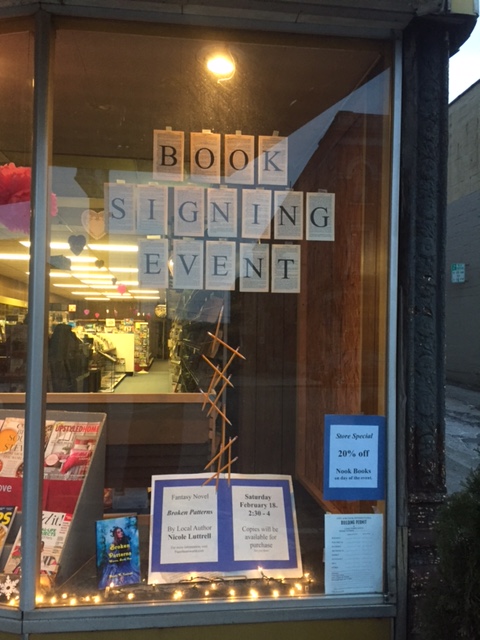
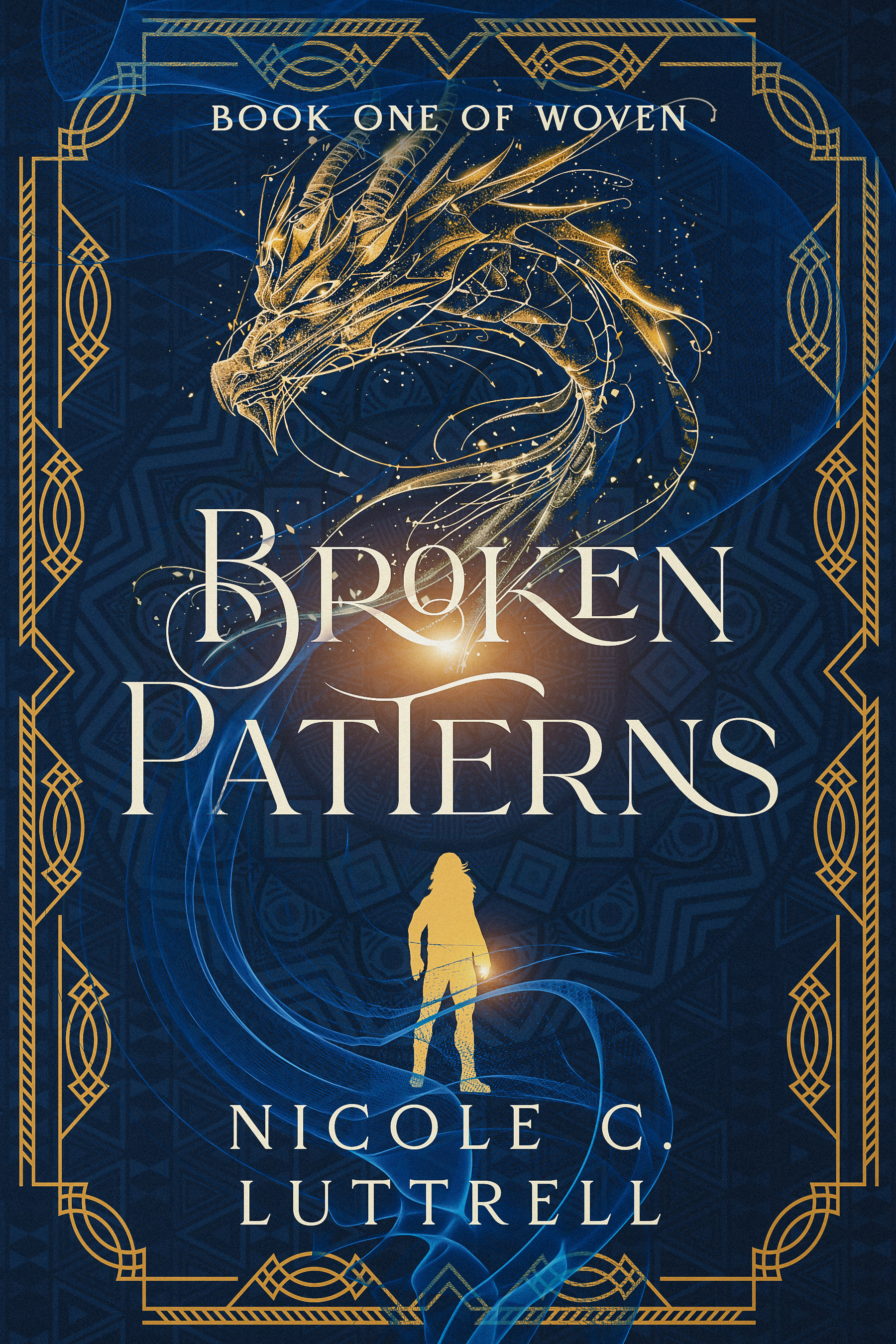
I had my first book signing there when Broken Patterns came out. A copy of the book sat in the front window for months. They even hung up a poster from Starting Chains.

For months. To the point that it faded.

That place never changed.

That was a great experience. A young mom came in, clearly with just barely enough money to get her daughter a book. I gave her a copy of mine and she was thrilled.

I hope she’s doing alright.

I’d pop in from time to time. Sometimes I’d find great things. The author’s extended version of The Stand and American Gods. I impulsively bought some hardcover books that I still love to this day. Strange The Dreamer and An Absolutely Remarkable Thing.

But I didn’t get the sequel to either book there. They never seemed to get them in.

As other stores came and went, Book Nook stayed. Its new releases dwindled. Its stationary options did too, until they went away entirely. So did the bookmarks.

There were no cute impulse buys at the counter. The same counter with the same register that had always been there. Instead, there was a display of lottery tickets. And they clearly made money from the lottery tickets. Once during a book signing, I watched an elderly woman come in and proceed to purchase a scratch-off ticket. She scratched it with no joy, then bought another and another. She kept going for quite some time, scratching tickets with absolutely no emotion on her face.

It became a place that wasn’t fun to be in. Where I rarely if ever found new books I was interested in reading. The hours were erratic, so even if there was something there I wanted, I had a hard time coming in.

And it never changed.

Earlier this year, I received an email from the manager, telling me they were going to close and that I needed to come pick up my books.

Losing my local bookstore has left me with mixed emotions. They survived so much, hanging on through decades of Amazon encroachment and even the pandemic. But they never, ever changed. They never grew with the times. They did nothing to offer readers and buyers a better experience. They simply existed.

And now, they don’t.

I do not blame the store entirely. But neither do I blame competition entirely. Neither do I blame consumers entirely. But all three share a bit of the blame.

Myself included.

I could have been more patient and asked them to order the books I wanted. I could have scheduled more events there, even though the reason I stopped was that no one showed up to them.

But in the end, the issue lies with all three. We should shop small when we can. Big corporations should stop using such predatory practices. They won’t, but they should. And small businesses should put in the effort to grow and change with the times.

In the end, though, I don’t write this to blame anyone. I write this to mourn. No matter the reasons, my local bookstore is closing. The store I shopped in as a child is gone. And I hate that. So I just wanted to hold space for it today.

I don’t remember who said this, or even where I first heard it. But someone somewhere said that every piece of writing is a love letter or a eulogy. This was both.

If you love what we do here, you can show your support by liking, sharing or subscribing. You can also support Paper Beats World financially on Ko-fi.

Broken Patterns is going wide on April 25th. You can preorder it now by clicking on the image below.

Stories Save Us

This is a speech I gave during the Stories We Share Event at the Butler Library event on December 27th. Several lovely people suggested that I publish it. So, here you are.

Hi there. My name is Nicole. I write stories about dragons, ghosts and spaceships. Sometimes I write about the ghosts of dragons on spaceships. And, like most people who are at least mildly funny, I have been through some hard life events.

Don’t worry, this isn’t all depressing, I promise.

I was raised by a mother with a lot of chronic health issues. This meant I spent more time in my childhood than I should have in waiting rooms, doctor’s offices, or just keeping myself occupied quietly so my mom could rest.

I passed the time by reading. Chronicles of Narnia, Goosebumps, Laura Ingells, Babysitter’s Club. These stories kept me company in dark places. I escaped into Secret Gardens and attic rooms enhabited by Little Princesses.

As an adult, I fell in love with and married a man who also has chronic health issues. Because of course, right? And again, books have come to my rescue. Stephen King, Philippa Gregory, Tamora Pierce, Kiersten White and Grady Hendrix keep me company through scary days.

Now I do more than read these stories, I write my own. And in the past few years, while almost everyone has fallen on hard times, it’s sometimes felt foolish to keep writing fiction. Indulgent, and insensitive even. A writer I’m very fond of named Matt Wallace, who wrote the Savage Rebellion series, said that marketing right now feels like standing outside of a burning building and yelling at the people coming out, “Hey, you wanna buy a book?”

But the answer is yes, yes I actually do want to buy a book and read it. I want stories.

Stories can save us. And they do this in two ways. The first is of course that they’re entertaining. It’s fun to read. And while you can’t run away from your problems, you can take a break from them. Maybe you need some time in Narnia, or a haunted house, or a world where sewing is magic. Because after we take that time, take that break in a book, we come out a little bit stronger. Maybe that gives us the clearer eyes we need to look for the helpers that Mr. Rodgers told us about. Maybe it even gives us the strength and courage to be the helpers.

Here’s the other thing that stories do for us. They tell us that we are not alone. Fear can make us feel like we’re the only ones suffering. That no one else understands the pain we’re going through. But that’s not true. We’ve all had those seasons in life where we’ve gotten a scary diagnosis, tried to leave a dangerous relationship, fought an addiction, moved far away from everything familiar, or worried about how we’re going to pay rent and get groceries, and keep the electric on. We’ve all said goodbye to people we never wanted to say goodbye to, or had something violent and terrible happen to us that we neither deserved or saw coming.

Neil Gaiman said this about writing Coraline. “Fairy tales are more than true: not because they tell us that dragons exist, but because they tell us that dragons can be beaten.” But we knew this before Gaiman. The author of Beowulf knew this and wrote about monsters and dragons that the great hero faced. These stories comforted and guided our first ancestors. They helped them cope, heal, and find the courage they needed.

We are not going to fight literal dragons. We aren’t going to face Voldemort, or a sentient haunted house, or a series of unfortunate events orchestrated by a school friend of our dead parents. But we are going to fight our own dragons. And a lot of the time we win, and live to see brighter days.

What worries me, is how many people can’t remember the last time they read something for pleasure. Most of us spend a lot more time doom-scrolling than resting our hearts in fiction. If that’s you, find a book you want to read today. We are standing in a library right now. Find a book to take home with you. Take half an hour, ten minutes, hell five minutes, and read a story you love. Maybe it’s something you read as a child, or maybe it’s a new book. Maybe it’s wildly out of your age range. Look, when I’m stressed I reach right for Beverly Cleary so I’m not going to judge.

Make the space for you to have joy, no matter how bad your day is going. Because we all need to remember that dragons can be beaten.

The insidious truth behind book bans

Banned Books Week is nearly over. But the fight isn’t. It’s an election year, which means politicians will want to look like they stand for something.

Seems to me that with over 50 school shootings so far this year with 24 fatalities, gun reform would be something they’d stand for. Especially since there have been (checks notes) no deaths related to literature this year. But what do I know?

Book banning is one of the most hypocritical, insidious things we’re dealing with in our country. It’s not the worst thing, of course. But it’s something that feeds into most of the other problems we have. Poverty, racism, classism, they’re all fed by book bans.

Let me explain.

It’s another barrier for people without money

So far, no one is talking about banning books outright. They just want to ban books from public and school libraries. If you want to read a book, you can just buy it, right?

I don’t like that argument. It’s the same sort of thing people with money always say, forgetting that there are people who don’t have money.

Books are expensive. Right now I’m reading William by Mason Coile, and it is $24.30. $14.99 for the e-book. I paid nothing to read it because I borrowed it from my local library.

Now, I’m not digging at Coile here. Nova is $14.00 for the paperback. Broken Patterns is $13.00. Books are expensive. Most of that money doesn’t go to the writers. And even if it did, I wouldn’t want you to buy my book if it meant you were going to struggle to buy groceries that week. That’s why they’re all slowly being added to Hoopla.

Libraries give people with limited means access to books. So no, we cannot just go out and buy books if they’re banned from the library. And the freedom to read what we like shouldn’t be one more thing in our society with a financial barrier.

It demonizes books that don’t discuss a very specific worldview

If you look back at the list of books most often banned, you’ll notice that a lot of them are about people in the LGBTQ+ community. Of course, that’s not the reason given by people who want to ban these books. They argue that the books are sexual. But they consider anything to do with the LGBTQ+ community to be sexual.

At least, that’s what they’d like people to believe.

The truth is that most book bans are meant to keep a certain kind of book off the shelf. Specifically, any book that isn’t about a straight person experiencing a story that doesn’t make America look bad. Anything that steps out of that narrow view is in danger.

This effectively closes off a powerful avenue of acceptance for people who don’t exist in that narrow view. Which is to say, most of us. It’s easy to feel like there’s something wrong with you when no one around you understands what you’re experiencing. Books can be one way to find out that you’re not alone. There’s nothing wrong with you, and how you’re feeling is normal.

But of course, some don’t want LGBTQ+ people to feel normal. Some don’t want questioning our sometimes dark and bloody history to feel normal.

It erases hard stories that need to be told

Some books are really hard to read. Maus, I Know Why The Caged Bird Sings, The Giver, 1984, Handmaid’s Tale. None of those books made me feel good.

Several of them made me feel seen. Most of them made me see the world in a way I hadn’t before, and understand better burdens that weren’t mine. All of them taught me something.

Yes, some books are hard. Yes, some books talk about stuff we don’t want to hear about. Sometimes those are the books we need to read. Because life is hard. Life is scary in ways we don’t all understand.

But if we want to change the world, if we want to make it less scary and more bright, we start by understanding. We start by seeing the shadows.

Don’t stop the fight just because Banned Books Week is done. Because the people who want to fight for censorship sure aren’t stopping.

So, what are you reading?

If you love this content and want to support Paper Beats World, you can do so on Ko-fi.

And if you’re looking for new books to add to your Fall reading list, don’t forget that Starting Chains is coming out on October 4. Broken Patterns is already available on Amazon.

What to do for Banned Books Week 2024

It’s Banned Books Week. Well, it’s actually day three of Banned Books Week. And I have some things to say.

Throughout writing this blog, for ten years now, I’ve always celebrated Banned Books Week. And for a long time, that’s what it was. A celebration of how far we’d come in the fight against censorship.

Maybe it was a celebration then. Maybe I was just naive. But it’s not a celebration of how far we’ve come anymore. It’s a staunch call to arms. We aren’t going forward anymore. We’re going backward at a dizzying speed.

The opposition is organized. They claim they’re protecting children, so their cause must be a holy one.

They are full of shit.

Organizations like Moms for Liberty, and politicians like Ron Desantis do not care about protecting children. If they cared about that, they’d be working towards gun reform. They’d be working against police violence. They’d work against incarcerating parents for minor drug charges. They’d work for a broader social safety net, free school lunches, well-funded after-school programs, affordable or free childcare, and healthcare for families with children. The list of worthy causes goes on and on. People who care about the protection and well-being of children put their efforts there.

Instead, book banners threaten teachers and librarians over books like All Boys Aren’t Blue and Marlin Bundo.

These people are loud, they are aggressive, and we need a strong defense against them. We need to be the strong defense against them. Because books save lives. Books help marginalized people feel seen. Books give us glimpses into worlds we don’t live in, paths we don’t walk, and lives we do not experience. We need books to help people see the world outside of their own experience. And that, of course, is why books are banned.

Do not let these loud people fool you. They are only interested in keeping the world the way they want to see it. In specific, binary black and white. Or pink and blue, if you prefer.

So what do we do? Well, of course, I have some suggestions.

Get educated

The American Library Association is a great place to start. You can find info about books most often banned, who is doing it and what is going through.

But you can also visit your local library. Go to board meetings and public discussion groups if you can. Know what’s going on.

And know what’s going on locally. Look, I know it’s an election year and we are all so damn sick of politics. But your local politics is way more important than what most people realize. Your local representatives are going to have a far greater impact on your life than you realize. Especially now, they might decide whether you can access healthcare or read queer books. Know who they are and what they stand for.

Register to vote

Make sure you’re voting, not just in presidential elections but in local ones. Here’s a link to register if you haven’t done it yet.

Read banned books

Get them from the library. Post about them on Bookstagram and Goodreads. Get other people interested. Assume that if a book is being banned, it’s one you should read. Be the resistance. Read the resistance.

Buy banned books (if you can)

This one might be a big ask. Money sucks. But if you can, consider buying books that are banned. I’ve bought like ten copies of Marlin Bundo for friends of mine with little ones.

Write books that are worthy of being banned

Finally, don’t censor yourself when writing. Especially if you are part of a marginalized community. Write difficult characters who are experiencing pain that you understand. Write the hard stuff. Write the confusing stuff. Write things that would piss people off. Write the truth.

Always write the truth.

I can’t wait to see what you’re doing for Banned Books Week. Please let me know what you’re reading, and writing, in the comments below.

If you love this content and want to support Paper Beats World, you can do so on Ko-fi.

And if you’re looking for new books to add to your Fall reading list, don’t forget that Starting Chains is coming out on October 4. Broken Patterns is already available on Amazon.

Waiting for the end of a series might kill the series

Who hasn’t felt this heartbreak? You get introduced to a series, and it’s love at first sight. The characters, the plot, the execution. Everything is just hitting that spot.

And then, you finish the first book or first season. So what is there to do but wait for the next one?

So you wait. And you wait. And you wait. Finally, one day, the dark truth is revealed.

Your series was canceled.

So many, many good series have been canceled before their time. Or, there’s so much time between one book or season and the next that it feels like it might as well have been canceled. And it sucks! I could just start listing off series that have ended without an ending for the rest of this post, and I’d run out of room before I ran out of titles. Just a few that still tear me up are Limetown, The Numair Chronicles, and of course the infamous Firefly.

No, Serenity doesn’t count as an ending.

And don’t even get me started on the extensive times between books or seasons. The last season of Stranger Things came out in 2022, and the next season isn’t expected until next year!

With all that being said, I understand why some people choose to wait until a series has ended before getting invested in it. Doing so would have certainly saved me from the heartache of the Santa Clarita Diet ending. And I didn’t like it, but I know Song of Ice and Fire fans probably wish they’d skipped the whole damn thing after waiting thirteen years and counting for the next book.

Here’s the thing though. Waiting to read a series or watch a show until it’s done, is just increasing the chances that it’s never going to get done at all.

The publisher is going to nope out

The publishing world is a business, like any other. And it’s going to produce what makes it money. Not what’s good, or what the editors like, but what sells. The same can be said for streaming platforms and TV networks. If enough people aren’t watching a series, there’s little chance it’ll get picked up for season two, if it even gets a chance to finish season one.

This is one of the things I hate most about the field. Storytelling is cutthroat, and I hate that creative endeavors have to be so. It’s like knowing fennec foxes will fight to the death with each other. It shouldn’t be in their nature, but it is.

The money is going to dry up

Unfortunately, we live in a capitalist society. And because of that, sometimes we have to make shitty decisions. So even an indie writer, like myself, might have to cut a project if it’s not making enough money to be worth the time.

Again, most people don’t want to do this. I love writing my stories. I want to see how my series ends as much as everyone else. Probably more. But when creative work is what’s putting food on your table and keeping the lights on, you have to make sure what you’re producing is what’s selling. Writers and creatives have to have some income from book one while they’re working on book two.

No one likes playing to an empty house

Okay, so what’s my excuse, you might ask. I don’t write for TV and I’m not traditionally published. I have a day job, so I don’t depend on my writing money to eat. So what’s stopping me from writing anything I want?

Nothing. I can, and do, publish whatever I want whenever I want. But what I want is to write stories that people read. Or listen to, in the case of AA.

If I didn’t care if other people read my work, I’d just publish it for fun and move on to another project. I certainly wouldn’t waste time promoting my books. I wouldn’t invest in cover art. I wouldn’t waste time with beta readers. I would just write whatever the hell made me happy.

But I want to put out work that other people enjoy. I want to put out work that people value. And the only way I can tell that people are valuing my stories is if they’re buying them. And if people aren’t valuing my stories, I’ll move on and write a different one.

To end today, please understand that I get the challenge. It is awful to have a story without an ending. And yes, if you jump on a new series right away, there’s a chance it might not have an ending. But if you never start, there’s even more of a chance that the story will never be able to end.

If you liked what you saw here today, please consider liking and sharing this post. Or you can support the site financially on Ko-fi.

Broken Patterns is available now for preorder! You can order it now on Amazon.

Are you reading right?

You’re reading wrong. You’re not doing it right.

That’s the message I get often on social media. Especially Bookstagram. I have such a hate/love relationship with Bookstagram. I can feast my eyes for way too long on these gorgeous pictures of new hardcovers set next to luxurious steaming cups of coffee, shelves full of expensive editions and books with colored edges, and a fluffy chair just waiting for a lucky reader to spend hours in a fantastical world. Oh, and there are usually super cute girls with big swords and perfect manicures.

Of course, it’s not just social media that makes me feel like my reading is inferior. I just finished attending Nebula Con a few weeks ago. And it was a fantastic experience. I came away with so much knowledge and writing inspiration. I also came away feeling like a dipshit who eats crayons regarding my reading choices. It seems like everyone else is reading large, important, influential works while I’m over here reading young adult fiction most of the time. And I can’t even do that right. I never seem to like the popular thing. I’ve never read a single Sarah J. Mass book, for instance. And as a child, I hated A Wrinkle in Time.

I still don’t like it.

All of this is to say that I have been feeling down on myself for the books I read. And really, the way I consume stories in general. Because frankly, I watch a lot of TV and movies. I listen to a lot of podcast fiction. I even, gasp, read comic books. The amount of time I spend sitting down and reading is small compared to the time I spend doing almost anything else.

I am not the only one who gets down on myself for this, I’m sure. So, I’m here to ask all of us a simple question today.

What in the hell are we doing to ourselves?

I didn’t start to love reading as a child because I loved bookshelves and proving I was smarter than everyone else because I finished a long and difficult book. I wasn’t the little asshole reading Anna Karenina during recess. I was reading Goosebumps, Bunnicula, Babysitter’s Club, Laura Ingles, and Sweet Valley High (my mom had them and I was bored one summer). I read Calvin and Hobbs, Far Side, Harry Potter, every Roald Dahl book, and Power Rangers. Lest you think it was all fluff, I also read Tuck Everlasting, Bridge to Terabithia and Where The Red Fern Grows, Chronicles of Narnia and Dragon Riders of Pern. I didn’t read these books to impress anyone. I read them because they were fun to read. And reading for fun shaped a lot of who I am as an adult.

I don’t want to lose that love of reading for fun. And I don’t want you to either. So today I want to answer four questions you might be asking yourself about your reading habits. Starting with the biggest one.

Am I reading enough?

I get it. I like numbers that go up too. I like feeling challenged, and I sure do the Goodreads goal every single year. But I do that mostly so I feel like I’m accomplishing something when I’m reading, otherwise I find it hard to relax and actually allow myself to read.

Otherwise, I feel like I’m just slacking if I’m not reading something educational or reviewing it. And this, I think, is the true curse of adulthood. We feel like we must be productive in all things.

But we don’t. And we certainly don’t have to speed read through 100 books in a year to prove that we are well-read. First off, when would you find the time? We all have work or school. We’re all trying to survive in this late-stage capitalist hellscape. Most of us are taking care of other people as well as ourselves. And it would be nice if we saw the sun sometimes.

If your goal is quantity, not quality, you’re going to have a shitty reading experience. You’re going to shy away from longer books because they’ll take too much time. You’ll be skimming, not consuming the stories. And that’s just not fun.

I want to read The Stand and enjoy the gory, dark tale without worrying if I can still finish five books this month. I want to dive into a book and experience it, even if that means I don’t get through more than a chapter a day. And I want to continue to eat food, so I do have to do actual work sometimes.

So if a reading goal helps you give yourself space to read, that’s fantastic. But don’t let it consume your reading joy. Don’t let it make reading just another burden.

Am I reading the right books?

Let me tell you a tale of two books. One is This is How You Lose The Time War by Amal El-Mohtar and Max Gladstone. The other is Light from Uncommon Stars by Ryka Aoki. Both won Nebula awards. Both came highly recommended by other SFWA writers. Both were getting a ton of love online.

I read Time War in a day. Granted, it was a novella, but still. It was fantastic. I’ve never read anything like it.

I didn’t finish Light from Uncommon Stars. It seems like a good book, but the story wasn’t grabbing me. I found myself making excuses not to read, which is always a kiss of death.

I think my dislike of the book stemmed from the romantic plot. While I like a little romance, it bores me quickly if there isn’t something else to catch my attention. And for me, there was too much romance and not enough sci-fi in this sci-fi story.

I think a lot of us feel like we aren’t reading the right books. We don’t know the classics. We aren’t reading the right authors. We aren’t reading things that are challenging enough, impressive enough, or thought-provoking enough.

My problem with this is that nothing is going to be thought-provoking if you’re not provoked to read the damn thing.

Yes, we should read out of our comfort zone. We should read indie books, books that we’ve never heard of before. Books that everyone’s talking about and books from authors no one recognizes. We should certainly read books by people who don’t look like us. We should read old books and new books. We should read banned books. We should read books we might not even agree with.

But just because you try a book doesn’t mean you have to finish it.

Stephen King gives an example in Hearts in Atlantis. Reading a book is like priming a water pump. You have to give it some work before it kicks in, but you wouldn’t keep pumping if nothing is coming out. He suggests getting ten percent of the way through a book. At that point, you can give it up if you don’t like it. My latest book is 250 pages. If I don’t have your attention by page 25, then the story isn’t for you. And that’s fine!

We all have different tastes. We should absolutely try new things and expand our pallets. But just because you try something doesn’t mean you have to finish it.

Am I consuming stories the right way?

This is the one that upsets me the most if I’m being honest. I cannot stand it when people put down movies and TV shows. Granted, some are hot garbage. But so are some novels. I don’t think someone who reads Twilight is intellectually superior to someone who watches Dr. Who, for instance.

Stories are stories, no matter how we tell them. TV and movies are just another medium. The same goes for comic books. I started this year reading Bone, and it was a good time.

The worst thing I’ve seen, though, is people who put down audiobooks as being somehow inferior. First off, that’s a privileged argument. Not everyone can read a physical book for many reasons. Vision issues, certain neurodivergent problems and physical health can all be boundaries to people reading. But it could also be a lack of time. I can listen to a book while I’m cleaning, cooking, or walking Oliver. All of these are things I have to do, so I can consume a story while I do it. I am not choosing to listen to an audiobook over reading, I am doing what I have space for in my life.

(And yes, before anyone points this out, I know that my books aren’t yet available as audiobooks. It’s expensive and time-consuming and I am working on it. As much as I want to provide my stories to people who can’t read a physical book, I also need to make sure that I’m creating a quality product that I’m proud of, paying people for their time and talent, and not overworking myself in the process. There’s a reason most indie books don’t come in audiobook form.)

This post has already gone on long enough, so let me finally answer the question we came in on. Are you reading right? Well, if you’re enjoying the story then the answer is, and will always be, yes. Don’t let anyone tell you any different. Not even yourself.

Paper Beats World is a labor of love. If you love what we do here, please like and share this post. You can also support us financially on Ko-fi.

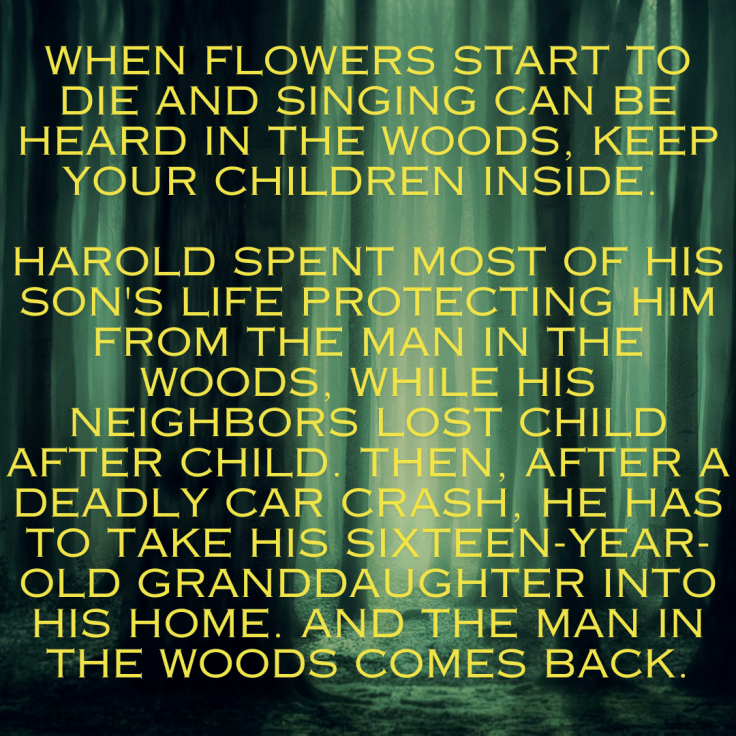
Man in The Woods is now available on Smashwords and almost everywhere!

A WordPress.com Website.

Up ↑