How to ruin your story

The first season of Amazon Prime’s Upload launched in 2020. And I was hooked from the start. It’s the story of a man named Nathan who is uploaded to a virtual afterlife after his death. He is, we’ll say, less than pleased with this.

The show was funny, thought-provoking, and touching. It had a lot to say about class disparity and how artificial our lives are becoming. And every season left us with a killer cliffhanger.

The last season was released in August of this year. And it was just, just terrible. It was a slap in the face of fans. And while I don’t think it’s the worst series ending ever, it was pretty damned close.

Of course, there is no great loss without some small gain. As writers, we can learn from bad writing as easily as good writing. And the last season of Upload is a perfect example of almost every single way you can screw up your ending and leave fans feeling ripped off and betrayed. So let’s see exactly how you ruin a series.

Spoiler alert! There is no way I can talk about this ending without spoilers. So if you haven’t seen the season yet and somehow still want to after that intro, you’ll probably want to do that before reading more. I will also be giving some spoilers for the show Shitt’s Creek. It will make sense when we get there.

Add in stupid, unrealistic storylines

Upload has always been about one thing above all. Class disparity. How far companies will go to make a buck off the backs of anyone.

Well, that seems to have been scrapped this season. Instead, we got a story about the AI guys becoming sentient and taking on lives of their own. And, for some reason, corporate espionage that led to Aleesha becoming a super spy. At least I think that’s what happened there. It’s actually kind of hard to follow, since they only had four episodes to introduce this concept, then bring it to a conclusion.

Scrap your main antagonists and replace them with much worse ones

For the first three seasons, the main antagonists of Upload were David Choak, played by the incomparable William B. Davis, and Oliver Kannerman, played by Barclay Hope. They were two grossly wealthy white men who killed people without qualms because the people in question were poor. Choak at least doesn’t seem like a bad guy at first. Then you learn more about him.

These were good antagonists. We wanted to see them fall. What ended up happening to them was not satisfying. It was not significant. Both antagonists were just sort of pushed aside to make room for the evil AI Guy. Who was, by the way, a boring and lazy antagonist.

I do not care that an AI assistant became sentient. I do not think it’s believable that evil AI Guy was going to destroy the world in some mysterious way. It wasn’t interesting, it wasn’t scary, it wasn’t compelling. And maybe it could have been if the storyline had been given time to grow or evolve. But it sure as hell didn’t have that time.

Drop a bunch of storylines and characters

I ended this series with a lot of questions. Maybe you’ve had some of the same questions.

What happened to Nora’s dad? Didn’t he have a fatal disease?

What happened with the Luds? Are they still trying to fight against modern tech? Did they just scatter?

What happened to Jamie? We know he’s dead, and that’s all we know.

What happened to Byron? Is he doing okay? Is he still pining after Nora?

Did anyone even care that Fran died? Justice for Fran!

And where the hell were Navaya’s parents this whole time?

Now, there are some stories that left us with good questions. Hunger Games is a good example. But bad questions are a death sentence. These are questions that should have been answered a while ago. And it feels like if the show had had more time, it would have answered these. But that’s not an excuse. This felt less like an ending and more like a bleeding wound of a story.

Give your main characters a bad ending that wasn’t deserved

Some stories don’t have happy endings. Some characters get bad deaths they don’t deserve. Some good relationships end.

Let’s use Shitt’s Creek as an example. Specifically, the relationship between Alexis and Ted.

They were so good together. They loved each other. But in the end, they loved each other enough to let each other go.

I cry every time I watch this. When Ted says, “Can’t say we didn’t try,” I just lose it.

This ending, sad as it was, made sense for Alexis. She had spent her entire life doing dumb shit for men. She was running all over the world, getting into dangerous situations, and ignoring her own identity for men who did not care for her.

She needed to choose herself. That was sad, but it made sense for her character.

Now, let’s talk about the ending between Nora and Nathan.

It was Goddamned mean.

Nathan’s personal arch was never about needing to let go of his mortal life. That was, for some reason, never a story arc for any of the characters. His arch was about making good changes in the world.

As far as main characters go, Nathan was a perfect foil for the antagonists. He was a good-looking white man. And while he didn’t have money, he had the talent and ability to make money. A lot of money. He could have been the next Choak or Kannerman. Hell, he might have married Ingrid and taken the Kannerman name.

If Nathan had died saving someone, that would have made sense. If he’d died like Luke did, that would have been a satisfying but sad ending. Instead, he’s only a victim. He dies because of senseless abuse.

Give up on everyone’s story arcs

This actually leads me to my last issue. Not a single character had a satisfying personal arc. Except maybe the AI Guy.

Dylan never got to grow up.

Luke was erased and never learned to love himself.

Ingrid got everything she thought she wanted, instead of learning that she can be a whole well well-rounded person without Nathan.

Aleesha achieved all the safety she deserved, then gave it up to become a corporate spy.

And Nora, our main character, really got shafted. She wanted to find someone to know her, but she had trouble letting people in. And she finally does. She trusts Nathan and loves him. And he dies senselessly.

There’s nothing there. Yes, I saw the ending. It’s bullshit. It’s not enough. Which honestly sums up my whole opinion about this final season.

In the end, the failure of this last season of Upload lies firmly with the writers. Yes, I am sure there was pressure from higher-ups. There always is. This was put out by Amazon, after all. But the writers could have done more.

The actors did a fantastic job. The effects were as good as ever. But the story is what we’re here for. And the story failed in every way possible. So learn from this, writers. Don’t make these same mistakes. Write better.

Paper Beats World is a labor of love. If you love what I do here, please consider liking and sharing this post and leaving a comment. You can also support me financially on Ko-fi.

Spooky season is coming, and it’s time for some creepy reads. Check out my horror novel Quiet Apocalypse, about a witch trapped in her apartment during a dark winter storm with a demon devoted to ending the world.

Or check out my horror short, The Man In The Woods. A man tries desperately to protect his granddaughter from the mysterious man in the woods. But his fear only grows when a new housing complex is built too close to the woods.

Adding new characters so people don’t hate them

If you’re writing a series, you’re going to find that your cast changes over time. This makes sense and is realistic in real life. If your MC is learning, growing, and changing then people are going to leave and come to their lives. They might move, go to school, change jobs, or get a new neighbor. Maybe a family member needs to come stay with them for some unexplained reason.

Sometimes this is great. Some fantastic characters have been added later in a series. Using some TV examples because they’re the best known, here are some later added characters I loved.

Patrick from Schitt’s Creek.

Kimmi from Rugrats.

Ben and Chris from Parks and Rec.

Alex from Chuck.

Natalie from Monk.

Chris from 30 Rock

Jessie from Burn Notice.

All of these characters were great additions to their respective shows.

But not all characters added later in a series are great. Some are Godawful. And the examples of that are downright cringy. Think of Dill from Rugrats, Suzie from Space Cases, Scrappy Doo, and the much despised Bobby from Brady Bunch. This horrible addition trend is so well understood, that it was mocked by the Simpsons in their eighth season.

So how do we do it right? How do we add to our cast without creating a Poochie? Well to me, this involves a series of do’s and don’ts.

Do add something to the story that was missing

Most of the characters in my ‘good’ list fall under this rule. Patrick added a straight man (comedic straight) to a pretty zany cast. Kimmi gave Chucky someone who admired him in Rugrats. Alex gave Casey a softer side that he needed in Chuck.

Do you have a character that is a little too silly? Too responsible? Too damn irritating? Give them a character that has the opposite qualities to balance them out. If your story is just a little too dark, add a character that can give levity.

Do give them a believable and sensible reason to be there.

How did this new character join your cast? Did they move? Okay, why did they move?

Kimmi’s a good example of this. She and her mom joined the cast after the Rugrats went to Paris. Her mom was working for the antagonist, fell in love with Chaz, and moved back to the States with him. That makes sense. Well, not in the real world. But in the lovely fictional world in which a school teacher can afford to keep her family in a house in the suburbs.

As a bad example, we can look at Scrappy Doo. Why is he hanging out with his uncle? Why did we never meet his parents? Why doesn’t he ever go home?

It needs to

Do make sure they fit the style and overall theme of the show

We all know that fiction content tends to have a certain vibe. Some shows are warm and cozy, some are more dark. For this example, let’s consider The Good Place with The Boys. In The Good Place, everyone seems to be a little messed up, but essentially decent people.

Compare that to The Boys, where no one seems like an essentially decent person except the two main characters, Hughie and Annie. And even they, if they were plopped into The Good Place, would seem far too dark and messed up to belong there.

So, as much as you’re trying to bring something new and different to your universe, you don’t want them to be so different as to feel like they don’t fit into the world you’ve already created.

Don’t force this character to take up too much space

Now, we’ve reached the don’ts. And this first one is a doozy.

If you’re adding a new character, you don’t want them to necessarily take over as the main character. So they shouldn’t be treated as such. Yes, they should have some storylines. Yes, they should take up space in the world. Yes, they should be important to the plot. But they shouldn’t be the new focus, to the detriment of other characters.

A great example of this done wrong was Rugrats. Dill took over too many of the storylines. Now that there was a baby who needed looked after and cared for by the rest of the cast, every story had to be about him in some way. Before, each episode told a story of one baby, or the assembled cast facing a problem. Now all the problems were about dealing with Dill. Or they were exacerbated by his presence.

Honestly, did Stu and Didi never actually watch their kids?

Don’t take the place of existing characters

This one is a personal issue with me. And it started young. I’m likely dating myself here, but when I was a kid I loved the show Space Cases. It was kind of like Voyager, but with a younger crew. A ship was lost in way outer space, carrying two adults and a group of teens. Scifi hilarity ensued.

My favorite character was Catalina. At the end of season two, she was replaced by her best friend Suzee, who until this moment most of us thought was an imaginary friend.

And I never got over that.

Of course, if you’re writing anything that requires actors, you’re sometimes going to have to replace people. I had a few actors leave my podcast between seasons one and two.

Some of the characters I recast. Some I simply wrote out and didn’t replace. But if you’re writing for TV, you can’t always just replace an actor.

(Yes, sometimes it can be pulled off.)

Then there are examples like Space Cases, or Charmed, where an actor leaves and their position is simply taken over by a new character. And that’s a jarring situation.

If you’re writing a book series, you don’t have to worry about actors leaving. So you do not ever need to shoehorn a new character in to take the place of somebody else. So, you know, don’t do it.

Don’t add a character just because they’re cute

Alright, you all knew this was coming. That’s why I saved it for last. I have some words of revulsion for the Scrappy Doo, Dill Pickles, and Cousin Oliver sort.

We do not need a character added just for the sake of being cute young and new. We don’t need it. If you find yourself writing a new baby, a new puppy, or a new adorable pet sidekick to keep things interesting and fresh, stop right there. Your story doesn’t need it, and it won’t be the saving grace you think it would be. That stunt has worked once and only once, and that was on Sailor Moon.

I hope this post has helped you. And I hope I didn’t trash-talk a character you loved. If I did, please let me know in the comments. And if there’s a later addition character I didn’t reference that you think deserves some love, please let me know about them too.

Paper Beats World is a labor of love. If you love what we do here, please consider supporting the site on Ko-fi.

And don’t forget that Nova, book five of Station 86 starts on Monday! And yes it does have one later series addition, a survivor from Station Central. See you then.

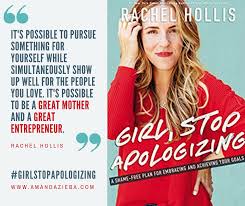
A review of Girl, Stop Apologizing by Rachel Hollis

I first heard about Rachel Hollis when I saw the cover of her first book, Girl Wash Your Face. 

That title is a case study in why choosing a good title is so important. Hollis got that title spot on. Of course, I had to find out what this was all about. And of course, I had to read her book.

After reading it I had to get the next one. Because the first one was so great. I did a review of it before, you can read it here.

Now, if you read Girl Wash Your Face, you know that it was half self-help book, half stop apologizing pic twoautobiography. That’s what I would expect from any good self-help book. If someone hasn’t lived through Hell, I don’t believe they can help me get through it.

There wasn’t much of the biography experience in Stop Apologizing. There are little snippets of her life, sure. But not the full-fledged stories like before. That was alright, though. We got all that in book one.

What this book focused on was being, fully, unapologetically you. and you know how I feel about that. I’ve all but removed ‘sorry’ from my vocabulary. Unless I mess up, of course. In the past, I’ve literally apologized when other people ran into me! 

I’m working on it. 

Stop Apologizing is broken into three parts. The first part, and the longest, is the list of lies we tell ourselves to stand in our own way. And, most importantly, why they’re all bullshit. 

I think this is the foundation of any real, honest change you’re going to make in life. Start with weeding out the lies and bad habits. It’s like cleaning, you can’t start until you get rid of the clutter.

Next, we move onto habits to adopt. These are not hard habits, but neither are they easy. For instance, Behavior number five hit me right between the eyes.

Build a foundation for success. 

Mind you, I didn’t start reading this book until I’d already picked out my word of the year. You know, Foundation. So this chapter struck me right between the eyes. I love it when the universe lines up like that for me.

Finally, the last part is skills to acquire. Some of these seem like the sort of thing you’re born with or not, but the truth is that there’s little to nothing you can’t learn. 

I appreciate that the first skill listed is planning. No surprise there, it’s my favorite thing. But guess what? The only reason I’m able to get done what I get done is that I plan shit out. Do you think I could hold down a full-time job, take care of a mother in law recovering from hip surgery, host this blog, work for another blog and still put out at least one book a year if I didn’t have my life planned down to the half-hour? No, never. At least not if I wanted to, you know, sleep. And I do, I really do. Sleep is sacred.

I loved this book, and I hope that Rachel Hollis keeps churning them out. I love following her on social media, and I’m excited to see what comes next.

Did you read Girl, Wash Your Face or Girl, Stop Apologizing? What books have you read so far in 2020? Let us know in the comments below.

Limetown series one overview. A huge letdown.

Okay, I have to start this out with an apology. I wrote a review of the first two episodes of Limetown, and I recommended it to you all. I thought it was going to be great. I thought it was going to be true to the podcast. I thought it was going to be worth your time to watch.

After finishing the show, I can confirm to you that it is, in fact, not worth watching it at all. It was such a disappointment, an absolute spit in the faces of the original creators. 

Let’s break down why shall we?

I’d like to start with Deirdre Wells. They decided to cast Marlee Matlin as Deirdre. If you’re not familiar with this incredible actress, let me tell you a few things about her. I first saw her on West Wing, where I fell in love with her. She’s funny as hell, a great actress, and also happens to be deaf. 

If you know about Limetown already, then you know that the town was testing tech that allowed people to hear other people’s thoughts. Now, I’m sure you can imagine that a deaf woman would be more interested in that than most. The ability to communicate, actually communicate with people after not being able to for most of your life would be too magical for words. They could have explored that. They could have gotten into how it was to be isolated her whole life, and then feel even more isolated when other people got the tech and she didn’t.

But they didn’t’ bother to do any of that. This was one of the few things that a show could have done so much better than a podcast. I mean, you can’t convey the actions of a deaf person in a purely audio medium. That sort of feels like a dick move. But no, there was none of that. She was just deaf, and they didn’t do anything with it.

What they did do instead was completely ruin the relationship between Dierdre and Max. If you recall from the podcast, Dierdre was all but convinced Max didn’t love her all that much. She was largely surprised when she heard that he’d called out “Goodbye Dorothy,” right before he died. She seemed more angry at him than anything. Like long term anger. One that had smoldered to a low blaze through the years. And Max? Max didn’t mention her at all.

Now, let’s talk about what really ruined the show for me. It was a specific thing, and it had a name.

Lia.

I touched on this in the first post I did about the show. I loved Lia in the podcast. She was sweet, smart and cared about what she was doing. And she really, really, didn’t give a shit about her uncle Emile. She didn’t remember him, didn’t realize the connection he had with her.

This was incredibly important if you read the prequel novel. Emile stays with his brother’s family for some time, and he has this great connection with Lia. It’s suggested but never said out loud, that he can’t hear Lia’s thoughts. That was important to him. Lia was important to him. So the fact that she doesn’t even remember their bond is heartbreaking. It means something that’s felt deeply. And this show just pissed all over that.

I especially hated what happened to Mark. It was ugly, it was brutal, and it was completely unnecessary. It just made me feel sick. And look, I’m all about the flawed hero character. I love flawed heroes. But there is a difference between a flawed hero and someone I just really genuinely hate. This made Lia into someone I hated.

Now, let’s talk about Emile showing up on the second to last episode. What in the hell was that? It didn’t make any sense for him to show up. And it made no sense, how Lia reached to him.

This whole show she’s having some sort of crisis because she wants to find her uncle. Then he shows up, right out of the blue, and asks her to come with him. And she says no. 

She hasn’t done a damn thing all season that wasn’t selfish. She’s done all these horrible things and she claims that it was all for the survivors. But it wasn’t, it was for her. But when the time came, she didn’t take what she’d been searching for all this time. 

But she didn’t. Now, this makes sense for the Lia of the podcast. She cared about the story, not her uncle. She would have turned him down. But the Lia of the show would have gone with her uncle all the way. 

Now finally, I want to point out something that I thought was done almost to perfection. The last episode was almost perfect.

Lenore was great. The actress, the lines, the execution. Everything about her was wonderful. All through this last episode were little added scenes that did add something to the story. It was masterfully done.

Maybe it was so good because Lia was hardly on the screen.

So that’s it. I have nothing more to say on the subject of this show. But I do have some advice for the creators. 

Don’t bother with a season two. Get season three of the podcast done instead. 

A WordPress.com Website.

Up ↑