What I Learned from My Second Journalism Class

I have an instant distrust of anyone who calls their time in high school their ‘glory days’. My time in high school was when I was the dumbest, hated myself the most and took care of myself the least. I don’t consider any of that glorious.

But there was one moment in high school that I was particularly proud of.

I was onto my second journalism teacher. Because I loved, respected and learned so very much from him, I’ll call him Captain. Also because Dead Poet’s Society is a fantastic freaking movie.

Now, let me give you a little back ground. I was in school during the clusterfuck that was No Child Left Behind. Every teacher reading this just broke something. Surprise, students didn’t like it either. Mostly it meant boring assemblies and crappy busywork. It meant a focus on just one path, college, excluding things like technical schools and just hopping right into the work force as ‘lesser options’. It meant that talented students who worked hard, like me, were held back so that other students could keep up. It meant money taken from things like art and music to go into ‘college preparation’.

I didn’t like it.

But then, I realized something. I could say something about it, and I could do it in print!

I decided that my own complaining, IE an editorial, wasn’t going to make my point. So I opted for writing a feature piece. I wanted to find out what people thought of the programs. The response was overwhelming. The piece ended up being quote after quote from students, talking about how much they thought this was a waste of time. I tried, oh so very hard, to find someone who liked it so that I could show the ‘other side’. You know, be ‘fair and balance’. I found no one who had anything good to say about it.

Captain had to run my story by the principal, who was less than thrilled. So much so that he threatened to fire Captain if he didn’t print my story with a note saying that it ‘was not balanced’. One of the other reporters had to write a story praising the program the issue after. She was not thrilled, and had just one student comment. I’ll never forget it, it was, “I’m sure it must help someone.”

The story got out, and students I’d quoted rallied to my defense. Even better, teachers found me, and quietly told me I’d done a good job. It was the first time I’d gotten such a great response from something I’d written.

Nothing was changed, we still wasted money and time on a system that didn’t work. In the end, students and teachers are powerless when it comes to what some politicians who went to private schools think is best for public schools. I lost this fight, and I kind of feel like my whole generation did.

If there is a lesson, and I’m not sure there is one, it’s that sometimes you can win and lose at the same time. I was right, and everyone knew I was right, but it didn’t matter. At the same time, no one got in trouble so I guess you can call it a wash.

And yet I am proud. Why? Because it was the first time I remember feeling like something was bullshit, and saying something about it. And when I didn’t win, I kept calling bullshit anyway. And if I want you to take anything away from this month devoted to journalism, it’s this.

Keep pointing out the wrongs in this world. Even in fiction, even if no one listens, even if you’re the only one. Call bullshit when it needs called.

Poetry Month, Week One

Here is the first installment of Paper Beats World Poetry Month. An awesome poem, (way better than the stuff I’m going to bore you all with on Wednesday) by Lyndal Outram


 BLOOD LIT MOON

Beautiful Autumn night
The moon hangs
Dangling above the midnight ocean.
Suspended by a few golden stars,
All aglow, a shade of unearthly red,
And singing itself to sleep.

By Lyndal Outram
B

Be sure to check Lyndal out on her blog, Deliawrites.wordpress.com

If you’d like to see your poem here, send it to NicoleCLuttrell86@Gmail.com. I’ll be taking submissions until April 30. For full details, check out the submission info here.

Using Journalistic Structure to Outline Your Novel

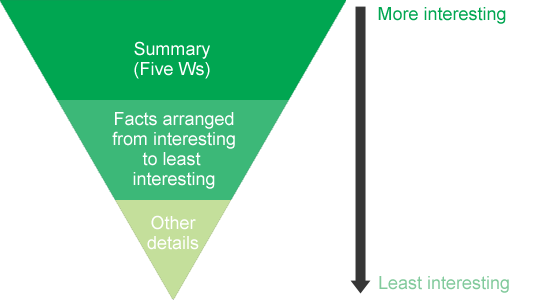
When you write for a newspaper, your stories have to fall under a specific structure. You take all of the information that you need to add into a story, and you list it from most important to least. It’s referred to as the inverted pyramid. Here’s an example.

30-03_inverted_pyramid_for_about_page

We do this for obvious reasons; the editor might have to trim the end of your story to save room, and the reader is likely only going to read the first paragraph anyway. So, that first paragraph, usually only one sentence, includes all of the important details. It must answer the who, what, where, when, why and maybe the how of the story. Example;

A crayfish faked it’s own death yesterday in my living room to avoid the unwanted affection of a 12 year old girl.

That’s the whole story. Is there more to tell? Yes, of course. But if you know that, you’ve got the basics. The rest of the story, how I came downstairs to find the dumb thing lying on it’s back, and how my kid poked it with a pencil and it jumped back to life like the little faker that it is, can all go below, in order of importance.

Obviously that’s not how we write creatively. That’s cut, dry, space saving, and would make for a terrible novel.

But it makes for a pretty great outline when you’re brainstorming!

Especially if you’re like me. I tend to have a lot of rough details when I’m in planning mode for a novel. This character is going to go do this, and this one will have that happen to them, an this whole list of people are going to die. All of that is important, but I need to get some other stuff in order first.

Who

Who is this book going to be about? There’s a whole cast, but I need to know who’s story we’re telling.

What

What’s happening? I mean the main, overlaying plot. Are there side plots? There are always side plots! But I need the basic, what is happening in this story.

Where

This one shouldn’t take a lot of explaining. What is our setting? Where is this story taking place?

When

The time, duh. Is your story set in the past, the future, the present? In some cases this is going to be dictated by your genre, but not necessarily.

Why

In journalism the why isn’t quite as important. In creative writing, of course, the why is essential. Why is any of this happening? What’s the point? Is it all just a series of random events that don’t have any meaning at all?

Once you have all that down, you can list all of your other details below in order of importance.

So, how about some homework. Take your favorite novel, and write down the five W’s.

Paper Beats World is taking poetry submissions

That’s not a typo above, we are the market this week

I’m celebrating National Poetry Month this year all sorts of ways. First, I’m writing a poem a day. Second, I’m sharing my poetry with you here on Paper Beats World instead of my short stories.

Third, for the first time ever, I’m opening Paper Beats World to you! Send me your poem, and I’ll share it here!

I’m sorry to say that, as I’m broke, I can’t pay you. But the best poem, voted on by all of you, will win it’s author a free copy of Days and Other Stories.

Some simple guidelines- Please don’t send anything over a page. Sexy is fine, graphic sex is not. The deadline is April 30. Voting will take place the first week of May.

Please send all submissions to NicoleCLuttrell86@Gmail.com.

I can’t wait to see what you guys come up with.


When I studied journalism in school, I had two teachers. The first was a woman who I loved while I was in her class. In the interest of her privacy, I’ll call her Miss because she was younger when I was in her class than I am now. Let me tell you how old that makes me feel.

At any rate, Miss and I had a really good relationship, which should have been my first tip off that A. I was a huge kiss ass and B. she was a little too comfortable with her students.

Learning journalism wasn’t like anything else I’d experienced in my short fifteen years. While it was, essentially the same, learn by practice, the only real way to practice it was to run our own school paper. Which is what we did. So, instead of having journalism as an elective, it was just another class. Just a class that we, most of the time, were writing and editing instead of listening while the teacher taught. As you can imagine, I learned a lot. And not just about journalism.

When I get comfortable, I have no kind of filter

And this was new to me, because as an introvert, it takes me a long time to get comfortable. So, I’d never really gotten to the point where I was comfortable before. So some of the things that came out of my mouth while we were having ‘current event discussions’. For instance, mine was the first class to have metal detectors. I had, on several occasions, had something on my person that made the damn thing go off. If you set off the detector, security guards went through your bag, often by taking everything ‘out’ of your bag. I was 15. Sometimes, they were taking tampons out of my bag. That was humiliating to a 15 year old girl. When we were discussing pros and cons of the metal detectors in class, that seemed like one hell of a con to me. Apparently that was inappropriate. Personally I thought then, as I think now, that if it’s too inappropriate to talk about in school, it shouldn’t be happening in school.

The world is a dark and scary place

If you do the math, you’ll know that I was 15 in 2001. I was, like so many of my contemporaries, sitting in a locked down school on September 11th, sharing rumors. The teachers were forbidden to talk to us about what was happening. My journalism teacher decided to forgo that rule. She turned the tv on, and we watched the news. Then we talked about what had happened. When Daniel Pearl was murdered, we talked about that, too. And at that age, with no adult in my life willing to discuss things like this with me, I learned that there was a lot to be afraid of.

Newspapers think we’re illiterate

Do you know that the majority of newspapers are written to a fifth grade reading level? That means that any vocabulary that would be too advanced for a fifth grader is not permitted. That’s, apparently all that can be expected of the American people. For my opinion of that, please see the above comment about the world being a scary place.

Sometimes editors are saints, and sometimes they are overly political assholes

This is the truth. I’m with Stephen King on this one, there is nothing that will teach you more than the first time an editor takes a red pen to your work and just marks it the hell up. (He didn’t phrase it that way, but he did talk about this in On Writing. If you haven’t read it, read it.) An editor who knows what s/he is doing will cut and tighten your writing in such a way to make it sing.

A bad editor will rip your piece a new one if they have ‘issues’ with it. I ran into this the same day that I found out that Miss and I didn’t fully agree on everything. Like whether we ought to have been at war. Shame.

The world is full of some amazing people, and I was privileged to go to school with some of them

I met two women in my class that I want to tell you about. The first was a very religious girl who always wore turtleneck sweaters with a small gold cross hanging out. She was incredibly conservative, like frighteningly so. She was also the first to help out when someone was having trouble with their edits and got straight A’s all year. The second girl was Gothic, atheist, sexually active at 16, frighteningly liberal, and possibly the coolest person I have ever met. Taught me all sorts of fun stuff my mother wished I didn’t know. She was also the first to speak out against any inequality in our school. Both of these girls were smart, kind, selfless people. They were funny, and their writing was thought provoking. They also, by the way, liked each other fine, despite pulling no punches during debates in class.

If two teenage girls as different as that can discuss the big issues in our country like wars, abortion, welfare, sexual discrimination and security after 9/11 without fistfights, we all can. I wish I’d met more people like that in my life. I hope that I’m like them in that one way.

There are some great people walking this world with us. It helps, know that they’re there when we’ve got so much scary stuff to face.

KISS, and Creative Writing

Creative writing and journalistic writing are two very different animals. If you’re accustomed to one, the other can be jarring at first.

Journalism works on strict deadlines. You are expected to get your piece done by that deadline, or it doesn’t go up. Miss the deadline too many times, and you my friend don’t work for that paper anymore.

Journalists are expected to turn out massive amounts of work, but at the same time, each of those pieces are expected to be a short and to the point as possible. The smaller your piece is, the more ad space the paper can sell. Scratch that, the paper’s already sold that ad space, and they’ll cut your piece if they have to/decide to.

Because of the constant deadlines and need for as slim copy as possible, journalists develop horrible alcohol addictions, I mean write by a code.

K.I.S.S

Maybe you’ve heard of it. It stands for Keep It Simple, Stupid. Journalists are also kind of assholes. It’s all the stress.

Yes, creative writers do live with deadlines and word count limitations, too. But think of our limitations as a bathtub. Journalists are working with shot glasses.

Here, then, are some of the ways I use the quick, tight, KISS style writing I learned in journalism to improve my creative writing.

Research

For one thing, journalists do a lot more of this than we do. I’m out there learning about Russian swearwords, a journalist is finding out how often Russian diplomats cuss out visiting dignitaries. I haven’t interviewed anyone since I worked on my school paper, when I did it literally for every article I wrote.

I started by writing down a list of questions I needed the answer for. Then, I wrote down all the things I thought I knew, so that I could fact check them. (That’s the other thing about journalism. If we’re wrong on a fact, it might not even matter that much unless you’re writing creative nonfiction. If they’re wrong, they’re gonna cause all sorts of hell. And by that I mean it could embarrass their publication, and potentially get them fired.)

Then I get to work. I need reputable sources, people that other people trust. And they can’t be other news establishments, that’s terrible form.

Then I would set up appointments for the people I wanted to interview. The time I had in between the first interview and right then was the time I had to research. I was looking for the answers to the questions I had in front of me. If I found something fascinating that I could add, I’d write it down. But I wasn’t looking for inspiration, I was looking for answers.

Next, I was double checking the answers, and making sure I kept track of my sources. (Which, by the way, is another thing we creative writers should work harder on.)

The interviews came next. I always hated that part a little bit, it was the skill that took me longest to master. At first I was pretty much reading my notes off cards. I learned, though. Some people are really good at talking to other people. Some of us hate talking to people we don’t know, let alone having to ask a whole bunch of what might be awkward questions. Yes, you can learn all sorts of tricks to make interviewing easier and more efficient. But at the end of the day, you’re going to have to practice a lot to get comfortable.

Now that you’ve got everything together, it’s time to actually write.

Omit Needless Words

If you haven’t read Elements of Style, by William Strunk, put this down right now and go do it. The words above are right from it, and they are words I live by in my writing. This is pretty simple to explain, even if it’s not easy in practice. If a word isn’t doing something useful, providing information, setting a scene or giving depth to a character. We don’t need to know about the drapes unless the drapes tell us something we need to know.

As creative writers, we need to take this two steps further.

Let’s talk about side plots. As a fantasy writer, this is kind of hard for me. I have a big cast, and because I put a ton of time into character development, they all have their stories to tell. It makes it worse that in the first draft, I throw everything in. You should, too, because there should be no filter in your first draft. You just don’t know what sort of awesome stuff you can come up with if you don’t have a filter.

Even so, I can’t tell them all, and that makes me sad. But telling too many stories is distracting. Not just for the reader, for you as well.

Fortunately, my second draft often weeds the weaker side stories out. It’s the easiest way to handle weak side plots, in my opinion. Once you’re down to just the strong ones, keep just the ones that perform double duty. Does your side plot deepen your main one, tell us something about an important character, or expand the reader’s understanding of your world? If not, maybe you should stash that story away for later.

Finally, let’s talk about your cast. Again, remember to KISS. If a character can be cut, she probably should be. Simple as that.

In closing, just remember, keep it simple, because you’re not stupid.


Journalism and Creative Writing

I’ve been writing Paper Beats World for awhile now, and it occurred to me that I’ve overlooked a pretty serious piece of information about myself.

When I was in high school I didn’t want to be a creative writer, I wanted to be a journalist. To that point, I took three years of journalism. In my first year, I won an award called a Keystone for a piece I wrote. In my last year, I was the editorials editor. That’s right, I ran the whole page. I loved and hated it at the same time.

I loved being on the school paper. It was completely student run, which meant we even did things like calling local businesses for advertising. And I learned so much.

I was introduced to a different way of writing than I’d experienced before. In English class we focused on writing a certain amount of words to fill a space. Everything was neat, with double spaces at the end of every sentence. We talked about our emotions in English, and how a piece made us feel.

There was no time for any of that shit in Journalism. We wrote the facts, in a very specific order. We didn’t add our feelings into what we were writing about unless we were writing an editorial piece. And we used as little room as possible!

I learned so much from studying journalism. Now, we’re going to talk about a lot of them this month, but here’s something that I don’t think I’ll get around to saying anywhere else. It’s something that, if you’ve never been told before, you should hear now.

An editor that is not afraid of hurting your feelings and will just honestly edit your work is worth everything.

Don’t ever be offended, don’t ever get mad. They are helping you more than you can ever imagine. In fact, if you can learn to self edit your work, you’ll go a long way.

Of course, that’s hardly the only thing our brothers and sisters in journalism have to teach us. Not only will we be talking about how journalism can help your writing improve this month, I’ll be talking a little bit about my experiences on both papers.

Should be fun.


Black Static

That name just got me, it’s so classy and dark!

This one’s pretty straight forward. I did like one clever thing in the submissions list. They say right off the bat that you shouldn’t be offended by a form rejection letter, because it just means that they’re really busy. I can relate.

Genre- New Horror and Dark Fantasy

Word count- Up to 10,000 words.

Payout- Not listed

Here’s a link to the full submission guidelines.


A WordPress.com Website.

Up ↑