I will do my best to avoid food puns in this post. But I might not be able to help it. Sometimes they’re just too tasty.
See, we’re starting already.
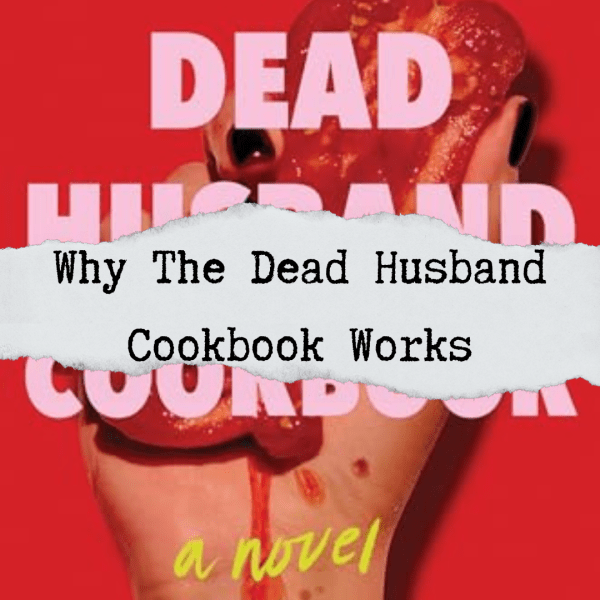
Released on the fifth of this month, The Dead Husband Cookbook is the latest novel from Danielle Valentine. If you’re just joining us, she’s written three novels so far that I’ve absolutely devoured.
Wow, two so far.
The Dead Husband Cookbook is about two women. One, Thea, an editor who’s hanging onto her career by a thread. She committed the ultimate sin of, gasp, revealing an author she was working for to be a predator. But she’s given a chance to redeem herself when a celebrity chef, Maria Capello, asks for her specifically to edit her brand new memoir. The memoir, which might, after years of speculation, put to rest the rumors of how her husband died.
So let’s break it down, like a good recipe. Let’s talk about what went into The Dead Husband Cookbook and why it works.
I loved the recipes
Through the book, we’re treated to some of Maria’s recipes. Now, I’m not as deeply into cooking as I am some other things, but I do enjoy it. I like a simple recipe full of things I can recognize and easily get at Walmart. I like making a recipe with the tools already in my kitchen.
I have managed to not buy an immersion blender for thirty-nine years, and I’d like to keep it that way.
All of these recipes are like that. Well, maybe not the one for duck. I’ve never seen duck at a grocery store here in Western PA. But then, I’ve never looked for one.
I got the e-book version of this book, just to make sure I can hang onto the recipes and try them. This made me feel immersed in the story. I, like Thea, will try my hand at making Maria Capello’s meatballs. Mine probably won’t taste the same either.
But it’s these little details that make reading a book not a passive experience. You get to become part of the story in a small way. That’s fun.
This feels like a book within a book
I am always a sucker for stories with additional documents in them. Journal entries, a VHS someone found tucked behind the guest room dresser, old medical records. And in this case, a manuscript that Thea is editing. As a reader, it breaks up the flow of the story in a good way. We feel like we have as well found something illicit. Something we’re not supposed to read or see, but now we’ve got our hands on it.
As a writer, this is also fun. It’s a way to experiment with different writing styles and formats. Even with different voices, as the pov of found content is different from our main characters. This leaves you open to all sorts of fun experimentation. And if the writer’s having fun, the reader will too. And Valentine was having fun when she was writing Maria.
Maria is creepy as hell, but not for the normal reasons
I loved the character, Maria. As someone who’s spent way too much time in medical waiting rooms, I’m familiar with the celebrity chefs she’s based on. The Pioneer Woman, Martha Stewart, The Barefoot Contessa, Rachel Ray. They all give off this air of near perfection. Like Maria, they appear smiling, joyful, endlessly energetic and endlessly working to feed others. I am a rabid feminist and I still sort of want to be that. I want to be the woman who saunters into a gorgeous, well-lit kitchen and throws together a fabulous meal without getting a single stain on my expensive blouse.
But I think we all know that these women are performing. They’re acting. And under that character, they’re real people. People with a whole range of human emotions and access to many sharp knives.
Maria isn’t scary in the way the killers from Never Flinch or Mexican Gothic are. She’s more like President Snow. She has the power, the money, and the know-how to destroy anyone she wants. She also has the will to do so. And she’ll sleep well that night.
Thea is very relatable
Unlike Maria, Thea is a relatable character. She’s struggling in a very Millennial way, trying to care for her family and her mother. She doesn’t know how to talk about what she needs to other people. She doesn’t know how to stand up to anyone at the start of the book.
But she’ll stand up for other people.
I also loved how much of a mom Thea is. Early in the book, she notes that Maria’s granddaughter has impeccable table manners. She’s not impressed, she’s concerned. That kid sat at the table and ate with a fork without spilling or interrupting seven times with incomprehensible questions? Nope, doesn’t pass the vibe check.
I also loved her constant irritation at having no internet connection. Look, I can’t do my work without the internet either. I have three tabs open just to write this post. She’s not irritated because she can’t scroll through Instagram before bed. She needs to be in communication with the people who depend on her and do research, damn it! Let the woman access Zoom.
The tension is thick
I was nervous as soon as Thea stepped into Maria’s house. It felt like she was stepping into a killing bottle. A well-appointed one, an expensive one, but a killing bottle nonetheless.
It started when they took her phone. Then her keys. Then she couldn’t get out through the Wi-Fi.
I don’t think we realize sometimes how accustomed we’ve come to being able to communicate with others. We can casually chat with people all over the world. I haven’t seen my best friend face-to-face since December. We talk all day long.
As soon as Thea arrives, though, she can’t contact anyone. Not just anyone. She can’t communicate with her boss, who is looking for an excuse to fire her. She can’t communicate with her team, who are waiting to make crucial publishing decisions on a short deadline. She can’t communicate with her husband and daughter.
Setting aside the horror part of this horror story, that is an anxious situation. Not being able to reach people who might need us, who usually do need us, is stressful.
As always, horror works best when it’s grounded in reality. Most of us will not be trapped in a killer chef’s house. All of us have felt stressed out because someone might need us, and can’t reach us. So when that layer of physical danger is layered over this emotion that we are familiar with, it feels so much more real.
I adored The Dead Husband Cookbook. Aside from everything else, it was a grown-up horror. It was a scary story that felt real to adult experiences. It relied on real fears and anger that real adults feel. All in all, it’s another hit from an author who hasn’t missed yet.
So now I want to hear from you. Did you read The Dead Husband Cookbook? Let us know what you think in the comments. And if there’s a book you want me to pick apart to see why it works, let me know that as well.
Paper Beats World is a labor of love. If you love what I do here, please consider liking and sharing this post and leaving a comment. You can also support me financially on Ko-fi.
Spooky season is coming, and it’s time for some creepy reads. Check out my horror novel Quiet Apocalypse, about a witch trapped in her apartment during a dark winter storm with a demon devoted to ending the world.
Or check out my horror short, The Man In The Woods. A man tries desperately to protect his granddaughter from the mysterious man in the woods. But his fear only grows when a new housing complex is built too close to the woods.



 Paper Beats World
Recent Comments