How to ruin your story

The first season of Amazon Prime’s Upload launched in 2020. And I was hooked from the start. It’s the story of a man named Nathan who is uploaded to a virtual afterlife after his death. He is, we’ll say, less than pleased with this.

The show was funny, thought-provoking, and touching. It had a lot to say about class disparity and how artificial our lives are becoming. And every season left us with a killer cliffhanger.

The last season was released in August of this year. And it was just, just terrible. It was a slap in the face of fans. And while I don’t think it’s the worst series ending ever, it was pretty damned close.

Of course, there is no great loss without some small gain. As writers, we can learn from bad writing as easily as good writing. And the last season of Upload is a perfect example of almost every single way you can screw up your ending and leave fans feeling ripped off and betrayed. So let’s see exactly how you ruin a series.

Spoiler alert! There is no way I can talk about this ending without spoilers. So if you haven’t seen the season yet and somehow still want to after that intro, you’ll probably want to do that before reading more. I will also be giving some spoilers for the show Shitt’s Creek. It will make sense when we get there.

Add in stupid, unrealistic storylines

Upload has always been about one thing above all. Class disparity. How far companies will go to make a buck off the backs of anyone.

Well, that seems to have been scrapped this season. Instead, we got a story about the AI guys becoming sentient and taking on lives of their own. And, for some reason, corporate espionage that led to Aleesha becoming a super spy. At least I think that’s what happened there. It’s actually kind of hard to follow, since they only had four episodes to introduce this concept, then bring it to a conclusion.

Scrap your main antagonists and replace them with much worse ones

For the first three seasons, the main antagonists of Upload were David Choak, played by the incomparable William B. Davis, and Oliver Kannerman, played by Barclay Hope. They were two grossly wealthy white men who killed people without qualms because the people in question were poor. Choak at least doesn’t seem like a bad guy at first. Then you learn more about him.

These were good antagonists. We wanted to see them fall. What ended up happening to them was not satisfying. It was not significant. Both antagonists were just sort of pushed aside to make room for the evil AI Guy. Who was, by the way, a boring and lazy antagonist.

I do not care that an AI assistant became sentient. I do not think it’s believable that evil AI Guy was going to destroy the world in some mysterious way. It wasn’t interesting, it wasn’t scary, it wasn’t compelling. And maybe it could have been if the storyline had been given time to grow or evolve. But it sure as hell didn’t have that time.

Drop a bunch of storylines and characters

I ended this series with a lot of questions. Maybe you’ve had some of the same questions.

What happened to Nora’s dad? Didn’t he have a fatal disease?

What happened with the Luds? Are they still trying to fight against modern tech? Did they just scatter?

What happened to Jamie? We know he’s dead, and that’s all we know.

What happened to Byron? Is he doing okay? Is he still pining after Nora?

Did anyone even care that Fran died? Justice for Fran!

And where the hell were Navaya’s parents this whole time?

Now, there are some stories that left us with good questions. Hunger Games is a good example. But bad questions are a death sentence. These are questions that should have been answered a while ago. And it feels like if the show had had more time, it would have answered these. But that’s not an excuse. This felt less like an ending and more like a bleeding wound of a story.

Give your main characters a bad ending that wasn’t deserved

Some stories don’t have happy endings. Some characters get bad deaths they don’t deserve. Some good relationships end.

Let’s use Shitt’s Creek as an example. Specifically, the relationship between Alexis and Ted.

They were so good together. They loved each other. But in the end, they loved each other enough to let each other go.

I cry every time I watch this. When Ted says, “Can’t say we didn’t try,” I just lose it.

This ending, sad as it was, made sense for Alexis. She had spent her entire life doing dumb shit for men. She was running all over the world, getting into dangerous situations, and ignoring her own identity for men who did not care for her.

She needed to choose herself. That was sad, but it made sense for her character.

Now, let’s talk about the ending between Nora and Nathan.

It was Goddamned mean.

Nathan’s personal arch was never about needing to let go of his mortal life. That was, for some reason, never a story arc for any of the characters. His arch was about making good changes in the world.

As far as main characters go, Nathan was a perfect foil for the antagonists. He was a good-looking white man. And while he didn’t have money, he had the talent and ability to make money. A lot of money. He could have been the next Choak or Kannerman. Hell, he might have married Ingrid and taken the Kannerman name.

If Nathan had died saving someone, that would have made sense. If he’d died like Luke did, that would have been a satisfying but sad ending. Instead, he’s only a victim. He dies because of senseless abuse.

Give up on everyone’s story arcs

This actually leads me to my last issue. Not a single character had a satisfying personal arc. Except maybe the AI Guy.

Dylan never got to grow up.

Luke was erased and never learned to love himself.

Ingrid got everything she thought she wanted, instead of learning that she can be a whole well well-rounded person without Nathan.

Aleesha achieved all the safety she deserved, then gave it up to become a corporate spy.

And Nora, our main character, really got shafted. She wanted to find someone to know her, but she had trouble letting people in. And she finally does. She trusts Nathan and loves him. And he dies senselessly.

There’s nothing there. Yes, I saw the ending. It’s bullshit. It’s not enough. Which honestly sums up my whole opinion about this final season.

In the end, the failure of this last season of Upload lies firmly with the writers. Yes, I am sure there was pressure from higher-ups. There always is. This was put out by Amazon, after all. But the writers could have done more.

The actors did a fantastic job. The effects were as good as ever. But the story is what we’re here for. And the story failed in every way possible. So learn from this, writers. Don’t make these same mistakes. Write better.

Paper Beats World is a labor of love. If you love what I do here, please consider liking and sharing this post and leaving a comment. You can also support me financially on Ko-fi.

Spooky season is coming, and it’s time for some creepy reads. Check out my horror novel Quiet Apocalypse, about a witch trapped in her apartment during a dark winter storm with a demon devoted to ending the world.

Or check out my horror short, The Man In The Woods. A man tries desperately to protect his granddaughter from the mysterious man in the woods. But his fear only grows when a new housing complex is built too close to the woods.

What I’m reading, Fall 2025

Fall is upon us, finally. Yes, technically, Fall doesn’t start until September 22nd. But I’ve been drinking pumpkin spice for weeks already.

Fall is easily my favorite season. And part of that is because it’s the best time of the year for reading. Warm drinks taste better. Candles burn brighter. And no one wants to be baking anything in the Summer.

I’m behind on my reading goal for the year still, but I have some fantastic books on my Fall Reading list. Some are new. Some are just new to me. We’ve got a blend of fiction and non-fiction. Hopefully, you’ll find something to interest you on this list. If you do, let me know.

And as always, you can follow along with my reading journey on Goodreads.

Halloween Tree by Ray Bradbury

Got to get this one out of the way first. It’s a yearly October read. Yes, it’s a children’s book. No, I don’t care.

Halloween Tree is the story of a magical, terrifying Halloween night. It’s the story of a group of boys flying through history to save their friend Pip. The story is wonderful, the artwork is a delight. All around a trick and treat.

House of Quiet by Kiersten White

This one was on my Summer reading list. But I still haven’t gotten my hands on it.

This is a very busy season in my life.

House of Quiet kind of feels like a cross between Ms Perrigrin’s Home for Peculiar Children and Witchcraft for Wayward Girls. Rest assured, we’ll be talking about it here as soon as I read it.

Banana Rose by Natalie Goldberg

My hero has written exactly one fiction book. And can you believe I’ve never read it?

It’s about a marriage in which two people become very different and eventually drift apart. It’s about her marriage. It’s probably also about Zen. Because everything she writes is, at its core, about writing and Zen.

They don’t seem that different.

The Great Failure by Natalie Goldberg

For some reason, I thought this book was coming out this month. Turns out it was published in 2004. Well, it’s still a Natalie Goldberg book, and I still want to read it.

The Library at Mount Char by Scott Hawkins

This book was a recommendation from my library. Shout out to my local library. It’s about a deity called Father going missing, and his children battling to claim his power.

This seems like wild dark fantasy and a great fun book.

Rehab, an American Scandal by Shoshana Walter

Because clearly, I needed another reason to be angry.

How we treat, or neglect, people with addictions is a particular sore spot with me. I lost two people I cared deeply about to addiction. It shouldn’t happen. And the places we depend on to help our loved ones sometimes do more harm than good.

The Locked Ward by Sarah Pekkanen

This one seemed like a chilly good tale for spooky season. It’s a psychological thriller about a woman locked in a psychiatric ward and her sister who attempts to save her. I’m currently on a rather long wait list at my library for this book, so I’m assuming it’s going to be a good one.

Jesusland by Joelle Kidd

If you’re a fan of Fundie Friday (and if you’re not, you should be), you recently got to see a long interview with this author. It was fascinating. And as a former Mormon, I am fascinated by Christian culture. The Silver Ring Thing. The music that makes it sound like God is our boyfriend. The magazines that exemplify a ‘pure’ life.

It’s all a little crazy when seen from the outside. I’m partway through this book already, and I am loving seeing this weird Jesus Freak culture from someone else who grew up with it and escaped.

Banned by Weston Brown

This is another one that I learned about from Fundy Friday. But it’s certainly darker. It’s about a young man who escaped his deeply fundamental family, struggled with discovering the world, and eventually went to battle against his own mother in the world of book banning. I am sure this one’s going to upset me. I’m still going to read it.

Don’t Blow Yourself Up by Homer Hickam

I read Rocket Boys years ago. It was fantastic. And now, Hickam’s written a book about his adult life. It’s about his writing, his career, his journey to working for NASA. I am very excited about this book.

Poetry as spellcasting by Tamiko Beyer, Destiny Hemphill and Lisbeth White

This book has been on my TBR list forever. I swear, I’m getting to it. I clearly have to read this book; it was tailor-made for a writing witch who’s super into social change. I will read this book this season. I just need to get to it.

Broke Millennial Takes on Investing by Erin Lowry

I loved the first Broke Millennial book. It taught me so much about money. And with the rise of ‘trad wives’, I’m really becoming an advocate for women’s financial literacy. So expect me to talk about this book after I read it.

Look, writers don’t always make a lot of money. If you’re going to have a small income and a long career, you need to be good with money. You need to learn about investing. So, that’s the plan.

Mary Magdalene Revealed by Meggan Watterson

I have been feeling called to learn more about Mary Magdalene for a while now. This probably won’t be the last book I read about her. But it sure seems like a great place to start.

Survivor Song by Paul Tremblay

I got this book purely because I found it randomly for five dollars at Dollar General. There was no way I was passing that up. And I’ve yet to read a Paul Tremblay book I didn’t adore. Also, this book is about something I am legitimately terrified of. A rabies-like illness. No joke, rabies scares the hell out of me. So this book will likely upset me in a very deep way.

I’m stoked.

Wouldn’t Take Nothing for My Journey Now by Maya Angelou

I don’t talk enough about how much I love Maya Angelou. She is amazing. Her life is amazing. She’s taught me so much. I got this book because it was on special for just two dollars. I am very excited to read it.

As always, I might not get to all of these books. But I will almost certainly enjoy every one I get to. Assuming I don’t accidentally pack them, like I did with my can opener. (I didn’t pack the corkscrew, just the can opener. Which should tell you where my priorities are.)

Now I’m excited to hear from you. What are you reading this Fall? Let us know in the comments.

Paper Beats World is a labor of love. If you love what I do here, please consider liking and sharing this post and leaving a comment. You can also support me financially on Ko-fi.

Spooky season is coming, and it’s time for some creepy reads. Check out my horror novel Quiet Apocalypse, about a witch trapped in her apartment during a dark winter storm with a demon devoted to ending the world.

Or check out my horror short, The Man In The Woods. A man tries desperately to protect his granddaughter from the mysterious man in the woods. But his fear only grows when a new housing complex is built too close to the woods.

Some thoughts on Jimmy Kimmel

I’m in the process of actively moving and close to a breaking point, stress-wise. So if today’s post doesn’t feel as polished as others, I ask you to bear with me.

I woke up today to the news that Jimmy Kimmel Live has been cancelled. And this is very scary. It comes after learning that Stephen Colbert’s show was cancelled. Kimmel’s end appears to be swifter. While Colbert will still be on the air until May, Kimmel’s show seems to be gone as of now.

I could be wrong. Please let me know in the comments.

I can only imagine that Seth Meyers is counting the days until his show is pulled.

Now, I’m not scared so much for Kimmel and Colbert themselves. They’re both wealthy men who will, I’m sure, bounce back from this just fine. Colbert just won an Emmy, for God’s sake. I’m sure they’ll find another platform.

What scares me is this. If this is what’s happening to the popular, visible, wealthy white men who are standing up to Trump, what is happening to the people like us? People with little blogs and little voices? How many of those voices have been silenced without us even noticing?

This is the eventuality that writers have been warning about for years. As news media is controlled by fewer and fewer companies, our access to it becomes easier to lose. It’s the same thing that happened as publishing companies began to buy each other up. This led to more gatekeepers, more control over what books were coming out, and worse treatment of writers. Because where were we going to go?

It’s been happening for decades, and now we’re truly seeing the results. We’re seeing how easy it is for one small, petty man to quiet voices he doesn’t like.

Let’s talk about Trump. And let’s talk about the staggering hypocrisy from the right.

See, the First Amendment is the first for a reason. I’m not sure why so many people today seem to want to hop right over that one and defend the second so quickly. But clearly that’s what’s happening.

“Congress shall make no law respecting an establishment of religion, or prohibiting the free exercise thereof; or abridging the freedom of speech, or of the press; or the right of the people peaceably to assemble, and to petition the Government for a redress of grievances”

But Nicole, you might say, no one’s taking away the First Amendment rights of late-night show hosts. They are perfectly free to say whatever they want. And that’s true. They’ll probably have very popular podcasts. Freedom of Speech doesn’t guarantee freedom of reach.

But you don’t have to remove Freedom of Speech if you can just silence everyone who disagrees with you. If you strangle every avenue they have to be heard. Sure, we can say whatever we want. But if no one can hear us, it doesn’t really matter.

I’d also like to point out that removing voices from large platforms corrodes the already shaky trust we have in our news media. It’s hard to know who to trust when the established voices aren’t established anymore. It’s also just easier to trust the word of someone who has a whole team of writers, fact checkers and editors behind them.

When someone on a late-night or news show tells you something, it isn’t just them talking. And this goes for everyone in the media. Rachel Maddow has a team of writers. And that helps us trust in what they’re saying more.

All this is being done intentionally so that we the people don’t know what’s happening. To let information and misinformation combine until we don’t know which way is up. And it’s working.

Fortunately, there are things we can do.

We can verify sources on social media before we share things. Don’t be part of the problem. Don’t share news unless it’s from a reputable source.

Of course, for that we need to know who the reputable sources are. I always trust the Associated Press, personally. I tend to trust late-night people, John Stewart, John Oliver, and Some More News.

Trust what you’re seeing with your own eyes. We can look around and see that climate change is impacting us. We can see that the economy is struggling. We can see prices going up and wages remaining stagnant. We can see police violence and racism on the rise. We can see women’s rights and LGBTQ+ rights being stripped away. Don’t let someone tell you that you’re not seeing what’s right in front of you.

More than anything, don’t allow yourself to be bogged down with despair. Don’t let fear cripple you. Take care of yourself, and take action. It’s the same advice I give every time I talk about politics. Vote. Go to protests if it’s safe for you to do so. Write politicians. Write physical mail and send it. Support your local libraries, local schools, and local food pantries.

After I’m moved, I’ll be doing a series about media literacy and disaster preparation. Until then, stay safe and stay informed.

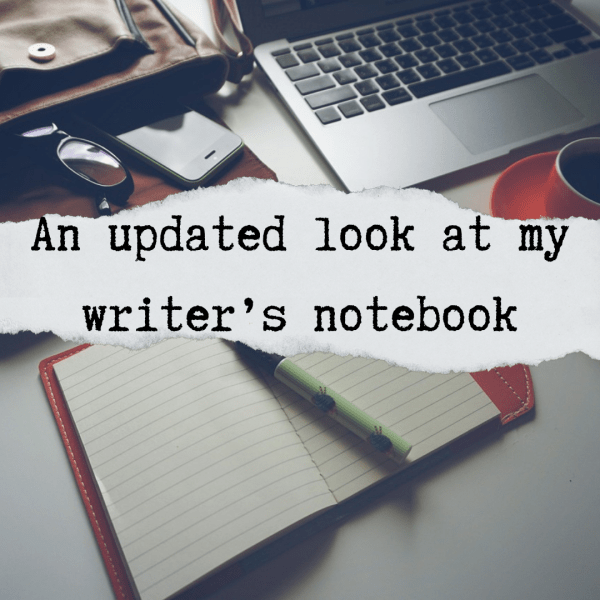
An updated look at my writer’s notebook

A writer’s notebook is the most important tool you can have. I will not be humoring arguments regarding this. Nothing is more essential. Nothing will make you a better writer than keeping a writer’s notebook. Not that special pen. Not the latest writing software. Not the craft book that everyone is talking about. The best way to become a better writer is by writing. And to that end, nothing is more important than a writer’s notebook.

I always consider this notebook to be like a visual artist’s sketchbook. It’s full of practices, studies, and first attempts. My friends who draw and paint usually have pages full of hands, feet, buildings, and plants. It becomes almost like a journal in both senses of the word. A memory-keeping journal and a practice journal. If you don’t have a writer’s notebook already, start one today. Don’t worry, I’m here to help you.

How to pick one

First, let’s talk about the physical thing. This is going to be a very personal decision, but here are some things to consider.

Price, unfortunately, must be considered. A simple spiral notebook can be had for less than a dollar at Walmart. A more sturdy composition notebook can be had for a few dollars. I used to write in a lot of those. And if you’re going to run through the pages quickly, an affordable option is essential.

For me, the quality of the book matters. I need my notebook to go everywhere with me. So it’s got to have a hard cover. I am personally offended by wide ruled pages, so my notebook has to have college rule. I usually end up with Moleskine knockoffs. And since I love stickers, there are usually quite a few on the cover.

This one cost me about seven dollars at Rite Aid.

Can you keep a writer’s notebook on your phone or pc? Sure, if that works for you. But I find that my notebook is best when I have it opened next to me. If that’s the note app on your phone for you, awesome. The best writer’s notebook is the one you use.

What to keep in it

Each writer’s notebook is going to be a little different. We are all our own brand of strange, of course. And what I consider essential might well be a waste of your time. But here’s a short collection of ideas to get you started.

Freewriting pages are a must for me. I need a place to just dump out my brain daily. And this is often when I get my best blog post ideas.

I’m forever struggling with character names. So when I hear a unique name, I write it down in my name bank. This saves me from rummaging through baby name websites for inspiration. (I end up getting diaper ads after that.)

Story ideas come at some of the most inopportune times. I wish I could stop whatever I’m doing and write, but that’s just not realistic. So when I get story and poetry ideas, I write them on a dedicated page of my writer’s notebook. Then, when I have the time, I have a list of story or poem ideas right at my fingertips.

Speaking of poetry, which I do a lot for someone who doesn’t publish poetry, I write poetry in my writer’s notebook. Haiku, rhyming poems, lyrical prose. I enjoy doing this, even though I don’t usually share it. Most of it lives in my notebook, as all it needed was to exist.

I also keep short story and chapter outlines. As well as little snippets of things I observe or think of during the day. Maybe someone said something funny or profound, or just really dumb, and I want to remember it.

Another thing I keep that I highly recommend is reading notes for whatever book I’m reading. Lines that stick out to me. Things I liked about the book. Things I hated about the book. Anything like that.

Finally, I do a lot of brainstorming in my writer’s notebook. Just figuring out what might happen in a story or blog post. Getting a feel for what the piece should look like.

How often should you use it

Here’s the real magic of a writer’s notebook. It’s not going to do shit for you if you’re not writing in it.

I would recommend writing in your writer’s notebook daily. Multiple times a day, if I’m being honest. I usually do freewriting in the morning, try to squeeze in a writing exercise in the afternoon, and capture whatever random thoughts come about during the day. The point is that every day, multiple times a day, I am putting pen to paper and building this writer’s notebook into something that can inspire me. Something that can make me a better writer.

So now it’s your turn. Do you keep a writer’s notebook? What do you keep in it? Let us know in the comments.

Paper Beats World is a labor of love. If you love what I do here, please consider liking and sharing this post and leaving a comment. You can also support me financially on Ko-fi.

Spooky season is coming, and it’s time for some creepy reads. Check out my horror novel Quiet Apocalypse, about a witch trapped in her apartment during a dark winter storm with a demon devoted to ending the world.

Or check out my horror short, The Man In The Woods. A man tries desperately to protect his granddaughter from the mysterious man in the woods. But his fear only grows when a new housing complex is built too close to the woods.

Discussing Long Quiet Highway

Published in 1993, Long Quiet Highway is the fifth book by Natalie Goldberg. Just in case you don’t know, she is the iconic writing teacher and author of Writing Down The Bones, among other amazing books about writing. This one, though, is not technically a book about writing. It’s a memoir. But, like all of her work, it sent me right to my notebook.

So today, let’s talk about Long Quiet Highway. How it’s different from her other books, and what I learned from it.

Long Quiet Highway starts with the story of Natalie as a child. Her parents were immigrants. She grew up in New York before they moved to the suburbs.

Natalie describes her childhood as being cloistered. Dull. To me, it feels cloying. Safe, fun, and full of little pleasures. Her parents clearly loved her and supported her. But there was little art in her life. There was little to wake her up, to make her feel alive.

This is used as an introduction to a teacher who woke her up. That encouraged her to listen to the rain. To experience it.

As an adult, Natalie taught high school. Or, maybe middle school. I’m honestly not sure which, and I don’t think it matters. While she was teaching the same bland curriculum she herself had learned, she felt lost and dull. Asleep. That’s when she decided to quit her job and join a Zen commune.

Because I guess that’s a thing you can do?!

For years, Natalie learned meditation and Zen from several teachers. Until she met one that changed her life, Katagiri Roshi.

He’s changed mine as well. But we’ll get to that.

The focus on the subject is solid

Through the book, it can feel like the story sort of rambles. One minute, Natalie’s talking about a train ride she took with a friend. The next she’s talking about learning Zen. Then we’re at a diner ordering a soda.

It’s only when we step back and look at the story as a whole that it makes sense. That we realize that every step was going in the right direction, we just couldn’t see the end of the path yet.

This was a fantastic way of memoir writing. Rather than going in strict chronological order, we skip around. It allows us to become completely immersed in the true subject of the story without even realizing it.

Even when she’s not talking about writing, she’s always talking about writing

I mentioned earlier that Long Quiet Highway is not a book about writing. It is about Natalie’s life. But here’s the thing. Natalie’s life is about writing. She writes passionately. She teaches writing. She exudes writing. This woman writes like the rest of us check social media. So when she talks about her life, she is talking about her writing.

In this way, much can be learned about the habit of writing from this book. Write when you’re happy. Write when you’re sad. Write when you don’t think you can possibly get yourself up off the ground. Fuck it, write from the ground, then. Write when you feel inspired and when you feel dull. Write when you’d much rather be eating chocolate.

Just keep your hand moving.

This is the best advice I’ve ever gotten about writing. Don’t worry about it being good, at least not at first. A lot of your first draft is going to be shit, no matter how many books you’ve written and how many you will write. Trust me, I speak from experience. I have published 12 books, and my rough drafts are still terrible. Hell, my second drafts are also bad. It’s only by the third draft that the story becomes anything I might consider letting someone else see.

And that’s okay. The purpose of a first draft is simply to exist. So if you’re still trying to complete your first piece, but you’re worried it isn’t good enough, it is. Just keep your hand moving.

Her work makes me want to live

I’ve mentioned before that reading Natalie Goldberg always makes me want to write more. More than that, it makes me want to live more. To do more things and to do them deeply.

Never before have I experienced a person who so deeply experiences every part of their life. She talks in such detail about going to get a croissant. Of riding the train.

Goldberg’s work makes me want to sit outside and feel the sun. To write about the rain, the people arguing in the parking lot outside of my window, and the cupcake I bought at a festival.

She also makes me want to travel. To go out and explore the world. To take a long trip alone or just a different route home.

The legacy of a teacher

Finally, I want to talk about how teachers can touch the lives of people they will never meet.

I am not a Buddhist. I am not a Zen student. I practice meditation, but more in a witchy way than a Zen way. And I certainly never met the famous teacher Katagiri Roshi.

And yet he has touched my life in a profound way. Because Natalie Goldberg was his student. And she wouldn’t have written Writing Down The Bones if it hadn’t been for his teachings.

Because of this, Goldberg was able to touch my life. I have learned so much from her work, and I continue to do so. Someday I want to actually work with her, attend one of her workshops. But for now, I have her words, and am one of the many students she’s inspired.

And Natalie is only one of Katagiri’s students. His kind, supportive teachings have touched countless lives.

I highly recommend reading Long Quiet Highway. As well as any of Natalie’s books. If you want to be a writer, or get into mediation, or just experience life more, this book will help you do that.

It will help you wake up.

Paper Beats World is a labor of love. If you love what I do here, please consider liking and sharing this post and leaving a comment. You can also support me financially on Ko-fi.

Spooky season is coming, and it’s time for some creepy reads. Check out my horror novel Quiet Apocalypse, about a witch trapped in her apartment during a dark winter storm with a demon devoted to ending the world.

Or check out my horror short, The Man In The Woods. A man tries desperately to protect his granddaughter from the mysterious man in the woods. But his fear only grows when a new housing complex is built too close to the woods.
A WordPress.com Website.

Up ↑