Storytelling with the Tarot Pt 1, The Fool to The Hierophant

If you know anything about tarot, then you already know it tells a story. It’s the tale of the Fool, traveling through a series of challenges and misadventures. As a writer and a witch, I love this. I love that we can find the Hero’s Journey in this spiritual tool. 

Using tarot to help you tell a story can be a fun exercise and a great way to fight writer’s block. So explain how each card of the major arcana can represent a plot point found in most stories. Of course, the major arcana is 22 cards long, and I’m shooting for this post to be under a thousand words. So this is probably going to be a mini-series. 

If you don’t know anything about tarot, you might pick up some info along the way. I am not in any way a tarot expert, though, just an enthusiast. And this isn’t a description of the card’s interpretation. Only an interpretation of how the card might apply to a story. 

As a final note, I’ll be referencing the Tarot of The Divine deck, by Yoshi Yoshitani. It’s a deck inspired by fairy tales and lore from different countries. It felt the most appropriate for this sort of thing. 

The Fool

The Fool represents our hero at the start of their journey. They are young, innocent, and dreaming of a better life. This is Ariel looking out at the castles of the people on land. It’s the heroes of countless fantasy stories, living in their sleepy villages and looking for adventure. I can almost hear Belle singing about wanting adventure in the great wide somewhere. 

The Magician

The Magician card is the part of the story when we learn something amazing about our main character. The thing that sets them apart from other people. 

This is Hagrid showing up to tell Harry he’s a wizard. It’s Luke finding out he’s a Jedi. It’s Luna coming to tell Usagi she’s Sailor Moon. It is, in short, the moment when our Fool finds out there’s something terrific about them. 

The High Priestess 

Now is when we start calling in the support team. 

The High Priestess is the learned elder. Think of Kit Snicket in Series of Unfortunate Events or Haymitch in Hunger Games. This is the character that’s in a perfect position to help our Fool because they’ve already walked to The World and back.

The Empress

Still rounding out the characters, the Empress is a character who acts maternally towards our Fool. It might be their mother, or legal guardian like Aunt May. But it’s someone who wants to look after and protect our Fool.

A thought on the Empress. I would also consider Mother Gothel to be an Empress personality in the life of Rapunzel in Tangled. She certainly has an interest in protecting Rapunzel, even if it’s for selfish reasons. 

I’m just saying, this doesn’t have to be a good character.

The Empress also doesn’t have to have anything to do with our next character. 

The Emperor 

Maybe this is a father figure. Maybe it’s a king or a leader. It doesn’t have to be a man. One great example is Melinda May from Agents of S.H.I.L.D. This is generally a ‘my way or the highway’ kind of character. Which is often why our Fool is butting heads with them. Again, this can be a good or a bad character. A father’s protection can be a blessing. A father’s watchful and judgemental eye can be a curse.

The Hierophant

The Hierophant has a lot of different meanings. It can mean a religious leader or a message from God/Gods. I consider this the inciting incident card. Or the call to action card. Someone or something has called to our Fool. Maybe their hometown was destroyed. Maybe their dog was killed. Maybe they’re destined to kill a dark wizard and someone’s just come and told them like an idiot.

Whatever it is, the journey is serious now. There are implications of real-world consequences for more than just our Fool. 

We’ve gone through the first six cards of the tarot and gotten to the real start of our story, so I think we’ll leave off here for now. But I’d love to hear what you think. Am I interpreting a card wrong? Let us know in the comments. 

Paper Beats World is a labor of love. If you’d like to support this site, you can do so on Patreon.

Get it now on Smashwords for free.
Alternative Memory Keeping

Paper Beats World is a labor of love. If you’d like to support us, you can do so on Ko-fi.

My birthday was this past Wednesday. Like most people, I spent a little time around the day, when I wasn’t enjoying extra coffee and the best brownie ever, reflecting on the past year of my life. And it’s been an interesting one. Some ups and downs, both personally and professionally. I’ve grown some and learned a lot. There have been better years of my life, for sure. But by God, there have been far worse. 

I enjoy having the ability to look back on the past year. Memory keeping isn’t a huge part of my life, but it’s still important. 

Here’s the thing, though. I don’t keep a journal. Frankly, on top of all the other writing I do in a day, it’s too much. And while I take pictures, I don’t often get them printed. I don’t scrapbook, though I do like it in theory. 

Record keeping is something that takes time. And time is something most of us just don’t have a lot of. It’s often something we do for holidays, birthdays, and vacations, but not so much on an everyday basis. I mean, who’s got that kind of time, right?

But the regular days hold so much joy. It’s on average Tuesdays when we find a new book series that will become our whole personality for the next three months. It’s a common Thursday when the dog finds the bag of flour and makes himself the cutest ghost ever. The creative breakthrough, the new coffee shop, the cozy rainy afternoons, the really good talk with your partner. These are things that I want to remember just as much as what we did for my birthday. 

So today, I want to share with you four things I do to collect memories daily. They aren’t large things, they don’t take up a lot of time. But they create a net that traps the everyday memories that I treasure looking back on.

Bullet journaling

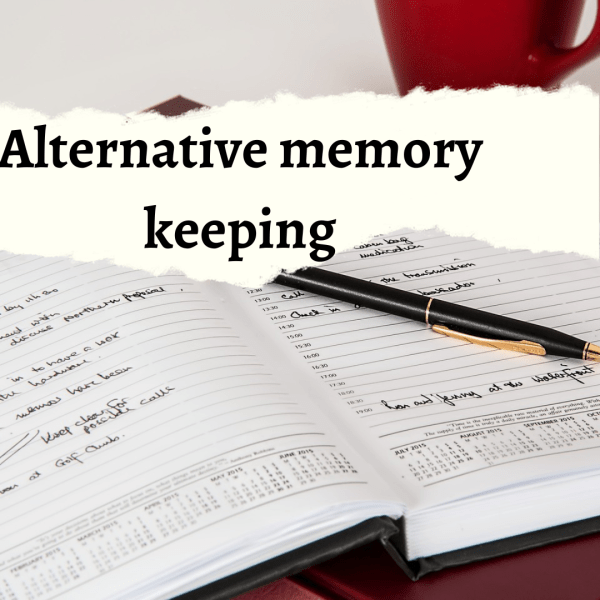
Most of you know that I keep a bullet journal. Mostly this is to keep myself organized and my plants alive. But it also catches memories. I have a page every month dedicated to recording the best memories. Here I’ll track big events, of course, but also little things. When I discovered the musical Six. When the power went out in our little city. 

Even my everyday to-do list in my bullet journal tracks some memories. Looking back I can see exactly how long I struggled with a short story. When I went through a big cleaning phase and cleared out a ton of house tasks. When I had to run every errand known to man in a single day. These are fun things to look back in, even if they weren’t fun at the time. 

Notes on a perpetual calendar

If you follow me on Instagram, you might have seen my Peanuts perpetual desk calendar. Because it’s one that I can use year after year, I decided to use it as a mini memory keeper.

On November 15th of 2022, I started writing one sentence about my day on the calendar page. This might be something like, we finished Reboot today. Or, I went to visit my grandma today. 

As the days and years go by, I’ll be building on these little notes. So this becomes more and more precious as time goes by. 

Instagram

I post something on Instagram most days. Often it’s pictures of things that made me smile that day. A new plant, a nice sunset, or the cute way Harper curled up next to my book.

Yes, I also post info about my books and blog posts. But even that’s kind of a fun look back. I spent some time on my birthday just looking back at what I’ve posted in the last year. Between this year’s picture of my birthday coffee and last year’s. And I was awash with memories. What I was reading. What I was passionate about. When my one air plant sprouted flowers without warning. A hundred little mini-adventures, snapping silly pictures of dogwood blossoms while running errands. 

Now look, I don’t suggest sharing your whole life on social media. And I caution you to remember that Instagram in particular is a highlight reel. But if you do use social media, consider using it in such a way that you’re reminded of good moments when you look back over your account. 

Gratitude logs

Finally, this is a practice I’ve used for almost a decade. Every morning I write at least three things I’m thankful for from the day before in my planner. 

First off, this is just a good way to start the day. Even if the day before was a hard one, I can at least think of three things I was thankful for. I made a really good cup of coffee. I slept well. I took a shower with a shower bomb and it was nice.

This also has a built-in memory-keeping factor. I keep all of my old planners, of course. And I can look back to any day and be reminded of at least three good things that happened. 

And on hard days, I can look back on other hard times. I can see that even at my lowest, I still had things to be thankful for. Hard not to feel good about that. 

What about you? What’s your favorite memory-keeping habit? Let us know in the comments. 

Get Seeming free here on Smashwords

Coming out

The first bisexual character I remember seeing on tv was The Todd on Scrubs. For those of you who never saw the show, imagine if Pepe Le Pew was a surgeon. During one episode some of the female doctors suggest to him that he might be gay, and use his abusive actions towards women as a way to mask this. 

Maybe they should have contacted HR, but that’s another story. 

At any rate, by the end of the episode, he realizes that he’s simply so horny that he’s attracted to everyone. There’s a scene that’s stuck in my brain to this day, of Todd walking down the hall, checking out the ass of everyone he walks past. Someone asked him, in disgust, “What are you?” 

He responds, “I’m The Todd.”

This introduction to the theory of bisexuality probably isn’t why it took me 35 years to figure myself out. But it sure as hell didn’t help.

I’m turning 37 years old next week. And I am just now coming out as bisexual. 

I am not being brave doing this. I am incredibly privileged in many ways. I am surrounded by friends who are wonderful, accepting people. Many of whom are part of the LGBTQ+ community. I’m married to a man, so I pass for straight unless I tell someone I’m bi. While I don’t belong to an organized church, I’m a Unitarian. My day job is wonderfully supportive. And I don’t talk to most of my family anyway, so it’s not like I’m alienating any of them. 

That’s part of why I waited so long to come out. For a very long time, it felt like some people were claiming to be bisexual because it was trendy. And maybe some people did that.

It’s not trendy to be LGBTQ+. You are or you’re not. But for a brief, shining couple of years, it was considered cool. And people got a lot of attention for coming out. That’s great, I loved that. 

I didn’t come out then. Because I didn’t want anyone to accuse me of lying. Of stealing attention from real members of the community. Because that’s what it felt like for me like I wasn’t really a member of this community. Like I wasn’t welcome. Because Cupid spun my wheel and landed on a man, a wonderful man, I did not feel welcome in this community.

It never stopped me from being an ally. It never stopped me from supporting LGBTQ+ rights. It just left me very confused about some relationships I’ve had in the past, that I would have sworn were just friendships. 

Friendships with a beautiful girl with thick brown hair and the brightest smile I have ever seen. Who I still miss every day. Who still has a little part of my heart. 

All that aside, I didn’t come out. It took me until last year to figure out that yes, I was bisexual and yes, maybe I should let people know that. Because as much of a party as Pride should be, it sure doesn’t feel like a party right now.

Because the ’20s are feeling more and more like the 1920s, and our society is going backward. Pride is taking on a whole new meaning for me this year, which is why I’m coming out now.

Pride, like a lion’s pride.

I have more to say on that in a moment. 

First, though, I want to talk about coming out in your late thirties. I guess coming out any time is weird. Coming out when you’re a full-blown adult has its series of issues. For me, it feels like having a project half done and just now realizing there was a second half of my toolbox I’d never even opened.

It also feels like looking back at that first half of the project and seeing a pattern I wasn’t trying to make come out clear as day. 

It’s taken me over a year, and some deep talks with my therapist, to come to terms with this. That I can’t go back and make different decisions, and I don’t know if I would if I could. I am married to a wonderful human being who is my partner in every sense of the word. The fact that he’s got boy parts isn’t a part of the equation. And that’s something beautiful to realize all by itself. To really and truly love the soul of a person, independent of the body, is a treasure.

Which brings me to my next point. Maybe we should just stop holding people to social expectations based on their private parts. Maybe it’s time we stop expecting men to act one way and women to act another way, even cisgender people. Maybe our strengths, weaknesses, and interests don’t have a damn thing to do with gender or sexuality. Maybe makeup is for anyone who wants to wear it, sports are for everyone who enjoys them, and I don’t need a goddamned pink jersey to support the Steelers. Maybe, and stick with me on this one, we should stop judging people before we get to know them as individuals.

Now, I need to talk about transgender people. Because frankly, we all need to be talking about transgender people. Because they need our help. Especially the kids.

Transgender teens and adults are at risk every single day in America, not just during June. They’re at a higher risk for suicide. They’re at risk of being attacked, abandoned by their families, and fired from their jobs. And we can’t let this happen. We have to stand up and support the trans community. We have to rally around them, like a Pride, and defend them. And, here are some ways we can all do that. It doesn’t matter if you’re trans, if you know someone who’s trans or if you’re a member of the LGBTQ+ community, or if you’re an ally. Trans people need our help right now. And here’s what we can do.

Contact your local representatives on every level and ask them what they’re doing to support trans rights. Especially if you’re in a state that is actively making it illegal to be transgender. (Looking at you, Florida.) 

If it’s safe for you to do so, attend protests and rallies in support of transgender people. Attend a drag show if you can and are comfortable doing so. 

Support trans creators, especially if they’re from one of the states cracking down on them. If you, like me, are super broke, support them by sharing their content and kind words. 

Support LGBTQ+ charities, like The Trevor Project.

And remember this. Lots of companies are going to put out rainbow-colored content this month. And that’s fun. But they don’t get credit for that if they’re supporting Republican politicians and lawmakers. They don’t get credit for that if they’re not supporting their workers. And they sure as hell don’t get credit for that if they take all their rainbows down on July first and don’t say another goddamned word about LGBT+ support until next June. 

What writers can learn from The Far Side

Welcome to the final in our collection of writing lessons from cartoonists. At least for now. I might well realize suddenly that Baby Blues taught me a lot and do another in this series. Or, perhaps you out there will have a suggestion I never even thought of.

But for today, we’re ending on a high note with The Far Side.

Written by Gary Larson, The Far Side comic strip ran from 1980 to 1995. Even though the strip technically ended, The Far Side still has fans all over the world. A wide variety of fans, too. Kids love it, of course. But scientists love it. Almost any scientific discipline has a Far Side comic they can claim as their own.

I personally love Far Side. Like Calvin and Hobbs, it’s another strip I was introduced to from my grandmother’s bookshelf. Here are the lessons I’ve learned from it. 

Your style doesn’t have to be everyone else’s.

When you look at a Far Side strip, you’ll notice that not a single character is cute. Or aesthetically appealing. Everyone is fat, everyone has hairs sticking out of weird places. Even if it’s someone who shouldn’t have hair, like a fish. Everyone in the Far Side world is, well, kind of ugly. And it’s kind of the only strip that is ugly the whole way through. Most strips will at least have a cute cat, a pretty girl, or a guy with a rugged chin.

But that’s just not Gary Larson’s style. In the Far Side world, that’s what things look like. And it works out pretty great for him. 

For starters, it’s recognizable. You see a Far Side strip from across the room, you know what it is. Among a flood of comics that can sometimes look very much the same, you can point Far Side out.

More importantly, though, it’s Gary Larson’s style of writing. He didn’t try to mimic anyone else. He didn’t compare his dogs to Snoopy and lament that they didn’t look as good. He just drew in his style. And that’s great. 

Now, I’m not saying you shouldn’t try to improve your art and get better. But maybe the best way to do that isn’t by trying to write like someone else. Maybe it’s by finding your style or voice and making it as good as it can be.

Write above people’s heads and they’ll reach for it

I bet you’ve read a Far Side strip that you didn’t get. I know I have. Hell, there’s even a joke about that in an episode of The Simpsons. The reason for this is simple. Larson frequently talks about scientific theories and facts that I don’t know or understand.

Here’s the cool thing, though. I’ve been reading Far Side since I was a little kid. Growing up, I’d go back to the collections on my grandmother’s bookshelves over and over again. And every time I read them, I got more of the jokes. I am not the only person who’s described this very thing.

And isn’t that cool? Isn’t it a great feeling to look at something and realize you understand it now? It’s a mental version of a mark on the wall to see how much you’ve grown since your last birthday. 

Don’t try to dumb yourself down. Talk about the topics that you want to talk about. If it’s not for some people, that’s fine. The people that it’s for will find it. 

Never stop having fun

Every strip of Far Side has one thing in common. They feel like the creator laughed when he came up with them. Larson is a fan of his own work.

And that’s awesome! You’ve got to be a fan of your work. You’ve got to have fun when you’re writing, at least when you’re coming up with an idea. (Not all the writing is going to be fun. I say this as someone about to start the fourth draft of her latest book. Not all the writing is fun.)

But you should be having fun with your art. It should be feeding your soul. Otherwise, why do it at all? Why not go get a real job? There’s lots more money to be made elsewhere. 

Being a likable person goes a long way

I have heard a lot of things about Garly Larson. He’s met some amazing people, like Jane Goodall and Robin Williams. What I’ve never heard from anyone is an unkind word about the man. Because Gary Larson is a likable guy. He’s not a pushover, as several legal issues will attest to. But he’s a good guy. 

Being a decent person, and treating other people well will get you places in this world, even when it doesn’t always feel like it will. Especially in the writing field, acting like a professional and a decent human being is a good idea. It might not open doors for you, but it will sure as hell not shut them like being an unprofessional dick will. 

Notice here that I’m not saying to be a pushover. I’m also not saying to not call out people who are being abusive or toxic. But there are ways to do that in a classy manner and ways to do that that will make people not want to work with you.

So be like Gary Larson. Stand up for yourself, but be professional about it. And be kind to people. It does more for you than you think.

I would love to know what your favorite Gary Larson comic strip is. Let us know in the comments. 

Paper Beats World is a labor of love. If you love what we do, please consider supporting us on Ko-fi. 

What writers can learn from Garfield

Yes, that’s right. We’ve talked about Calvin and Hobbs. We’ve talked about Peanuts. We’ve talked about Cathy. Now, I’m back from Nebula Con, and I’m fighting allergies for every breath that goes in or out of my body. So I’m pissy and ready to talk about Garfield. 

 A cautionary tale for writers if there ever was one. 

Unlike the other comic strips in this series, Garfield is a lesson in what not to do. As in, what not to do with a franchise that is smart, edgy, and popular.

Launching in 1976, then titled Jon (The name didn’t change to Garfield until the strip was syndicated in 1978) the Garfield comic strip is probably as well known as Mickey Mouse.

In the beginning, it was way darker than most people realize. Jon once had a roommate named Lyman. He was Odie’s original person, and he vanished without a trace. He’ll make the occasional appearance, but for the most part, he’s not around. When questioned, Jim Davis would for the longest time say that no one should look in Jon’s basement. 

Man, I loved that. I also loved the series of comics that seemed to suggest that Garfield was left alone at home, without food or family, to starve to death. There’s a fan theory that nothing after that strip is real, it’s just a fever dream of Garfield’s to comfort him as his life ends, lonely and starving. 

Lots of people have dark fan theories about Garfield. And they’re fun. At least to a twisted person like me. 

The strip itself used to be fun. You had Jon, a successful cartoonist who isn’t successful at anything else. He strikes out constantly with Dr. Liz. He has no friends, except Lyman. His pets don’t respect him, and his neighbors hate him.

That’s funny. 

Then, there’s Garfield. He’s smart-mouthed, violent, and self-indulgent. He eats too much and doesn’t work out enough. He hates Mondays (even though he doesn’t work) and loves lasagna, his bear Pookie and his grandma. (Jon’s Grandma, who is exactly who I want to grow up to be.)

Add Odie into the mix as the idiot with all the luck, and it’s a cute mix. 

Then, things got stagnant. The stories came to a standstill. Then, like everything else that stops moving, it started to rot. 

Now, to my dismay, Garfield is a joke. It’s a strip that tells the same five jokes over and over. It’s a cartoon that has the laziest artwork I’ve ever seen. It’s a cringe-inducing movie. It is, in short, a disappointment.

So today, let’s discuss how we can learn from this. How can we avoid being Garfield? 

Don’t stop growing

Some of you reading this are going to be stars. It’s just a numbers game. Someone reading this is going to make it big. You’re going to be a household name, a Stephen King or a Toni Morrison. 

Many of you reading this will achieve at least some success so long as you keep writing and keep submitting. Again, it’s just a numbers game. To succeed in writing you need talent, persistence, and luck. And talent means the least of those three.

When you succeed, do not stop growing. Do not stop learning and becoming a better writer. 

That’s what, I think, happened to Jim Davis. He had success. Like, a lot of it. His characters are well-known and loved all over the planet. 

So he stopped getting better. 

Do you know who hasn’t stopped getting better? Stephen King. I know, me praising the King? Big surprise. But it’s true. His books keep on getting better. The Outsider was better than anything he’d written to that point. Then he wrote If It Bleeds, and that was even better still.

I would like to think that the same can be said of my work. I think Quiet Apocalypse is the best book I’ve ever written. I think the book I’m working on right now is even better. (It damn well better be. It’s the last Station 86 book. It had better blow your minds.) 

That’s how art should be. Every story should build on the talent and strength of the last one. The dialog can always get better. The story can be more creative. The characters can feel more real. You are probably already a pretty good writer, my friend. But don’t ever stop getting better.

Don’t give up your edge

Garfield is at its best when it’s a little edgy. When it’s a little dark. When Garfield is trying to send Nermal to Abu Dhabi without air holes in the box. When he’s smoking a pipe. When he’s shredding the neighbor’s dog within an inch of his life.

Garfield is at his best when he’s at his worst. When he is the hedonistic, unmotivated rage ball that we all kind of want to be at times. And because he is that so much of the time, it’s all the more endearing when he is kind. When he lets slip how much he cares about Odie. When he’s cuddly with Pooky or sensitive with Arlene. He is in that way a mini version of an anti-hero. We love Loki and Magnito for the same basic reasons. They do horrible things we would never think to do but might secretly want to. At the same time, they have kindness in them that only a precious few ever see.

That doesn’t work when the balance gets tipped. When the bad sides of a character are blunted. 

If you want to write a compelling anti-hero, let them be sharp. Let them do terrible things for their warped reasons. Let them do the things that you would never do, but secretly want to. Like, I would never stab a guy at a bar for touching me without my consent. But it feels so good when a character does it. I would never eat a whole lasagna, kick someone I don’t like over a fence, or cause an uprising in a vet’s waiting room. But I kind of want to.

And Garfield stopped doing those things. Maybe it’s because he was expected to be a good example for children. Or maybe it’s just because Jim Davis got soft. Either way, the strip doesn’t really without it. 

Don’t say yes to everyone who wants to play in your sandbox

Finally let’s talk about Garfield, the movie. Released in 2004 and almost universally despised, this could have been good. It wasn’t, but it could have been. 

If it wasn’t so cheap.

If it wasn’t so lazy.

If the characters didn’t suck and have little to nothing to do with the originals.

Here’s the thing. The Garfield movie was not done by people who loved the source material. It was written by people who wanted to make some quick money off a popular name. And it worked, sadly. 

This wouldn’t have happened if Jim Davis had been protective over his intellectual property. And it shouldn’t have happened. 

I’m all for shared worlds. Star Wars has been such an astounding success because so many diverse authors have been permitted to write in it. But not everyone who wants to write with you wants to do so with good intentions. Some people do not care about your characters in the same way you do. Some don’t care at all, except for what they can get out of it.

Remember, your story belongs to you. Your characters belong to you until you agree to let someone else play with them.

You always have the right to say no.

So that’s it. I hope you’ve been enjoying this series. If there’s a cartoonist I’ve missed, please let me know in the comments. 

Paper Beats World is a labor of love. Please consider supporting us on Ko-fi. 

The Man In The Woods is available now on Amazon.

What writers can learn from Cathy

Paper Beats World is a labor of love. If you love what we do here, please consider supporting us on Ko-fi. 

The comic strip Cathy has gotten a lot of shit over the years. It’s seen as kind of sexist. Written by Cathy Guisewite and running from 1976 to 2010, it’s a strip that follows a ‘modern’ woman struggling to balance her career and social life. And yes, there are some arguments to be made there. Cathy is obsessed with shoes, chocolate, makeup, and home decor. She is annoyed by her long-term partner’s obsession with sports. She lavishes attention on her dog, Electra.

So, why am I, a modern feminist, talking about Cathy? 

Well, for one thing, Cathy was a modern feminist in her time. By that I mean both the character and the creator. For another thing, I don’t think that there’s anything wrong with liking shoes, chocolate, and putting effort into your appearance. I like all of those things. Lots of men also like those things. I also like the Penguins, the Steelers, Star Trek, dragons, and things that drip blood in the night. And for a third thing, the comic strip never said that all women like those things. Cathy likes those things. Cathy has an unhealthy relationship with food. Cathy spends too much on clothes and shoes. Cathy has a difficult relationship with her mother. And again, I’m talking about the creator and the character here. 

So yes, we’re going to talk about what writers can learn from the comic strip Cathy. Rather than disregard it as a ‘fluffy’ or ‘girly’ comic. I want to do this because women’s interests are often treated as silly and frivolous as a way to condemn female-leaning people as also being those things and I’m sick of that. I also want to do this because the strip is, ack, good. And yes, there’s plenty that writers can learn from Cathy.

Write realistic romances

Cathy has a long-term partner in the strip named Irving. They dated, broke up, and got back together more times than Ross and Rachel.

Unlike Ross and Rachel, they had a realistic relationship. Cathy was kind of a mess, and so was Irving. He was never a knight in shining armor. Never drop-dead gorgeous. They didn’t have a meet-cute. They had a million reasons for everything not to work out.

They did work out because they made it work. Because they put in the work with each other. They put in the work on themselves. Sometimes they were both childish, selfish, and stupid. They grew up together.

Just in case you’ve never been in a real relationship, that’s how they look. Real relationships are built on mutual respect and care. Cathy tries her damndest to get into golf so they have something to do together. Irving goes shopping with her. The two of them struggle with each other’s families. They bond with each other’s dogs. They sit down and talk about money, even though it ends in a fight. They go from two rabidly independent, career-oriented individuals to being a family. That’s not something you’ll find in a Hallmark movie. But it’s honest.

Write realistic families and friends

Cathy has a difficult relationship with her mom. An even worse one with her mother-in-law. She is her daddy’s girl. She has friends who push all her buttons, but she still loves like sisters. She has a boss who’s kind of an idiot, but a well-meaning one. She has relationships that make sense.

One thing in particular that I like is that the other characters make sense in their little world. They are not only side characters in Cathy’s life. They are the main characters in their mind. Which is something I am still learning the trick of myself.

As a side note here, Cathy doesn’t have a relatable life, aside from her relationships. I will point out here that Cathy is a Boomer. She was a young, independent career woman in a time when a single person working a full-time job could buy a house and still have money for things like food, expensive shoes, and really good chocolate. Yes, she is incredibly entitled. I think it’s important that we accept this, and keep it in mind as we keep talking.

Start where you are, and get better. But start!

Looking back at the start of Cathy, way back in 1976, you might be a bit surprised. The artwork is not great. It’s pretty damn bad. If by some chance this blog post ends up in front of the eyes of Cathy Guisewite, I’m sorry. But girl, you know it’s true. The artwork and storytelling in Cathy were kind of shitty.

But by God, it was there. It was published and went out into the world. And it got better. Over the years, the comic strip got so much better.

Some people might say Guisewite should have worked at her art harder before she published. It might have killed her career to put out a subpar product.

Let me be as clear about this as I can be. Thinking like this will lead your creative career into a never-ending holding pattern. Because you will never, ever think your work is good enough. 

We learn best by doing. I certainly did, and so did Cathy. When I started this blog I didn’t have any idea how to add graphics. I’d never published a book hadn’t published anything except for some poems in high school. I started this blog to provide some structure and a reason to build a writing practice.

Lines improved. Color and detail improved. Stories, characters, descriptions. All of these things got better as Cathy grew as a creator. The same can be said of me. 

And the same can be said of you if you can give yourself that opportunity to grow. 

Write honestly about who you are, and people will find that relatable. 

Cathy is not relatable because all women love shoes and chocolate. Cathy is relatable because she’s written by a real person about her reality. And that is what makes her relatable. 

Of course, we’re not all writing semi-autobiographical comic strips. I write about ghosts, dragons, and spaceships. But into each one, I place a part of myself. It’s not on purpose, it happens. I write about my experiences, and in doing so breathe a part of myself into my characters. I hope that people can relate to that. And if I come off as a bit of a cliche, I guess that’s alright. I am a broke, bisexual Millennial with a side hustle, trying to fulfill a creative dream while not starving I treat my dog and cat like children. I suffer from depression and a coffee addiction. And yes, ack, I like chocolate and shoes. I am none of these things because they’re trendy or popular. I am those things because, well because I am. Cathy was all of the things that she was because she was.

Write from who you are. You’ll be amazed how many people can relate to that. 

As an aside, there will not be a post next week. I’m attending Nebula Con, and taking a long-needed staycation with my family. I’ll see you back here on May 19th.

Get Man in The Woods now on Amazon

Man in The Woods launches today

Hey everyone! I just wanted to pop in during a very busy week and let you know that my lovely dark short story, Man in The Woods, is available now on Amazon. If you’re in the mood for a story about an old man trying to protect his granddaughter from a horrific entity that haunts the woods behind their home, then it’s your lucky day.

Click here to get it right now on Amazon!

Don’t ignore people who have lived in a land for generations when they tell you something is wrong. They know the land, and they know the dangers that live there. They know where the poison ivy grows and can’t be cut back fast enough. They know where the old wells are. The ones with the rotting covers. And they know about the dark, creeping things that share the land with them.

I hope that you love Man in The Woods. And if you do, leave a review on Amazon, Goodreads, Bookstagram, really anywhere. You have no idea how much that helps. And thank you all, so much, for all of your support.

What writers can learn from Calvin and Hobbs

Last week we talked about Peanuts, the comic strip about Good Man Charlie Brown by good man Charles Schultz. Today, I’m going to change directions entirely and talk about my favorite comic strip from childhood, Calvin and Hobbs. 

Written by Bill Watterson, Calvin and Hobbs ran from November 18th, 1985 to December 31, 1995. While a decade of work with one character on one project might not seem like a lot, let me put this in perspective for you. Garfield, who we’ll be discussing later in this series, has been running from June 19, 1978, until today. Foxtrot started on April 10th, 1988, and is still published on Sundays. So ten years is honestly quite a short career.

And in that short career, Watterson taught me a lot about being a creative. I owe him a great debt of thanks for that. Not only for the lessons but for many peaceful and joyous hours when I was a little person. 

That being said, not everything I’m going to say is kind. But here are six things I learned from Calvin and Hobbs, and the writings of Bill Watterson. 

Don’t write down to your audience

People have mentioned that I have a wide vocabulary. Not in a positive way, but that’s another story for another time. While some might assume I got this from reading difficult books early in life, the truth is that I learned lots of big words from Calvin and Hobbs. Because there are a lot of big words in there. Lots of big ideas, too.

And I got them. I learned how to look up words I didn’t understand, which is the number one way to increase your vocabulary. I learned that I could teach myself, in other words. Which is incredibly important for kids to learn.

See, here’s the crazy thing that happens when you assume most of your readers are at least as smart, if not smarter than you. You turn out to be right. And when you assume kids can learn things, they rise to the occasion. 

Great art can exist within ‘pulp’ creations

As Calvin and Hobbs went on, the art style changed. Sometimes it was simple, a boy and his tiger bashing around the house and woods, flying through fields and landing, more often than not, in the lake. But the artwork, especially in Calvin’s fantasies, got better. It was deeper, more expressive. More like a painting than what you’d expect in a kid’s comic strip. 

Watterson also started writing poetry. Some of it was for Calvin and Hobbs. Some of it was just good poetry.

As someone who writes genre fiction, it’s easy to feel looked down upon. Genre fiction, much like comic strips, is often not seen as real art until at least ninety years after the creator is dead. 

But that’s frankly bullshit. Art is subjective, but it’s not tied to any specific medium. So if graffiti artists can create works of art, if a cartoon about a little boy with an overactive imagination can include some of the best paintings and expressions of visual art I’ve ever seen, then a genre fiction story can have literary merit. Don’t limit yourself, or your work. 

Put what you love into your work

Bill Watterson likes to learn about weird stuff. If you read Calvin and Hobbs from the first strip to the last, which I have done multiple times, you’ll see Calvin’s knowledge and understanding of dinosaurs grow. That’s because Watterson’s understanding of dinosaurs grows. This is not the only thing that fascinated Watterson, and Calvin by extension. They both love detective noir, outer space, and nature. Calvin brings up politics and money from the perspective of a very bright six-year-old, which is a perspective I think a lot of adults fail to reach.

Write about what you love, and what you know. Write about the things that bother you. In my speculative fiction, I’ve written about witchcraft, depression, fearing that I’ll die alone. I’ve written about coal mining, bad landlords, and small-town living. My characters have dogs because I like dogs. Things that interest me work their way into my writing, whether I mean them to or not. So, why not lean into it? Why not have some fun with our art?

Don’t sweat details you don’t need

Throughout the whole run of Calvin and Hobbs, Calvin’s parents are never given names. We don’t know Susie’s parents, we never even see them. And of their entire class, we only ever know one other classmate’s name.

We don’t know these things because they are not important to Calvin or the way he experiences the world. He probably does know his parents’ names, but that’s not who they are to him. They are Mom and Dad. To Hobbs, they are Calvin’s Mom and Dad.

We do know that Calvin’s dad is a patent lawyer, though. It doesn’t come up a lot, but you can see how that might play into how Calvin sees his dad. Dad is a square who likes plain oatmeal and has a boring job as a patent lawyer. That’s all we need to know.

Sometimes we as writers put way too much detail into our work. Like, way more detail than we need. 

Listen, if it doesn’t have any impact on the story, we don’t need to know every little detail about the world you’re writing. We don’t need to know about the character’s family members that don’t impact the story. Hell, I usually don’t even mention what eye color my characters have unless it has something to do with the plot. Will it help you enjoy Quiet Apocalypse anymore if you know she has brown eyes? No, it doesn’t matter at all. So I didn’t include it.

If you’re in the process of editing something right now, let me give you a bit of advice. Go through your draft with a red pen and see how many details you can remove without impacting the story or the pleasure of reading. I bet you take out quite a lot. 

Protect what is yours

I’m sure you’ve noticed that there isn’t any Calvin and Hobbs merchandise. This isn’t because of a lack of demand. It’s because Watterson decided early on that he never wanted any toys, lunchboxes, cartoon spinoffs, or cereals tied to Calvin and Hobbs. There were lots of emotions regarding this decision. Lots of people stood to make a ton of money from merchandise. Lots of money from me, frankly. Do you know what I would spend on a Calvin and Hobbs lunchbox? Bill, if you are hurting for money you could still license that and make bank off silly nostalgic women like me. (Nostalgic being one of the words I first learned from a Calvin and Hobbs strip.)

But he never wanted that. He wanted Calving and Hobbs to be about just the comic. And I think that’s beautiful.

By the way, any of those awful decals you’ll see of Calvin peeing on various things are not licensed, and in fact, violate copyright law. So in addition to being tasteless and tacky, they’re also illegal.

It was a hell of a battle to keep Calvin from being plushy, or these days a squishmallow. But it was a battle that Watterson won. And despite my desire for a lunchbox with Calvin and Hobbs sitting in a tree on a fall day, I’m glad he won that fight. It sets a precedence for creatives like us, who might like our work to be about the work itself, and not have our characters slapped on anything that doesn’t move fast enough.

Leave when you know your project is done

I don’t feel that there’s enough Calvin and Hobbs. This is a world I could live in forever. 

That being said, there are a lot of comics I thought I could say that, and eventually, it all gets a little dull. 

Calvin and Hobbs ended while the characters were still fresh. When there was still passion in the story. 

When there was still passion in Watterson for these characters. 

There are a lot of reasons to end a story. Maybe it comes to its eventual conclusion. Maybe you as the creator lost your passion for it. Maybe the project didn’t take off with fans like you wanted it to. Maybe there are just lots of other things you want to spend your time working on. 

Whatever it is, you as the creator get to decide when it’s time to walk away. When it’s time to bring your characters to their happy (or not) ever after.

So that’s it. Sorry this post was a little late, but it was also a little long. Now, I’d love to hear what you think. Have you read Calvin and Hobbs? Let us know in the comments. 

Click here to preorder Man in The Woods today!

What writers can learn from Peanuts

Writers love Snoopy at the typewriter. At least, I love him. Like, a lot. I love his terrible stories that all start the same way, it was a dark and stormy night. I love his rejection letters that threaten violence. I love the everlasting optimism that drives him to write another story, send another submission, and even enlist Lucy as his beta reader. While his writing might be terrible, his ability to get up and dust himself off is an inspiration to all of us drowning in the slush pile. 

But that’s not all the inspiration that Peanuts has for us. Unlike his beloved creation, Charles Schultz was a terrific writer. Charlie Brown, Snoopy, and the gang have been a constant source of joy and inspiration for decades. Today, I wanted to share with you the five most important lessons I’ve learned as a writer from them.

It’s okay to lose

Charlie Brown never has a winning baseball season. Lucy never gets Schroder to like her. Linus never gets to see the great pumpkin and Snoopy always gets rejection letters. Even Peppermint Patty, who always wins on the football field loses in the classroom. 

But that’s okay. They all lose, over and over, and they’re fine. They get through, they get by. And they’re pretty happy most of the time.

Look, we’re going to lose from time to time. I know I do. I’ve had failed launches. My football and hockey team didn’t make it to the playoffs this past season. I’ve bottomed out my emergency fund more times than I care to talk about. Life is far from perfect. And that’s okay. Life is still good, even when we lose.

Don’t shy away from what you believe in

My favorite Peanuts character is Linus. He knows himself. He knows what he needs, what he believes in, and who he is. 

Linus is a Theologian who carries around a blue blanket for support and believes wholeheartedly in God and The Great Pumpkin. And he doesn’t care if anyone else believes. He also doesn’t care if anyone thinks he’s foolish, or childish for doing what’s best for him.

Linus is my role model. I want to be brave enough to tell people exactly who I am and what I believe in. And in fairness, I usually am. Most people reading this will already know that I’m a witch and also a Christian. It’s weird, but it works for me. 

I also aspire to be unapologetically me. To carry my version of a blue blanket for comfort as I face a world that is sorely lacking in peace. To insist upon my cup of stars. 

What’s your blue blanket? Let us know in the comments. Mine is a specific red lipstick and my favorite crystal necklace with a St. De Sales medal attached to it. 

Plan for the rain

One of my favorite Charlie Brown quotes is this. He said the secret to happiness is to own a convertible and a lake. If the sun is shining, you can ride around in your convertible and enjoy it. If it’s raining, you can be comforted by the knowledge that all that rain is good for your lake. 

It’s gonna rain in your life. Bad things are going to happen. Life’s gonna be a lot easier if you accept that. Especially in your writing life. Maybe your publishing company will go under. Maybe your computer will crash and take your document with it. (Cloud backups, people!) Maybe your loved one will get sick while you’re trying to launch your book. Your career and your life is going to be a lot brighter if you accept right now that things aren’t always going to go to plan, and it’s not even a little bit your fault. 

It’s okay. Enjoy your convertible, and know that the rain is good for your lake. 

Know when to fight for yourself and your creations

This one’s a bit of a cautionary tale. Charles Schultz, much like his beloved Charlie Brown, was a little bit wishy-washy. He never liked the name Peanuts for the strip. He wanted to call it Lil’ Folk. 

He also wasn’t super thrilled with the rampant commercialization of Charlie and the gang. I’m not thrilled that Hallmark owns the rights.

At some point, Schultz lost control of his creation. Likely it happened in the same way the frog is boiled, little by little. 

We have to protect our creations. Yes, as writers we have to work with publishers. Yes, sometimes we need to listen to other people’s ideas. But sometimes we need to listen to ourselves and stand up for ourselves. Sometimes we’ve got to say no, even if that means we don’t work with a certain company. Otherwise, we end up with a comic strip named something we don’t like, or a whole series of books with trashy covers. 

This was a lesson I needed to learn myself.

Keep trying

Even though Charlie Brown never wins a baseball game, he keeps trying. Even though Linus never sees The Great Pumpkin, he keeps trying. Even though Lucy will never win Schroder’s love, she keeps trying. Okay, maybe Lucy should stop trying. That’s kind of stalker behavior. 

But the rest of them are right to keep trying. And so are we.

We’re not idealists here. We’re professional writers, and we know how freaking hard that is. It’s getting harder every year.

There are fewer and fewer publishing companies and bookstores. Magazines are dying. The paying markets are drying up. More and more people are struggling to make ends meet, so they sure as hell aren’t buying luxury items like books. At least not as many. 

And yet, I’m going to keep trying I’m going to publish my books and submit my short stories. I encourage you to do so as well. 

Step up to that pitcher’s mound. Show up in the pumpkin patch with your best friend and blue blanket. Yes, you might lose the game, or miss trick-or-treat. 

But maybe, just maybe, the Great Pumpkin will find that your pumpkin patch is the most sincere. And he’ll bring toys to all the good little boys and girls. 

Or, in our case and Snoopy’s, publishing contracts.

Pre-order Man In The Woods on Amazon now.

Here comes another book!

If you’re following me on Instagram or Mastodon, you might have seen some fun and dark videos from me in the last few days. And you might have been wondering what that was all about.

Actually, if you read my post last week you probably know what this is about already. But just in case, here you go.

That’s right. I’m relaunching The Man in The Woods as a standalone short story on Amazon. And if you’ve never read this eerie little tale of mine, you are in for a treat.

Plus, check out that new cover. I love that cover!

The Man in The Woods was inspired by the consistent residential development of my sleepy little hometown. I have a deep hatred of insta-neighborhoods where each house looks exactly the same. They often go up in or near quiet neighborhoods where families have lived for generations.

Families that know the land. They know the things that exist in those lands and what to do to protect themselves. They know to watch for the signs of danger. And there’s often danger to watch for. Such is the case in The Man in The Woods.

The short story is available now for pre-order on Amazon. It’ll launch on May 5th, and I’m super excited. It’s a fun read, and I hope you love it.

Go preorder your copy, and share it around if you want to give me a little bump. I’ll appreciate you forever.

A WordPress.com Website.

Up ↑