Hope Chests

When I was preparing to leave my mother’s house and begin my life as an adult, she and I built a hope chest together. It was a big maroon footlocker, in which we placed things I was going to use in my new home. Some of these things I still have, like a set of decorative porcelain bowls. Many of the things were baby items, as I was already pregnant.

This ended up being a rushed job for me because we started building the hope chest late. Some parents create their hope chests almost as soon as their baby is born.

More parents, however, have never heard of hope chests. At least, that was the impression I got when my older daughter turned thirteen last month and I started talking about building her one. So, in an effort to help my fellow parents of teenagers out there, I wanted to share our hope chest building experience so far with you.

What is a hope chest?

Traditionally, a hope chest was a big cedar chest that mothers and daughters filled with useful things that the daughter would need in her home. This was back in the days when a young lady would create a home for her husband and children. When husbandry was an art highly treasured. Women started creating these early because they would largely be filled with handmade items like sheets, blankets, towels, rugs and baby clothes. Nice dishware was often included if the family was well off enough to afford it.

While the days of the happy homemaker being a woman’s only option in life are long gone, thank God, a hope chest is still a good practice. In five years my kid is leaving my house for a crappy college dorm, or a crappy first apartment. She’s going to need blankets and curtains, towels and wash clothes. She’s going to be all on her own, broke and probably cold. (Excuse me while I go hyperventilate for a second.)

Not just for girls!

If you have a son, I do suggest making a hope chest anyway. We don’t teach men how to create homes they’re comfortable in, and I think that does them a disservice. If you have a son, you should be teaching him how to keep a home comfortable, do minor clothing repairs and cook a few simple dishes for himself. He should also go into the world with the means to make his home comfortable without a girl.

Start with the box

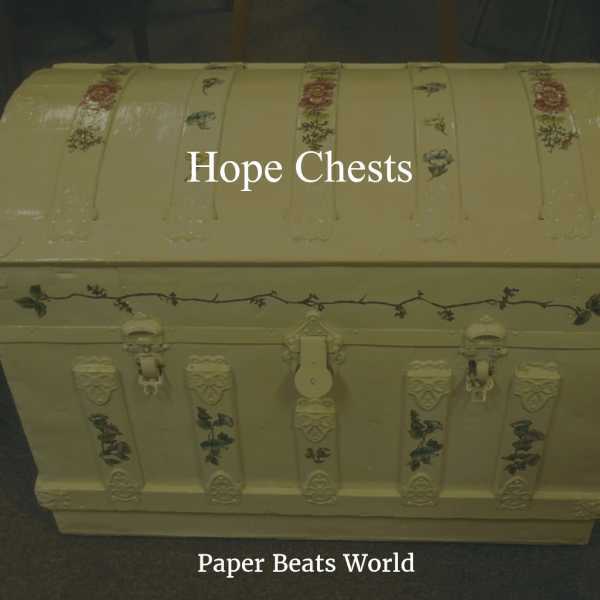
We’re still on the lookout for the best box. By the time I find one, I’ll probably buy two. My other daughter is turning 13 in August. (Pray for me.) I want to find them something sturdy. Something that can be a coffee table or extra seating when needed. Something big enough for us to fill, yet not so big that two people can’t lift it. Something that, once all of the needful things have been taken out of it, can be used as a memory chest. I don’t have mine anymore, and I’m kind of sorry for that. I wish I’d kept a hold of it. I’ll encourage my daughters to do so.

Modern twists and traditional items

Of course, this is the 21st century and we like functional things in our house. So there’s not going to be a lot of fancy in this box. There will be no tatted lace or decorative things. There will be warm blankets, and we’ll be hand making that. But there will also be a tool box so that if something breaks my daughter can fix it. There will be extra charging cords for whatever electronic device she leaves my house with. There will be a bible, probably with a couple hundred bucks tucked in the book of Ruth. (Why the book of Ruth? Because it’s my favorite.) There will be a blend of the traditional handmade items and practical modern accessories.

Our list

With my kid’s permission, I’m sharing with you the list of items we’ll be collecting over the next five years. Many of these things will likely not suit your needs or taste. But it’s a place to start if you are ready to begin building your hope chest with your child.

The Chest

A copy of The Bible. (Money to be inserted later, without telling her.)

Kitchen

Wash clothes

Hand towels

Dishes

Pots and pans

Dish drainer

Tea kettle

French press

Flatware

Salt and pepper shakers

Cutting board

Cleaning sponges

Bathroom 

Towels

sponge

toilet scrubber

toothbrush holder

soap holder

rug for the floor

curtains

Bedroom 

Sheets

comforter

curtains

bedside tray

Living room

blanket

curtains

Misc

Toolbox

charging cords

What do you think of the hope chest tradition? Do you have any suggestions for the chest that I might not have thought of? Let me know in the comments below.

Picking Apart Coraline

This is going to be a long post. So, maybe go grab a Coke.

Coraline is a cult favorite of Neil Gaiman fans. The movie did amazingly well, even if everyone thought it was Tim Burton, the book has been reprinted at least twice. My kids and I have seen it a ton of times. The book is, quite honestly, mind-bending. Which is strange to say because my first impression of the story was that it was fairly simple. So why did it get under my skin so much?

Today we’re going to pick apart Coraline, lay it out on the table. We’re going to do this as fans, but we’re also going to do this as writers. While no one can ever duplicate Neil Gaiman, we can learn from him.

The Characters

I first want to look at the characters. I wouldn’t consider Coraline a character driven story, despite the fact that it’s named after her because if we just had Coraline all by herself there wouldn’t be much of a story. She’s a great character, don’t get me wrong. But she is a similar character to many that you’d find in young adult literature. She’s strong-willed, brave, and kind of a pain in the ass from a parent’s perspective. She’s kind of in fairness, a brat. But she’s not that dissimilar from many other protagonists. In fact, the story starts out like half of the Goosebumps books. A kid moves into a creepy house with her parents. She’s not happy about it and misses her old friends in her old town. Really, we can insert any other kid there and we’d get a similar result.

It’s the Other Mother that makes this story.
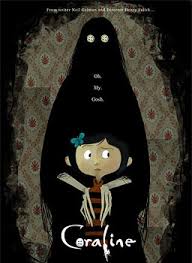
Coraline 2I just want to take a moment and consider how insidiously creepy just that name is. The Other Mother. You’ve got to remember that this book is written for kids. As adults, we see our parents as humans with faults and fears. As kids, we see our parents as fearless, strong and capable of solving anything. Our mothers and fathers are there to protect us and, when we’ve gotten ourselves in too deep, they’re who we run to. So what the Other Mother represents is, essentially, running to your mother in fear only to find yourself embraced by the very thing you were running from. She’s like reaching out for a loyal pet and finding that it’s turned rabid. She’s a razor blade in a slice of birthday cake.

She’s also, I think, a metaphor for the way we perceive things we don’t have and think that we want. While Coraline’s mother is busy and short tempered, the Other Mother has nothing but time for Coraline, nothing but patience. Coraline’s real mom is writing a book, a gardening catalog with her husband. She’s been in a car accident recently and just went through a tiring move. She and Coraline’s real father are focusing on what parents focus on; keeping the bills paid. This is something that I can relate to, as a parent. But Coraline’s Other Mother and Other Father just want to spend time with her. They don’t have anything to distract them from her, even sitting in her room to watch her fall asleep. Of course, it’s all a horrible lie, intended to trap Coraline so that the Other Mother can eat up her life. In short, the Other Mother feeds off of our inherent selfishness. And in this way, I feel that she’s a great antagonist. What do we fear more than our own weaknesses, our own sins?

Because I mentioned Coraline’s mother and father, let’s take a look at them. I read CoralineCoraline as an adult, and so I loved her parents. They were real, they were honest. I am Coraline’s mom, sitting at the table trying to work, being irritated by a bored kid. I get her. I get feeling angry, and guilty at the same time. Sometimes I just want to scream, “I’m taking care of you, can’t you see how hard I’m working to take care of you? Can’t you see that if I stop what I’m doing and play with you there won’t be food or the house will become infested with bugs? How many parents reading this right now would love to be the Other Mother? I’d love to have all the time in the world to make wonderful, scrumptious dinners for my family, provide them with all the new clothes they want and just focus all of my time and attention on my daughters. But there are bills to pay. And we can listen to Cat’s in The Cradle as many times as we want and talk about how money doesn’t matter until we don’t have a breath left. The bills have to be paid, the food has to be bought. And yet we feel guilty when we do it!

Even the background characters are memorable, all four of them. (Eight if we count their Other World manifestations.) I think this small cast is part of what makes them memorable, though. They are unique, certainly able to stand out in a crowd. And yet there is not a crowd for them to stand out of. There’s no normal in this world. Well, Coraline’s family is normal. But I’m willing to bet that none of your neighbors have a mouse circus no matter how much it sounds like it at night.

The World

Now that we’ve talked about the characters of Coraline, let’s take a look at the world. It’s broken up into two distinct universes for Coraline; the world and The Other Mother’s world. (Actually, there’s a fan theory that there’s actually a third plane of existence and that once Coraline goes into the Other Mother’s world she never really goes back to her own world. But more on that later.)

Let’s look first at the real world. Coraline and her family live in an old house that’s been broken up into apartments. It’s called the Pink Palace, which honestly sounds like a sort of slummy place. It’s realistic, though. It’s old, boring, and rainy. It’s average, brought alive by the people who inhabit it.

The Other World is the opposite. The world itself is designed to love Coraline all by itself. The bedroom is full of animated toys, the very plants in the garden want to come and say hello to her. Chandeliers that dispense mango milkshakes are a common occurrence, as are huge taffy cocoons that are full of vengeful taffy monsters. Much like the Other Mother, this whole world is a lie. When Coraline looks through the Seeing Stone she sees the world for what it really is; thin, one-dimensional, and dead.

In this way, the world itself feeds into the symbolism of the story. The real world is gray and boring, but it’s honest, tangible and solid. The Other World is fantastic, bright, and unsubstantial. It can all go away so easily, like wiping away steam on a mirror.

The things that are not in the story

Coraline isn’t a long book. I was actually surprised that it made such a long movie. And here’s not a lot of explaining things. You just sort of go through the story and if you get what’s going on super. If you don’t get what’s going on, well, that’s too bad because the rest of us are moving on.

I’ve read Coraline, of course, and I’ve seen the movie. And I still have questions about the damn story! Why can the cat get back and forth from the real world and the Other World? Why does he care to save Coraline? Why did the landlady let Coraline’s family move in, after not allowing kids in for so long? Did she know that the Other Mother was responsible for taking her sister and would still prey upon children in that house? Why can’t the Other Mother, or the Beldame, leave the Pink Palace and hunt other places? Is Coraline really in the real world at the end of the story? There are fan theories on Youtube, and you could fall down a really long rabbit hole watching them. I have, and that’s actually what inspired me to write this post. This longer than I thought it was going to be post.

There are so many mysteries left unexplained in this story, even after the book, movie and graphic novel. I’ve seen this movie a lot, and every time I watch it I catch something I didn’t see before. The picture of a boy dropping his ice cream cone in the real world, contrasted by the same picture of him enjoying his treat in the Other World. The single snow globe in the Beldam’s sitting room. The fact that, even when Coraline is entranced by the Other Mother she refuses to call her mother. She instead called her ‘she’ or ‘her’. There is a depth to this story, simply because it assumes that we know things we don’t.

And this not knowing has inspired a generation of fans to make up their own answers. Many of the answers are as interesting as the story itself. And really, there’s nothing better than managing to get audience participation with a book.

It’s the same thing we talked about with Dr. Horrible’s Singalong Blog. It’s 1 + 1 instead of 2.

The book, the movie and the comic.

To really understand Coraline you almost have to experience all of the material. Reading the book is a different experience than watching the movie is different than reading the comic book. Not only because they’re highly different mediums, but because the same story is told different ways each time. This includes things like one of the ghost children being replaced by a fairy in the comic book.

Let’s take a look at that decision from a writer’s perspective. While Gaiman didn’t get to completely rewrite the story three different ways, he did get three different cracks at it. That’s an artist’s dream right there. But it also got people, like me, to buy the same story three different times. That’s kind of evilly brilliant. I doubt that was Gaiman’s intention, but it’s still awesome.

If you have the chance, I do suggest reading Coraline. If you’ve already read it, do so again with the mind of a writer.
My Freeform Outline

I’m a big fan of outlines. I kind of have to be, with what I write. I have sixteen books planned out for the Woven universe and I kind of need to have an idea of where the story is going. So I have a series outline, of course. But the series isn’t all one long story. There are trilogies and two book collections and stand-alone books. So, in the event that I have a couple books that go together, they need their own, separate outline. Then, of course, I have an outline for the book I’m working on at the moment. I’ll even go so far as to outline the chapter I’m working on before I get started.

What I’m saying is, I pretty much know what’s going to happen in every book I intend to write for the rest of my life.

Except that I don’t. While I was writing the Broken Patterns Trilogy, I made outlines like I described above. Then I’d rip the outlines up and redo them part way through. Or I’d end up rewriting so much of the book in the editing process that what I ended up with was totally different than what I’d started with. This doesn’t mean that my outline was bad. It just means that the story grew and went on its own path, like a living thing. It did what it was supposed to do, in other words.

Now I’m writing a new Woven story. A two book collection, hesitantly titled The Roc Hunters. (That’s pronounced rook, like the chess piece. It’s a great huge mythological bird.) It’s a new story, with new characters. I thought it might be time for a new approach.

I opened up an Evernote note and got down some of the major things I know I want to have happen in the books. I have a beginning, an end, and an antagonist. Then I threw in a few protagonists for good measure.

Then I started writing.

As I go along, I’m adding some things to the outline and deleting others. Characters are appearing, weaving themselves into the story in ways I didn’t expect at all. It’s all flowing, all coming to me in new, fascinating surprises.

I was afraid I’d get writer’s block, writing this way. But actually, the opposite has happened. The story is just coming to me as I write. The more I move the pen, the more of the path ahead I can see. I’m more excited than ever to get to my writing every day, and I find myself writing more than I used to.

Now, I don’t know how this rough draft is going to end up. The benefit of a more detailed outline is that the first draft ends up reading more like a second draft. So it might be that the second draft of this book is an even more massive rewrite than I usually do. (Traditionally second drafts take me five to six months to write.) But maybe that’s worth it if the book I write is more original, more organic. Maybe this will be the best book, the one that shows how I’m growing as a writer. Maybe I’ll hate it and scrap the whole thing.

The point is that I don’t know how this is going to turn out. Which is a feeling I’m used to in life, but not so much in my writing. I think I like it.

Station 86, The Book!

I have a pretty awesome announcement for all of you. It’s not a huge announcement, like a new book coming out or anything like that. But it’s kind of a big deal for me.

I’ve been working on what I thought was going to be a small project but turned out to be way more time consuming than I thought it was going to be.

As of today, you’ll be able to buy the first Station 86 collection, which will include Seeming and You Can’t Trust The AI in one convenient book.

The reason I’m doing this is so that I can physically publish these two books together. I didn’t want to put out a physical novella, it just didn’t seem worth my time or printing money. But together the stories are long enough to warrant a real book.

This is the first time I’ve ever published a real physical book. Broken Patterns, if you recall, was done by Solstice Publishing. So the physical printing is going to be a new experience for me. As of this posting, I haven’t gotten my hands on a copy. I might cry when it arrives.

For those of you curious, I’m using Createspace. I’ve had nothing but good experiences with Amazon so far, so I figured I’d stick with it.

The process, if you’re wondering, was pretty straightforward. I was able to upload and design my own cover, front, and back. I was able to go through the whole book before it went into print, and it looks pretty good.

If you’d like to order a copy of my first print book, you can do so by clicking here.

I hope you get a chance to get your hands on a copy of Station 86, Volume one. I’ll be hosting several signings and readings in my local area. I’d love it if you could make it to one.

Thank you, as always, for supporting my stories. I hope that you enjoy them as much as I enjoy writing them.

Cross Training Your Writing

If you’ve been following along with me on Instagram and Facebook this month, you know I’ve devoted some time to writing poetry. I don’t write a lot of poetry, and it’s not good by any means. But I write it. I also write short stories in just about any genre. I write almost everything, even though I only really market my speculative fiction work.

This has got to seem crazy. I mean, when you think about everything we do every day, fitting in writing that you’re not going to market and might not even be good at can seem like a pointless waste of time.

But it’s really not. There are a lot of reasons that I would advise cross training your writing.

Different perspective

I talk about this a lot, and I’m not the only one. Getting a new perspective on things, especially if we’re talking about anything creative endeavors. What can suspense writing teach a fantasy writer? How to write some damn scary monsters for your hero to face. What can fantasy teach a romance writer? To write in such a way that evokes the suspension of disbelief.

Stretching muscles you might not stretch normally

Your brain is a muscle, we’ve all heard this. Just like we would cross train our bodies, we want to cross train our brains. It will just make all of your brain smarter. It’s like how learning an instrument will help you understand Math, or how when you learn a second language it’s easier to learn a third. Our brains need to stretch.

It’s something new

If all you ever do is write one genre, you’re going to get bored. It’s just the same as everything else. I don’t care how much you love Steampunk, eventually, you’re not going to love it any more if it’s all you write. It’s like eating your favorite food. If you have it too much, you won’t like it as well. Though, I can’t imagine being in a position where I could get my hands on to much sushi. Maybe when I’m rich and famous.

It’s fun

Writing is a job, a passion, a dream life. It’s also freaking fun. Or at least it should be. I mean, if you’re not having fun writing, what are you wasting your time for? Go do something else that doesn’t take up all of your soul.

You might want to write in it for real

There was a time when I wrote horror, nothing but horror. I love it, not going to lie. But after a long hiatus, when my life was falling apart and I needed something to save my sanity, I decided to try fantasy. I was reading a lot of fantasy at the time, you see. My life was in some serious need of magic.

Last year I wanted to write something episodic for this site. I didn’t want to write more fantasy, and I couldn’t think of a horror story. I was watching a lot of Star Trek and Firefly. A lot of superhero stuff, too. That’s where Station 86 came from. I never intended to write fantasy or science fiction. But there we have it.

I still love horror, don’t get me wrong. I’d like to write a horror novel. But right now I’m entirely engrossed in two genre’s I just wanted to write for fun.

Like No Time Has Passed

I’ve got this friend that I don’t talk to much. It’s not because we don’t get along, quite the opposite. It’s just that we’re both mad busy.

She’s in school, pregnant with her second child, and working. She also lives in Pittsburgh, while I’m stuck in Butler. I have two kids, a full-time job, a side hustle and this whole writing thing I do. We’re busy, is what I’m saying.

She and I have been friends forever. Since high school, if you can believe it. I know, it’s shocking to me that anyone’s been able to put up with me this long. We both love technology, have really eclectic taste in music, shop at second-hand stores and love cats. We love hockey, independent coffee shops, and comic books. We argue about politics and cry about our mothers.

To be honest, we go months without talking sometimes. Like I said, we’re busy. I understand, as time goes on, people fade away from each other. We move, we change, we grow. Or, we don’t grow. I have other friends from high school that I don’t hang out with anymore because I grew up and they didn’t. Or maybe they’re doing it right and I’ve got a stick up my ass. I don’t really think so, given the fact that I really think I’m going to be a full-time writer someday. But I won’t rule it out.

But that’s not the case with this friend of mine. Like I said, we’ll go months without talking. Then one of us will message each other out of nowhere. I’ll send her something I found on Reddit. She’ll message out of nowhere to bitch about something or other. And we’ll just pick right back up like we talked every day.

Like no time has passed.

Protecting Yourself Online

Writers depend on our computers a lot. You just can’t be a writer these days without a computer and internet access. You don’t the latest or greatest, but you do need a computer with proper internet connection.

Which means you also need your freaking computer to not die. Honestly, if you want to strike fear in the hearts of a writer, kill their computer while they’re working on a project.

And, since most writers are low on cash, you need to maintain your computer so that you don’t need to replace it.

Here are some lessons that I’ve learned over the years when it comes to computer care. I’m also including some basic online safety information for writers in general, to help you avoid scams.

Note: I am a regular person. I don’t have any sort of degree in computers. These are just things that I have learned from experience, and I’m not in any way saying that doing these things will always protect you from computer viruses all the time. Sometimes hackers get in. Please take these suggestions with that in mind.

Clear your cache and cookies.

If you’re unsure how to do this for your browser of choice, you can google step by step instructions. You want to do this once a month, or really any time your browser’s being slow. Be warned, though, you’re going to lose all of your saved password information on any site where you’ve selected ‘Keep Me Signed In’. Do it anyway, just make sure you have your passwords first.

Have multiple browsers on your computer.

While we’re discussing your browser, I’d suggest having at least two on your computer. Sometimes websites aren’t on speaking terms with some browsers for whatever reason. Sometimes you find out that Firefox freezes up every time you try to copy a link to a WordPress post so you have to use Edge.

Have two browsers, is what I’m saying.

Back it up twice.

Here’s something else you should have two of. Backups for your important documents. Like, for instance, your manuscripts. I use Dropbox, but I also save all of my manuscripts on a flash drive. Why do we do this? Because nothing is 100% and flash drives are next to nothing to buy. Dropbox is free for limited space and sometimes flash drives break. So do yourself a favor and save your stuff twice.

If you have a launch day or any other event where you need to have an internet connection, be prepared with an Ethernet connection. Don’t depend on wireless unless you have to.

Wireless is wonderful, but it can be spotty. All sorts of things can mess with it like the location of your router, other people around you on the same wireless channel or weird signals coming off of your microwave. (No, I’m not joking.)

So if you have a day when you know it’s going to be catastrophic if you lose the internet, directly connect to your modem.

Run a virus scan at least once a month. No, the auto scan your anti-virus performed is not good enough.

Yes, if you have an anti-virus it does do an auto scan. No, it’s not the same as running a scan yourself. I’d advise doing it once a month, the same as clearing out your cache. This is something that I do on the first day of every month, right along with backing up my manuscripts on DropBox and on a flash drive.

An anti-virus and a firewall are not the same things.

I hear this all the time, so let me break it down for you.

An anti-virus’s job is to keep viruses from getting onto your computer from bad sites or other bugs. A firewall is intended to keep other people (hackers) from accessing your network and devices. If you’re wondering, yes you need both.

Don’t call phone numbers that appear on popups, or click on them.

If a pop-up appears on your screen, don’t click on it. If it asks you to call a number, don’t do it. Popups are never your friends; they are almost always scammers attempting to get information from you. Just don’t do it.

Always check Predators and Editors.

I think this one goes without saying, but just in case no one’s told you, I will. If you’re submitting writing, before you send anything to anyone, check out their name through Predators and Editors. I can’t tell you how many bad situations this site has saved me from. Just check it, trust me.

And the Better Business Bureau.

This one is for just about everything. If you get a weird email that doesn’t seem kosher, run the company through the BBB. If you’re considering doing business with someone, check the BBB. If someone claims that you owe them money, check the BBB. There are scams out there that claim to be from old landlords or utilities. Just make sure you double check before you send someone money.

Any agent or publishing company that asks you for money up front is not legitimate.

Again, I feel like somewhere along the lines we’re all told this. But I might be the first person to tell you this. No legitimate agent or publisher will ask a writer for any money up front. Flat out, if they ask you for money, they’re not legit. Agents and publishers make money from your writing, end of story. They make money from your work, not from you.

If your computer doesn’t automatically update, update it often.

This is something else I used to do on the first day of the month, but I have Windows 10 now and it updates for me. Whenever it wants to, even if I’m in the middle of something. This is frustrating as hell, but at least I don’t have to update Adobe Flash Player every other week. I swear you’ve got to update that the way you buy milk.

Computers need to be taken care of, just like anything else. So if you don’t want to quite suddenly lose a year’s worth of work in a heartbeat, or have your computer crash hours before a deadline, you’ve got to take care of it.

By the way, I want to let you guys know that as of April 27th, you’ll be able to get both Station 86 books in one volume. It’s going to be available in e-book form, of course, but it’s also available in paperback. (Yay!) Both options will be available on Amazon, or if you see me at a live event.

My New Business

I want to take a minute today to let you guys in on a new project I’ve been doing for about a month now. I’ve been pretty vocal about it in my business circles, and you might have noticed the new button above.

I started a new business, freelance writing for independent creative types online. I write product descriptions, website copy and things like that.

I’m not telling you this because I’m trying to drum up sales, or cross promote between my two platforms. I’m telling you this because, when I mentioned to a friend of mine that I was doing this, she said, “I didn’t know that was a thing you could do.”

So I’m telling you, in case you didn’t know, that’s a thing you can do.

While my creative writing will always come first, I consider this a step towards being able to write full time. And, to be honest, I really like doing this work. It’s not creating a whole fantasy world with dragons and magic. But it is, after all, writing.

Just to let you know what I’m up to. And, you know, in case you didn’t know it was a thing.

Managing Social Media for Multiple Books

I’ve seen a lot of people on my Facebook and other writing groups recently ask the same question. How do I handle social media promotion when I have multiple books to sell?

Since I publish two different series, I’m a decent person to ask about this. It’s a pain, I don’t mind telling you. I only do so much social media-ing to start with. So to balance two books is sometimes a downright pain in the ass. Then we throw in any other events I’m planning or attending (like my poetry month challenge or the B2B Con earlier this month). And I don’t want to spam people, of course.

I have a list of simple rules that I follow when it comes to social media. They’ve worked well for me so far.

If a book is coming out, promote the other ones in the series.

You Can’t Trust The AI came out earlier this month. Two weeks before that, I started promoting only Seeming. I made a big point about getting the book before it’s sequel comes out. This made a lot of sense because a lot of people were showing interest in book two who didn’t grab book one yet. Also, while you can pick up book two before you read book one, that’s not going to be true later in the series. So I want to get my readers in the habit of reading them in order now.

Besides that, it’s not a terrible thing to read two books instead of one.

For real, don’t spam people.

I’ve brought this up before. In fact, every time I talk about social media I mention this. If you work to create a platform, you don’t want to kill it by spamming people. You’re not even going to get a platform built if you’re spamming people.

Once again, the most accepted ratio is eighty percent content and twenty percent advertising. So for every promotional post you write, you should post five other things. Here’s a short list of things you can post. It’s by no means exclusive, and I highly encourage you to think outside of this list, but here are some ideas to get you started.

  • Updates about your life that are interesting and relatable.
  • Information about books, tv shows, movies and anything else that relates to your genre. I share as much as I can about other indie writers who write speculative fiction. If you like my writing, I assume you’re also interested in Norse Mythology by Neil Gaiman. (See what I did there?)
  • What are you reading? I would love to know what Tamora Pierce and Stephen King are reading right now. I think you all care what I’m reading, as you can probably tell. I’d love to know what you’re reading right now. Why? For the same reason I watch every single ‘Sephora Haul, Ulta Haul, best and worst product haul’ video on Youtube. I am nosy as hell, and I want to know what you’re doing.
  • Anything random that might interest your readers. A lot of this depends on you knowing your ideal reader. I write for adults, mostly parents. Parents, I think, focus so much on creating magic for their kids. We work hard to make holidays and other special occasions happen, even making dinner happen nicely. We tend to squeeze the magic out of our own lives to create it for the kids. That’s why I write speculative fiction for adults. So, when I’m filling up my Buffer feed, I include fun things for parents. Like Tasty videos. There’s no reason to include those, they have nothing to do with speculative fiction. But they do appeal to parents.

If you have free books, use them to split up your paid books.

If you write a book, or a collection of short stories, to promote your name and get new readers then you should promote them just like you do your paid books. Well, maybe not just like. I mean, I scheduled several book signings and online events for my last book release. But I do post about my free books as much as my paid books. After all, nothing gets people’s attention like ‘free’.

Talk about the most recent book you’ve got.

Now that You Can’t Trust The AI is out, I don’t post about Seeming. I post about AI instead. Now, I might go back to posting about Seeming or at least tie it into promotions I do for AI. I’ve been promoting Seeming for awhile now. There’s no sense in continuing to do it when I have something new to share.

Just make a list and talk about them in order.

This is kind of a no-brainer, but it’s what I do if I don’t have anything major going on. I just make a list of books, write out some solid social media promotions, and post them in order. Really, this is one of those things that can be made as automatic as possible. Because really, the whole point of social media is to talk about your writing and let your readers know what you’re doing. So don’t stress over it so much.

Bonus post: Creators on Youtube need our help.

I’m not on Youtube, I’m not a very visual person. I’m a writer, my work is there.

But the entertainment industry is evolving all the time. Indie writers are inventing new ways every day to bring our stories to people. We host podcasts, publish blogs, participate in indie cons and countless other things.

I myself had been thinking of putting out videos on Youtube. You know, have some nice artwork overlaying someone reading one of my stories. I’d also been looking into making trailers for my books, and putting them out on Youtube.

Turns out I have terrible timing.

A lot of people who aren’t active creators on Youtube don’t know how their advertising system works. I didn’t know until this worked until recently. Advertisers pay to have their ads up. Then they go up on videos sort of randomly. I personally think that it’s based on ad information, because I get a shit ton of makeup ads.

Then some stuff happened. Some ads were put on some questionable content. Some advertisers and brands were getting some clap back over it from people who don’t understand how the ads work on Youtube.

This resulted in these brands pulling their ads.

Here’s how Youtube is dealing with this. They are de-monitizing Youtube videos that are not ‘ad friendly’.

For the most part, I watch makeup tutorials and they’re safe. But I do know that Rob Dyke and Matt Santoro are likely going to be hit. There’s a good chance that your favorite creators might be taking a serious hit as well. I want to remind you that a lot of people make their living on Youtube through this ad money. Rob Dyke, for instance, has a team of people creating content for his various channels.

I’m telling you this for two reasons. One is that if you, like me, were looking to Youtube as a way to expand your audience, you want to keep this in mind. Questionable content, like politics, gay rights and horror might not be able to be monetized.

I also want to tell you this because I am a writer. I am a creator, specifically an independent creator. I know that a lot of people who read this blog are also writers. We are creators. And these are creators who are losing a ton of their ad revenue. This is a problem, and they need our help.

Now, I’m not saying damn Youtube. I’m not saying that you shouldn’t still look to Youtube as a medium to promote your work.

All I’m doing is giving you some information and encouraging you to find new ways to support your favorite creator.

  • Many of them have Paetron pages.
  • Many take donations via PayPal
  • Share their work on Social media, to show businesses how popular these videos are and what they stand to lose.
  • Like and leave comments for your favorite creators.

Hopefully advertisers will see that this is a mistake. Let’s all do our part to support our fellow creators.

A WordPress.com Website.

Up ↑