My Review of Notion

So I’ve been using Notion for a couple of months now. I started using it after watching an Amanda Lee video on YouTube. She just made it seem so cool, I had to try it.

I have a bad habit of trying new software and apps, spending hours moving all my notes and info over to them, then dropping them like a hot coal a few days later. The reasons vary. It didn’t do what I thought it would. It’s redundant. It’s just one more bloody app to check in the morning. It’s not easy to use. Something new and shiny caught my eye. You get the idea.

But I’ve continued to use Notion for long enough now that I think I’m ready to share it with you. (Not a sponsored post.) 

So, if you don’t know what Notion is, it’s a note-taking app. Think of it as a virtual notebook. I tend to use it as a virtual bullet journal. You can keep to-do lists, pictures, documents. if you have a paid account, you can share access to all of those things.

I don’t work with a team, so I don’t have a paid account. And I have to say, I use it almost every day for both my personal and my writing life. 

Here’s what I use it for. 

Social media plans- Pretty self-explanatory. I keep a little chart of ideas for Tweets, pins, Instagram posts and the like. I hate sitting down to plan a day worth of social media and having no ideas. Why do I have all these pithy thoughts until I have my keyboard under my fingers?

Meal prep plans- Whatever makes my brain go blank when I’m trying to write social media does the same damned thing when I’m trying to figure out dinner. Even when I try to write a shopping list, I forget every meal I have ever made. So having a list of meals I make, or that I want to try, is a huge help.

Utility info- Another pretty self-explanatory thing. This is the information I need if I have to deal with any of my utilities.

Savings info- I know everyone suggests having separate savings accounts but I don’t have time for all that nonsense. So my savings account has just one chunk of money. Then I keep track of what money is for what on this Notions page.

Expense trackers- If you’re not tracking how much your bills usually are, you should be. 

Address book- Again, pretty simple. Nothing’s worse than fumbling for the vet’s number because Oliver swallowed something he ought to know not to.

Rolling to-do list- While my daily goals are in my bullet journal, I like to keep a rolling list of things I need to get to. This gets slowly moved to my bj as I can manage these tasks. Nothing gets forgotten, but I’m not looking at a list of things that no one could do in a day.

Contests- I have a bad habit of entering too many contests. I like to have a place to keep track of them. Due dates, word requirements, all the rules, links to pages. It’s super useful to have all of that in just one place.

Project pages- This is especially useful as I get into more forms of storytelling. As I work on AA and other podcasts, there’s just a huge amount of info to keep track of. And Notion is where it all goes. 

Blog post schedule- Finally, I keep track of all my blog posts for here and Haunted MTL. I keep notes, links, info, calendars. 

Now, you might be wondering if I still use a bullet journal. The answer is yes. I use Notion for long-term planning and things that need to stick around as I switch from book to book. My daily and weekly planning are more in the moment. Even my monthly goals to a degree. And of course, there’s also the memory capturing part of a bullet journal that I don’t want to convert to virtual just yet.

The big reason why I started using Notion is that I had things that either changed too often or not often enough. Things like my blog schedule, which might switch on a whim, are a pain to do then redo on paper all the time. Things like what recipes I like to make for dinner don’t change so often that they need refreshed every three to six months when I get a new BJ.

I do appreciate that I can pull Notion up on any device. My tablet has the app, of course. And I can pull up the website on any computer. I like that I can access all of my notes, for both home and writing life, no matter where I am. 

The fact that it’s cute doesn’t hurt. 

Have you tried Notion? Let us know in the comments below. 

You can support Paper Beats World on Ko-fi.

Don’t Dream Low

Storytime, guys. Once upon a time, right before I started this blog, I managed a shoe store. And back then, I’d worked hard to get that position. I’d put in intense hours, said yes to abusive things. I did something I’m still pretty proud of and worked with several cheer squads to provide their shoes. That alone brought in thousands in revenue for my store. I could go on, but you get the point. I wanted to be the manager.

And I got it. 

Funny thing about wanting something and working really really hard for it. You often get it. And you think that’s going to make you happy, right? 

I got the manager job, and I did a happy dance around the store. And if I was committed before, I was doubly so after. I was so proud. 

It took me months to realize I was struggling emotionally. To realize that I hated the damn place, the job and everything about it. 

For a long time, I tried to ignore that feeling. I beat myself up over it. I told myself that I didn’t have any right to be unhappy. Isn’t this what I’d worked for? A poisoned mantra was imprinted in my mind, and I couldn’t get rid of it. I didn’t want to get rid of it, because it served me. It made me get up and go to work every day, even when I’d rather have died.

I’ll never be happy if I’m not happy here. 

The realization that something had to change didn’t hit me all at once. It came in trickles. Moments that, when looked back upon, should have been my wake-up call. (Like the time I got a bad kidney stone. I was in so much pain I thought I was going to have to be hospitalized. And I was scared to take a day off of work.) But there were so many, many reasons to ignore them. Really good, adult reasons too.

This was the best job I’d ever had. 

I was making more money than ever.

This job was way better than any my mother had ever had.

I had a family relying on me.

I loved most of the people I worked with.

Our rent was high.

I didn’t think I was qualified for any other job.

I didn’t think I deserved a better life. 

I’d worked so damn hard to get there. What if I threw it all away and I still wasn’t happy?

I would love to tell you that I eventually made the leap and improved my life all on my own. Sadly, I didn’t. But I did start writing again, after not writing anything for years. And this helped, for a time. 

I thank God that I got fired from that job. Honestly, I don’t know if I ever would have been brave enough to leave on my own.

From there, everything changed. I got another day job, something I never thought I was good enough for. I wrote more and got published. I worked hard, again. I got what I wanted again. Thank God, I liked it a lot better this time.

I’m telling you all that to tell you another story. The manager at my current day job, the one I didn’t think I was good enough for but went for anyway, just left. She got a better job. Which isn’t to say, at all, that this job isn’t good. Just that she could do better, so she did. 

Right now I have a day job that I like. I help people, that has value to me. I respect the company that I work for, that has value to me. I feel respected, that has huge value to me. I have a nice home. I have a job as a critic on Haunted Mtl. I have several published books.

In short, the life I live today has exceeded my dreams from before I started this blog. I am happy. 

But I will never, ever let that poisoned mantra come back. 

We can do better. Obviously, I don’t just mean our day jobs. I mean, more than anything, our art.

If you have a job writing, or you’ve been published, that is freaking amazing. Pop some champaign, do the Snoopy dance. Then, decide what your next step is. Because I told you all that to tell you this. While I didn’t let that poison mantra return, I did plateau over the last few years. 

So I’m working on that. I’m going back to the basics. I’m working on really improving my writing. I’m trying to get an agent, trying to join SFWA. 

I never want to learn this lesson the hard way again. There is always another level to reach for. I can always be a better version of myself. I can always surpass my goals, my dreams. 

Dream high, guys. You are capable of so much more than you think. 

You can support Paper Beats World on Ko-fi.

Writing Nonfiction-Research

Most of you know me as a speculative fiction author and blogger. But I’m much more than that. I am a Gemini after all, duality is in my very being. So I am a speculative fiction author and a blogger. But I’m also a critic and podcaster. And as if that weren’t enough, I’ve decided to add nonfiction author to my list.

That’s right, I’m working on my very first nonfiction book. It’s an emotional project that I’m not ready to talk about publically yet.

Writing a nonfiction book is totally different than writing fiction. And there’s been quite a bit of a learning curve. I’m writing something where facts matter, statistics matter. I need to get things right. But it also needs to be entertaining and people need to want to read it.

I’m learning a lot in this process. So I thought I’d do a series on nonfiction writing.

Today, we’re going to talk about where it all begins, research. 

Yes, I do research things when writing fiction. But it’s not the same. If I mess up a fact in a fiction book, most people aren’t going to notice. Or I can just say this is a fictional world and this is accurate for the book. 

Nope, none of those cop-outs exist in nonfiction. Here’s what you do instead.

Know what you’re looking for before you start researching

For the sake of this series, let’s say you’re writing a book about how crystals have been used by different cultures through the years. That’s not what I’m writing, it’s just a handy example. Before you start diving into research, have an idea of what information you’re looking for. I found it best to have certain questions I wanted answers to. I kept track of them at the beginning of my notes. (Don’t worry, I’m doing a whole post on organizing your notes both digitally and physically.)

This keeps you from getting too far off in the weeds while you’re researching. Because if you don’t know what you’re looking for, then you’re looking for everything.

Of course, you’re going to find new things as you learn. New questions you didn’t even realize existed. And as you do, feel free to add them to your list of questions. But at least having a basic idea of what you want out of your research at the start will help you with some direction.

Vet your sources

Some people think they know everything about a subject there is to know. It does not matter what subject we’re talking about. Someone out there thinks they are the expert. That someone is usually a Youtube commenter.

I kid. But you must know where information is coming from before you believe it. If you’re using a book, who is the author? Are they a specialist in this topic? Where did they learn it from? If you’re on a website, do some basic digging. Is it a reputable website? Do they cite sources? Are they the original source? Basically, where was this information before it was in your hands?

I did this a lot when I was researching for the first season of Off The Bone. It turns out there’s a lot we don’t know about HH Holmes, for instance. But lots of dumb schmucks on the internet think they know. I do not want to be one of those dumb schmucks.

Double-check facts

On a similar note, let me advise you to double-check facts, even if you think you know them.

I’ll use Off The Bone as an example again. When I was researching for the episode about Dauphine LaLorie, I thought for sure she’d had some sort of run-in with Marie Laveau. They never met. I’m pretty sure I got that from American Horror Story, Coven. I’m really glad I double-checked that little ‘fact’ before I just threw it out there.

Don’t lean too hard on books

A lot of people have written a lot of books about a lot of topics. So no matter the topic of your nonfiction book, others are going to cover at least similar topics.

And if all you do is regurgitate information from the other books, that’s a waste of time. It’s also kind of shitty behavior.

It’s much better to do the research yourself. I’m not saying that you’ve got to reinvent the wheel here. If you’re writing about crystal lore, you don’t have to ignore historical knowledge. But you also want to go talk to people who know about these things. At the very least, you want to add a new perspective to your topic. Otherwise, why the hell are you writing the book?

But at the same time, read a lot of books

All this is not to say don’t read books about your subject. But maybe be a little more varied about the books you read. Let’s go back to that crystal lore example. (Is it weird that I kind of want to write that now?) 

Maybe you can research what other kind of lore a culture had. Or what minerals were around them. What was more or less valuable? What kind of society did they have? What were their means of saving stories and information? All of these things can be avenues of research that can dramatically change how you write your book.

Keep careful track of all of your sources

You’re going to learn a lot for your book that comes from other people. I mean, that’s the whole point of this post. And since this information was not yours, but obtained through working with others, you have to give them credit. 

There’s always a source list at the back of books for this reason. When I’m doing an episode of Off The Bone, JM and I include links to our sources. We want you to know where we got the information from. 

So for the love of Gatsby, write down your sources and keep very careful track as you go!

Never for a second think you’ll remember later where you picked up some obscure fact. Write it down. Get a link to the site. Write down the author, book title, edition and page number. You will need it. 

Personal stories are fine, but cannot be relied upon

Finally, let’s consider personal stories. This is also called anecdotal evidence. And it’s a tricky thing. 

Lots of people will tell you to leave these kinds of things out altogether. But I’m not one of them.

Anecdotal stories are great for showing different sides to a subject. They give an emotional punch. They put a real face on your topic. They move your topic from the hypothetical to the relatable. And if you’re using an anecdote to do these things, you’re using them right.

If you’re using an anecdote to prove a point or a fact, you’re doing it wrong. 

As House says, everybody lies. But even if your anecdote isn’t a lie, it might still be total bull. We don’t mean to lie. We just often see things differently than other people. 

If you need proof, here’s an experiment. Think of something in your childhood. Some memory that you have a clear recollection of. Now, go as your parent about that memory. I imagine you’ll get a wildly different set of facts.

I’m planning on doing a whole series about converting to nonfiction writing. If you’ve got any specific questions or topics you’d like me to cover, please drop them in the comments. Until then, have a great day.

If you want to support Paper Beats World you can become a patron on Patreon.

Or you can buy me a cup of coffee on Ko-fi.

Camp Nano, 2021

It’s that time again. July is a week away, and I’m getting ready to participate in Camp Nanowrimo. 

I almost decided not to do it this year, to be honest. A lot is going on in my life right now. I’m working on some big projects for Haunted MTL. I have a pretty big personal project that I’ll talk more about early next year. And I’ll be going back to the office for my day job in July.

So why in the hell am I thinking of adding another major project to July? Well, as always, there’s a reason. I’m not just being self-abusive, stacking projects on top of myself until it all comes crashing down like Jenga bricks. This project is good for me. Here’s why.

I’d like to have some fun

Yes, writing is hard. Especially that second draft! But it’s also kind of the most fun thing? I don’t know, writing confuses me. The second draft has the bare bones of the story already there, but it needs so much work to get it right. 

And in that work, nestled like opals in a mine, are a thousand aha moments. Realizing the hows and the whys and the wheres of the story. It’s like the best puzzle in the world. And I live for it, despite complaining about it like crazy on social media.

I haven’t been working on my novel as much as I want to be

As I mentioned, I’m busy as hell. And I love that I have the opportunity to do so much good work. I even got a screener for a show! I’m like an actual critic or something. 

But I haven’t worked on my novel since I finished the rough draft in December. And that just doesn’t fly with me. See, this novel is important. And I’m going to be self-publishing it to get it right into your hands. And I think, I think, you’re going to love it.

So I want to work on it. And Camp Nano is a great way to make myself make the time. 

I love the feeling of community

Why will Camp Nano inspire me? Because the feeling of community is amazing. I love that feeling when you put in your word count at the end of the day and see how all your writing friends did. We’re all working on different projects, all working alone. We may never meet in person. But we’re still working together. And that just never gets old.

 I’m never really myself unless I’m working on a novel

I am a writer. And a critic, and a podcaster. Most of all, I am a writer. And I am just never, ever myself when I’m not working on a book. I learned this in the years before I started this blog. I am happiest when I have a novel.

And so yes, I am busy. And yes, I am doing all sorts of other writing. But this is writing that is just for me. One day, it will be for all of you. 

But for now, my novel is for me. And I need to take the time to write for myself. Even if it’s just during July.

I hope to see you at camp. You bring the chocolate, I’ll bring the marshmallows.

You can support Paper Beats World on Patreon.

Or buy me a cup of coffee on Ko-fi.

My favorite LGBTQ+ characters in speculative fiction

Representation matters. We know this. And as nerds, we know that the speculative fiction genre is full of great, and not so great, representations of the LGBTQ+ community. So today, I wanted to put a spotlight on my top six favorite examples. These are characters that are not caricatures, not stereotypes. They’re real, honest people who happen to also be LGBTQ+. I’m only talking about speculative fiction characters, so we won’t be talking about characters from Brooklyn 99 or The Loud House. Though both have several great examples.

Bess Till, Snowpiercer

If you want a full review on Snowpiercer, I’ll be doing that over on Haunted MTL later this month. But for now, let’s just talk about Bess.

Bess is a great character for a lot of reasons. She starts out being pretty much a pain in the ass. She, like everyone else, looks down on the people in the ‘tail’. Eventually, she becomes one of the main character’s strongest allies.

Bess has a relationship with a woman in the second class of the train. They’re hiding their relationship because Bess is from third class, and such relations are frowned upon.

But her character isn’t defined by this relationship. She’s defined by who she is, a badass fighter for equality. 

Jadzia Dax, Deep Space 9

Alright, this is a bit of a stretch but hear me out. Jadzia Dax might be one of the earliest transgender characters ever. They are essentially two (or more) souls in the same body. Many people see Jadzia and interact with them as a female. Some, who know Dax, see them as a man. But Jadzia Dax responds just the same to both. 

Taru, Savage Legion

I talked about Taru during my Why it Works post about Savage Legion, but I’d be remiss not to mention them again. They’re one of the first non-binary characters I’ve ever seen in fiction. And they’re amazing. They’re loyal, funny, smart, and scary strong. 

Yes, being non-binary is part of their story. But it’s only a part. The larger story is one of loyalty and struggles to protect the poor districts they were raised in.

April May, An Absolutely Remarkable Thing

April’s a wonderfully flawed character. She’s quick to get caught up in all the craziness of THE CARLS. But she’s just as fast to sacrifice her whole life to save the world.

With her girlfriend, their potato plant, and CARL, they manage to save the world from something so much bigger than they could ever imagine.

Kisha, Alice Isn’t Dead

Well, and also Alice, I guess. But Kisha’s the main character. 

I talked at length about this podcast on Haunted MTL. But basically, it’s the story of a woman driving across America to find her wife. Well, as Kisha says, this isn’t a story. It’s a road trip. 

Kisha is in love with Alice, but soon enough her mission isn’t just about finding her. It’s about all the dark strange corners of the country that are hard to explain. It’s about fighting an enemy that is so unfairly equipped to beat us that we can’t help but battle against injustice. It’s about the magic of a rest stop at three in the morning, the shadows in the booths of roadside diners. It’s about America.

So what do you think? What’s your favorite LGBTQ+ character? What’s one that you think needs a little extra love? Let us know in the comments.

Writing to be read Vs. Writing to be heard

<a href="http://Image by <a href="https://pixabay.com/users/opropriomarco-4405610/?utm_source=link-attribution&utm_medium=referral&utm_campaign=image&utm_content=4300802">Marco Migorança Migorança</a> from <a href="https://pixabay.com/?utm_source=link-attribution&utm_medium=referral&utm_campaign=image&utm_content=4300802">PixabayArtwork by Marco Migoranca

I don’t know who needs to hear this, but you’re not as old as you think you are and people older than you want you to shut the hell up.

This has been said with love, as someone who complains too often about being in her mid-thirties. 

(It’s my fault I feel old, by the way. I watch all these creators on YouTube who are in their twenties. They’re all great, inspiring women who make me feel like a crone.)

But I’m not old. And even if I was, I’m still not too old to learn new things.

All of this is a roundabout way of saying that I’m learning a new way to write. 

This year I launched a true-crime podcast called Off The Bone with the amazing Boxhuman. I’m getting ready to launch a fiction podcast sometime this year. In creating these new podcasts, I’ve learned to write a different way. I’ve learned to write content that’s meant to be heard instead of read.

It kind of astounds me how different it is to write this way. I don’t know why this should be so shocking. It’s a totally different medium. But I think if I’d realized how different it was going to be, how alien it would feel, I might have chickened out.

If you’re considering starting a podcast, let me share with you what I’ve learned. Here are four things to consider when writing to be heard. 

Are you talking over people’s heads?

I’m not a big fan of talking down to people or thinking I’m smarter than others. I’m not. That being said, sometimes my word choice is, well, unusual. 

If I’m writing a blog post or book that doesn’t matter so much. If a reader doesn’t know the word I used, they can look it up. But if someone’s listening to a podcast, they don’t have as much time to stop and look up some archaic weird word I used. The same can be said for concepts or references unless I’m going to take the time to stop and explain them.

Now, I’m not saying you should assume people won’t know what you’re talking about. I’m also not suggesting that challenging people with new concepts is a bad idea. But we all have topics and theories that we know a stupid amount about. Like, more than most people do and anyone needs to. Maybe that’s why you’re doing a podcast to start with. Maybe the whole point is to explain more about the life cycle of kiwi birds. But if you’re just quickly referencing some obscure thing like everyone knows what you mean, that’s going to throw some people off. You’re going to lose listeners. So don’t go over people’s heads. If you’re talking about something complex or not commonly understood, take a few seconds to make sure everyone’s on the same page. Or at least in the same book.

How do your sentences sound?

Sentence structure is one of the real nut and bolts parts of grammar that I don’t always pay as much attention to as I should. Usually when I’m writing it’s to tell a story or entertainingly convey information. The smaller the piece, the more I pay attention to sentence structure, though. I also pay more attention to word usage and flow to convey an emotion.

When you’re writing a script to read out loud, though, you want to keep in mind that you are going to have to actually read it out loud. And it needs to sound a certain way.

Do yourself a favor, and read your entire script out loud as part of your editing process. Some sentences look and feel just fine on the page, but sound clunky and soulless when spoken. 

Are you droning on?

Remember earlier when we talked about not talking over people’s heads? Please, for the love of Benji don’t use this as an excuse to drone on.

Yes, the point of most podcasts is to talk at length about a certain topic. But that doesn’t mean you need to over-explain.

Let’s say I’m writing a podcast about HH Holmes. (Which I did). Do I want to talk about how he put people down a body chute to his basement to ‘play’ with the corpses? (Not like that, you pervert.) Oh yeah, that’s the kind of content a listener is there for. Do I need to go into a lengthy explanation of how the chute was built? Probably not. Maybe I want to toss in a little bit of info, but a ton is not needed. 

How’s your pacing?

Honestly, a lot of this advice comes down to this one factor. Is your pacing entertaining? Are you giving information in an informative way without bludgeoning someone with facts they can’t absorb?

This goes for fiction, too. Info dumping isn’t a great idea in a book. It’s even worse in a podcast. If you go into an info dump on the page, at least the reader can go back over it a couple of times if they need to soak it all in. But people listen to podcasts most often when they’re doing other things. I listen to them while I edit, wash dishes, schedule social media, or any of the other less glamorous parts of writing. (It’s not all prancing through a mental playground, folks. Writing is work. Work worth doing, the best work there is, but still work.)

The point is, if someone’s listening to your podcast while driving to the grocery store and you info dump on them, they’re not going to retain half of what you just said. And if they didn’t retain it, you might as well have not wasted anyone’s time by saying it. 

So what do you think? What should writers keep in mind while writing a script to be read? And, as a bonus, what’s your favorite podcast? Let us know in the comments below. 

Want to support Paper Beats World and get ad free blog posts a day early? Support us on Patreon.

Love this post but not big on commitment? Buy us a cup of coffee on Ko-fi.

My favorite bullet journal spreads to keep your life in order and plants alive

This month I began my seventeenth bullet journal. Her name is Sage. 

In all this time, I’ve never really taken the time to share my bullet journal strategies or collections with you. I’d like to say I don’t know why, but I do. 

My bullet journal isn’t as pretty as most of the ones you see online. 

I love watching those videos on Youtube of people making these gorgeous spreads. It’s one of my favorite things about getting ready for a new month. And I’m not a terrible artist. I try, I do.

But here’s the thing. The pages I’m going to share with you today don’t need to be aesthetically pleasing to help you out. The important thing is the information you’re tracking, not the decorative doodling. I’m going to suck it up and share some pages with you today. If you don’t bullet journal, I hope this inspires you to start, artistic abilities or not. 

These are not my daily, weekly or monthly spreads. These are extra spreads that save my ass and help keep my life in order. At least, as much order as it can have. If you’re interested in a post about what goes into my daily, weekly and monthly spreads, let me know in the comments. 

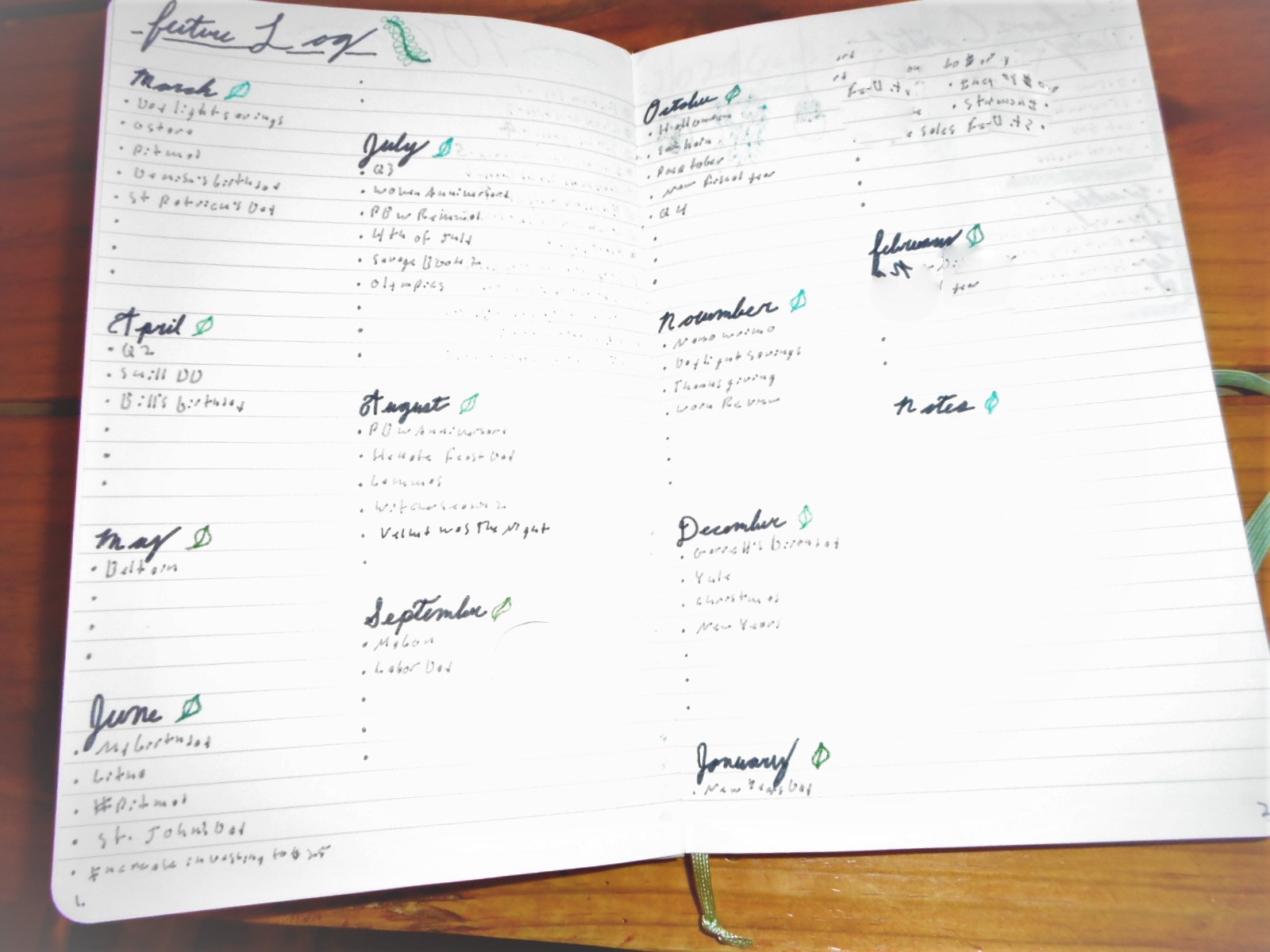
Future log

Everyone’s got a future log. I just think mine’s the best. 

It’s very simple. I’ve just written the days of the month, followed by space to add in things as they come up. I set this page up every time I start a new bullet journal, keeping notes for the next twelve months.

What you track here will be up to you. But I keep track of holidays, holy days, birthdays, upcoming book releases, upcoming show releases, or anything else I might need to know about when that month comes around. I also make sure to build in at least three blank spaces for things I’ll find out about as I work through this bullet journal.

I like to keep the decorations on this page minimal and clean. I’ll be referring to this page a lot, and a clean page is less likely to get tiresome. It also gives me space to add things in as I need to. 

Yearly goal page

Again, this is a pretty common spread, but one that does wonders for my mental health. I keep a list of my life goals at the top of the page. Not really because I think I’ll forget. But because I want to keep my focus. 

Then I write down all the things I want to accomplish in a year. I like this list to be simple, but specific. Get a new computer, beat my 2020 income, produce Off The Bone season one. Later on, I’ll have a page dedicated to a step by step process for a goal if it needs it. Here is the space for just a bullet point list. This is what I want my big-time goals to be for this calendar year.

It is the best feeling to cross off a yearly goal. I made a couple of goals I knew wouldn’t take all year to accomplish just so I could get to that feeling sooner.

In case of emergency page

No, this isn’t a list of emergency numbers or anything like that. That information is at the front of the book. 

No, this is a list of things I need to remember for an emotional emergency. 

Maybe I’m feeling down. Maybe I’m having an anxiety attack. Maybe I’m so tired I don’t think I can go on.

When I get like that, I tend to forget my coping mechanisms. I don’t think I’m the only one who does this. Even something as simple as making a cup of tea, I can’t think of that when I’m in that sort of mood.

Fortunately, I can go to my emergency page and see the little notes I’ve left myself. 

I feel stressed. Okay, Make a cup of tea, light a candle, and journal about it. I feel sad. Read my gratitude list, light a candle, find a small win and draw. It’s the spread that has saved me mentally more times than I can count. 

Goodreads goal

This is another one that a lot of people have, but I love it. It’s pretty simple. I drew little rectangles to represent books I want to read. Then I write the title in the book. I keep track of when I started it and when I finished it. And as I make progress on the book, I slowly color it in. 

You might notice on the page that there are also three smaller rectangles at the bottom of the page. Those are the books I finished for my goal this year before I started this bullet journal. 

I also keep a list of books I want to read at the bottom of the page. Honestly, I wish I’d done a two-page spread for this. I’ll probably do that next time.

Rolling shopping list

You know what, there are a lot of apps to keep shopping lists on. Do you know what I never have with me? My tablet.

But I’ve always got my bullet journal. So if I suddenly notice that we’re low on Tums, I can write that down right away. Then, when I go to the store, I know what I need.

When was the last time I…

Here’s another page that has saved me a ton of hassle. On it, I keep track of things that I need to do, and when the last time I did them was.

When was the last time I washed the bedding?

When was the last time I took a day off?

When was the last time I ran a virus scan?

You get the idea. I check this page every week when I’m making my to-do list. And I know if it’s been too long since I’ve backed up my files. Instead of just being pretty sure it’s been too long.

Plant care log

If any plants in my house are alive, it’s because of this spread. I keep a neat list of all the plants I have when the last time I watered them and fed them.

This again saves my brain from having to remember when the last time I remembered to water anything. And it saves the lives of my little green darlings.

This is by no means an exhaustive list of every page in my journal. But it is a list of pages that help me out. If they help you out, give the post a like or share it.

Thanks a lot, guys. See you next week. 

You can support Paper Beats World on Ko-fi and Patreon.

My favorite stationary for writing and bullet journaling

<a href="http://Image by <a href="https://pixabay.com/users/monfocus-2516394/?utm_source=link-attribution&utm_medium=referral&utm_campaign=image&utm_content=3297317">Monfocus</a&gt; from <a href="https://pixabay.com/?utm_source=link-attribution&utm_medium=referral&utm_campaign=image&utm_content=3297317">PixabayToday’s lovely art is from Monfocus.

After a long month of cleaning and organizing our whole lives, let’s take things down a notch today. Let’s talk about one of my favorite things and something you probably like too.

Let’s talk about stationary. 

Specifically, this is a list of the products I use to write rough drafts and keep my bullet journal. This isn’t a sponsored post, I don’t get kickbacks for any of these products. They’re just what I’ve found works best for me over the years.

LePen

I’ve talked about these pens pretty frequently. It’s because I’ve been writing with them for six years now. They’re beautiful, come in a ton of colors, and they write on almost anything. I don’t know what it is about a felt tip pen that makes me so happy. But it does.

These are great because I can use them for literally anything. I write rough drafts, write in my bullet journal and planner with them. They’re just one of those things I have to keep on hand at all times.

Good old composition notebooks

If you’ve read any fiction from me, chances are it started life as a rough draft written longhand in a composition notebook.

I mean like the old black and white marble covered ones we used to use in school. 

They’re cheap, let’s start with that. So I feel comfortable writing absolute shit in them. I also love that they’re hard covered, so I can more easily take them places to work on novels outside of my home. Easily the best notebooks to write rough drafts in.

George Stanley notebooks

I do enjoy something a little more long-lasting for my writer’s notebook, though. I stumbled upon one of these notebooks at Staples years ago. After using it for quite some time, I was impressed by the quality. The coil doesn’t come apart, the paper is thick, the cover is solid. I drag my notebook all over the place, as any good writer should. So I need a notebook that’s going to stand up to that sort of abuse. Yes, these notebooks are a bit pricey. But it’s the sort of thing I need to invest in.

Index cards

Another staple in my office is index cards. I use these mostly for outlining. So almost any novel starts with me buying a fresh new pack. 

What a feeling that is. 

I love this because I can write out plot points on the cards and then spread them all out over the floor while I’m figuring the story out. It looks a little mad, to be honest. 

Post its, multiple sized

No writer should be without post its. They play a part in most of my editing. I use them to mark out chapters, keep notes in rough drafts, leave messages and reminders in books. Essentially anytime I need a layer of paper on top of paper, this is what I reach for. 

If I can get them, I also like the little tab markers for keeping drafts in order.

Moleskine

I think these have fallen out of style for bullet journals, but I honestly don’t care. I love these things.

I always get the lined hard covered ones, but I’ll switch up the color. I love everything about them. I love their hardcover. I love the little ribbon to mark my place. I love the envelope in the back to store things. I love the creamy paper that rarely bleeds. I love how soft the paper feels. I love the elastic holder.

Sometimes you can grab these on sale if $20 is too much to drop on a notebook. And keep in mind, I don’t go through these. I might fill two a year. If I went through any more, I don’t think I’d buy the super expensive ones.

Tombow Brush pens

These are a recent find, but I love them. These brush pens are used in my bullet journal and for any drawing I do. Their colors are bright and vivid. They last forever. And they just feel so artsy. 

They also cost a decent amount, usually $3.50 per pen. So it’s a good damn thing they last awhile. 

Sakura Gelly Roll 

Because I like to do a lot of layering in my drawing, gelly roll pens are a must. I use them to draw over ink I’ve already put down. This is especially useful with a white one. It helps me give dimension to drawings or make them look like they’re shining. 

Pilot Precise V5 in red

In red and red only. I use these pens for just one thing, editing. 

The pen tip is super sharp, and it makes me feel like I’m literally cutting the fat out of my drafts. The ink stands out well and doesn’t dull when I’m shuffling through pages for months. 

So that’s it. Those are the tools of my trade and where most of my money goes. But now I want to hear what you think. What are your favorite stationery supplies? Let us know in the comments.

You can support Paper Beats World on Patreon and Ko-fi.

Life audit with me, week one

2020 sucked and I’m so glad to kick it to the curb. It was a dumpster fire of a year. And the worst thing about it, the absolute worst, is that I fell into some coping mechanisms that need to stop right the hell now. I stopped doing a lot of good things that I need to be doing again. 

In general, my life is a bit of a mess. I needed a life audit in the worst way. So, in early December I wrote a list of things that needed an update in my life. These were things in my personal care routine, my writing life, my family life and my spiritual life. 

Since I’ve made that list, I’ve done one thing every day to make my life better. To make things run smoother. And I’ve been pretty happy with the results. So I thought it would be a great thing to share with all of you. Because I bet (no judging) that you’ve fallen out of some good habits and into some bad ones too. Let’s get better together. 

I’ve separated each prompt into categories, starting with self-improvement, then home care, money, and ending with business. Each Friday I’ll give you the prompts for the next seven days. I’ll also tell you a little bit about it went for me.

I’m including a whole week in one post for two reasons. One is that I’m working on two major projects right now and I just don’t have time to post every day. But I also understand that everyone has different levels of work on any given day. Some people will have time on a Tuesday afternoon to clear out all their craft supplies. For others that will need to be a Saturday activity. I don’t suggest trying to do more than one activity a day, whatever you do. This is a thoughtful process, you need to give yourself time and space.

That being said, let’s go into week one.

Day one-Your nightly routine

What you do right before bed has more impact on your life than you can imagine. I will die on this hill! It sets you up for a good night’s sleep and a smoother morning. 

Start with writing down what you do before bed now. Do so without judgment. We aren’t doing this to beat ourselves up. We are doing this to make small changes to make our lives better.

Next, write down all the things you’d like to do before bed. You want to be realistic here. I think we’d all like to end each day with a rose-scented bath, full-body lotion, a cup of lavender tea and thirty minutes of journaling. But that’s not happening every night. We just don’t have the hours in the day for it.

So think about instead what’s going to help you the most. What would you like to wake up to? 

When I did this, I came up with the following list.

1. Set out clothes for tomorrow.

2. Make my to-do list for tomorrow.

3. Put on face cream and under-eye cream after shower.

4. Take my medication.

Boom, that’s it. I’ll have clothes in the morning, I’ve put everything out of my mind and onto the page, and I’ve delayed the ravages of time on my face. I can now sleep easy. Your list may look different than mine, and that’s perfect. It’s a personal thing. 

Day two- Your morning routine

Now that your evening routine is in place, it’s time to build on that. What do you want to do in the morning?

Do you want to make time to move your body or read a devotional book? Maybe your day would be so much better if you could just watch the birds out your kitchen window while you drink coffee in peace. 

Whatever goes onto your list, you want to make sure it follows two rules. It should improve your day and be something you have time for.

Here’s my list. 

1. Wake, feed pets, make coffee

2. Do ten minutes of yoga

3. Dress, brush my hair and teeth, do my makeup.

4. Meditate and pull an oracle card.

5. Check in with my planners. 

6. Track my spending from the day before.

Day three- Your afternoon routine

This is what I call my after-work routine, but it could also be an after school routine or a before dinner routine. It’s a list of things that are meant to keep my house orderly. The goal of this list is that it should take no more than 30 minutes.

Think about the biggest problem areas in your home. The things that bother your the most if they build up. The things that smell. That’s my biggest issue. I can handle clutter, but I can’t stand it when things smell.

Here’s my list.

1. Scoop the cat box.

2. Do the dishes. 

3. Do the FlyLady task of the day.

4. Water the plants.

5. 10-minute pickup.

And boom, we’re done. Just like that, the house is in good enough shape for me to make dinner and relax for the evening. 

Day four- Daily task list

Think of this as sort of a chore chart. Certain things need to be done, but they don’t need to be done every day. Things like running the vacuum, taking the garbage out to the curb on trash night. Because I’m a blogger, I also have tasks like writing my weekly blog posts.

Start by writing down everything that needs to be done in a week. Then, decide what day it’s best to do it on. Try to not have more than one task on a day, or it’s going to get overwhelming. So maybe you clean out your car on Sunday afternoon, vacuum your house on Saturday and clear out your fridge on Wednesday. You get the point.

Day five- Plan spiritual activities

No matter your faith there are certain activities that you probably like to practice to observe. Maybe you attend service or perform good works. I like to give donations, help people, read devotional materials. All of these things are more likely to happen if I, you know, schedule them. I’d say they’re probably not going to happen if I don’t schedule them.

If you aren’t someone who considers themselves spiritual, then certainly you have things you wish you did more of. Gardening, reading, things like that. There is something that feeds your soul. Find it, and find time to make it happen.

Day six- Plan what you want to learn

This is where things get fun. What do you want to learn this year? Is there a class you can take for a better job? Do you want to learn a new language, or take an art class? Seriously, there’s no better time to get some education in. I’m taking an ASL class, and I subscribed to Skillshare. I’ve been working through all the writing courses available. But I think I’ll also be taking some hand lettering classes. I love some hand lettering. My bullet journal is going to be freaking awesome this year.

So what do you want to learn? Remember, we’re not in school anymore. There are no required classes here. You can learn whatever you want. How cool is that?

Day seven-Audit your notebooks and apps

This one isn’t as fun, but man did I need to do it. I had a ton of planners and notebooks, not to mention a bunch of apps I used to organize my life. The problem is, I’ve got way too many. Some of them I only used for one thing. I mean, there was one app I used only for a list of twitter ideas. I used another app to remind me when to water my plants. Which is, you know, great if I remember to open it. But if I was the sort of person who remembered to open an app to see what plants needed to be watered, I’d probably be the sort of person who didn’t need an app for that in the first place.

Most of my app info got moved to bullet journal spreads. I still have a budget book and a yearly planner. Everything else got downgraded.

That’s it for the first week. Stay tuned next week for week two of our life audit. And if you share any pictures on Twitter, be sure to tag me so I can see them.

The top ten posts of 2020

I always look forward to writing this post every year. It’s a look back at what’s been on our collective minds for the last twelve months. And in a year as twisted as 2020, I was especially interested to see what posts resonated with you all the most.

This year I’ve limited the list to only posts that were written in 2020. I don’t know why I haven’t done that in the past but there it is. Here are the top ten most popular Paper Beats World posts for 2020, the year that shouldn’t.

The Middle Finger Project, The Book, Launches today!

I love that this post got so much attention because it means this book got a lot of attention. And it deserves it. No, you deserve to read this book. Because it’s life-changing.

The holidays are going to look different this year

I don’t think I was the only blogger talking about this. But it helped me to get my feelings out to the world. I hope that it helped you to see the good in the holidays even if they weren’t what we wanted them to be. 

Don’t forget when this is over

I’m going to keep repeating the message for this post. We can’t stop fighting in America. We’re too great a country to settle for what we’ve got right now. There are still babies in cages at our border. There are still people going hungry in one of the wealthiest countries on the planet. Don’t forget, and don’t stop fighting to make our country better. 

I’m going for a Milwordy

This was a big shiny goal that I had at one point. It didn’t go to plan. But more on that later. 

Should we even do Nanowrimo this year?

My answer to this was yes. And I think I wrote an awesome book I can’t wait to share it with all of you in 2022. Did you write a book in November? Tell us about it in the comments.

Why Ballad of Songbirds and Snakes works

I loved this book, as I’ve already mentioned. I guess a lot of you loved it too. I hope you learned something from this installment of Why it Works. I enjoy writing those and will keep doing so in 2021.

An interview with Madolyn Locke

Madolyn Locke is a writing buddy of mine and a great author. I’m so happy this interview got so many reads. If you like my work, you’ll love hers. Tell a friend. 

I’ve decided not to do a Milwordy, here’s why

Best laid plans and such. I thought a million words in a year would be no big deal with all the different projects I have going on. Turns out when you’re a professional writer you spend a lot more time editing than writing. Oh well, live and learn.

Things that irritate me as a fantasy fan

This post still riles me up. I’m glad you all liked it, and I hope you agreed with some of my pet peeves. 

Writing Medicine in Fantasy Books

This was the most popular post of the year by far, and I’m so glad. I love writing detailed posts about little writing tools, and I’m going to write more of them in the future. 

So that was it for 2020. I have some really exciting things planned for 2021 that I cannot wait to share with you. Let’s raise some champaign glasses and kick 2020 the hell out of here. 

A WordPress.com Website.

Up ↑