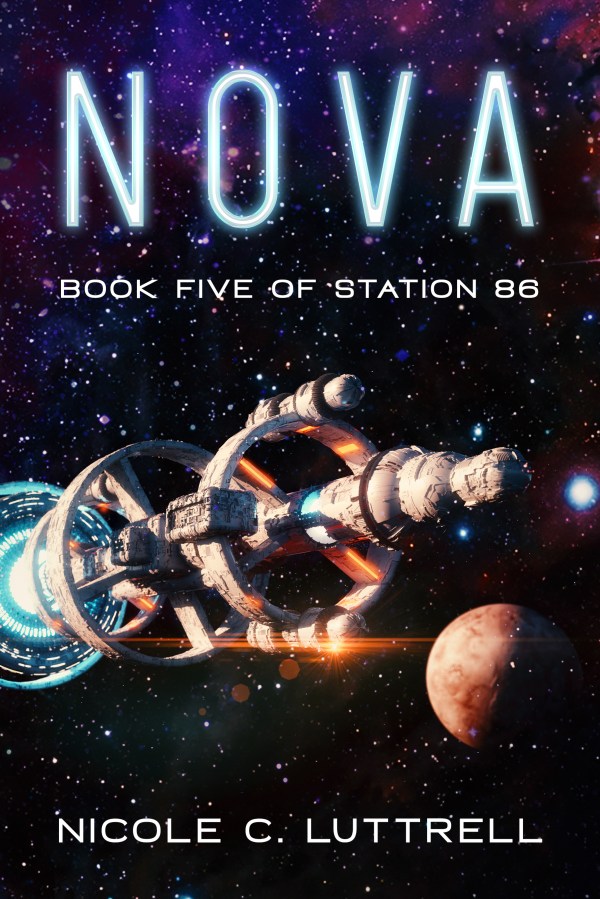
Nova, Chapter One

Hold on! This isn’t the start of the story. To go back to the prolog, click here.

To begin at the start of Station 86, click here to get book one for free.

Sennett

Station 86, six years before our story takes place.

Sennett expected Lo to be annoyed with her, but instead, he laughed. “I thought you said you wanted frozen yogurt. Isn’t that the whole reason we came down here?” He was holding two dishes in his hands, his lovely crystal-like hands. She didn’t take one.

The overhead lights on the station were dimming, it must be after six. Some people who’d been to Earth said it looked like something they called twilight. The colors shifted from yellow-white to blues and purples. Lo looked so beautiful in that light. His broad, strong shoulders shook as he laughed at her disdain. His rose-pink complexion was somehow a richer hue when he laughed. His wide nose wrinkled, and he seemed to almost glow.

“Yeah, but I wanted it from Harlequin’s frozen yogurt,” she said. “They’re the only ones that don’t have that weird aftertaste.”

Lo’s face fell. “Harlequin’s is on the other side of the level,” he said. “It’s the farthest one from the transit station.”

Sennett put a hand on her growing belly. “I cannot control these cravings,” she said. “Your child has a discerning pallet already.”

“Honey, it’s been such a long day,” he said.

She sighed and took one of the paper bowls from him. “Alright, maybe this will hold them over.”

Lo put his arm over her shoulder, and they started walking toward the transit. The market level was as busy as it ever was in the evening. People stopped by after work for things that just couldn’t wait. Shops were closing down, and the people who worked in them were heading in the same direction as Lo and Sennett. People were coming the opposite way to start evening shifts at overnight shops.

Sennett ate a spoonful of her yogurt, then leaned against Lo. “What do Khloe crave when they’re pregnant?”

“That’s not how things work with Khloe,” he said. “We don’t really do the whole pregnancy thing.”

“Guess that’s why you were so confused when I was trying to explain it to you,” Sennett said.

He laughed again, and it made her smile. His laugh was another reason to love him. It was deep and loud and vibrated through his whole body.

“That was a surprise. But, you are always full of surprises,” he said.

The crowd around them thinned as they drew closer to the transit station. A train was just pulling away, taking those who had already been waiting. So the two of them had the platform to themselves.

Sennett sat down on a bench and applied herself to her yogurt. Lo stood just at the safety line, watching down the tube for the train to arrive. “You in a rush to get home?” Sennett asked.

He turned towards her, about to answer.

Then there was a sound that didn’t belong on the platform. Didn’t belong anywhere anymore. It was a sound from another time. Sennett didn’t recognize it, had never heard anything like it before. It was loud, so immensely loud, and sharp. Sennett’s ears rang. She dropped the paper cup on the ground to cover them. Then she looked back at Lo.

He didn’t have part of his face anymore. What remained was ragged, bloody, almost as though something had reached out and ripped half of it away. He fell backward, onto the transit track.

Someone was running away. Sennett saw a woman in a denim jacket with brown hair. She didn’t have time to do anything about that. Instead, she went to the edge of the platform. There wasn’t any way for her to get down to where Lo was lying. He wasn’t moving. His glow was gone. “Help!” she screamed. “Someone, help!”

Sennett didn’t find out until later that the sound she’d heard was a gunshot.

Now

The brown hair Sennett remembered was longer. It was pulled back in a dirty bun. The denim jacket had been replaced with an oversized grey sweater that looked like she’d slept in. The woman standing in front of her was a mess. Of course that wasn’t enough for her to mistake Candace sitting on her front step, with a beat-up backpack next to her.

Candace stood up when she saw Sennett, eyes downcast. “Um,” she said.

Sennett froze, still as glass. If she’d been alone, maybe she’d have killed the woman who had no business being here, not at her house and not on this station. But she wasn’t alone. Her family, the people she cared about were around her. Her brothers were there, Mason and Russell. She and Russell share the same dark complexion, though his hair was lighter than her black braids. Mason, her adopted brother, was paler than normal. Godfrey was there, almost as good as a brother, his dark brown curls completely unmanaged after their escape from Station Central. Liam was there. He was tall enough to see above all of them, with reddish-blond hair. And Sennett didn’t want Candace anywhere near this man she was only starting to love.

Finally, April was there. April, the baby who’d been nestled under Sennett’s heart while this woman killed her father in cold blood. For no other reason but that he was a Khloe and she, Candace, had been ordered to do it. April, who had the same pink complexion as her father, with wild hair that she got from Sennett.

“Mason,” Sennett said, “take April inside through the back door.”

“Mommy, what’s going on?” April asked.

“Come on,” Mason said. He picked the child up and hurried past Candace, not even looking at her. April’s AI terrier Bailey trotted after them.

Sennett was still too frozen to speak, but her brother Russell wasn’t. “Candace, what in God’s name are you doing here?” Russell asked.

Of course, he knew her. They’d been raised in the same terrorist group, The Core. He probably knew Candace better than he knew Sennett.

“I, um,” Candace said. “I tried to message you, Sennett. I didn’t get any answer.”

“That’s because I didn’t send one,” Sennett snapped.

“Wait, this is Candace?” Godfrey asked. He put a hand on Sennett’s shoulder. Whether it was to give his best friend comfort or to hold her back was unclear.

“Sorry, who’s this?” Owen asked. It was maybe the longest sentence he’d spoken since Station Central, his home, had been destroyed.

“Someone who really shouldn’t be here,” Godfrey said.

“If you’re here to offer some sort of apology, you can shove it up your ass,” Sennett said. “I don’t want to hear it, and you don’t deserve forgiveness.”

“No,” Candace said. “I mean, you deserve an apology. You deserve a lot more than that.”

“She deserves to live the rest of her life without having to think about you,” Liam said. “So why don’t you take off now.”

“I, I will,” Candace said. “But Sennett, I have to tell you something. It’s important, or I wouldn’t be here. Everyone here in Station 86 is in danger. I came to warn you.”

“Us being in danger isn’t exactly new,” Godfrey said. “Is this about the Hollow Suits? We know about them already.”

“The what?” Candace asked. “I’m sorry, I don’t know what that is. But this is-.”

She stopped. She put a hand to her head, as her eyes glazed over. Then, she sat down again on the step, hard.

Pain engulfed Sennett’s head. She thought she might fall like Candace had, but instead, she lunged for the other woman. Liam and Godfrey together barely held her back as she reached, screaming and clawing for Candace. She needed to get her, to grab her and rip into her flesh with nails and teeth.

Russell yanked Candace up, and shook her, hard. Candace’s head flopped around until she seemed to come back to the present. When she saw Sennett reaching for her, she pulled away as though she’d seen a monster. “What’s the matter with your eyes!” she cried.

“Maybe you should get the hell out of here!” Liam yelled. “You’re making it worse, not better.”

Sennett didn’t see Russell hustle Candace off. She only saw red, until she only saw black.

Copyright © 2024 by Nicole C. Luttrell

All rights reserved.

No portion of this book may be reproduced in any form without written permission from the publisher or author, except as permitted by U.S. copyright law.

If you love the story and want to support Paper Beats World, you can do so on Ko-fi
Nova, Prolog

Need to go all the way to the start of Station 86? Click here to get book one for free.

There was a yellow handprint on Maven’s desk, just at the left corner. Many years ago a little hand had reached up covered in paint and made the print before Maven could prevent it. It had been a bright hour between meetings of a darker nature, finger painting with her son. Smears of rainbow-colored paint on pages that were supposed to be cats and ships. All hung up for everyone to admire when they dried. None so precious as the smile on Russell’s face also smeared with paint.

She hadn’t washed the handprint off. Even when Russell was a little boy, she’d known that moment would be something she never wanted to forget.

Maven stared at the screen in front of her. She saw a few ships, small ones, flying away from Station Central. They were too few and too small to hold everyone who’d been on the vacation station.

Was Russell on one of them? Was Sennett?

She put her hands over her eyes. Unwilling to turn the screen off, but unable to watch.

To lose Sennett was to lose a dream. She’d been stolen from Maven when she was so young, no more than a baby. By the time they’d found her on that nothing little station that no one had even heard of before it became the station of First Contact, she was nearly a grown woman. Maven never stopped hoping they could be reunited. She dreamed of placing her hands on her daughter’s face and telling her that she loved her. That she loved her from afar and prayed for her every day. Now, that was never going to happen.

To lose Russell, well that was something else.

That was losing the moments when she made him place his hand, now bigger than hers, over the yellow handprint to measure how much it had grown. It was losing dinners spent watching him argue with his father. It was losing the quiet moments when she could just quietly admire the strong, brilliant young man she’d raised. It was losing any chance of him finding happiness, and bringing children of his own into the world. To lose Russell was to lose the brightest part of her life. Maybe the only bright part she’d ever had.

Maven shook her head. This wasn’t helping, this mourning. It couldn’t be the face she showed her generals, and they would be arriving soon. She took a deep breath. “Put it away,” she whispered. She pictured herself taking all of her rage, all of her anger, all of her sorrow, and putting it into a box like one might shove outgrown clothes to be dealt with at a later time. She pulled out a mirror to fix her makeup. Her generals would be arriving soon, and there was much to discuss. There wasn’t any reason to hold back from attacking Station 86 now. Especially since their defenses were lowered.

She had just a few moments to start typing notes for the meeting. With steady hands and dry eyes, she typed.

We must secure the existence of our people and a future for Earth’s children.

When we last left our heroes, all hell had broken loose.

When we last left our heroes, it was the beginning of the end.

Copyright © 2024 by Nicole C. Luttrell

All rights reserved.

No portion of this book may be reproduced in any form without written permission from the publisher or author, except as permitted by U.S. copyright law.

If you love the story and want to support Paper Beats World, you can do so on Ko-fi.

An overdue announcement (Yes, it’s a new book)

I’ve become the thing I’ve most hated. I’ve become that writer who leaves horrid long stretches between their books. I know how you feel, believe me. Tamora Pierce published Tempest and Slaughter in 2018, and there’s no sequel in sight.

Look, we can’t all be Brandon Sanderson, as much as we might want to be.

But that’s done now. The wait is nearly over.

Nova, the fifth book of Station 86, is launching right here on February 5th.

And I understand that the wait has been quite long. Literally, it’s been five years. Things are going to be a bit different this time around. Previous Station 86 books have, first off, been much shorter than this one. None of them before have reached novel length, and Nova exceeds it, clocking in at just under 70,000 words. So instead of posting one episode a week, I’ll be posting three. One on Monday, another on Wednesday, and a third on Friday.

You’re also going to meet a character that, if you only read what’s on the website, you haven’t had the chance to yet. His name is Michael, Godfrey’s father. He’s a survivor of the Hollow Suits on Earth, and he’s been collecting lost children to protect them. This time around, his story became too integral to what was going on aboard Station 86 to leave him to his own devices.

And besides that, I like Michael. I didn’t really mean to make a hero out of him. But here we are.

There is no secret episode this time around. It’s all going to be published here, one chapter at a time, from February 5th to April 17th. And the reason for that is simple. You deserve it.

You, who’ve been reading Station 86 since Seeming launched in 2016. You, who found the series or this blog somewhere along the way and decided to stick around. And even you if this is the very first time you’ve been here. You all deserve a full, complete, good story about a group of people trying to survive against impossible odds. Because while we aren’t facing hollow suits of armor intent upon killing us, we are all trying to survive against what seems like impossible odds.

Finally, I’ll be offering a limited number of beta copies of Nova. And I mean a very few. Because you are all my beta readers. Nova will be available here in its entirety for two weeks after its finale to make sure everyone gets a chance to read it who wants to. If you like it, I’d love it if you’d share it with your friends. It would mean the world to me.

Just in case this is your first time here, or you’ve never heard me talk about this series before, here are links to the whole series on Smashwords. And to help you get into the world quicker, book one is free.

Seeming

You Can’t Trust The AI

Virus

Station Central

The books I’m reading this winter

Winter starts next week. So it’s time for my quarterly reading goals.

I wear a lot of hats in my life. I’m a writer, blogger, critic, and witch. What do all these things have in common? They demand lots and lots of reading. As such, every year my Goodreads goal gets bigger. And I would like to read something now and again just because it’s fun.

I can’t remember the last time I did a why it works post here.

In the hopes of being more intentional, which is my word of the year, I’m trying to make sure I’m hitting all my bases. So here are the twelve books I intend to read before spring. If you’re a writer, maybe you want to read some of these with me. If you’re a witch (or witch curious) you might find some fun books here. And if you just love reading, I’m sure there are some suggestions here.

Art Magick by Molly Roberts

Molly Roberts is such a wonderful, uplifting soul. I’ve been wanting to read this since it came out. It’s a collection of art magic spells, and I can’t wait to try some out.

The Witching Year by Diana Helmuth

I’m kind of cheating here because I already started this one before Christmas started and I began reading all Christmas books all the time. But so far it’s an incredible journey through the first year of witchcraft. And it feels very much like my first year of witchcraft.

This is going to hurt by Adam Kay

Every year I read Twas the Nightshift Before Christmas. And every year I say I’m going to read the proceeding book. And every year I forget. Well this year, I’m going to be intentional (see that word of the year in there?) and read it early.

Six Wakes by Mur Lafferty

I fell in love with Mur Lafferty listening to her podcast Ditch Diggers. And I’ve been meaning to read her book forever. I’m finally getting around to it this year, so help me.

Let the whole Thundering world come down by Natalie Goldberg

We know I love Natalie Goldberg. So when I found a memoir of hers that I hadn’t read yet, I had to add it to my list.

Where the gods left off by Sara Razteresen

Razteresen is a fellow Christian witch, and I’m fascinated to hear what she has to say about it. This book appears to be about other deities and their relationships with Christian witchcraft.

The Hacienda by Isabel Canas

Someone on Instagram described this book as Mexican Gothic meets Rebecca. And honestly, that’s all I needed. Oh, and there’s a witch priest.

New Moon Magic by Risa Dickens and Amy Torok

This cover grabbed my attention, and I love moon magic. So this was as well a no-brainer.

Welcome to Nightvale by Joseph Fink

While I’ve never listened to Welcome to Nightvale, I did listen to Alice Isn’t Dead. Then I read the book Alice Isn’t Dead because I loved it that much. I know that Welcome to Nightvale is his better-known podcast. So I’m excited to explore it.

Self Publishers Legal Handbook by Helen Sedwick

I know nothing about the legal aspects of self-publishing. I’ve self-published six novels. I should maybe learn about the legal side of self-publishing.

Save The Cat Writes a Novel by Jessica Brody

Look, I don’t know what to tell you. I thought I should have read this one before now too. It’s a well-loved writing manual, and it’s past time I knew what the hell it has to say.

A Tea Witch’s Grimoire by S.M Harlow

I don’t want to say that tea is a gateway to witchcraft. But it was sure my gateway to herbs, and witchcraft.

I already have a few personal recipes for magical tea. But I could sure learn a ton more. It’s an incredibly complex subject.

So, that’s my winter reading list. Now, I want to hear from you. What are you planning to read this winter? Have you picked out your word for 2024, if you do words of the year? Let us know in the comments.

And I do want to let you know that I won’t be posting next week, as I’m taking some time off for the holiday. I hope that you all have a wonderful Christmas, Yule, Hannukah (last night), or anything else that you’re celebrating. I’ll see you back here on the 29th.

If you want to support Paper Beats World, you can do so on Ko-fi.

Are you making art or making a product?

Continuing in our back-to-basics series today, I wanted to touch on a difficult topic. It’s a question that I think a lot of creatives ask themselves. I’d like to say writers have been asking that question for longer than other artists, but that isn’t fair. Even so, I’m a writer, so I’ll just be talking to the writers today.

When we write, are we creating a piece of art or are we creating a product?

The maddening answer is that we’re doing both.

We are artists

Writing is an art, don’t let anyone ever tell you otherwise. And you are an artist, no matter what stage of your writing career you’re in. We are creating something new. Something that brings joy to people. We craft sentences with thought put into each word and each turn of phrase. We practice, read, and study to make our story the best, most original creative, and perfect story it can be.

We are marketers

But we are also selling a product. And I’m sorry if I’m the first to tell you this, but you’re probably going to have to do most of the selling of your book yourself. Even if you get picked up by one of the big publishing houses, you are probably going to do most of your marketing and promoting yourself.

If you’re an indie or hybrid writer, like me, you’ll be doing all of it yourself. And that requires you to think of your story like a product. A product that you have to market and sell.

A product that feels like a piece of your soul, surgically cut off from you and placed out in the world for people to abuse, tread upon, and spit on. No big deal.

How do we do both?

So, how do we do this? How do we craft a piece of art and still make money? How do we successfully make a living and not feel like a sell-out?

For me, it comes down to two rules. These two rules are vital, and set in stone.

The first of these rules is that you deserve to make money for your art. All artists deserve to make money for our art. Don’t ever feel bad or guilty about charging for your work.

Look, I give a lot of writing away for free. I post here weekly. I produced two seasons of a podcast that you do not have to pay to listen to. I post micro-fiction and short stories. And every time a new Station 86 book comes out, I post it here on Paper Beats World for free before publishing it.

But I charge for my books. I get paid for my reviews on Hauntedmtl. I leave links at the bottom of every post to my ko-fi account. I do not write for experience organizations, or to gain exposure. I deserve to get paid for my writing. You deserve to get paid for your writing.

The second rule is a little more nuanced. But it’s possibly more important.

Be clear about what activities are making art, and what activities are marketing.

When I’m writing a piece of fiction, I am creating art. I am not wondering if I’ll be able to sell this. I am just writing a story. Maybe it’s bad, maybe it’s good. But it’s the story that I want to tell. I’m having fun while I’m writing it.

In later drafts, I’ll polish it. Make sure the story is satisfying, and that it makes sense. That it’s fun to read. During all that I’m still not worrying about if it’s marketable. I’m not writing a main character that I think would be a cool Halloween costume or look good on a hoodie. I am writing a character that I want to trek through at least 50,000 words with. More if it’s a series. I didn’t write Sennett as a single mom and police officer because I considered her a marketable character. I wrote her that way because that’s the person who appeared in my head.

Later, when I was thinking about how to market Station 86, I sure as hell used the fact that she was a single mom cop. When I’m making a book cover, crafting social media posts about my book, making bookmarks and little video clips to share on Instagram, then I’m marketing a product. The artist part of me has given me a story. Now it’s up to the part of me that is a saleswoman to sell the hell out of it.

Render unto art what is art and marketing what is marketing.

I hope this post helps you today. Trying to balance the different aspects of a writing career is difficult. But always remember that your art is worth it. But no one’s going to see it if you don’t market it.

See you next week. And I hope you have a terrific Thanksgiving if you live in the States.

Paper Beats World is a labor of love. If you love what we do here, please consider supporting us on Ko-fi.

An overdue conversation

A long time ago, I wrote a blog post about living a more healthy lifestyle. At the time it was Summer, I was on a big healing kick, and very excited about a new app and dieting system I’d just started.

I’m not going to say the name of the app, because I don’t want to get sued. I also want to point out that my opinions are my own, and this is all based on my own experiences. If you’ve used that app and it helped you, that’s fantastic.

That being said, I am really sorry that I ever recommended that app, and I hope none of you downloaded it. First of all, it was way too expensive for what I was getting. Second, it turns out calorie counting is bad for you.

I actually stopped using the app shortly after writing this post. I kept some healthy habits, though I’m bad at keeping up with them. But I gained some healthy habits after getting rid of that app.

I ate until I was full, and didn’t worry about the calories.

I got rid of my scale and measured my health based on how I felt.

I hadn’t even thought about this for years until I started hearing about the damage done to people with eating disorders by this app.

And I honestly feel so bad. The last thing I’ve ever wanted to do was hurt someone with advice. As someone who’s never had a serious eating disorder, I had no idea how much this could negatively impact someone.

Then I watched this episode of Some More News.

Then I watched this video with Micky Adkins.

I know better now, and I can do better now.

Yes, writers need to worry about our health. But, health means all your health, including emotional.

I am not the person to talk in-depth about this. I am a writer, not a therapist or a nutritionist. But here’s what I can tell you.

I feel a lot better since I’ve stopped counting calories and started eating what makes me feel good. I feel a lot better since I’ve thrown my scale away. I feel a lot better since I move my body in fun ways, like walking Oliver, instead of feeling like I have to do boring things I don’t want to do.

I planned this post for today for a very specific reason. We’re now smack dab in the holiday season. And that means food, less time, more activities, more family commitments, food, food, and more food.

It also means that some of us are going to be around people who want to give us their opinions on the food we are eating or not eating.

So this holiday season, I invite you to listen to your own body when it comes to food. Not your social media feed, not some app that tells you to only eat 1,500 calories. Not some judgemental mother-in-law. You are an adult. You know what food makes you feel good and what makes you feel sick. Honor yourself. You deserve to enjoy all of the lush, wonderful things the holidays offer. You deserve to eat when you’re hungry until you are full.

Paper Beats World is a labor of love. If you love what we do here, you can support us on Ko-fi.

Preptober Week Four

It’s the last full week of October. This means that we’ve reached week four of Preptober.

This also means that next week is Halloween and the start of November which means any sitting down or breathing you plan to do you’d better get out of the way now.

Week four of Preptober is always my favorite week. Because it’s the week we start outlining our stories.

Hold your applause.

That’s right, we are outlining this week! Now, there are as many ways to outline as there are writers. But I thought it might help today to tell you the way I outline a rough draft. It might work for you, and it might not.

Step 1, Start with the big scenes

Whenever I start thinking about a story, some scenes just jump out at me. Or, if not a whole scene, an image. For the book I’m working on now, I have an image of an older woman in dress clothes, standing on a battlefield with a sword.

Start with the scenes you’re excited about. The scenes you know need to happen.

I like to write my scenes out on index cards. These can be moved around, erased, and thrown out if need be. This will be important later.

Step 2, Plot out the main storyline

Now that you’ve got the big scenes in place, we need to figure out how we’re getting to them. Figure out the plot points for the main story you want to tell.

Now, here’s where some people get caught in the weeds. And by some people, I mean me.

You don’t need to write down every single little that happens in this story when you’re outlining. For one thing, you probably don’t know everything that’s going to happen yet. That’s the joy of a rough draft. You’re still learning about the story. Just get down the points you’re pretty sure you want to hit.

Step 3, Layer in subplots by order of importance

Next, you’ll be outlining your subplots. I usually have too many of these, to be honest. But a good subplot adds to the main part of the story. It cannot generally be lifted out without requiring a change to the main storylines.

There’s no time or space here to go into the hows and whys and how nots of sub-plotting. But if you want, I could do a post about that at a later time. Let me know in the comments if that’s something you’re interested in. For now, it’s just important that your sub-plots come after your primary plot.

Step 4, Prepare for this to all go out the window when you start writing.

Writing a rough draft is a wonderful discovery process. You do not know everything you want to say in the book until you start writing the book. Which is, of course, the fun of writing a rough draft.

Yes, an outline is a great place to start, so you have some direction when you’re beginning your rough draft. But don’t get committed to it.

Give yourself the freedom to redo your entire outline. Let your story go off the rails if it seems better or more exciting. I usually redo my outline at least once before my rough draft is finished.

So that’s it for our Preptober series. I hope you’re eager to get into Nanowrimo next week, armed with a solid story foundation.

See you then.

If you want to support Paper Beats World, you can do so on Ko-fi.

When do you write?

We are back to our back-to-basics series, after a bit of a delay. I did mention this was going to be a delayed series.

But, as they say, timing is everything.

With that awkward segue out of the way, we’re talking about time today. As in, when you write and how often you write.

I’ve never been a big fan of the advice to write every day. While it sounds terrific in theory, it’s unrealistic. We’re all adults here. However, if you’re not, you still have responsibilities.

We are writers. But we’re also humans trying to survive in late-stage capitalism. We have to fit writing in where we can when we can. And that’s just not going to happen every day.

Don’t despair, though. I manage to finish a book or podcast season a year, most years.

So today let’s consider when we can fit writing in, when the best time to do it is, and how we can make the most of the moments we have.

Let’s start with some questions to figure out where you are, time-wise. First, when is your best time of day, energy-wise? This is basic advice, yes, but it’s worth knowing about yourself.

Me, I’m a morning person. The later it gets to the day, the less likely I’m going to get anything done. So getting up early to write before I go to work works best for me.

If you would rather stick needles in your eyes than get up a minute earlier than you have to, this isn’t your best bet.

I wouldn’t spend a lot of time fighting your internal clock if you didn’t have to. I’ve tried to write in the afternoons, after work, and it just doesn’t work as well for me. I’m tired, I’m irritated, and this is the time of the day when my family needs the most from me. Dinner needs made, Oliver needs walking, the cats need attention. This is also the time the darling husband and I tell each other about our day and all the cool things we saw on social media. To think that I’d be able to write during all that is madness. To think that I’d want to write after all that is settled and dinner is done is also madness.

So know your internal timing and honor it as much as you can.

This brings me to our next step. Before you can decide when you’re going to write, you need a crystal clear understanding of when you cannot write.

You want to start with a blank weekly calendar. I like a Google calendar, but a paper one will work just as well.

I start by putting in my work schedule. Not because it’s the most important but because it’s the thing I can’t control. These hours I am working, and I cannot plan to do anything else.

Next, I put in my family time and self-care time. This includes when I need to sleep, cook, and clean my space up a little. I’m a pretty spiritual person, so I also like to add in times I’m going to spend doing rituals, spells, or studying.

This might feel like writing, my art, is coming in fourth place.

And sadly, it is. Writing is vital to me, but I have to make money to survive. I have to take care of myself and the people (pets) that I care about.

That being said, making time for my writing is a priority. And as such, I schedule time for it.

So what if you write out your schedule and you don’t think you’ve got any time at all for writing? I get that, schedules can get tight fast. But I am sure that everyone can find some time most days to write.

If you’re sure you don’t have time to write, start by tracking your time for a week or two. Myriad apps will help you with this, or you can just keep track on paper.

Keep track of how you spend your time, without judgment. There is no reason to beat yourself up. This is your time and you get to choose how to spend it.

Once you have an idea of how you spend your time, you can see where you can cut out some space for writing. Maybe you find that you’re puttering a lot in the morning, so streamlining your morning routine might help. Maybe you’re spending too much time cleaning at the end of the day.

This is the first place I’d start cutting, by the way. If you let them, household chores can consume every second of your free time. There is always another chore, another task, another project. Don’t let yourself get sucked in.

While you will likely find a few half hours or even hours that you can spend on writing, you’ll likely also find minutes.

Likely you won’t find these while mapping out your time, but by living out your day.

Waiting for other people’s doctor’s appointments are my most common times like this. But I also travel by bus, so there’s lots of time there.

But, you might ask, what can you possibly get done in these snatched moments? Well, not a lot individually. But when you count them all up a the end of the day, week, or month, you’ll be surprised how much you can accomplish.

Finally, I want to give you the best advice I’ve ever found.

Be firm and flexible.

Here’s what I mean by this. If you have looked at your schedule and you’ve found time to write, write then. Tell the people in your life that this is your writing time, and that you are not available to do anything else during that time.

Take it seriously, and require the people who love you to take it seriously.

But understand that God laughs when men make plans. You’re going to have days when that writing session isn’t going to happen, no matter how respectful anyone is about it. You’ll get sick, pets will get sick, kids will get sick. You’ll have to pick up overtime because your gas is about to be shut off. Your water heater will explode, or the septic system will start backing up into your basement.

On the flip side, make yourself ready for unexpected moments of writing time. Maybe you didn’t realize you were going to have to wait twenty minutes to see your doctor. You didn’t know your car was going to break down. In short, you now have time you didn’t

Be prepared! Take a notebook with you wherever you go. If you prefer to type, take a tablet or laptop with you.

Because we are artists. We are creatives. And sometimes to make our art happen, we have to get creative.

So that’s it for this week. I hope that you’re finding time to write right now, as we get closer to the holidays. Let us know in the comments when you write.

If you want to support Paper Beats World, you can do so on ko-fi.

The top 8 best horror books I’ve read this year

Happy spooky season! It’s October, and it’s Friday the 13, so that’s pretty awesome.

While I always love a good horror book, they’re the best this time of year. There’s nothing better this time of year than curling up with fresh sugar cookies, a fire video on the TV, and a book about someone getting their face mauled in a haunted house.

Today I’m sharing with you the eight best horror books I read this year so far. Sadly there are only eight because I am well behind on my reading list. It’s not that I’ve been in a reading slump. It’s just that editing a podcast takes time, and life takes time. Then I decided to start reading Needful Things, which maybe wasn’t the best idea when I’m trying to finish my Goodreads goal because it’s almost 700 pages long.

But here we are, and eight is better than none. And I can honestly say, that not a single horror book I read this year disappointed.

(Speaking of podcasts, the second season of AA is out now. You can listen to all of it and season one right now on Haunted MTL.)

Now, some of these books I’ve talked about before. Some of them I either have already reviewed on Haunted MTL or plan to. So I’m not going to go into a ton of detail here. But any of these stories would be an eerie addition to your Halloween season.

Hide by Kiersten White

A tantalizing offer of money and fame lures fourteen strangers to an abandoned theme park for a massive game of hide and seek. This is not the story I thought was going to tackle the deep theme of generational guilt, but boy did it. Watch for my full review on Haunted MTL.

How to sell a haunted house by Grady Hendrix

This review is out. I read this book in a day, and it has me on a serious Grady Hendrix kick.

This book has family drama, generational pain, and Southern charm. What else could you honestly ask for?

Delicate Condition by Danielle Valentine

Again, I have talked on and on about this book, its tie-in with American Horror Story, and how this was a whole thing for me.

It’s a great book, and it’s led to a great season of AHS so far. However, if you have any trauma related to miscarriage, birthing, or anything baby-related, this is your trigger warning.

Dread Nation and Deathless Divide by Justina Ireland

Again, I went into great detail about these books here and here. If you like historical fiction, you’ll love these. If you like zombies, you’ll love them.

I do need Ireland to write another one in this series, though. Like, today.

Silver Nitrate by Sylvia Moreno-Garcia

I love this author so much. And after being kind of disappointed in the last book of hers I read, this one was such a relief.

It’s got witchcraft, movie trivia, love affairs. Watch in late November for the review.

How to survive your murder by Danielle Valentine

Again, this was something I read because of American Horror Story. You can read the whole review here. But while I was expecting a light, fun slasher book, I instead got one that talked about some very disturbing questions.

Check out my whole review here.

The Roots Grow Into The Earth by Bert S. Lechner

What says Halloween more than a collection of Lovecraftian horror stories?

I got an arc of this book to review for Haunted MTL, but it’s out now. And it is well worth the read.

So now it’s your turn. What’s the best horror book you’ve read so far this year? Let us know in the comments.

You can get my own horror novel, Quiet Apocalypse, on Amazon

Preptober Week One

Here we are, week one of October. And it’s, let me tell you, a busy week.

The first week of spooky season.

Banned Books Week, in case you missed my angry rant earlier today.

Fat Bears Week.

And, of course, it’s the first week of Preptober.

As promised, we’ll be walking through each page of my Preptober Planner together until we reach the big event in November. Because everything is better as a team.

Don’t forget, you can get my Preptober Planner on my Ko-fi store now to print out and play along all month.

Week one is all about making a plan. We’re going to answer some questions, make some lists, and get signed up on the Nanowrimo website.

First, some questions. Let’s make a plan for when you’re going to be writing, and how you’re going to make that time.

1. When are you going to write?

2. What projects do you need to wrap up before November to make space for writing a novel?

3. Are there any days I know I won’t be able to write? What days can I get in extra words to catch up?

4. What are the other obligations that you still need to meet like work, school, or home care?

Now, we’re going to consider the other people in your life. First, let’s make a list of the people who can help you this month. Who’s going to cheer you on? Who can pick up some extra work around your home? Who might bring you a coffee?

Now we’re going to make a second list of people. These are your fellow writers who are participating in Nanowrimo. Who are you writing with? Who can you meet up with for writing dates?

Next, we’re going to consider the physical things you’re going to need to write your novel.

Do you type or write on paper? Do you need index cards or post-its for organizing and brainstorming? How about a file folder for notes? Make a list, it’s time to go stationary shopping.

Finally, it’s time to go onto the Nanowrimo website and announce your project! It’s an exciting moment if you’ve never done it before.

That’s it for this week. We’re on our way to a successful month of writing together. Let us know in the comments what you’re going to be working on this November. And I’ll see you next week.

A WordPress.com Website.

Up ↑