Why Who Holds The Devil Works

In December last year, I was privileged to attend a local writer’s event at my library. Many of the authors, including me, gave small talks during the event. You can read my talk here.

Another author who spoke was Michael Dittman. And the story he told about his book was enough to have me rushing over to his booth at my first chance to grab a copy.

When I got there, I had just one question. Is the witch a good guy? Dittman laughed and said yes, she was.

So I bought the book, Who Holds The Devil. And I am so pleased I did. It was a wonderfully fun read.

Published in 2022, Who Holds the Devil is the story of a man named Aaron. He’s a quiet man who works as a researcher/ghost writer for authors and is healing from a bad divorce. One morning, his quiet healing is interrupted when the city tears down a massive tree and takes out part of his brick wall in the process.

At first, Aaron only wants to get his wall fixed. But he soon finds himself beset by a horrific spirit determined to possess him.

The main character is relatable

The main character, Aaron Moody, is going through some stuff. He’s been through a divorce. He’s being jerked around by his employers, taken advantage of. His hard work is being dismissed. He’s sad, frustrated and angry. And then a bloody tree is taken down improperly and busts up his stone wall.

From the start, he’s just a regular guy who finds himself in a terrifying paranormal situation through no fault of his own. But when the time comes, he runs towards danger and not away. He was, in my opinion, a fantastic guy to root for.

We need to see more animal friends in adult fiction

Aaron doesn’t have a cat himself. But he does occasionally get visits from his neighbor’s cat, Mr. B. As I’m sure you can imagine in a book about demons and witches, Mr. B does become an important part of the story.

I don’t know why more books for adults don’t have animal characters. They’re always great. They always add something to the story.

The witchcraft makes sense

As a practicing witch, I love a story that includes realistic witchcraft. Which isn’t, of course, to say that anyone in the real world can steal someone’s voice while sitting in a coffee shop. But the studying feels real. The laying of sigils and the use of protection magic feel very real.

Always a good thing. And since I don’t think Dittman is a witch himself, it suggests that he did his research.

I loved reading about a place I’m so familiar with

While this might not apply to everyone, it will for sure apply to anyone who is from my little town or Pittsburgh. It was so fun reading about places I have been. I have lived near Institute Hill. I’ve even walked up it, God help me. I recognize places described in this book because I’ve lived in these places since childhood. At one point, I was literally walking down Main Street while reading (a terrible habit but one I’ve never gotten over) and realized the character and I were in nearly the same place. And that was freaking cool!

This book is the perfect example of writing what you know

All of that brings me to the best lesson you, as a writer, can take from Who Holds The Devil.

Through this book, it’s clear that Dittman is writing about things he knows. Things he has experience with. He knows how to research a novel. It’s clear he’s had to deal with our courthouse and knows the weird puzzle box of a building it is. He knows this town. He might or might not be in the process of stealing his neighbor’s cat.

All of these details are real. And so it helps us to follow along with the story when it becomes unreal. When the demons start crawling out and infecting people’s minds, it’s scarier because it feels like it could happen.

This is what writers mean when we say ‘write what you know’. We are never saying that you should only write about things you have experienced. While you might have some fantastic stories, that would probably kill most fantasy and sci-fi unless you’ve got a pet dragon or a spaceship in the backyard. But you can include things you do fundamentally understand, and then build the fiction around that.

All in all, there’s a lot to be learned from Who Holds The Devil. It was a delight to read, and I would recommend it to all of you. And if there’s a book, movie or TV show that you’d like me to pick apart to see why it works, let me know in the comments.

If you’d like to support Paper Beats World, you can do so by liking or sharing this post. You can also support the site financially on Ko-fi.

Starting Chains is launching wide on May 30th. Click here to see everywhere it will be available.

My local bookstore closed

For my entire life, there’s been a bookstore on my local Main Street. It was called Book Nook. And, being who I am and doing what I do, I loved that place.

It had old-fashioned wood-paneled walls. Shelves that smelled more like an old library than a shop. As a child, my favorite part of the store was the spinning rack of bookmarks.

Did anyone else have this weird bookmark obsession as a child? Fancy bookmarks were everything I wanted in this world. These days I just use any nearby scrap of paper. That’s a little sad.

Man, that place never changed. I used to beg my mom to take me there anytime we were on Main Street. At the time, Main Street was a place we were a lot. She worked at several different restaurants over the years. We lived in three different apartments tucked above stores. There was a little five and dime where I marveled at the fancy pens that looked like crystal. We ate at Burger Hut and the Hot Dog Shoppe. We used to have Woolworths until it burned down when I was a child, but I remember sitting at the counter and having milkshakes.

I remember the fire, too. The way the smoke coughed upwards in the sky and terrified me. I worried that it would come for us as well. I think I’m still a little afraid of that.

The five and dime is gone. The Woolworths is gone. Any number of other little shops are gone. The Unicorn Gift Shop, several antique stores whose names I’ve forgotten, a frozen yogurt place. There used to be a classy little bar where I watched presidential debates during the first Obama campaign, drinking Long Island ice teas with the campaign director in my town. Now it’s the classy little wine bar where I go to enjoy a glass of chocolate-flavored wine and read. Life moves on, tearing itself down, burning itself out, building new days and lives and stores upon the memories and ashes.

But not Book Nook. Man, that place never changes.

As a kid, I went there to buy Goosebumps and Babysitters Club books, series I loved equally. As a young woman, I waited outside the door for them to open the day the last Harry Potter book came out. The storekeeper there that morning was both confused and, I think, annoyed to have some overly excited woman in her early twenties waiting at her door. Apparently, this was a new experience for her.

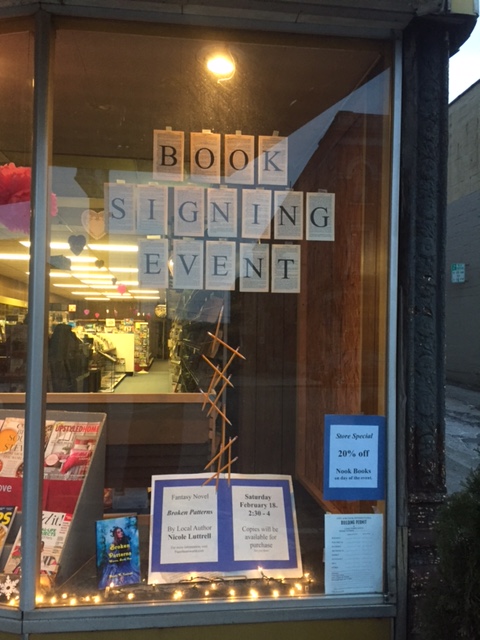
I had my first book signing there when Broken Patterns came out. A copy of the book sat in the front window for months. They even hung up a poster from Starting Chains.

For months. To the point that it faded.

That place never changed.

That was a great experience. A young mom came in, clearly with just barely enough money to get her daughter a book. I gave her a copy of mine and she was thrilled.

I hope she’s doing alright.

I’d pop in from time to time. Sometimes I’d find great things. The author’s extended version of The Stand and American Gods. I impulsively bought some hardcover books that I still love to this day. Strange The Dreamer and An Absolutely Remarkable Thing.

But I didn’t get the sequel to either book there. They never seemed to get them in.

As other stores came and went, Book Nook stayed. Its new releases dwindled. Its stationary options did too, until they went away entirely. So did the bookmarks.

There were no cute impulse buys at the counter. The same counter with the same register that had always been there. Instead, there was a display of lottery tickets. And they clearly made money from the lottery tickets. Once during a book signing, I watched an elderly woman come in and proceed to purchase a scratch-off ticket. She scratched it with no joy, then bought another and another. She kept going for quite some time, scratching tickets with absolutely no emotion on her face.

It became a place that wasn’t fun to be in. Where I rarely if ever found new books I was interested in reading. The hours were erratic, so even if there was something there I wanted, I had a hard time coming in.

And it never changed.

Earlier this year, I received an email from the manager, telling me they were going to close and that I needed to come pick up my books.

Losing my local bookstore has left me with mixed emotions. They survived so much, hanging on through decades of Amazon encroachment and even the pandemic. But they never, ever changed. They never grew with the times. They did nothing to offer readers and buyers a better experience. They simply existed.

And now, they don’t.

I do not blame the store entirely. But neither do I blame competition entirely. Neither do I blame consumers entirely. But all three share a bit of the blame.

Myself included.

I could have been more patient and asked them to order the books I wanted. I could have scheduled more events there, even though the reason I stopped was that no one showed up to them.

But in the end, the issue lies with all three. We should shop small when we can. Big corporations should stop using such predatory practices. They won’t, but they should. And small businesses should put in the effort to grow and change with the times.

In the end, though, I don’t write this to blame anyone. I write this to mourn. No matter the reasons, my local bookstore is closing. The store I shopped in as a child is gone. And I hate that. So I just wanted to hold space for it today.

I don’t remember who said this, or even where I first heard it. But someone somewhere said that every piece of writing is a love letter or a eulogy. This was both.

If you love what we do here, you can show your support by liking, sharing or subscribing. You can also support Paper Beats World financially on Ko-fi.

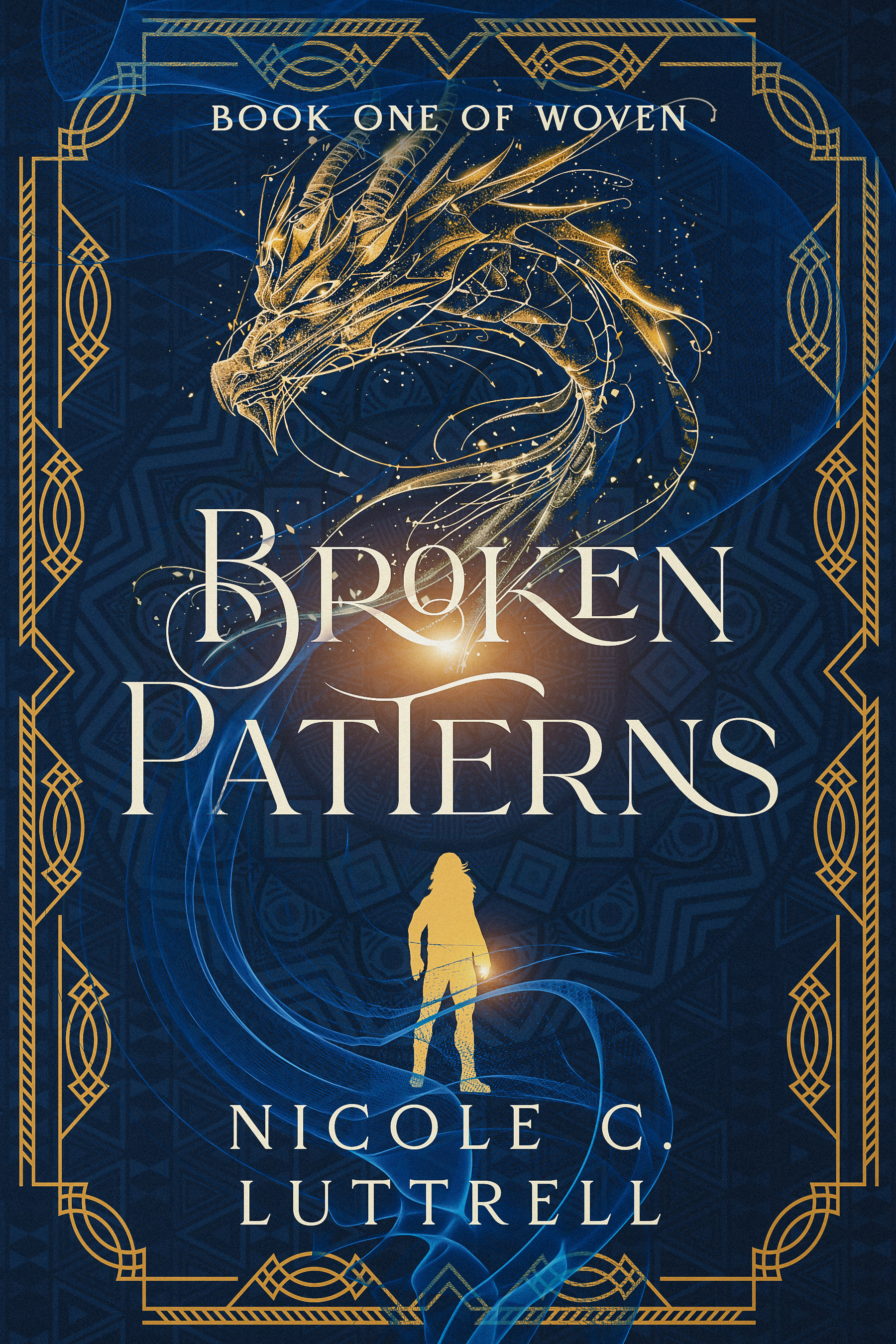
Broken Patterns is going wide on April 25th. You can preorder it now by clicking on the image below.

My review of Inspiring Creativity Through Magick

Writing and magic seem to go hand in hand. When I started my witchcraft practice, I was shocked by how many witches were also writers.

Well, not just writers. Singers, painters, dancers, actors. Witches seem drawn to art.

That makes sense to me. Writing has always seemed to me a tangible form of magic. To be able to experience other worlds while lying on your couch. To be distracted in stressful times and invited to another place or time. To hear the thoughts and musings of people long dead, but still here in ink and paper. To write something, and have it read by people all over the world.

That’s magic.

Many books have been written about writing from a magic perspective. I’ve read a few. But, I’ve never really talked about them here. I don’t know why. Maybe it’s because the witch part of my life still feels like something very private. I’m slowly getting over that. I even posted a whole Modern Witch review series on Haunted MTL. So I think it’s time to introduce you to my favorite writing books for witches. Because if there’s one thing that’s universal, it’s that we all want to be better artists.

Today, we’re talking about Inspiring Creativity Through Magick, by Astrea Taylor.

Published in 2023, Inspiring Creativity Through Magick is a firsthand guide to creating a fulfilling ritual around your art. It walks the reader through each step of the creation process, from inspiration to the final product. And it is delightful.

The book starts with a conversation about creative spirits. Muses, and the like. This was great fun, and I actually learned about spirits I hadn’t heard of before.

The thing I appreciated most about this part was the discussion of the unnamed creative spirits that many artists say they’ve come in contact with. Taylor even mentions Stephen King talking about his muse in one of my favorite writing books of all time, On Writing. There he talks about his muse being a short man with a cigar that might show up and start working his magic if King puts the work in and all the conditions are right.

Taylor also talks about Big Magic, another book I’ve talked about here. This book also talks about feeling as though the artist is a partner in the act of creation. We are all capable of tapping into the creative flow of the universe and inviting spirits that want to help us bring our creations to life.

And we know this is true. Every artist has those moments when it doesn’t even feel like we’re on the same plane of existence anymore. When the words are coming or the paint is flying with no effort. When all the pieces fall together, or that subplot now makes sense and is exactly what the main story needed, or the character says just the right (or wrong) thing at just the perfect time. When you write a poem that just smacks you between the eyes because it’s so true, and you hadn’t even thought of those words before they were in front of you on the page, somehow coming out of your own hand.

Clearly, this was my favorite part of the book.

We then delve into the step-by-step process of creating a finished art piece. Not the technical details, of course. This book is for all artists, after all, and that would be a bit much. Instead, it explores the basic stages of creation. The inspiration phase. The first pass phase where we create our rough drafts and start telling ourselves our stories. The edits, and revisions. And of course, the eventual release of the work out into the world.

This is wonderful for many reasons. First, sometimes it’s hard to feel the creative magic in the later phases. Writing a rough draft is all creation. Making something from nothing. There are no rules, we’re just throwing words on the page and seeing what sticks. But editing? Revising? Grammar checking? That’s not creative.

It very much is. Honestly, I find that I’m far more creative in the second and third passes of my stories. It doesn’t feel as immense anymore. I have a better idea of what I’m trying to say, and how I utterly failed to say it the first time. So I can fix this bit here, and rewrite that part there. I know what doesn’t work, and now I can figure out what does work. And this is a process that is clearly explained in a far better way than I ever could in this book.

It’s also wonderful to have this breakdown of steps, especially as a beginner. Looking at a finished project, it’s impossible to see all the work that went into it. And if you’re starting at the other end, looking at a blank page, the thought of turning that blank page into a whole book is incredibly overwhelming.

Breaking this process down, step by step, is more manageable. And it’s something I still do. Today, I’m not writing a book. I’m just writing this scene or this chapter. I don’t need to worry about the edits or the rewrites. Or even the next chapter. All I need to worry about is writing this page right now.

One thing I will say is that Inspiring Creativity Through Magick does feel like a beginner book. If you’ve been creating art for a long time, it might feel redundant. I already knew the steps of creating, I didn’t need them drawn out for me. So there might be parts that a more experienced artist finds a bit boring.

Overall, though, this was a really useful book. I think every artist can take something useful and uplifting away from this book. Whether you’re a witch or not, it’s well worth a read.

If you want to support Paper Beats World, you can do so on Ko-fi

My top ten favorite books of 2024

The year is nearly over. And while the events of 2024 might have sucked (it sucked so hard) I read some great books. Like, some really great books.

So let’s focus today on the good books and not on the horrible life and world events.

Here are the top ten best books I’ve read this year. It was a tough decision. I was shocked that Rift didn’t make it, even though I loved that book. But here’s what made the cut.

Also, if the book in question is a horror book, assume that I reviewed it on Haunted MTL. Just in case you want a more in-depth perspective on one title.

You Like It Darker by Stephen King

I can’t believe a King book made the list at the bottom! Don’t worry, he’s coming out with a new Holly book next year, and I’m sure that one will make it higher.

I did a whole review of this one on Haunted MTL. But the short version is this.

You Like It Darker had stories for long-time King fans, like a follow-up to Cujo. But it also had some fantastic stories that any new reader will love. My favorite of the bunch is Danny Coughlin’s Bad Dream.

A Well Trained Wife by Tia Levings

This is not an easy read. But it was so impactful. Here’s a link to my full review. But if you’re struggling with an abusive religion or an abusive marriage, this is the book to remind you that you are not alone.

Hekate by Courtney Weber

If you’re interested in witchcraft, or if you’re already practicing and want to deepen your understanding of the goddess of Witchcraft, this is a must-read.

Bad dreams in the night by Adam Ellis

If you’re not already following Adam Ellis on Instagram, do it. These stories were eerie, clever, and fun to read.

Hide comic by Kiersten White

This was a year of comic books for me, starting with Bone and ending here.

Last year I read Hide and loved it. When I found out there was a comic version, it seemed like a great read. And, it was. Whether you’ve read Hide the novel or not, you should check this graphic novel out.

Two sides to every murder by Danielle Valentine

If you’re a big slasher or true crime fan, like you know I am, this is a book for you. It had all the quaint and gorey charm of a good horror movie, with a modern feel.

The Hacienda by Isabel Canas

I read this book in January, and I haven’t shut up about it since. It’s a fantastic little ghost story with a love story built in. And, of course, a witch priest. Love it.

Three simple lines by Natalie Goldberg

I thought this would be a book about writing haiku, and in a way it was. But it was also about traveling to an unknown country and experiencing everything that had to offer. And, it turns out I needed to read that. Some of you might know I had to take a trip by myself out of my hometown alone for the first time in 16 years. But I had courage. Because if Natalie could go to Japan alone, I could go to another city alone.

So thank you, as always, Natalie.

Horror Movie by Paul Tremblay

This book was brilliant. It was so well thought out. The writing was so clever. It was so meta. The punchline was completely unexpected. I loved every second of it.

Mister Magic by Kiersten White

The fact that Mister Magic made number one on my list should not surprise anyone. This book wrecked me. I mean it led me down such a journey, I can’t begin to tell you.

If you are suffering from religious trauma, read this book. If you just want a beautiful, dark horror story, read this book. If you’re breathing, read this book.

Well, that is it for my top ten list and it for the year. But don’t worry, I’ll be back next Friday to start another year of reading, writing and struggling against the forces of evil.

See you then.

If you love what we do here and want to support us, you can do so on Ko-fi.

Woven is now available in its entirety on Amazon! Click the image below to check it out.

Stories Save Us

This is a speech I gave during the Stories We Share Event at the Butler Library event on December 27th. Several lovely people suggested that I publish it. So, here you are.

Hi there. My name is Nicole. I write stories about dragons, ghosts and spaceships. Sometimes I write about the ghosts of dragons on spaceships. And, like most people who are at least mildly funny, I have been through some hard life events.

Don’t worry, this isn’t all depressing, I promise.

I was raised by a mother with a lot of chronic health issues. This meant I spent more time in my childhood than I should have in waiting rooms, doctor’s offices, or just keeping myself occupied quietly so my mom could rest.

I passed the time by reading. Chronicles of Narnia, Goosebumps, Laura Ingells, Babysitter’s Club. These stories kept me company in dark places. I escaped into Secret Gardens and attic rooms enhabited by Little Princesses.

As an adult, I fell in love with and married a man who also has chronic health issues. Because of course, right? And again, books have come to my rescue. Stephen King, Philippa Gregory, Tamora Pierce, Kiersten White and Grady Hendrix keep me company through scary days.

Now I do more than read these stories, I write my own. And in the past few years, while almost everyone has fallen on hard times, it’s sometimes felt foolish to keep writing fiction. Indulgent, and insensitive even. A writer I’m very fond of named Matt Wallace, who wrote the Savage Rebellion series, said that marketing right now feels like standing outside of a burning building and yelling at the people coming out, “Hey, you wanna buy a book?”

But the answer is yes, yes I actually do want to buy a book and read it. I want stories.

Stories can save us. And they do this in two ways. The first is of course that they’re entertaining. It’s fun to read. And while you can’t run away from your problems, you can take a break from them. Maybe you need some time in Narnia, or a haunted house, or a world where sewing is magic. Because after we take that time, take that break in a book, we come out a little bit stronger. Maybe that gives us the clearer eyes we need to look for the helpers that Mr. Rodgers told us about. Maybe it even gives us the strength and courage to be the helpers.

Here’s the other thing that stories do for us. They tell us that we are not alone. Fear can make us feel like we’re the only ones suffering. That no one else understands the pain we’re going through. But that’s not true. We’ve all had those seasons in life where we’ve gotten a scary diagnosis, tried to leave a dangerous relationship, fought an addiction, moved far away from everything familiar, or worried about how we’re going to pay rent and get groceries, and keep the electric on. We’ve all said goodbye to people we never wanted to say goodbye to, or had something violent and terrible happen to us that we neither deserved or saw coming.

Neil Gaiman said this about writing Coraline. “Fairy tales are more than true: not because they tell us that dragons exist, but because they tell us that dragons can be beaten.” But we knew this before Gaiman. The author of Beowulf knew this and wrote about monsters and dragons that the great hero faced. These stories comforted and guided our first ancestors. They helped them cope, heal, and find the courage they needed.

We are not going to fight literal dragons. We aren’t going to face Voldemort, or a sentient haunted house, or a series of unfortunate events orchestrated by a school friend of our dead parents. But we are going to fight our own dragons. And a lot of the time we win, and live to see brighter days.

What worries me, is how many people can’t remember the last time they read something for pleasure. Most of us spend a lot more time doom-scrolling than resting our hearts in fiction. If that’s you, find a book you want to read today. We are standing in a library right now. Find a book to take home with you. Take half an hour, ten minutes, hell five minutes, and read a story you love. Maybe it’s something you read as a child, or maybe it’s a new book. Maybe it’s wildly out of your age range. Look, when I’m stressed I reach right for Beverly Cleary so I’m not going to judge.

Make the space for you to have joy, no matter how bad your day is going. Because we all need to remember that dragons can be beaten.

Falling From Grace is coming in December

Once upon a time, I wrote a story about a boy who wove visions and a girl who spun light. About how, together, they changed their world for the better.

I love that story. But it had a few problems. Problems I only saw after writing three whole books about Devon, Lenore, Sultiana and Victor. All of my main characters but one were born into nobility and wealth. All of them were mages.

Now, that is all well and good. But it’s also a narrow view of the world. Most of us aren’t wealthy. I’m sure as hell not. Most of us are not gifted with such inherent talent that it cannot be denied, which I feel is the closest equivalent to mages in our world.

Some of us have to get by on working hard, saving money and learning skills.

So I wanted to write a story in the world of Woven about a regular woman. Maybe someone not gifted, or destined to do great things. A woman who chose to do great things instead, and shape the world around her through determination and courage.

This brought me to Grace.

You might remember Grace as the angry woman Victor left behind when he moved to Septa. And if you didn’t like her, I’m sorry. I never meant for her to be even a temporary antagonist. She had every damn reason to be angry. Wouldn’t you be if your boyfriend vanished and ended up dating some rich girl?

I needed to give Grace a chance to tell her own story. And in doing so, I told a little of mine as well. Because while I was writing this book, I was also discovering modern witchcraft.

Falling From Grace was first published in 2020. It was a terrible year for most of us, but at least Trump lost his election bid that year. But this time he won, and I think we need Grace again.

I think we need as many women and men as possible who are ready to fight against a mad king. We need witches, advocates and activists. And we need stories about them. So here is mine.

Preorder Falling From Grace here.

I loved writing this book. And I hope that you love reading it. It’s fun, sweary, irreverent and optimistic. I hope it inspires you to see some light in a dark time.

My review of Three Simple Lines

I have talked (a lot) about Natalie Goldberg and how much her work has taught me about writing. While she’s best known for Writing Down The Bones, she has many other books about writing, Zen, and how those things intersect.

Having read Writing Down The Bones, Thunder and Lighting and Wild Mind, I thought I knew what to expect from Three Simple Lines.

I was wrong.

Released in January of 2021, Three Simple Lines is a deep and reverent look at the art of haiku. To really explain this book, I think it’s best to start by describing what it is not.

It is not technically a writing manual. At least not in the same way Writing Down The Bones or Wild Mind were. This is not a collection of personal essays, followed by introspective writing advice and prompts. There are no exercises in this book.

Instead, Three Simple Lines chronicles two trips that Goldberg made to Japan to learn about two Haiku masters that inspired her work; Matsuo Basho and Yosa Buson.

Most of the book reads like a travelog. And honestly, with Goldberg’s deep and melodic writing style, I could read her description of a trip to the grocery store. So that alone was worth the price of admission. I loved her descriptions of exploring Japan. Especially the food.

This would have been an education by itself. If you want to write about travel, this is how to do it. I wanted nothing more than to hear everything about her trip.

But of course, that wasn’t all of it.

Learning how to write a haiku isn’t hard. You write three lines. They should add up to nineteen syllables. The standard belief is that the lines should be five syllables, then seven, then five. But most artists agree you can play a little fast and loose with that.

The soul of a haiku comes from the subject matter. A haiku should capture a moment in time, like a firefly in a bottle. Some people say that they should exclusively be about nature. But I’ve seen plenty that have moved me and had nothing to do with nature. The important thing is that it captures that moment and the feelings within that moment.

These descriptions seem simple, and they technically are. The difficult part is in the doing. This takes years and even lifetimes to master.

During Three Simple Lines, Goldberg talks about the lives of famous haiku masters. She also shares some of their most famous works. I am astounded by the slow pace of these artists. They seemed dedicated to their craft before all else.

This is especially astounding to my modern mind. I feel like I am so often focused on producing rather than creating.

Three Simple Lines is a blend of Goldberg’s story and the stories of these two haiku masters. If nothing else, this book will leave you inspired by the small, lovely craft of haiku.

And probably craving mochi.

If you love the story and want to support Paper Beats World, you can do so on Ko-fi.

Broken Patterns is now live! You can get it right now on Amazon.

We need to talk about A Well-Trained Wife

Sorry, today’s post isn’t ten-themed. There will be more of that this week. But I just finished A Well Trained Wife by Tia Levings. And I need to talk about it.

Like, a lot.

For those who saw Happy, Shiny People on Amazon, Levings’s name might sound familiar. That documentary introduced me to her, as well as Fundy Fridays, one of my favorite YouTube channels. It also set off a very long journey into the anti-fundamentalist movement for me. A Well Trained Wife is part of that journey.

A gut punch part, but a part nonetheless.

I feel like I sat across from Tia over coffee and heard all of this. I delighted in her successes. I felt rage when people abused her. Honestly, after reading this book I kind of want to put her ex-husband’s name in a vinegar jar. The only thing stopping me is that I doubt Tia would be too happy with that.

This book talked about a lot of situations I have personal experience with. I was also in a physically abusive relationship. I was also raised in a high-control fundamentalist religion. I also escaped from both. Maybe that’s why I have such a strong reaction to this book. Maybe there are way too many of us who might feel that way.

And I have one more thing in common with Tia, which I’ll get to soon. In the meantime, I want to talk about why this book was so powerful, and why everyone should read it.

So many horrible, beautiful lines

When you read A Well Trained Wife, you might want to do so with a highlighter. Or at least the highlighter function on your tablet at the ready. Because there are so many lines that jump off the page and demand to be remembered. Of course, the best example of this is the tagline for the book.

Today it hit me when he hit me, blood shaking in my brain. Maybe there wasn’t a savior coming. Maybe it was up to me to save me.”

Damn Tia, I feel like I got hit after reading that line.

Her healing hasn’t been easy

I thought Tia’s story was going to end after she escaped from her ex-husband and divorced him. But the story went on. She talked, openly and honestly, about her healing process. How it wasn’t a straight line. There were setbacks, backtracking. She got into a relationship too early. She had to go to several therapists before she found one who helped her. She got sick and had to help heal herself. She had to rest. She wasn’t able to be the mother she wanted to be.

I think too often we end stories too soon. We don’t see the emotional fallout. The monster is defeated, the hero saves the day, and we assume everyone’s going to live happily ever after.

This is fine in fiction, to a point. But it’s not how real life works. When we experience trauma, we have to heal from that. We don’t just bounce back. Especially after years and years of trauma.

When I left an abusive situation, I was very much in that movie healing headspace. I left that ex, left my high control group church, and thought life would be all good. After all, I was free at last!

But it’s not that simple. Leaving is, first off, not always safe. It’s not always easy. Sometimes some factors mean you have to keep seeing your abuser and smiling like we’re all friends now. Shouldn’t we be able to laugh about the time he shoved me against the wall and grabbed my arm so hard he left bruises? Oh, was I not supposed to tell the new girlfriend that story? Oh well, here’s that box of T-shirts you left in the back of the closet. See you later!

Healing is healing. And healing from emotional trauma takes time. I am still healing from my experiences. And Tia is as well.

We don’t expect someone who survived a house fire to be out to brunch with a smile the next day. We shouldn’t expect it of people healing from trauma either. And I hope that I’m not the only one who feels seen reading this.

Her message is terrifying, and it’s one that I can echo

As I’ve already hinted, I have a lot of the same trauma as Tia. However, I do want to point out that I never experienced anything as horrific as she did. I grew up in a high-control church, surrounded by women who toed the gender expectation line and insisted that I do the same.

Levings says that she wrote this book because she wants to warn people about the rising of Fundamental values in our country. The Joshua Generation is rising. And those of us who escaped that life, those who still carry physical and emotional marks, are terrified of it. And we’ve got to sound the warning.

We cannot force gender expectations on people. Especially the children coming up. It kills kids. Men and women suffer under this umbrella of expectations that most if not all of us fall short of. That none of us should expect of ourselves.

Look, I don’t talk about my faith a lot here because it’s very personal, but I feel compelled to say this. Gender norms are defined by people, not God. God does not care if girls wear jeans or boys wear skirts. God wants us to thrive, and care for each other.

As the prophets Bill and Ted say, be excellent to each other. That’s all that matters.

Making someone feel shitty because they don’t fall in line with made-up owner manuals our genitals seem to come with is not being excellent to each other.

Writing saved her

Finally, as this is a writing blog, I’d like to bring our discussion back to writing.

A lot of things came into Tia saving herself. Her maternal need to protect her children. Her friendships woven across the country across the internet. Her bravery. Her kindness.

It was also her writing, though.

Her writing was an outlet while she was trapped. Her writing gave her an outside community that her husband couldn’t control. Her need to create gave her the strength to stand up for herself. It empowered her to seek God in a new home.

Writing saved her.

Writing saved me, too.

Your art can save you. It can give you freedom in a cage. Sanity in an insane world. Quiet in a storm. Or a safe place to be the storm yourself.

I highly encourage you to read A Well-Trained Wife. It is a hard read, but so very worth it.

Be who you are.

Cling to your art with bared claws.

Don’t forget, we’re still doing giveaways for the Paper Beats World anniversary series. Like this post and leave a comment for a chance to win You Can’t Trust the AI. See you tomorrow.

If you liked what you saw here today, please consider liking and sharing this post. Or you can support the site financially on Ko-fi.

Broken Patterns is available now for preorder! You can order it now on Amazon.

The best books I’ve read in 2023 so far

July is halfway gone, which means several things. It means back-to-school sales are starting, my local convenience store put out its first bag of candy corn, and I should have had this post out two weeks ago.

But, that just means I’ve had a chance to read a few more books that have made it on my list of the top ten best books I’ve read so far this year. And I’ve read some pretty awesome books so far. 

As always, these are listed from ten to one. 

(You can always follow along with what I’m reading on Goodreads.)

 Equal Rites by Terry Pratchett

If you’ve never read anything by Pratchett, I don’t know how to describe this book to you. 

This is the story of a little girl who’s given the magic of a wizard. The trouble is that girls aren’t wizards in her world. So after the local witch does her best to teach the girl, she instead has to get her to the School of Unseen Arts. Of course, hilarity ensues. 

Light Magic for Dark Times by Lisa Marie Basile

Easily, this is my favorite witchcraft book. It dives deep into the hard topics. With spells for self-care, emotional healing, and facing our darkest and lightest selves, this book really has helped me through some hard times. 

Shut up and write the book by Jenna Moreci

I got an arc of this book and did a whole review right here. So I’m not going to go into too much detail. Suffice to say, it’s a great book for anyone who needs help navigating the writing and publishing world. In other words, all writers. 

Memoirs of a Geisha by Arthur Golden

This is not the first time I’ve read this book. And I’ll be the first to admit that it’s all sorts of problematic. But it’s also an absolutely gorgeous look at a part of the world I will likely never see. It’s just dripping with gorgeous details of kimono, architecture, art, culture and interpersonal relationships. It is, in short, just a gorgeous read.

Series of Unfortunate Events by Lemony Snicket

I’m just including the whole series here because you have to read them all if you’re going to read any of them. If I had to pick a favorite, it would be The End.

This series is fun, dark, twisted and surprisingly educational. 

How To Survive Your Murder by Danielle Valentine

I did a whole review on this book, including a long-winded explanation of why I read it in the first place, on Haunted MTL. So I would definitely suggest reading that if you’re a fan of American Horror Story. 

Deathless Divide by Justina Ireland

This is the sequel to a book coming up later in this list. But I wanted to include it because it honestly felt so different from the first one. This is a gunslinger Western but with zombies.

Again, I did a full review of this book on Haunted MTL.

Dread Nation by Justina Ireland

This is the book I was talking about a moment ago. And it was entrancing. If Deathless Divide is a Western with zombies, Dread Nation is a post-civil war period piece with zombies. And it was fantastic. Once again, see Haunted MTL for a full review

How to Sell A Haunted House by Grady Hendrix

This book has been all over Bookstagram, and for good reason. I read this book in one day. It was, in short, fantastic.

Unfortunately, I am planning to do a review on Haunted MTL, so I’m not able to say much. Look for that review next week. But until then, go read this book. 

Squid Row by Bridgett Spicer

Finally, we end not on a book, but on a comic book. Because I need comics in my life, and this is a good one. 

This is the content I turn to when I’m feeling creatively depleted. It’s a comic about an artist named Randi living in California. She’s broke, working retail and trying to make a name for herself as an artist. Her best friend Ryan is a writer, working as a waiter, trying to do the same. 

Together they drink coffee, make art and try to pay all their bills. All the while being menaced by a big orange cat named Twinkie. I freaking love this series. It reminds me that what I’m doing now, working a full-time job and trying to make it in the writing world, is the same thing countless others are doing. And even though the strip is over, you can still read the archives here

So that’s it. Of course, I always want to hear from you. What’s the best book you’ve read so far this year? Let us know in the comments below. 

(Oh, and stop by tomorrow, because I’m going to be making a huge announcement. See you then.)

Paper Beats World is a labor of love. If you love what we do here, please consider supporting me on Ko-fi. 

Check out all my books on Smashwords during their Summer Sale!

The best books I’ve read so far in 2022

It’s almost July, which is crazy for two reasons. I can’t believe the year is almost over. I also can’t believe we’re still here as a species. 

While this year so far has been a struggle, at least my reading game’s been on point. So let’s take a moment to check out the top ten books I’ve read in 2022, so far. These are done in ascending order, but every single book on here is a must-read as far as I’m concerned. 

Shattered Bonds

By Dorothy Roberts

I read this book, and man was I in tears over it. It’s about our current situation as a country with Children Services. In particular, it’s about how Children Services seems to be specifically designed to rip apart families of color and poor families. 

It’s not an easy read. But it’s such an important one. Honestly, the only reason it’s number ten on the list is that it’s not what I’d call an enjoyable read. I didn’t have fun reading it. I did kill two highlighters making angry notes in the margins. 

City Magic

By Christopher Penczak

Since the launch of Quiet Apocalypse, I’ve been a bit more open about this specific aspect of myself. And, I think I’ve always been pretty clear that I’m only really happy living in an urban environment. This book was a must-read for me.

It’s a bit outdated, especially the parts about technology. But the vast majority was super useful and incredibly uplifting. If you have even a passing interest in witchcraft and city living, read this book. 

(Side note, do you guys want me to talk more about my witchcraft journey? Let me know if you do.)

How to be a Christian Witch

By Valerie Love

The whole concept of being a witch and still loving Jesus might seem weird until you start looking into it. Then it’s the most natural thing in the world and you start to realize that no one is more witchy than an old Catholic grandma. (Don’t say that to her, though, she’ll hit you with her broom.)

Reading this book was like getting a hug and having tea with Valerie. And I adored every moment. 

Again, if you have even a passing interest in witchcraft and also happen to be a Christian, consider checking this out.

End of Watch

By Stephen King

This was the final book in the trilogy that started with Mr. Mercedes. And it was, let me tell you, awesome. The epic story of a retired detective and a psycho with a grudge was just spectacular. It was for sure an example of a book being too short, even though it was a brick-sized hardcover. 

The Lottery

By Shirley Jackson

I finally got the nerve to read the whole short story collection that contained Jackson’s epic short, The Lottery. And I have to tell you, it was an experience.

If you want to be just soaked in 50’s vibes, while occasionally getting the shit scared out of you, you’ll love every second of this book. I spent most of my time reading this interrupting whatever the darling husband was reading because I just had to share passages with him.

I was expecting a collection of spooky little tales. I got a whole lot more. 

Savage Bounty

By Matt Wallace

Normally trilogies suffer from a book two slump. I sometimes refer to this as a bridge book. You need to read it to get to book three, but it’s not super thrilling.

Wallace managed to avoid that. 

This is the sequel to Savage Legion, which made it onto my list last year. It continues the story of a group of people, fighting a battle for the soul of their country. And let me tell you, I loved every page. 

Days of Blood and Starlight

By Laini Taylor

This is another book two in a trilogy. And I’ll be honest, it was a bit of a slouch compared to book one.

But only if we’re comparing it to book one. 

I’m going to talk more about this series since book one is the next one on the list, so let me just say that this is an epic fantasy set in modern times. And it is such a surprising and lovable journey.

Daughter of Smoke and Bone

By Laini Taylor

Book one in the series, Daughter of Smoke and Bone is the story of a girl between worlds. Raised by demons, living in the world of men, loved by an angel. She’s a part of a war she doesn’t know anything about. Until she gets pulled in. Then, she’s a real big part of it. 

I have yet to pick up a Laini Taylor book that I didn’t dive into. And the saga of Karou is no different. 

This is How You Lose the Time War

By Amal El-Mohtar and Max Gladstone

If you haven’t read this, you need to right now. 

It’s the story of two time travelers, each trying to change the timeline for the good of their side. As they go through history, making small and big changes, they start leaving each other notes.

Enemies to lovers are nothing new. But the writing, storytelling, and just overall vibe of this book are.

The notes are teasing, at first. Then they become something more. 

The next person who tells me genre fiction can’t be literary, I’m throwing a copy of this book at them. 

Hard. 

The Graveyard Book

By Neil Gaiman

If there ever comes a day when I don’t include a Gaiman book either I’ve run out of them or been body-snatched.

The Graveyard Book is technically a children’s book, but you won’t catch me giving a damn. It’s the story of a boy named Bode (short for Nobody) who’s raised by a collection of spirits in a graveyard. As he grows, he discovers that he’s being hunted by a mysterious cabal of men who call themselves Jack.

It was such a good read. And the illustrations were amazing. I loved every second of it. 

So that’s it for my list. Will any of these books still be on my end-of-year list? It’s certainly possible. Or maybe my second half of the year will blow everything out of the water. We’ll have to see. 

What about you? What are the best books you’ve read so far? Let us know in the comments so we can all share in the reading goodness. 

Paper Beats World is a labor of love. If you would like to support this site, you can do so on Ko-fi.

Amazon link

Smashwords link

A WordPress.com Website.

Up ↑