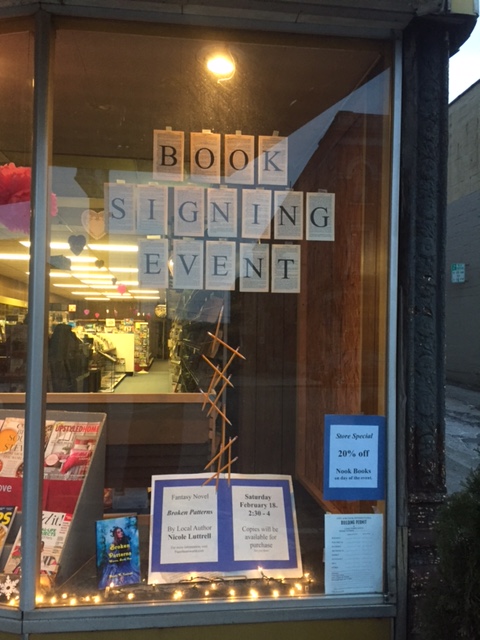
My local bookstore closed

For my entire life, there’s been a bookstore on my local Main Street. It was called Book Nook. And, being who I am and doing what I do, I loved that place.

It had old-fashioned wood-paneled walls. Shelves that smelled more like an old library than a shop. As a child, my favorite part of the store was the spinning rack of bookmarks.

Did anyone else have this weird bookmark obsession as a child? Fancy bookmarks were everything I wanted in this world. These days I just use any nearby scrap of paper. That’s a little sad.

Man, that place never changed. I used to beg my mom to take me there anytime we were on Main Street. At the time, Main Street was a place we were a lot. She worked at several different restaurants over the years. We lived in three different apartments tucked above stores. There was a little five and dime where I marveled at the fancy pens that looked like crystal. We ate at Burger Hut and the Hot Dog Shoppe. We used to have Woolworths until it burned down when I was a child, but I remember sitting at the counter and having milkshakes.

I remember the fire, too. The way the smoke coughed upwards in the sky and terrified me. I worried that it would come for us as well. I think I’m still a little afraid of that.

The five and dime is gone. The Woolworths is gone. Any number of other little shops are gone. The Unicorn Gift Shop, several antique stores whose names I’ve forgotten, a frozen yogurt place. There used to be a classy little bar where I watched presidential debates during the first Obama campaign, drinking Long Island ice teas with the campaign director in my town. Now it’s the classy little wine bar where I go to enjoy a glass of chocolate-flavored wine and read. Life moves on, tearing itself down, burning itself out, building new days and lives and stores upon the memories and ashes.

But not Book Nook. Man, that place never changes.

As a kid, I went there to buy Goosebumps and Babysitters Club books, series I loved equally. As a young woman, I waited outside the door for them to open the day the last Harry Potter book came out. The storekeeper there that morning was both confused and, I think, annoyed to have some overly excited woman in her early twenties waiting at her door. Apparently, this was a new experience for her.

I had my first book signing there when Broken Patterns came out. A copy of the book sat in the front window for months. They even hung up a poster from Starting Chains.

For months. To the point that it faded.

That place never changed.

That was a great experience. A young mom came in, clearly with just barely enough money to get her daughter a book. I gave her a copy of mine and she was thrilled.

I hope she’s doing alright.

I’d pop in from time to time. Sometimes I’d find great things. The author’s extended version of The Stand and American Gods. I impulsively bought some hardcover books that I still love to this day. Strange The Dreamer and An Absolutely Remarkable Thing.

But I didn’t get the sequel to either book there. They never seemed to get them in.

As other stores came and went, Book Nook stayed. Its new releases dwindled. Its stationary options did too, until they went away entirely. So did the bookmarks.

There were no cute impulse buys at the counter. The same counter with the same register that had always been there. Instead, there was a display of lottery tickets. And they clearly made money from the lottery tickets. Once during a book signing, I watched an elderly woman come in and proceed to purchase a scratch-off ticket. She scratched it with no joy, then bought another and another. She kept going for quite some time, scratching tickets with absolutely no emotion on her face.

It became a place that wasn’t fun to be in. Where I rarely if ever found new books I was interested in reading. The hours were erratic, so even if there was something there I wanted, I had a hard time coming in.

And it never changed.

Earlier this year, I received an email from the manager, telling me they were going to close and that I needed to come pick up my books.

Losing my local bookstore has left me with mixed emotions. They survived so much, hanging on through decades of Amazon encroachment and even the pandemic. But they never, ever changed. They never grew with the times. They did nothing to offer readers and buyers a better experience. They simply existed.

And now, they don’t.

I do not blame the store entirely. But neither do I blame competition entirely. Neither do I blame consumers entirely. But all three share a bit of the blame.

Myself included.

I could have been more patient and asked them to order the books I wanted. I could have scheduled more events there, even though the reason I stopped was that no one showed up to them.

But in the end, the issue lies with all three. We should shop small when we can. Big corporations should stop using such predatory practices. They won’t, but they should. And small businesses should put in the effort to grow and change with the times.

In the end, though, I don’t write this to blame anyone. I write this to mourn. No matter the reasons, my local bookstore is closing. The store I shopped in as a child is gone. And I hate that. So I just wanted to hold space for it today.

I don’t remember who said this, or even where I first heard it. But someone somewhere said that every piece of writing is a love letter or a eulogy. This was both.

If you love what we do here, you can show your support by liking, sharing or subscribing. You can also support Paper Beats World financially on Ko-fi.

Broken Patterns is going wide on April 25th. You can preorder it now by clicking on the image below.

My thoughts after Pathfinders Writing Collective’s March Madness

I got an email on Monday that maybe you got too. It was from the Nanowrimo organization, explaining that they are shutting down.

I have mixed feelings about this. I posted months ago about why I was stepping away from Nanowrimo. But it’s an organization that inspired millions of writers over the years. It gave me the inspiration and courage to write my first published novel.

This one. Available now on Amazon and going wide as of April 25th.

And yet, I also feel we are seeing the writing community’s response to AI writing. We will not support any organization that gives quarter and comfort to AI platforms that steal our work and produce flat and soulless stories flooding our markets.

There is one part of the letter that I agree with, though. Interim executive director Kilby Blades said, “Many alternatives to NaNoWriMo popped up this year, and people did find each other.”

And this is true. We found each other. And this past month I participated in a writing challenge that does just this. The Pathfinding Writers Collective March Madness event. And it was a fantastic experience. Even though my team lost. If we’re being fair, I personally lost twice.

Let me explain.

My personal goal for the month was to write for 31 hours in March. One hour a day. And that sounds easy until we remember that I’m caring for a husband who had a hemorrhagic stroke. He needs an incredible amount of hands-on care. So there were a lot of days where an hour of writing was a delightful daydream.

But this was still an incredible success for me. Let me explain.

I still wrote more than I had been writing

As mentioned, this is a busy season of my life. And for much of February my writing took a back seat. Hell, it wasn’t even in the back seat. It wasn’t in the trunk. It was in the attached trailer behind the damn car. Most days I couldn’t even think of looking at my writing.

But in March, I wrote twenty days out of thirty-one. I made the time. I tried to write an hour, but sometimes made only 15 minutes. Sometimes I only made 10. But that’s still more than what I had been doing. I didn’t make a ton of progress, but I made more than the month before.

There was this incentive, you know. This desire to make sure I had some numbers to put on the board, even if it was a small number. Because any number, any number at all, was better than zero.

I kind of love time-based writing goals

Writing goals work for me. I like having numbers to work towards. For most of my writing career, my goals were word-count based. But I’m realizing that this sort of goal isn’t conducive to actual writing. It doesn’t take into consideration all of the work that goes into writing that isn’t putting words on the page. I was ignoring the time I spent researching, freewriting, outlining and planning. Those are all vital parts of writing that need time and space. They need to not be rushed.

I also find that my writing goes faster when I devote that time, unrushed, to the brainstorming process. It’s as if by giving my mind time to mull over the story without a keyboard under my fingers, it has more space to breathe and is already written when I am ready to write.

Having a community is awesome

We’ve talked about this before, so I’m not going to devote much time to this. But that doesn’t mean it isn’t important!

It is, if I’m being honest, the most important part of challenges like this. It’s what made Nanowrimo so special.

Writing is solitary. Its deadlines are often self-imposed. I have no boss asking me for updates. I have no co-workers to bounce ideas off of. I have no external pressure to create. Which is both a blessing and a curse.

For one thing, it’s lonely. For another, it makes it so much easier to push off tasks I don’t want to do because, after all, there are no repercussions.

But when I have a team of people I’m working with, there is some good pressure. When I don’t want to let my team down, I’m inspired to get my ass in my chair and write. On days when I might not have written at all, I wrote. On days I needed inspiration, I had the rest of my team. And that made all the difference.

I didn’t take as much advantage of the challenge as I wanted to. I could have done more. I could have attended more writing sprints. I could have chatted more and made more friends. But for where I am, I think I did the best I could. And I saw so many writers reach so much farther than they thought they could. I saw this wonderful community of writers cheering each other on, supporting each other, and inspiring each other. I don’t want to give out names that aren’t mine to give, but one writer in my group wrote through 249 hours in one month. Girl, how?!

But whether we wrote almost 250 hours or thirteen hours, we all came together to reach a goal. We all made progress on our stories. And we need stories now more than ever.

So the question is, will I be participating in more Pathfinder Writing Collective events? Absolutely. I cannot wait.

Paper Beats World is a labor of love. If you want to support us, you can do so by liking and sharing this post. You can also support us financially on Ko-fi.

Broken Patterns is going wide! You can preorder it now everywhere.

Stories Save Us

This is a speech I gave during the Stories We Share Event at the Butler Library event on December 27th. Several lovely people suggested that I publish it. So, here you are.

Hi there. My name is Nicole. I write stories about dragons, ghosts and spaceships. Sometimes I write about the ghosts of dragons on spaceships. And, like most people who are at least mildly funny, I have been through some hard life events.

Don’t worry, this isn’t all depressing, I promise.

I was raised by a mother with a lot of chronic health issues. This meant I spent more time in my childhood than I should have in waiting rooms, doctor’s offices, or just keeping myself occupied quietly so my mom could rest.

I passed the time by reading. Chronicles of Narnia, Goosebumps, Laura Ingells, Babysitter’s Club. These stories kept me company in dark places. I escaped into Secret Gardens and attic rooms enhabited by Little Princesses.

As an adult, I fell in love with and married a man who also has chronic health issues. Because of course, right? And again, books have come to my rescue. Stephen King, Philippa Gregory, Tamora Pierce, Kiersten White and Grady Hendrix keep me company through scary days.

Now I do more than read these stories, I write my own. And in the past few years, while almost everyone has fallen on hard times, it’s sometimes felt foolish to keep writing fiction. Indulgent, and insensitive even. A writer I’m very fond of named Matt Wallace, who wrote the Savage Rebellion series, said that marketing right now feels like standing outside of a burning building and yelling at the people coming out, “Hey, you wanna buy a book?”

But the answer is yes, yes I actually do want to buy a book and read it. I want stories.

Stories can save us. And they do this in two ways. The first is of course that they’re entertaining. It’s fun to read. And while you can’t run away from your problems, you can take a break from them. Maybe you need some time in Narnia, or a haunted house, or a world where sewing is magic. Because after we take that time, take that break in a book, we come out a little bit stronger. Maybe that gives us the clearer eyes we need to look for the helpers that Mr. Rodgers told us about. Maybe it even gives us the strength and courage to be the helpers.

Here’s the other thing that stories do for us. They tell us that we are not alone. Fear can make us feel like we’re the only ones suffering. That no one else understands the pain we’re going through. But that’s not true. We’ve all had those seasons in life where we’ve gotten a scary diagnosis, tried to leave a dangerous relationship, fought an addiction, moved far away from everything familiar, or worried about how we’re going to pay rent and get groceries, and keep the electric on. We’ve all said goodbye to people we never wanted to say goodbye to, or had something violent and terrible happen to us that we neither deserved or saw coming.

Neil Gaiman said this about writing Coraline. “Fairy tales are more than true: not because they tell us that dragons exist, but because they tell us that dragons can be beaten.” But we knew this before Gaiman. The author of Beowulf knew this and wrote about monsters and dragons that the great hero faced. These stories comforted and guided our first ancestors. They helped them cope, heal, and find the courage they needed.

We are not going to fight literal dragons. We aren’t going to face Voldemort, or a sentient haunted house, or a series of unfortunate events orchestrated by a school friend of our dead parents. But we are going to fight our own dragons. And a lot of the time we win, and live to see brighter days.

What worries me, is how many people can’t remember the last time they read something for pleasure. Most of us spend a lot more time doom-scrolling than resting our hearts in fiction. If that’s you, find a book you want to read today. We are standing in a library right now. Find a book to take home with you. Take half an hour, ten minutes, hell five minutes, and read a story you love. Maybe it’s something you read as a child, or maybe it’s a new book. Maybe it’s wildly out of your age range. Look, when I’m stressed I reach right for Beverly Cleary so I’m not going to judge.

Make the space for you to have joy, no matter how bad your day is going. Because we all need to remember that dragons can be beaten.

Falling From Grace is coming in December

Once upon a time, I wrote a story about a boy who wove visions and a girl who spun light. About how, together, they changed their world for the better.

I love that story. But it had a few problems. Problems I only saw after writing three whole books about Devon, Lenore, Sultiana and Victor. All of my main characters but one were born into nobility and wealth. All of them were mages.

Now, that is all well and good. But it’s also a narrow view of the world. Most of us aren’t wealthy. I’m sure as hell not. Most of us are not gifted with such inherent talent that it cannot be denied, which I feel is the closest equivalent to mages in our world.

Some of us have to get by on working hard, saving money and learning skills.

So I wanted to write a story in the world of Woven about a regular woman. Maybe someone not gifted, or destined to do great things. A woman who chose to do great things instead, and shape the world around her through determination and courage.

This brought me to Grace.

You might remember Grace as the angry woman Victor left behind when he moved to Septa. And if you didn’t like her, I’m sorry. I never meant for her to be even a temporary antagonist. She had every damn reason to be angry. Wouldn’t you be if your boyfriend vanished and ended up dating some rich girl?

I needed to give Grace a chance to tell her own story. And in doing so, I told a little of mine as well. Because while I was writing this book, I was also discovering modern witchcraft.

Falling From Grace was first published in 2020. It was a terrible year for most of us, but at least Trump lost his election bid that year. But this time he won, and I think we need Grace again.

I think we need as many women and men as possible who are ready to fight against a mad king. We need witches, advocates and activists. And we need stories about them. So here is mine.

Preorder Falling From Grace here.

I loved writing this book. And I hope that you love reading it. It’s fun, sweary, irreverent and optimistic. I hope it inspires you to see some light in a dark time.

The books that inspired me to write Woven

Writers are readers first. I have been honored to know and befriend many writers, and I have never met one who didn’t have a passion for books. Ask any of us about what we’re reading, or what our favorite books from childhood are, and watch our faces light up.

(I am currently reading Halloween Tree by Ray Bradbury. Tis the season.)

What we read shapes what we write. Because of course, we want to tell the sort of stories that we love to read.

There are exceptions, of course. I love some good historical fiction, memoirs and biographies of interesting people. But I have no desire to write one of those.

As a child, I loved fantasy, science fiction and horror. As an adult, that’s what I write. And there are three series in particular that inspired my fantasy series, Woven.

Likely, you’ve read these before. If you have, maybe you can see the inspiration already. If you haven’t read them, I cannot recommend them enough. Here now are the three series, what they taught me, and how they inspired me to write Woven.

Dragon Riders of Pern taught me to love dragons and see a place for myself in writing fantasy.

This might surprise you, but Dragon Riders of Pern was my first introduction to dragons. It shouldn’t surprise you, because this introduction took place when I was about five, being read to by my aunt. I immediately fell in love with the relationships between humans and dragons. And when I discovered dragons who were just as smart, if not smarter, than humans in the film Dragonheart, I was hooked.

Dragon Riders of Pern was also the first time I remember seeing a woman’s name on the cover of a book. At least, a fantasy book. I was fully aware that The Babysitter’s Club and Sweet Vally High were written by women. And I was already hooked on Ramona. I mean no offense to Francine Pascal, Ann M. Martin, and certainly not Beverly Cleary. They wrote great books that I loved as a child. But they always wrote about, well, children and teenagers. They wrote about the real world, and all the problems girls and boys got into. The people who wrote about robots and dragons and ghosts were, well, men. Stephen King, J.R Tolkien, R.L Stine, C.S Lewis. I loved them, but I had a hard time seeing myself among them. Anne McCaffrey showed me that I could belong in that world first.

Chronicles of Narnia taught me to write about faith.

Speaking of C.S. Lewis, I love him. I love the Chronicles of Narnia.

The story is fantastic, I cannot stress this enough. But it’s also faith-affirming.

Gently. And that is the important part here.

Chronicles of Narnia is not judgemental. It’s not the Left Behind series. It’s not one of the many books I read as an LDS child. It is a gentle story that teaches real morals about being a good person.

While Woven doesn’t have a strong religious component, it is a little bit about faith. Lenore specifically learns about celebrating your faith when it doesn’t celebrate you. She deconstructs and removes herself from the Church, but not the Creator.

Gee, wonder why I wrote about that.

Chronicles of Narnia gave me the inspiration to write about faith, as I experienced it, without worrying that I was going to be judgemental towards others.

Circle of Magic taught me to write about tactile magic

Finally, Tamora Pierce’s Circle of Magic was the biggest inspiration for Woven.

Pierce once said that she was inspired by her mother and sisters doing handcrafts. She saw magic in creating cloth from string. This is something I agree with. I knit and crochet, and that’s always felt like a very attainable magic.

Great, grand magic is loads of fun. It’s fun to read about people who wave a sword and bring lighting down from the sky. So I wrote that. But it’s also somehow comforting to imagine magic coming from such a simple act and powerful act.

Now it’s your turn. What books inspired your current WIP? Let us know in the comments.

If you love this content and want to support Paper Beats World, you can do so on Ko-fi.

Starting Chains is available now on Amazon. Check it out.

Starting Chains, Chapter One

By the way, if you’re interested in starting at the beginning for free, Broken Patterns is free on Amazon today. Click here to check it out.

Prologue

You think you know anger, you silly thing. You think you understand fury, betrayal. It’s hilarious when you little nothings think you have an understanding of those emotions.

Your hero failed you, didn’t he? The Great Calvin, who everyone thought would be the champion for the common man. They all fail, after a while. Heroes are just people, after all, and people fail. Certainly, your hero failed me. The greatest fault of the males of your species is always your obsession with the females.

But it is not as though he was important. Not so important that he cannot be replaced by a hundred others. After all, you’re hearing me now.

Your new hero will arrive soon, and he will fail you, too. The difference is, this time you will know my rage. Soon, you will learn the true meaning of anger.

And while you take care of the shining one, the precious little vessel, I can deal with other matters. My blood waits in the rip of the land. It only needs a drop of blood to awaken, and I’m sure it will get it. There is always blood when two neighbors fight over history.

Chapter One

Victor paced the floor of the game room, a low growl barely contained in his throat. Everything about the room, from the soft backed chairs to the heavy curtains and the thick wooden tables irritated him right then. Including every single other man in it.

Lord Lewis, Victor’s uncle by marriage, and his son Howard played pool. They were knocking the balls together louder than he thought was really necessary. Every now and then Lewis would look up at Victor and chuckle. He was a broad man, with gray hair and a paunch he hadn’t had in his youth. Howard looked much like him, but with darker hair and no paunch to speak of yet.

“First time jitters,” Lewis said finally. “I was just the same when my twins were born.”

Oliver sat on the couch by the fire with Lord James. “Sit down, Victor,” he said. “The king will be back in a moment to tell us how it’s going.”

Oliver was, in Victor’s opinion, too good looking for a man. His hair got far too much attention; his perfect face was in need of roughening. The only thing that redeemed him was the kindness in his eyes.

Lord James chuckled, flipping through the pages of a book. He was the only other man besides Victor in the room with light hair, a sign of their shared Montelarian heritage. But where Victor was tall and broad, James was a thin man. “It’s hard for you to be away from her right now, isn’t it?” James asked.

“It is not right,” Victor snapped. “I should be with her, she needs me.”

“That’s just where you shouldn’t be,” Lewis said, pointing his pool cue at him. “You have no more place in a birthing chamber than Lenore would have on a battle field.”

Victor thought of his wife and how she’d looked on the battle field, digging her dagger into the back of the neck of the man who’d killed her brother. He thought she’d done just fine.
“That is the way things are done in Montelair,” Victor said. “My da was with my ma when she had us.”

Howard set a hand on his shoulder. “You know you shouldn’t talk like that,” he said. “The people of Septa are having a hard enough time accepting a Montelarian so close to the throne. If we can’t let you wear your furred boots in public, we can’t let you follow Montelarian birth customs.”

Victor glanced down at his high polished boots. As far as he could tell, their only benefit was to match his black silk pants and Septan blue jacket. “Don’t remind me; they pinch,” he muttered.

“Victor, we all know how hard it’s been, getting used to Septa customs. But Montelair has been our enemy for so long. You can see why it’s been necessary, can’t you?” Oliver asked.

“You would think killing my brother would be enough to prove my loyalty to the Mestonie family,” Victor said, “Maybe even give me enough leeway to actually take care of my wife the way I think she should be taken care of!”

There was a scream from the other wing of the palace. Victor recognized Lenore’s voice. He started towards the door, but it opened before he could reach it.

King Samuel, his father in law, stood there. He was one of the few men in the palace big enough to look Victor in the eye. His hair was thick, with a steady streak of gray coming from both of his temples.

“Where are you going?” he asked with a smile.

“Lenore is screaming,” Victor said.

“She’s in pain,” Samuel replied, “Women suffer to bring our children into the world, and we should never forget that.”

“Did they let you in to see her?” Victor asked.

“No, of course not,” Samuel said with a chuckle. “But Lorna spoke to me in the outer chamber and told me that all is going as well as can be expected.”

“Lenore’s got two midwives, Lorna and her auntie Heather,” Lewis said, naming his wife. “She is well supported.”

“Ramona and Tabitha are with her, too,” James said. James was common born, too. He knew the presence of Lenore’s own nurse and maid would be more of a comfort to Victor than a noble aunt neither of them was fond of.

Samuel sat down at a table that supported a chess set. “Come and have a game. It will make the time go faster,” he said.

Victor thought this unlikely, but to please Samuel he took a seat. But for the gray in his hair, Samuel looked just like he had the night they met. Victor had been so afraid that night, desperately trying to stop his mad brother from murdering Lenore and her family. He hadn’t expected to survive, let alone be given a job. Nearly three years had passed, and now he was the husband of the princess who would someday be queen.

“I remember when Lenore was born,” Samuel said, setting up the chess pieces. “It was the first time I ever heard Lorna raise her voice.”

“Not much like Lenore then,” Howard answered with a grin.

The men laughed, but over their laughter Victor could hear Lenore’s voice. It didn’t sound like just a scream this time.

“Is she calling for me?” he asked.

Samuel’s cheeks turned red. “No, you’re hearing things,” he said. But the scream came again, and this time it was clearer. “Victor!”

He was out of his seat and to the door before anyone else in the room had time to react. As he ran through the halls of the palace, no one dared stop him. The other noblemen didn’t even bother to follow.

Lenore’s new body guard, Anthony, was standing in front of the door to the entry chamber. A tall, lanky man with a long tail of hair, he looked as bored as ever. He saw Victor coming and moved aside.

“Thanks,” Victor said.

“Queen Mother is only going to throw you out anyway,” Anthony replied.

Howard’s twin sister Harper sat in the chamber with Lady Hannah. They were Lenore’s ladies of court and closest noble friends. Harper was a tall woman, thinner than her brother. Hannah was shorter, with a broad, soft build.

Lenore’s hound, Shepard, was lying in front of the door to the birthing chamber, looking forlorn. She, like Victor, was unaccustomed to being away from Lenore this long.

Both women jumped when he burst into the room. “What are you doing? I nearly put my needle through my finger,” Harper cried.

“Was Lenore calling for me?” he asked.

“She was,” Hannah said with a nod. Unlike the rest of court, she had not yet removed the black mourning cloths for Prince Octavian. “But I don’t think the queen will let you go in.”

“Don’t you tell me what I want!” Lenore screamed. “Victor promised me he would be here, and I want him here now, not later when I’m all fancied up!”

“Are you entirely sure you want to go in there?” Harper asked.

“Of course. She won’t yell at me like that.” He opened the door to the birth chamber while Harper snorted.

The room was large and circular. In the center of the room was a bed on which Lenore sat, her nightgown pulled up around her waist. Her long, curly hair was pulled back in a messy braid, and her face was covered in sweat. A midwife knelt in front of her, hands between her legs. Queen Lorna stood between two waiting bassinets, looking tired.

“What in The Creator’s name took you so long?” Lenore cried.

“I am sorry,” he said, coming to her side.

“Oh, no,” Lorna stopped him with a raised hand. “You’re not staying, not with her in this state.”

“Mother, shut up!” Lenore cried. “He put the babies in there, he’s seen it. And if anyone makes him leave I’m going to make them as miserable as me!”

Ramona and Tabitha glanced at each other. “No, that’s all right,” Tabitha said.

“He’s not bothering me,” Ramona added. “Make yourself useful, boy.” She handed him a clean cloth and pointed towards a bucket of iced water.

Victor took off his jacket and dipped the cloth in the water. He sat down behind Lenore on the bed so that she could lean against him and set the cloth to her cheek. “Your uncle said to me that I had no more place in this room than you would have on a battlefield,” he chuckled.

“Then you should do fine,” Lenore replied, tensing with pain.

“He must not remember the last time Montelair attacked,” Victor said. He washed her face. “We’re changing all the rules, aren’t we, my girl?”

Lorna sniffed, but brought a fresh towel to the bed. “I suppose the next thing will be that you want me to teach you how to run the bloody palace,” she muttered.

“I’d be honored, if you have the time,” he said. When Lorna gave him a sharp look he shrugged. “My old job is taken. I cannot be idle while my wife works.”

Lenore screamed, and pressed against him. He put his arm around her. “Deep breaths,” the midwife said. “In, hold, out.”

Lenore breathed for a few minutes. When the pain subsided, she said, “I wish Devon could have stayed to meet the girls. And Octavian, they’ll never even get to meet him.”

“Octavian will watch over our girls like a guardian angel,” Ramona said. “And I’m sure Devon and Sultiana will visit soon.”

“We haven’t thought of any names yet,” Victor said, trying to change the subject.

“You pick,” Lenore said.

“You can’t give them Montelarian names,” Lorna said.

“Hush, Lady Mother, you are upsetting my wife,” Victor replied.

Hours passed. Lenore’s pain grew worse. Victor started to get worried. He brushed stray bits of hair from her face. “Tabby, will you come and fix her braid?” he asked, thinking that getting her hair out of her face would be some relief.

Tabitha nodded. She brushed Lenore’s hair and set it in a neat plait while she napped between bouts of pain. “One of the many benefits of being sapphic,” she whispered. “Girls don’t get other girls pregnant.”

“Does it normally take this long? The midwife would know if there was something wrong, wouldn’t she?” Victor asked.

Tabitha gave him a smile. “Yes, she would know. She’s the best midwife in the country.”

The midwife in question moved Lenore’s knees apart, and said, “Don’t you fuss about me. The princess has only been in labor for six hours. Many women take days to bring their children into the world. They will come when they’re ready and be cared for like every other baby born in this palace.”

“My heir, the first girl ever to be born heir to the throne,” Lenore said with a smile. Then, she drifted back into a light doze.

Lorna shook her head. “You should talk her out of that, you know. It’s one thing for Lenore to rule, Octavian chose her. But your daughter doesn’t have to.”

Victor raised an eyebrow at her.

“I’m only thinking of the baby,” Lorna said, “Lenore’s life is going to be hard. Don’t you want something better for your daughter?”

“My Lady Mother, how about you suggest to Lenore that her daughter not inherit?” Victor asked.

Lorna sighed. “I only want what’s best for you all.”

Lenore was stirring, moaning in pain again. The midwife looked between her legs, and said, “She’s crowning.”

“Are you ready?” Ramona asked.

“I’d better be,” Lenore replied.

“Push!” said the midwife.

Lenore pushed. Victor held her close and whispered, “You are so strong, so brave.” Lenore screamed, and soon her screams were joined by those of her daughter.

The midwife pulled the baby girl out and held her up. “Look at that blond hair,” she exclaimed.

Victor looked at his daughter, aching to hold her. But there was another baby coming, so Ramona took the first born to clean her.

Lenore was screaming again, and another ten minutes of pain followed. Finally, the second daughter, tiny and dark haired, came into the world.

“Our girls,” Lenore murmured.

The midwives hurried to get Lenore cleaned up and in a second waiting bed.

Ramona and Lorna brought the babies to the bed. They placed the girls into Lenore’s arms, and she set them to her breasts for their first meals.

“I’m so tired I don’t know if I can hold them,” she whispered.

“I’ll help,” Victor said, placing his arms under hers, supporting them all.

“What do you want to name them?” she asked.

Victor smiled. “The one with the golden hair, we’ll call Eleanor, for you my love. And the dark haired one can be Loralie.”

“To match,” Lenore said. “That’s good. Eleanor will need her sister. She’ll need all the help she can get.”

Lenore fell asleep, and Victor held his little family close. There were so many dangers waiting outside of those doors, he thought. The people in Septa who didn’t want a ruling queen, much less one with a Montelarian husband. A bitter Montelair, full of men furious at how the war had ended, hung over their heads as well.

“Other das just have to worry about scraped knees and boys,” he whispered. He looked up at Tabitha, who sat nearby. “These girls have inherited all of our enemies.”

Tabitha gave him a sleepy grin. “Good thing they’ve inherited all of your friends, too,” she replied.

Lorna wiped tears from her face. For the first time ever, Victor felt close to the cold woman. “You should take Eleanor out to see her people,” she said.

“Just her?” Victor asked. “Won’t the people want to see both of them?”

“She is the heir. She will always be the people’s first priority,” Lorna said.

“She’s sure to curse us for that one day,” Victor said. Nevertheless, he took his daughter with care, and carried her to the balcony attached to the birthing chamber to see her people.

Want to read the whole thing? Starting Chains will be launching on Friday. You can pre-order it right now on Amazon.

The insidious truth behind book bans

Banned Books Week is nearly over. But the fight isn’t. It’s an election year, which means politicians will want to look like they stand for something.

Seems to me that with over 50 school shootings so far this year with 24 fatalities, gun reform would be something they’d stand for. Especially since there have been (checks notes) no deaths related to literature this year. But what do I know?

Book banning is one of the most hypocritical, insidious things we’re dealing with in our country. It’s not the worst thing, of course. But it’s something that feeds into most of the other problems we have. Poverty, racism, classism, they’re all fed by book bans.

Let me explain.

It’s another barrier for people without money

So far, no one is talking about banning books outright. They just want to ban books from public and school libraries. If you want to read a book, you can just buy it, right?

I don’t like that argument. It’s the same sort of thing people with money always say, forgetting that there are people who don’t have money.

Books are expensive. Right now I’m reading William by Mason Coile, and it is $24.30. $14.99 for the e-book. I paid nothing to read it because I borrowed it from my local library.

Now, I’m not digging at Coile here. Nova is $14.00 for the paperback. Broken Patterns is $13.00. Books are expensive. Most of that money doesn’t go to the writers. And even if it did, I wouldn’t want you to buy my book if it meant you were going to struggle to buy groceries that week. That’s why they’re all slowly being added to Hoopla.

Libraries give people with limited means access to books. So no, we cannot just go out and buy books if they’re banned from the library. And the freedom to read what we like shouldn’t be one more thing in our society with a financial barrier.

It demonizes books that don’t discuss a very specific worldview

If you look back at the list of books most often banned, you’ll notice that a lot of them are about people in the LGBTQ+ community. Of course, that’s not the reason given by people who want to ban these books. They argue that the books are sexual. But they consider anything to do with the LGBTQ+ community to be sexual.

At least, that’s what they’d like people to believe.

The truth is that most book bans are meant to keep a certain kind of book off the shelf. Specifically, any book that isn’t about a straight person experiencing a story that doesn’t make America look bad. Anything that steps out of that narrow view is in danger.

This effectively closes off a powerful avenue of acceptance for people who don’t exist in that narrow view. Which is to say, most of us. It’s easy to feel like there’s something wrong with you when no one around you understands what you’re experiencing. Books can be one way to find out that you’re not alone. There’s nothing wrong with you, and how you’re feeling is normal.

But of course, some don’t want LGBTQ+ people to feel normal. Some don’t want questioning our sometimes dark and bloody history to feel normal.

It erases hard stories that need to be told

Some books are really hard to read. Maus, I Know Why The Caged Bird Sings, The Giver, 1984, Handmaid’s Tale. None of those books made me feel good.

Several of them made me feel seen. Most of them made me see the world in a way I hadn’t before, and understand better burdens that weren’t mine. All of them taught me something.

Yes, some books are hard. Yes, some books talk about stuff we don’t want to hear about. Sometimes those are the books we need to read. Because life is hard. Life is scary in ways we don’t all understand.

But if we want to change the world, if we want to make it less scary and more bright, we start by understanding. We start by seeing the shadows.

Don’t stop the fight just because Banned Books Week is done. Because the people who want to fight for censorship sure aren’t stopping.

So, what are you reading?

If you love this content and want to support Paper Beats World, you can do so on Ko-fi.

And if you’re looking for new books to add to your Fall reading list, don’t forget that Starting Chains is coming out on October 4. Broken Patterns is already available on Amazon.

What to do for Banned Books Week 2024

It’s Banned Books Week. Well, it’s actually day three of Banned Books Week. And I have some things to say.

Throughout writing this blog, for ten years now, I’ve always celebrated Banned Books Week. And for a long time, that’s what it was. A celebration of how far we’d come in the fight against censorship.

Maybe it was a celebration then. Maybe I was just naive. But it’s not a celebration of how far we’ve come anymore. It’s a staunch call to arms. We aren’t going forward anymore. We’re going backward at a dizzying speed.

The opposition is organized. They claim they’re protecting children, so their cause must be a holy one.

They are full of shit.

Organizations like Moms for Liberty, and politicians like Ron Desantis do not care about protecting children. If they cared about that, they’d be working towards gun reform. They’d be working against police violence. They’d work against incarcerating parents for minor drug charges. They’d work for a broader social safety net, free school lunches, well-funded after-school programs, affordable or free childcare, and healthcare for families with children. The list of worthy causes goes on and on. People who care about the protection and well-being of children put their efforts there.

Instead, book banners threaten teachers and librarians over books like All Boys Aren’t Blue and Marlin Bundo.

These people are loud, they are aggressive, and we need a strong defense against them. We need to be the strong defense against them. Because books save lives. Books help marginalized people feel seen. Books give us glimpses into worlds we don’t live in, paths we don’t walk, and lives we do not experience. We need books to help people see the world outside of their own experience. And that, of course, is why books are banned.

Do not let these loud people fool you. They are only interested in keeping the world the way they want to see it. In specific, binary black and white. Or pink and blue, if you prefer.

So what do we do? Well, of course, I have some suggestions.

Get educated

The American Library Association is a great place to start. You can find info about books most often banned, who is doing it and what is going through.

But you can also visit your local library. Go to board meetings and public discussion groups if you can. Know what’s going on.

And know what’s going on locally. Look, I know it’s an election year and we are all so damn sick of politics. But your local politics is way more important than what most people realize. Your local representatives are going to have a far greater impact on your life than you realize. Especially now, they might decide whether you can access healthcare or read queer books. Know who they are and what they stand for.

Register to vote

Make sure you’re voting, not just in presidential elections but in local ones. Here’s a link to register if you haven’t done it yet.

Read banned books

Get them from the library. Post about them on Bookstagram and Goodreads. Get other people interested. Assume that if a book is being banned, it’s one you should read. Be the resistance. Read the resistance.

Buy banned books (if you can)

This one might be a big ask. Money sucks. But if you can, consider buying books that are banned. I’ve bought like ten copies of Marlin Bundo for friends of mine with little ones.

Write books that are worthy of being banned

Finally, don’t censor yourself when writing. Especially if you are part of a marginalized community. Write difficult characters who are experiencing pain that you understand. Write the hard stuff. Write the confusing stuff. Write things that would piss people off. Write the truth.

Always write the truth.

I can’t wait to see what you’re doing for Banned Books Week. Please let me know what you’re reading, and writing, in the comments below.

If you love this content and want to support Paper Beats World, you can do so on Ko-fi.

And if you’re looking for new books to add to your Fall reading list, don’t forget that Starting Chains is coming out on October 4. Broken Patterns is already available on Amazon.

Why aren’t you writing?

Writing for most of us starts as a passion. It’s something we love, something that brings joy to our lives. I started writing stories as a child, scribbling down my imagination play.

These days, writing is still a passion. It’s still something I get very excited about. Time spent writing is still fulfilling, still fun. It’s still the best way I know to get my feelings out, entertain myself, and get the demons out of my head.

So why, then, do I feel like I don’t want to write?

Not all the time, of course. Most of the time I want to write so much that I actively forgo other activities to write. I used to play video games, for instance. Used to. Writing and reading are the best ways I can think to spend my time.

And yet there are still times when I want to do literally anything other than write. If you’re a writer, I bet you feel the same way sometimes.

This isn’t ideal. Anything that makes you want to avoid the thing you love most of the world is not great. But to avoid the desire to avoid your writing sessions, we need to figure out why you don’t want to write. And to help you with that, I have five questions for you to ask yourself.

Do you not like your current project?

Sometimes we don’t like our projects. Usually, this happens in the middle of a rough draft for me, and for a lot of other writers. The story feels boring here. It feels like starting at point A was a ball, and getting to point C will be fantastic. But point B is shitty and we feel shitty writing it.

When you feel like this, you want to consider what you’re writing. Is it dull? If so, then maybe you should change it up. Make it more exciting. Because I’m sure we all know as readers that books bog down in the middle. But there’s no reason to accept this as a matter of course. Middles of books can be great fun to read and write. And this will help a lot if you find that you don’t want to write what you’re writing right now.

Remember, if you’re not having fun writing, the reader isn’t going to have fun reading.

Have you made writing into a chore?

When you write for a (alleged) living, it’s easy to feel resentful towards your work. I have a real problem with this. I have this innate hatred of anything I’m supposed to do. This often seems like a kiss of death for things that I love. If I adore a show, there’s no way to ruin that love faster than to decide to review it.

Which isn’t to say I don’t love reviewing things. It’s just that as soon as it turns from something I do for fun and something I do because I have a deadline I’m irritated by it.

But if I let that dumb rebellious you can’t tell me what to do attitude win, I would never do the thing I love most in this world. I would never write work I’m proud of and share it with all of you.

We all have an inner child, but we also all have an inner teenager who wants to slam our bedroom door and play loud music while our parents try to reason with us. The problem is that, in most cases, our parents were right and we should have listened. The other problem is that now that we’re adults and working for ourselves for the most part, we have to be the parents to our inner teens. And the best way I’ve found to do this is bribery.

Bribe yourself to get started. Promise yourself a new book, a trip to your favorite coffee shop, or your favorite bag of chips if you’ll just sit down and get started on the project. I’m sure you’ll find, like I do, that once you get your ass in the seat you don’t need that reward anymore. The writing is always rewarding after we get over that rebellious hump.

Are you tired?

These next two questions might sound the same at first, but they’re quite different. Being tired is a shorter-term malady.

Which isn’t to say it shouldn’t be respected. Maybe you’re tired today. Maybe yesterday you wrote a whole bunch. Or maybe you didn’t get a lot of sleep last night. Maybe you had a few days that asked more of you than you had to give and now you need to rest.

Never put your health in jeopardy to get words on the page. If you need to rest, then rest. The work will be there when you get back.

Are you burned out?

Burnout isn’t the same as being tired. It’s like the difference between a cold and a flu. Burnout is going to take much longer to recuperate from and will take more serious treatment.

I wrote a whole series about writing burnout a few years ago, that you can check out starting here.

The first thing to remember when feeling burned out is that it is morally neutral. You are not lazy. You are not failing. You have been doing too much for too long and in our society that’s almost unavoidable.

Being burned out might require more time away from your desk than you like. I know I hate it. I feel like I’m falling behind while everyone else is running ahead of me. And it sucks.

But you’ve got to give yourself grace.

There are going to be things you cannot put down. You have to do your day job. If you have contractual obligations, you have to meet them or ask for an extension. You have to care for your family, your pets, and yourself. Not in that order. If your writing isn’t the sort of thing that you’re working on a deadline for, then put it aside for a while.

It will be there when you get back. And so will your readers.

Are there more important things you need to be doing?

Finally, I come to the worst question. Because it involves adulting, and it’s the reason why this post is so late. I didn’t have time to write it this week when I usually do. I had obligations at my day job, then I had to go to a doctor’s appointment. Then I had to go get blood work done because of the doctor’s appointment. Then I had to run errands for Easter on Sunday. Then I had to fight with my bank over something. I woke up with the will and desire to spend an hour at my desk working on my current rough draft. What I didn’t have was the time.

I had to be a grownup yesterday. Today, I have to be a grown-up again write contractually obligated work, and clean my house. I have to be an adult, even though I want to write my story.

Sometimes your creative writing is going to have to take a back seat. Sometimes there are other priorities that you just cannot ignore. You have to take care of yourself. You have to mind the business that pays you. You have to care for your family and your living space.

The important thing here is to separate what needs to be done, what probably should be done but can wait for another day, and what doesn’t need to be done at all or could be delegated to someone else. I would never skip writing to dust, sweep, wash the windows, or vacuum. I might have to skip writing to do dishes or wash clothes. It’s about what needs to be done, and what doesn’t.

So that’s it. Now, I want to hear from you. What do you think is the best question to ask yourself when you’re not writing? Let us know in the comments.

Paper Beats World is a labor of love. If you love what we do here, please consider supporting us by liking and sharing this post. You can also support us financially on Ko-fi.

My top ten favorite books of 2020

One good thing can be said of 2020. I read a lot of good books. Coming up with my top ten for the year was a bit of a challenge because of this. I mean, I read The Exorcist this year and it didn’t even make it into the top ten. But if I’m going to have a challenge, I can think of worse ones. 

Not all of them came out this year, this is just the first year I read them. This isn’t news to anyone who’s read my previous year-end round-ups. You’ll find all sorts of genres represented here. Some books I’ve done a full review on, some I haven’t. One I haven’t even finished reading yet, but it’s so awesome already that it had to make my top ten. No matter what differences these books may have, they all have one thing in common. They were damned good.

If you want to follow along with what I’m reading all year long, you can do so on Goodreads. Now, on to the list. 

The Middle Finger Project by Ash Ambridge 

If you need to get your life in order, this is the book you need to do it. I have never read such in your face realistic business advice. I cried multiple times while reading it.

Top of my lungs by Natalie Goldberg

Have you ever read a book and immediately knew you were going to reach for it again? That was what Top of my Lungs was like for me. The poetry is inspiringly beautiful. The artwork is soothing. I put this book on my in case of an emergency bullet journal page. If I’m in doubt, Natalie is there for me.

The Handmaid’s Tale by Margaret Atwood

Yes, I know this show blew up on Netflix. No, I don’t know if I’ll be watching it. That’s not what I’m here to talk about. This book was good. This book was deep and thoughtful and felt way too real. It’s a reminder that we lose the rights we don’t insist upon. 

Savage Legion by Matt Wallace 

This is the one I haven’t finished yet. But the story is so good, I had to include it on the list. 

A young woman is sent to the front line of an unwinnable war as punishment for a barroom brawl. But it turns out she got herself sent there on purpose to find the one man who can stop this brutal practice and save the soul of their country. And I have loved every second of it. Expect a full review on that soon.

The War on Everyone by Robert Evans

This was an eye-opening book in a year that was quite eye-opening for everyone. It goes a long way to explain where we are in America and exactly how we got here. Of course, it’s written by the man who hosts a podcast called Behind the Bastards. So, be aware that this book isn’t for the faint of heart.

If It Bleeds by Stephen King

I did a whole review of this book over on Haunted MTL, so I’m not going to spend a lot of time on it. Let’s just say it’s worth a read, and for more than just the title story. Especially if you were a fan of King’s The Outsider. 

Now, then and everywhen by Rysa Walker

It’s hard to do a time travel story right. It’s even harder to do it when you’re working between a trilogy you already wrote. But Walker has done this, as well as providing a great story. There’s fighting racism in this book, exciting adventures, fun characters, funny shout outs to real-world fandoms. And I have to admit, I didn’t see the ending coming. The sequel is coming out in January, and I’m stoked.

The Ballad of Songbirds and Snakes by Suzanne Collins

Everyone was looking forward to this book, and it caused a lot of dust-ups among nerds. I loved it. It was a great story that didn’t humanize President Snow as much as I was worried it would. Again, I’ve done a whole review of it here, if you’d like to read it.

Mexican Gothic by Silvia Moreno-Garcia

Again, I reviewed this book on Haunted MTL and you can read my review here. If you haven’t read Mexican Gothic, do it right now. It’s a rich, atmospheric read that I just lost myself in. 

A Beautifully Foolish Endeavor by Hank Green

This was, by far, my favorite book of the year. You might remember that last year the first book, An Absolutely Remarkable Thing made my list. So it’s no surprise that the conclusion made it onto this year. It’s a difficult book to describe, but I attempted to here in my review of it. Do yourself a favor and read it now if you haven’t. 

So that’s it for my top ten list of books in 2020. I’d love to know what made it onto your list. Let us know the best book you’ve read this year in the comments below. 

A WordPress.com Website.

Up ↑