I switched to a Traveler’s Notebook

Long-time readers of this site will know I’m a big advocate of the Bullet Journal system. It helps me organize my life so I can get what I need done. And I have a lot of things that need to be done. I’ve long relied on the simple listing structure for just about everything as I have a full-time day job, a writing career, and a home and family to care for.

As much as I’ve loved my bullet journal for over a decade now, it has some drawbacks. I often find that I need pages for certain projects for a small amount of time, and then I never need to look a them again. There are other pages that I need to refer to long term, that need to be moved from book to book as I fill them. Then there’s the fact that often end up carrying around multiple notebooks as I don’t want to keep writing notes in with my day-to-day lists. The last thing I want to do is rummage through a month’s worth of daily to-dos, grocery lists and mini-project pages just to find that one story idea I had at some point.

When I saw people converting their bullet journals over to traveler’s notebooks, I was interested. This seemed like the sort of thing that would solve a lot of my problems.

The system is a lot more free-flowing than a normal notebook. It’s a small book of sorts in which you attach thin notebooks. There are different ways to do this, but I use simple elastic bands. The notebooks you fill it with are varied. You can get planner pages, calendars, lined paper, graphs, and blank pages. I got an insert that acts as my wallet. More on that soon.

Because of this, you can swap out notebooks anytime you please. It’s like a school trapper keeper got a massive upgrade.

I’ve been using this method for a few months now. And I have to honestly say, it’s helped me in ways I didn’t anticipate.

Let’s discuss.

It’s helped with my organization

As I mentioned above, one of the first things I added to my notebook was an insert that has sleeves for cards and a little zippable envelope in which I keep a little cash and a glasses cleaner. And because of this, I haven’t lost my wallet!

I don’t think you understand what an impressive statement this is for me. Not once since I’ve started this have I had to shamefully rush back home, leaving my purchases at the counter of a store. Not once have I been late to something or worse, missed a bus, because I couldn’t find my damned wallet. Not once have I had to tear my house apart trying to figure out if I left my wallet on the sink, on my desk, in my jeans pocket, or maybe on the counter of the crystal shop I was just at.

This might seem trivial, but it was a huge game-changer for me. I also always have a glasses cleaner with me now.

I can switch out notebooks as I need them

Right now in my travelers notebook I have four notebooks. The first is my standard bullet journal. The next one is my holiday planning book. This is nothing too elaborate. I just take a page or two to plan out what I want to do for each holiday, what I need to do to accomplish these goals, and a shopping list for the holiday in question. I also write down a few memories of the day there.

Image from my Traveler's Notebook.

(Larger holidays, of course, take more pages. If you’d like me to talk about my Yule and Christmas planning pages when we get closer to the season, let me know.)

Next, I have a reading journal. This isn’t nearly as elaborate or detailed as some of the amazing ones you can find online. It’s simply a place for me to record some key things for my amusement. Here’s a quick bullet list of the things I track, in order. I don’t do anything cute with this, I just write down the information.

– Title of the book and what format it was. Physical, audio or ebook.

– Name of the author and whether it’s fiction or nonfiction.

– What day I started it and what day I finished it.

– Star score, from 1 to 5.

The rest of the page, or pages, is space for notes as I read. I’ll copy lines that stick out to me. Or things that occur to me as I’m reading. For instance, my notes while reading Sunrise on The Reaping had a lot of melting down over that ‘painting my poster’ line.

Finally, I have a writing notebook. At least, a mini one. I keep a larger one, but I can’t always take that with me. And we all know inspiration strikes when it strikes.

The important thing is not necessarily what I have in my notebook right now, even though I spent a good amount of time describing each one. The important thing is that I can swap these out at any time.

Let’s say I want to do away with my planner and put a small one in my notebook. I’m not likely to do that, but I could. I will almost certainly put a specific notebook in just for Nebula Con in June.

Sometimes I like to have a mini sketchbook in there. When I eventually go on vacation, I’ll have a specific notebook for that. (Man, I’m going to love this system when I go on vacation.) I might eventually make a notebook for dealing with the Darling Husband’s health.

I also use a similar method, by the way, for my grimoire. But that I’d just as soon keep private.

The point is that you can have notebooks for anything. Dream journals, recipes you want to try, cleaning routines. Anything you like. And you don’t have to commit to having it there forever. I won’t need my convention notebook in there all year round. The same goes for my vacation planner. But when I need them, I can sub them in. That is my favorite part of this system so far.

f you try the traveler’s notebook, let me know what it does for you in the comments. I’m always excited to hear about new notebook ideas.

Paper Beats World is a labor of love. You can support us by liking or sharing this post. And you can support us financially on Ko-fi.

Broken Patterns is now available everywhere! Check it out wherever you buy e-books.

The four notebooks that control my life

It’s no surprise to anyone who follows me on Instagram that I’m a bit planner obsessed. I’ve talked before about my love of bullet journals, and Notion. Being highly organized is the only way I can keep up with all my projects and responsibilities, and still keep my plants, pets and darling husband alive. 

It’s been a while since I’ve done an updated walk through of the planners I use. At this point, there are four books that I consider essential. So I thought I’d go through them with you today. 

This is the system that works for me, and it works for me in part because I like planners. I like having all four of these. Honestly, you could probably get your system down to two books. And I will discuss how as well. But for me, this works too well to tinker with it. 

My planner

Let’s start with a good yearly planner. I personally use the Magic of I astrology planner because, well, I’m a witch. I like the planetary information is right there for me to see, and I love that the 12 Sabbats are included with the rest of the holidays. This isn’t a sponsored post, and I’m honestly not even trying to sell you on this specific planner.

The point is that this planner works for me and the way I live my life. There’s lots of space on each day for me to write out everything I need. The pages are thick and take everything but Sharpies without ghosting. And I like that there’s a menstrual cycle tracker built in. 

(As a side note for people who menstrate, you should not be using any sort of period tracker app if you live in America. That information can be accessed and used against you in a court of law. I don’t think I need to go into any more detail as to why.)

Here’s a list of the things I keep track of in my yearly planner.

My work schedule for my day job.

Contest and writing deadlines.

Birthdays and holidays, like a normal person.

Launch dates for tv shows, podcasts, books and other content I review.

Scheduling days off and self care events.

Doctor and vet appointments.

Finally, I write a list of gratitude into the remaining space each day. It’s part of my morning routine, and has been for some time. Starting out each day by reflecting on the good things that happened the day before has helped me through some truly dark times. 

Now some people can, and do, keep all of these things in their bullet journal. But I really like the ability to plan in detail for a full year. I also like the extra room for gratitude journaling. If I had to, I could put those in a bullet journal, though. It would likely mean I go through journals faster, but it could be done. 

My bullet journal

If I had to just have one planner, do away with all others, this would be the one. 

A lot has been said about bullet journaling, both here and on the internet in general. I’m a huge fan of this system. I like that it can be anything I need it to be. It’s held book notes, launch plans, cleaning schedules, plant care notes, holiday plans. Literally anything that can be organized can fit in a bullet journal. 

Personally, I keep the following pages in my bullet journal right now. 

Year at a glance calendar.

A reading log.

Grocery list.

Quarterly, monthly and daily to do lists.

Mood tracker

Habit tracker

Social media tracker

Monthly business tracker

My daily tarot pulls

Monthly memory pages

A list of shows and movies we want to watch

If you want to learn more about bullet journaling, honestly there’s no end to the resources you can find online. 

My sketchbook

This is something I used to keep in my bullet journal. But honestly, I had to move it to its own book. And every creative should have a sketchbook.

This is a book I use for outlining and planning creative content. I write notes on reviews, my morning pages, freewriting, outlining chapters, brainstorming, random thoughts, a haiku about that bird I saw. This is a notebook I reach for several times through my day, and it should be. Any sort of creative project I do starts in this sketchbook. As such, it’s a mess. But a good mess.

Every creative should have a sketchbook. And everybody’s sketchbook is going to look totally different. And that’s beautiful. 

My money bullet journal

This is a recent addition to my collection. Yes, I do keep an entire separate bullet journal for money. Because money is complicated and I’m learning. This isn’t something I’ve done in the past, and it’s not something I’m likely to do forever. But right now, as I’m learning more about money and trying to handle it better, I need this extra space. 

In my money bullet journal I keep the following pages.

My monthly budget

My debt payoff plan

My savings plan

A list of minor debts I need to pay off, aside from the big ones

A list of big ticket purchases I want to save for

A page for weekly money checkins

Yearly, quarterly and monthly money goals

A list of things I want to save for eventually

A page to celebrate money wins

A page to keep track of my bill due dates each month.

Notes from the financial books I’m reading

A net worth tracker by month

Finally, a holiday money tracker since I’m starting to make Christmas and Yule gifts this month. 

If you want me to do a full post about how and why I’m using a money bullet journal, let me know in the comments.

So that’s it for my notebooks. Now, it’s your turn. What notebooks and planners do you use? Are you partial to a pre-purchased planner, or a bullet journal fanatic? Let us know in the comments. 

Don’t forget, Season two of AA premiers next Tuesday the 15th with the first two episodes. And you can binge the whole first season now on Haunted MTL

And you can check out my Ko-fi shop for writing planners and exclusive short stories. 

How I use Notion and bullet journaling together

Recently my favorite Youtube planner person, Catlin, made a shocking announcement. She is not going to be using a bullet journal anymore. Instead, she’s switching over to virtual planning.

This prompted me to think about my planning habits. It’s 2022, everything is expensive and everything else is digital. Maybe the time has come to switch to a fully digital planning system.

Nope, not going to happen. I’m not saying it’s never going to happen, mind you. But right now I get much-needed serotonin from my bullet journal and I’m not giving it up. 

That being said, I do use Notion for roughly half of my planning. So I thought it might be interesting to break down what I use my bullet journal for, and what I use Notion for.

Bullet journal, micro, art, and memories

My bullet journal sits open next to me most of the time. That’s because my daily task list and schedule are listed there. Anything that I have planned for this month will be in the pages of my bullet journal. Here’s a quick rundown.

-Monthly goals

-Monthly budget

-Three-month business plan

-Projects and social media plans for the current month

-My current ‘to read’ list

-Monthly habit trackers

-Shopping list

These are things I check in with daily. Things I’d like to be able to check in with by flipping a page.

Another thing that will be found on my monthly pages is a memory tracker. Here I doodle and sketch pictures that memorialize the fun events that happened that month. If we went to see a good movie if a book came out if I got a new plant. If there was a holiday, of course.

This is part of my memory keeping. I want to be able to look back at my journals and remember how my month went. That’s harder when using an app. 

It’s also harder to get creative on an app. I take great joy in drawing out borders and decorations in my bullet journal. It’s something I look forward to, every time I make a new page. 

Honestly, I just finished setting up holiday pages in my bullet journal with stickers, and it was such a joyous activity. I know I can decorate with pictures on Notion, and I do. But it’s just not the same. 

My bullet journal is for short-term planning, memory keeping, and art therapy.

Notion, macro, fluctuating, and repetitive tasks

All that being said, there are some things that a paper planner is just not useful for. Like long-term planning.

Anything that’s going to outlast my bullet journal probably isn’t going in there. So my annual plan goes into Notion. As does my OCN board. If you don’t know what that is, you’ve got to take this course by Lisa Jacobs. It’s helped me get so much more shit done, I can’t even tell you. 

I also keep a project page for each of my books in Notion. Books take a long time to write, and much longer to edit. I don’t want to rewrite a ton of information each time I switch journals. 

Then there are the things that change too often to be worth the time to write down. Things like my blog schedule, which I switch up all the time. Or my plant watering schedule which gets updated every three days. Chore charts are another big one for Notion, as they need to be updated all the damn time.

Anything in Notion is, essentially, there for too long of a time or too short of a time for it to comfortably fit in my bullet journal. 

This system works well for me. Doing things this way I’m able to keep track of managing my family, day job, and writing career. I’m also able to catch memories of my life, so I can look back and cherish them. I can build for myself a wealth of learned wisdom. I can learn from my past while giving my future plenty of room to grow.

So what about you? Do you use just a bullet journal or just a virtual planner? Let us know in the comments. 

It’s not too late to start planning for Preptober! You can get my Preptober planner now on my ko-fi shop. 

I tried a binder bullet journal, here’s how it went

Over the holidays, I realized I was coming close to the end of my bullet journal. Part of me wanted to jump right online and order myself a fancy new one to start 2022 off right. The other part of me realized it was the holiday season, and money was tight. 

I’d purchased a three-ring binder and some paper to fill it some time ago from Russell+Hazel. So, I thought maybe I’d try a little experiment. I decided to set up my bullet journal in that instead.

At the time, this felt revolutionary. Why don’t more people do their bullet journals in a binder? 

After a month, I went onto the Archer & Olive site and ordered some notebooks during their Black Friday sale. I’m in one of those now. 

I wanted to take you through some of the reasons I liked the binder bullet journal, and the reasons I went back to the traditional book format. Maybe this is a system that will work for you.

What I loved

The first thing that I loved about the binder bullet journal was the flexibility of it. I could take pages out, move them around. I could add or remove things as needed. If I decided I didn’t like a page layout, as I often do because I’m indecisive, I could simply remove it. If I had a long shopping list, I could add another page.

I also loved the ability to throw just anything in there. I was limited only by my three-hole punch. I was throwing in cookie recipes, envelopes, all sorts of things. That was a lot of fun. 

Having a binder bullet journal is also a lot cheaper. At least for me, it was. My Russell+Hazel setup was $17 for the binder, $7 for a pack of paper. Archer & Olive notebooks average around $30. So you’re saving quite a bit of money.

Of course, always keep in mind that you can bullet journal just as well in a dollar store notebook and with cheap pens. That’s exactly how I started, with a marble composition notebook. 

Alright, so if it’s cheaper, more efficient, and more flexible, why didn’t I keep at it? Honestly, there’s a part of my brain asking why I don’t switch back right now. And I could. It’s not like I got rid of my binder or anything. 

Well, first off, I’ve already converted it to take notes for my nonfiction novel. But the real reasons are below.

What I didn’t love

The first reason is purely an aesthetic issue. I couldn’t find a quality paper that I enjoyed using that fit into my binder. 

It wasn’t a dot grid. It wasn’t thick enough to hold paint. If I wasn’t careful, I was apt to rip pages out.

It was also a pain finding paper that fit in the thing. As I soon found out, three-ring binder refills almost always have to be bought from the same company that you got the binder from. Unless you’ve got a traditional school-sized one. And that’s no fun to lug around.

The biggest reason I went back to a more traditional bullet journal, though, is this. The binder didn’t feel like as much of a keepsake. 

I love bullet journaling because it keeps my many projects and responsibilities manageable. But there’s also a big memory-keeping component. I can look back in my bullet journals and see when I was going on vacation, what I was working on, what I was loving. Each month I keep a page full of memories, big and small. I doodle and draw all through the thing. I write down little notes about the day. I keep movie stubs, tickets, little mementos tucked into the pages. Every bullet journal is half organization, half time capsule.

Somehow, a box full of loose paper didn’t feel like it would be as nostalgic as a row full of beautiful, hardcover books. 

In summary, maybe converting to a binder bullet journal is perfect for you. Or maybe you, like me, will keep to the traditional method. That’s why bullet journaling works so well for so many people. It is entirely up to you what your bullet journal setup looks like. 

This is not a sponsored post. There are no links to any companies on here, nor do I get paid by any such companies. If you would like to support Paper Beats World, you can do so on Ko-fi.

Bullet journal pages, weekly and monthly

A little while ago I shared a list of my favorite bullet journal collections to keep my sanity and my plants. When I did so, I also promised a list of my everyday pages. Pages that I set up for the month and week that allow me to keep track of my projects, due dates, house and everything else I need to keep track of. 

Well, folks, today is that day. We’re going to be looking at my monthly pages, what function they serve, and what sort of planning goes into them.

They’re not pretty, and most of them aren’t unique. But they are lifesavers. I know I lived before I had a bullet journal. I just don’t know how.

The first thing I put in is a cover page. It is 100% not necessary and serves no other purpose but designating the start of the month. I just happen to think they’re nice. And, since part of the reason I bullet journal is to have fun with drawing and scrapbooking, this is one place for it to shine. 

Next comes the calendar. Now, a lot of bullet journalers like to use a layout that resembles a full monthly calendar. I like the traditional vertical layout with one line per day. This gives me plenty of space to write down any appointments or events for the day. I can also put in big satisfying lines for things like vacations. Finally, I keep track of the days of the week on one side, and the moon cycles on the other. Everything I need to know about a month is in one place.

Next, I have a three-month overview. This is nothing big. It’s just a mini calendar with a little list of appointments and events happening that month. On the far right of that page, I write down a rough idea of things I think I’ll be working on that month. This is in no way set in stone, just an estimate.

Next comes my social media tracker. If you’re not an online business person or content provider, you might not need these. But if you are, you do. I keep track of all the social media places I post and check off if I’ve posted that day. I use the same page to track when I’m posting anything anywhere. This includes blog posts here, on Patreon, on Haunted MTL, any episodes of Off The Bone, guest posts. If I have a piece coming out anytime that month, it’s on this page.

After that, I have a space for check-in dates. This is a half-page spread because it’s just a few questions. How much money did I make this week? How much did I spend? What’s my overall number for the month? Easy enough.

The other half of the page I use for blog post ideas. As I think of things I want to write about, I write them down. So when I’m making the next month’s social media page and I’m stuck for a post idea, I’ve got a well of them. 

Next comes my mood tracker. This is the same as any other mood tracker you’ve seen all over the internet. I have some bit of blank artwork that is slowly filled in as the month progresses. I think it helps to see how my emotions are fluctuating. And it makes me take a moment and think about them. I tend to be very in the moment and not contemplate how I felt about something. So this makes me question how I felt, overall, in a day.

After that comes the monthly goal page. Pretty self-explanatory. This is where I write down all my goals for the month. At the bottom, I like to write a little motivational quote. But that’s not necessary.

Now, here’s a fun one. I set up a best moments and wins page. This is where I’ll record moments or drawings that represent things that happened during the month that were just awesome. For instance, in March my mother-in-law got her covid vaccine, I sold two short stories, we went to Phipps Conservatory, and I made some personal tea blends. Below you can see how I memorialized each of these things. I love building this page every month. It also helps to remind me that even hard months have good moments.

Now, it’s time to talk about money. First up, we have the abundance tracker. I keep track of how much money I made in every way that I make money. It helps me see where my abundance is coming from. 

Now, let’s talk about where it’s going. The next spread is an envelope budget one. It’s not a pure envelope budget because I don’t take out cash. But I do separate my money into specific categories and try to keep spending to those categories within that budget. 

At the start of the month, I make a budget based on my paycheck and bill due dates. This helps me figure out what paycheck is going to be bill heavy, and which one I can save a little more from.

Finally, I track my savings goals. I like to do a good old-fashioned bar graph for each goal.

Once the month is set up, it’s time for a weekly spread. There are lots of ways to do this, but I like to keep it pretty simple. I just list out each day of the week, any events I have planned, and a to-do list. I also like to keep a list of things I can make for dinner with what’s in the house.

So that’s it. That’s all the pages I used in my monthly setup. What about you? Do you use any I didn’t have on the list? Let us know in the comments.

(A note about the graphics used in this post. I love making all my bullet journal pages look like a scrapbook. But you don’t need to do that for bullet journals to be a great tool. Please don’t let the artwork overshadow the planning. Also, all of these photos have been highly edited. )

You can support Paper Beats World and get extra content, as well as ad free posts when you subscribe on Patreon.

You can also support Paper Beats World on Ko-fi.

My favorite bullet journal spreads to keep your life in order and plants alive

This month I began my seventeenth bullet journal. Her name is Sage. 

In all this time, I’ve never really taken the time to share my bullet journal strategies or collections with you. I’d like to say I don’t know why, but I do. 

My bullet journal isn’t as pretty as most of the ones you see online. 

I love watching those videos on Youtube of people making these gorgeous spreads. It’s one of my favorite things about getting ready for a new month. And I’m not a terrible artist. I try, I do.

But here’s the thing. The pages I’m going to share with you today don’t need to be aesthetically pleasing to help you out. The important thing is the information you’re tracking, not the decorative doodling. I’m going to suck it up and share some pages with you today. If you don’t bullet journal, I hope this inspires you to start, artistic abilities or not. 

These are not my daily, weekly or monthly spreads. These are extra spreads that save my ass and help keep my life in order. At least, as much order as it can have. If you’re interested in a post about what goes into my daily, weekly and monthly spreads, let me know in the comments. 

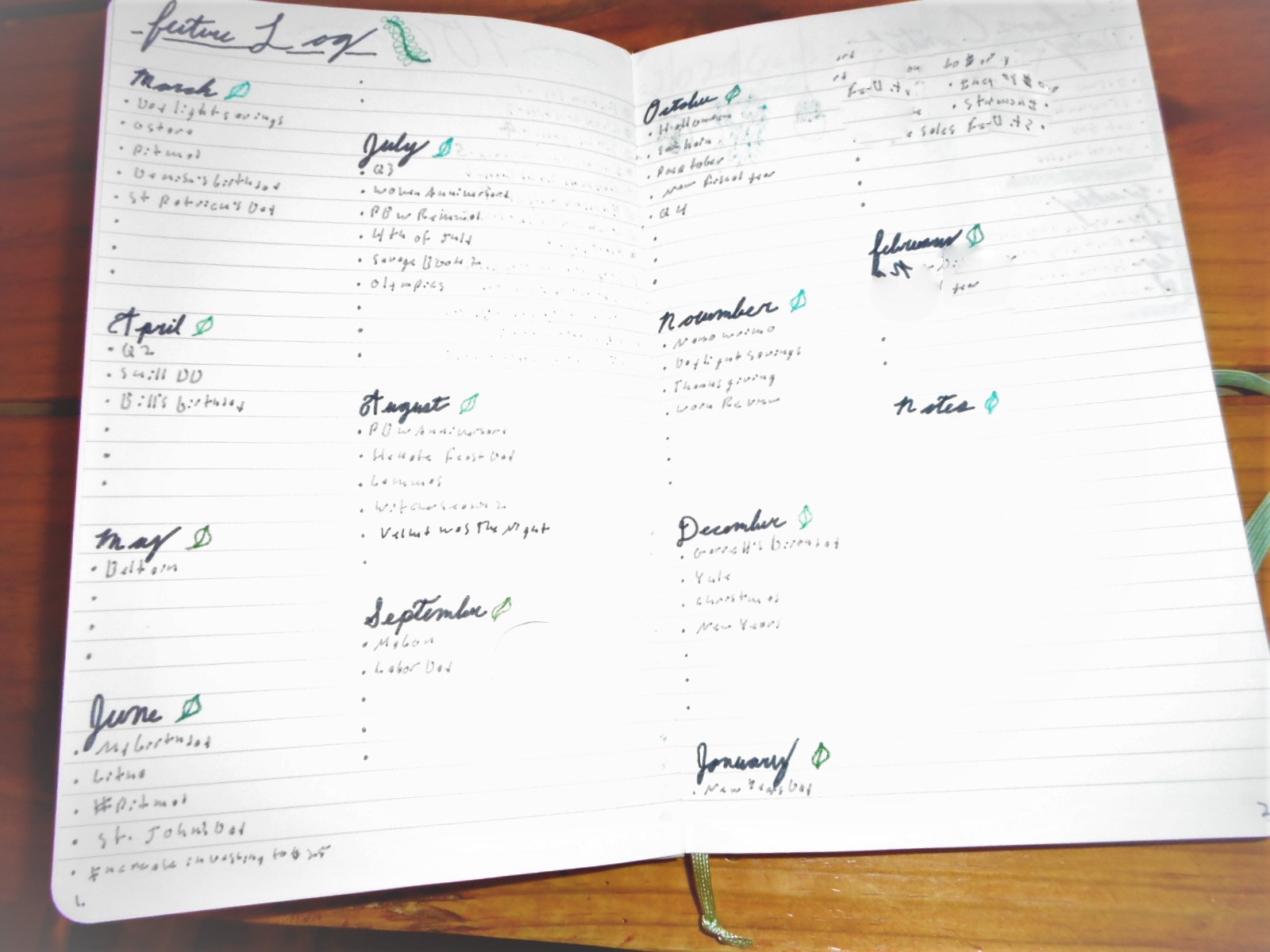
Future log

Everyone’s got a future log. I just think mine’s the best. 

It’s very simple. I’ve just written the days of the month, followed by space to add in things as they come up. I set this page up every time I start a new bullet journal, keeping notes for the next twelve months.

What you track here will be up to you. But I keep track of holidays, holy days, birthdays, upcoming book releases, upcoming show releases, or anything else I might need to know about when that month comes around. I also make sure to build in at least three blank spaces for things I’ll find out about as I work through this bullet journal.

I like to keep the decorations on this page minimal and clean. I’ll be referring to this page a lot, and a clean page is less likely to get tiresome. It also gives me space to add things in as I need to. 

Yearly goal page

Again, this is a pretty common spread, but one that does wonders for my mental health. I keep a list of my life goals at the top of the page. Not really because I think I’ll forget. But because I want to keep my focus. 

Then I write down all the things I want to accomplish in a year. I like this list to be simple, but specific. Get a new computer, beat my 2020 income, produce Off The Bone season one. Later on, I’ll have a page dedicated to a step by step process for a goal if it needs it. Here is the space for just a bullet point list. This is what I want my big-time goals to be for this calendar year.

It is the best feeling to cross off a yearly goal. I made a couple of goals I knew wouldn’t take all year to accomplish just so I could get to that feeling sooner.

In case of emergency page

No, this isn’t a list of emergency numbers or anything like that. That information is at the front of the book. 

No, this is a list of things I need to remember for an emotional emergency. 

Maybe I’m feeling down. Maybe I’m having an anxiety attack. Maybe I’m so tired I don’t think I can go on.

When I get like that, I tend to forget my coping mechanisms. I don’t think I’m the only one who does this. Even something as simple as making a cup of tea, I can’t think of that when I’m in that sort of mood.

Fortunately, I can go to my emergency page and see the little notes I’ve left myself. 

I feel stressed. Okay, Make a cup of tea, light a candle, and journal about it. I feel sad. Read my gratitude list, light a candle, find a small win and draw. It’s the spread that has saved me mentally more times than I can count. 

Goodreads goal

This is another one that a lot of people have, but I love it. It’s pretty simple. I drew little rectangles to represent books I want to read. Then I write the title in the book. I keep track of when I started it and when I finished it. And as I make progress on the book, I slowly color it in. 

You might notice on the page that there are also three smaller rectangles at the bottom of the page. Those are the books I finished for my goal this year before I started this bullet journal. 

I also keep a list of books I want to read at the bottom of the page. Honestly, I wish I’d done a two-page spread for this. I’ll probably do that next time.

Rolling shopping list

You know what, there are a lot of apps to keep shopping lists on. Do you know what I never have with me? My tablet.

But I’ve always got my bullet journal. So if I suddenly notice that we’re low on Tums, I can write that down right away. Then, when I go to the store, I know what I need.

When was the last time I…

Here’s another page that has saved me a ton of hassle. On it, I keep track of things that I need to do, and when the last time I did them was.

When was the last time I washed the bedding?

When was the last time I took a day off?

When was the last time I ran a virus scan?

You get the idea. I check this page every week when I’m making my to-do list. And I know if it’s been too long since I’ve backed up my files. Instead of just being pretty sure it’s been too long.

Plant care log

If any plants in my house are alive, it’s because of this spread. I keep a neat list of all the plants I have when the last time I watered them and fed them.

This again saves my brain from having to remember when the last time I remembered to water anything. And it saves the lives of my little green darlings.

This is by no means an exhaustive list of every page in my journal. But it is a list of pages that help me out. If they help you out, give the post a like or share it.

Thanks a lot, guys. See you next week. 

You can support Paper Beats World on Ko-fi and Patreon.

Why I Write on Paper

I don’t think it’s any surprise that I’m a tech geek. I work with computers, play video games, walk around with my tablet all of the time and read e-books more than physical ones. I use my computer and tablet to write almost everything.

Almost, is what I said. Because the first draft of almost everything I write ends up in a composition notebook first. I also keep a bullet journal in an honest to goodness moleskine notebook. There are a ton of reasons why I do this, and you should consider it too. Here’s why.

It helps me remember things. I know there is research for this, but hell of I could find it. Somehow, though, if I’m making a list of things I need to do, I find that I will remember things I’d forgotten, but need to add to the list.

I also find it easier to brainstorm for a story on paper. I need to write random ideas that might not be in any order yet, and plot points that will have multiple repercussions. Think mind mapping. I know that there is software that allows you to mind map on screen, but I have yet to find one that does it for me.

It keeps a solid record of something. Like my memories of a day. If something’s on a screen, I might go back later and ‘fix’. It’s the editor in me. But there have been days that I had a deep, raw, emotional reaction to something. I was thankful to have the reaction to those events on paper, unchanged. Also, I tend to treat my bullet journal as a scrap book. I paste pictures, movie tickets, and other paper mementos into the pages. This makes my journals precious to me.

I can doodle and sketch, and if you don’t think that’s important to the creative process, I don’t know what you’re doing with yourself.

It’s easier to take with me. Yes, I do love my tablet, but it’s not as comfortable to write on it as it is to write in a notebook. I don’t know why, I’ve just never gotten to a point where I’m comfortable typing on one of those screens. Maybe I’m too old to ever really like that. Maybe my nails are too long.

Finally, it makes writing a physical experience. Three’s something to be said for the soothing sound of clicking keys. But there’s also something to be said about being alone with the blank page, just you and a pen. The quiet scratching, the feel of ink flowing onto the paper. It’s a nearly spiritual experience for me.

I usually try to avoid talk like this, but I don’t think I’m the only writer who feels this way. When I write on paper, there are times when I feel like I’m not making the story up at all. It’s just flowing out of me, the words coming in just the right order, as though I’m seeing the story happening and just dictating it. I have never experienced this on a screen.

I do keep a lot of things on my screens. My flylady control journal is kept on Evernote, and I actually don’t keep my to do lists in my bullet journal, because the Todoist app makes more sense for my lifestyle. But when it needs to matter, when it needs to be my voice, my life, my blood, it needs to be on paper first.

A WordPress.com Website.

Up ↑