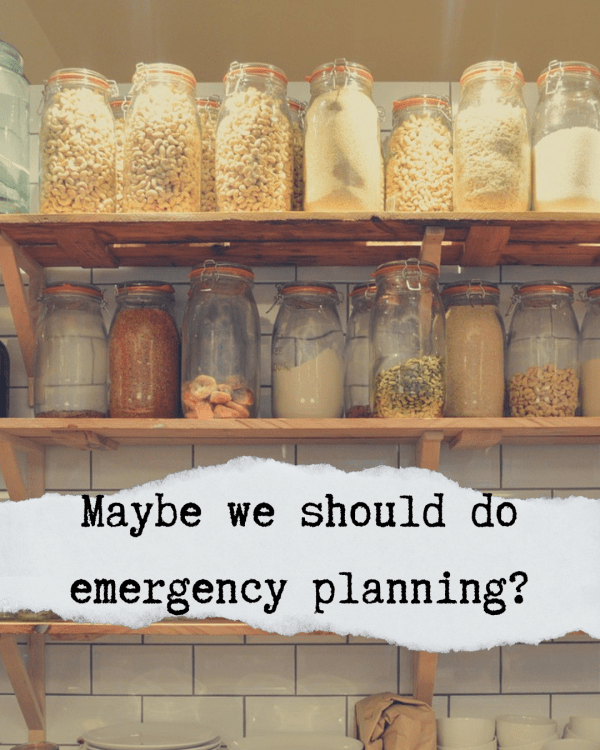
Here’s something you might or might not know about Mormons. Or, as they prefer to be called, members of the Church of Jesus Christ of Latter-day Saints. They are really big on emergency prepping. Specifically, keeping emergency food stores.
I was raised in the Church. And while my family didn’t go overboard, we did always have a little bit extra around. Extra batteries, extra canned veggies.
When I visited the homes of my church friends, they’d have basements full of canned or preserved food. Around here in Western PA, where the Mormon traditions blend with Appalachian common sense and know-how, lots of women garden and preserve produce. If you want a great deep dive about Mormons and emergency planning, check out this video from Alyssa Grenfell.
Now, I didn’t walk away from the church so much as I put on running shoes and took the hell off. But as I go through my healing journey, I’m learning that not everything I was taught as a child was bad. For instance, emergency prepping and food storage are sensible practices.
If a bad storm hits, you’re going to be happy you have some extra food, candles and batteries. But having a food storage also allows you to bless your community in times of great need. Like when people weren’t getting their SNAP benefits last November. It will also be a blessing to you if you lose your job or if a surprise gas bill wipes out half your paycheck. Then, of course, there’s the ever-present fear of ICE invading your community and making it unsafe to leave your home if your skin happens to be brown or black.
But Nicole, you might be saying, this is a writing and book blog. Food storage doesn’t have anything to do with ghosts, dragons or spaceships. Well, that’s where you’re wrong. Much like you can’t write your stories if ICE kills you, you can’t write your stories if you’re starving. So, let’s get started.
Make a plan
Everything starts with a plan. And for this project, we’re going to start with a list of things you’ll eventually buy for your emergency storage. This can include anything that you might need, but I recommend starting with food.
And I mean food that you won’t mind eating in case of an emergency. Food that your whole family will eat. For instance, most people have dried beans in their food storage. I don’t, because the Darling Husband wouldn’t eat them if we were starving.
I started by making a spreadsheet in Notion. But any spreadsheet software will work. Even a cheap notebook will work.
In the first column, write a list of things to buy for your emergency storage. Everyone’s needs are very different, so my list might not be the same as yours.
If you need a list of suggestions, there are a million online from people far smarter than me. However, one category that I think gets overlooked is spices.
Frankly, some people who look like me could also use a reminder that spices exist in everyday life. Cayenne, curry, cumin, red pepper. All of these are good additions that will be well-appreciated when and if the time comes. I also suggest salt, an extra pack of playing cards, and powdered milk.
Now that we have all of that in our spreadsheet, time to move into column two. In here, we’re going to write down how many of these items our family will need within a time frame. I suggest starting with one week and moving up from there as you grow your food storage.
Column three is where we’re eventually going to keep track of how many of these items we have on hand.
And finally, column four is where we’re going to keep track of expiration dates for these items, if they have them. All food goes bad eventually. So as you’re keeping your food storage and growing it, you’ll want to occasionally weed out things that are about to expire.
Start small
Now, I don’t want you to be overwhelmed. Because I have good news. Once you’ve made your spreadsheet, the hardest part is over. Now, you just have to start slowly getting the items on this list. You do not have to buy everything on your list all at once.
Let me say this louder. YOU DO NOT HAVE TO BUY EVERYTHING ON YOUR LIST ALL AT ONCE.
Nor do you need rows and rows of shelving units in your basement to hold all of this. I am just starting this process myself. Right now, my emergency storage looks like one bag of rice, some packets of instant mashed potatoes and a gallon of water, all tucked in a reusable shopping bag in the corner of my dining room.
Think of it like writing a novel. (See, I can always work things back to writing.) You’d never think to sit down and write an entire 50,000 + word rough draft in a day. You write a thousand words, or 500 words. The words add up until you finish your story.
Every time I go grocery shopping, I try to grab one or two things for the food storage. A tub of oatmeal here, a bag of rice there.
Slowly but surely, it all adds up.
And yes, it’s true that an emergency might happen at any time. But any amount of food storage is better than nothing. If tomorrow I lose my job, at least I know I’ve got a few meals’ worth of rice and mashed potatoes standing between me and my family going hungry.
Some bigger items you might consider
Now, if you happen to have some extra money, or if you’re the sort who likes to ask for practical gifts, I do have a list of suggestions. These are some bigger ticket items that will sure come in handy if things go south. I don’t actually have any of these items yet, but I have plans to get them.
– A battery-powered hot plate
– A good first aid kit
– A battery-powered lantern
– A blow-up mattress complete with extra bedding
– A generator
I am sure there are more things to be added to this list. I’d love to hear them in the comments.
Don’t be scared, be prepared
Remember, the point of all of this is not to live in fear. It is, in fact, the opposite.
Things happen in life. Things you never see coming. My God, things you never imagined living through just sneak up on you like fog at night.
Is having a well-stocked food storage going to protect you from everything that might go wrong? Of course not. But knowing that you’ve done what you can is a comfort. Whatever happens, at least you won’t go hungry. And at least you’ll be able to write about it.
I’d love to hear what you think. Is there a crucial item I’ve left off my emergency planning list? Let me know in the comments.
If you love what we do here and want to support Paper Beats World, please like and share this post. You can also support us financially on Ko-fi.
Want to start of the year with a free book? Check out Seeming, book one of Station 86.



 Paper Beats World
Recent Comments