Falling From Grace is coming in December

Once upon a time, I wrote a story about a boy who wove visions and a girl who spun light. About how, together, they changed their world for the better.

I love that story. But it had a few problems. Problems I only saw after writing three whole books about Devon, Lenore, Sultiana and Victor. All of my main characters but one were born into nobility and wealth. All of them were mages.

Now, that is all well and good. But it’s also a narrow view of the world. Most of us aren’t wealthy. I’m sure as hell not. Most of us are not gifted with such inherent talent that it cannot be denied, which I feel is the closest equivalent to mages in our world.

Some of us have to get by on working hard, saving money and learning skills.

So I wanted to write a story in the world of Woven about a regular woman. Maybe someone not gifted, or destined to do great things. A woman who chose to do great things instead, and shape the world around her through determination and courage.

This brought me to Grace.

You might remember Grace as the angry woman Victor left behind when he moved to Septa. And if you didn’t like her, I’m sorry. I never meant for her to be even a temporary antagonist. She had every damn reason to be angry. Wouldn’t you be if your boyfriend vanished and ended up dating some rich girl?

I needed to give Grace a chance to tell her own story. And in doing so, I told a little of mine as well. Because while I was writing this book, I was also discovering modern witchcraft.

Falling From Grace was first published in 2020. It was a terrible year for most of us, but at least Trump lost his election bid that year. But this time he won, and I think we need Grace again.

I think we need as many women and men as possible who are ready to fight against a mad king. We need witches, advocates and activists. And we need stories about them. So here is mine.

Preorder Falling From Grace here.

I loved writing this book. And I hope that you love reading it. It’s fun, sweary, irreverent and optimistic. I hope it inspires you to see some light in a dark time.

My review of Three Simple Lines

I have talked (a lot) about Natalie Goldberg and how much her work has taught me about writing. While she’s best known for Writing Down The Bones, she has many other books about writing, Zen, and how those things intersect.

Having read Writing Down The Bones, Thunder and Lighting and Wild Mind, I thought I knew what to expect from Three Simple Lines.

I was wrong.

Released in January of 2021, Three Simple Lines is a deep and reverent look at the art of haiku. To really explain this book, I think it’s best to start by describing what it is not.

It is not technically a writing manual. At least not in the same way Writing Down The Bones or Wild Mind were. This is not a collection of personal essays, followed by introspective writing advice and prompts. There are no exercises in this book.

Instead, Three Simple Lines chronicles two trips that Goldberg made to Japan to learn about two Haiku masters that inspired her work; Matsuo Basho and Yosa Buson.

Most of the book reads like a travelog. And honestly, with Goldberg’s deep and melodic writing style, I could read her description of a trip to the grocery store. So that alone was worth the price of admission. I loved her descriptions of exploring Japan. Especially the food.

This would have been an education by itself. If you want to write about travel, this is how to do it. I wanted nothing more than to hear everything about her trip.

But of course, that wasn’t all of it.

Learning how to write a haiku isn’t hard. You write three lines. They should add up to nineteen syllables. The standard belief is that the lines should be five syllables, then seven, then five. But most artists agree you can play a little fast and loose with that.

The soul of a haiku comes from the subject matter. A haiku should capture a moment in time, like a firefly in a bottle. Some people say that they should exclusively be about nature. But I’ve seen plenty that have moved me and had nothing to do with nature. The important thing is that it captures that moment and the feelings within that moment.

These descriptions seem simple, and they technically are. The difficult part is in the doing. This takes years and even lifetimes to master.

During Three Simple Lines, Goldberg talks about the lives of famous haiku masters. She also shares some of their most famous works. I am astounded by the slow pace of these artists. They seemed dedicated to their craft before all else.

This is especially astounding to my modern mind. I feel like I am so often focused on producing rather than creating.

Three Simple Lines is a blend of Goldberg’s story and the stories of these two haiku masters. If nothing else, this book will leave you inspired by the small, lovely craft of haiku.

And probably craving mochi.

If you love the story and want to support Paper Beats World, you can do so on Ko-fi.

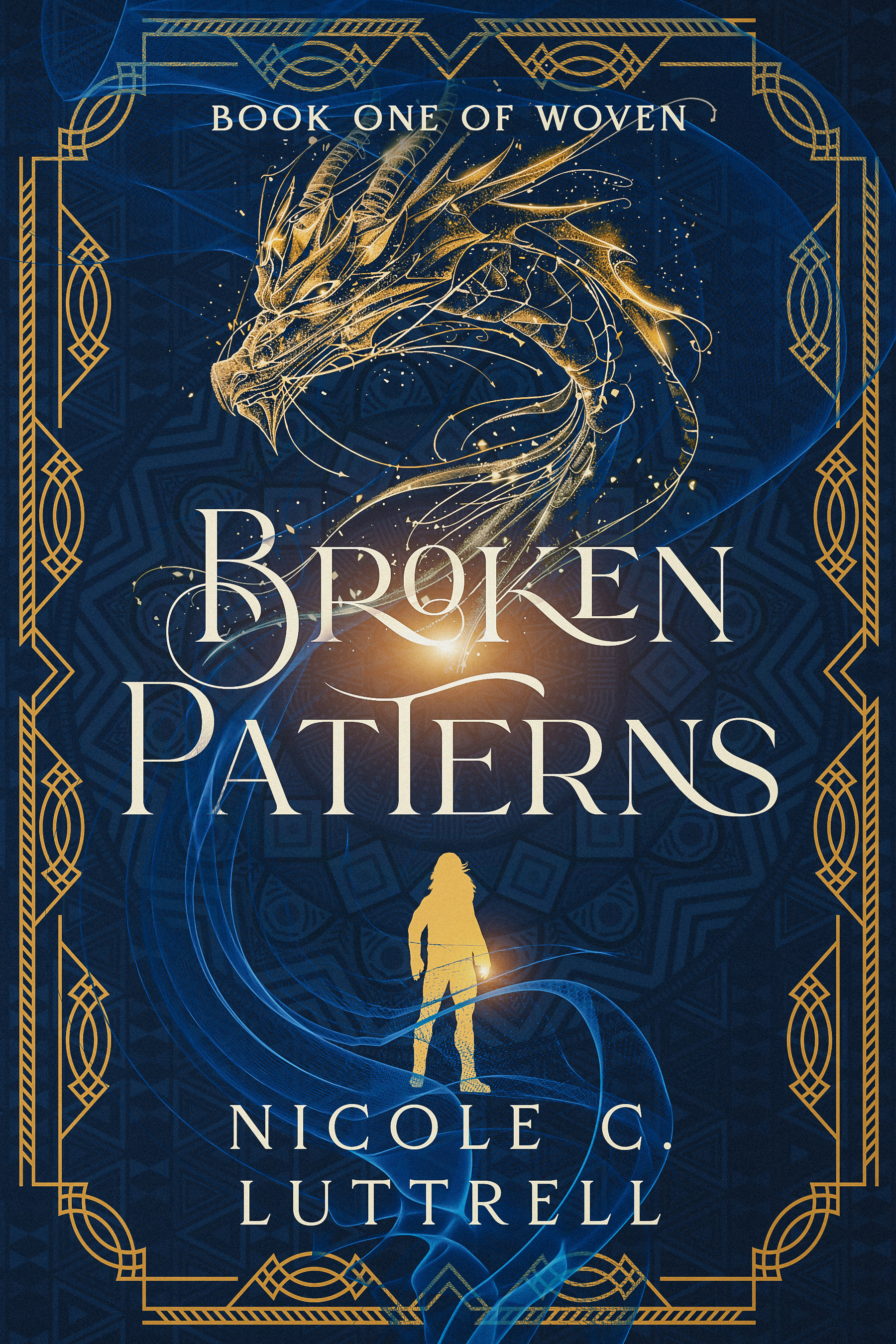
Broken Patterns is now live! You can get it right now on Amazon.

Prose poetry in genre fiction

Writing is a beautiful art that comes in as many forms as the people who do it. Novels, music, script writing, poetry. Within each are myriad genres and subgenres, themes and structures.

I write speculative fiction, for the most part. Horror, science fiction and fantasy stories. I do not write poetry. At least, not any that I’d consider publishing.

And yet learning about poetry has been a cornerstone of my writing education. It’s something that I love, and something that I think improves my writing every day. Even my horror writing. Especially my horror writing.

The reason for this is that I practice prose poetry. This is a piece of writing that has a prose structure, but with an emphasis on poetic elements. Word usage, pacing, sentence structure. These are the elements that I focus on to make my writing read more like a poem. 

It just doesn’t normally rhyme. 

I use prose poetry in my writing for several reasons. The first is that I enjoy it and I like writing it.

The second is that it’s the best way I’ve found to write descriptions in a meaningful and entertaining way. 

Consider a scene in which a character is introduced to a haunted house. We could simply describe the place. We could write about the broken front steps, the peeling paint on the front door, the cracks in the windows. That’s fine, it gets the job done.

But what if instead we talked about steps that sang a funeral march when mounted? Windows that looked out over the street with nothing but darkness and madness beyond them? What if we talked about the paint that peeled off like flesh seared by unfriendly flames? 

Isn’t that more interesting? 

Many genre authors use this method to their advantage. One fantastic example is the book This is How You Lose The Time War. It’s a fantastic science fiction love story that reads like a poem. Another example that’s a little more classic is the Halloween Tree by Ray Bradbury. These books are lyrical, and a treat to read.

Which isn’t to say that you’ve got to write your whole book like that. If the front steps have already sang a mourning song to us, we don’t need each hallway to howl like bitter wolves. I mean, they can. But a little bit of this style can go a long way. 

I highly suggest giving prose poetry a try in your writing. Here’s an exercise to get you started. 

Take a scene from your work in progress that’s heavy on description. Maybe a fight scene, or the first introduction of an important character or setting. Write your description of this battle, person or place. Then, write it like a poem. Here are some tips.

-Play with word usage. We all know that some words mean the same thing with completely different interpretations. 

-Don’t discount sentence and paragraph structure. Sometimes simply moving to the next line can have an impact. Consider this example. 

She ran through the field and up the stairs. Her brother didn’t follow. 

She ran through the field and up the stairs.

Her brother didn’t follow. 

The second example feels more ominous. It feels more like we should have some concerns regarding why her brother didn’t follow. 

– Metaphors and similes are your friends. Especially in horror, this can be fun. Blood blooms like a rose around a bullet hole. Bones crack like kindling. Wind gnaws at the door and windowpanes with ice teeth. No, ice fingers. 

Take some time with this, and have fun. Because of course, writing should be fun. And I’d love to know if you try this technique. Let us know in the comments how it goes. 

Don’t forget, my Preptober Planner is updated for 2023 with new character creation and world building pages. You can get it now on my ko-fi store.

Some more really bad poetry by me

Oliver

The wiggle, waddle

The excitement of your life!

You cannot stand still

Sluggish morning

Pouring myself in

Fitting into the crevices

Of the morning flow

Chai

Rain on he window

Steam rising from my tea cup

the scent of warm leaves

mingled with sweet, strong spices

warm hands, even in the cold

Color on My Lips

A little color on my lips

and I’m ready, now, to go

With a gentle swing to my hips

A little color on my lips

for comfort and courage to sew

to face the world with a glow

A little color on my lips

And I’m ready, now, to go

Writing Prompt Saturday, Write an Ghazal Poem

Four days until a really awesome announcement

Yet another really obscure poetry form, ghazal poetry is going to be my new favorite thing for awhile. For one thing, it’s all about couplets, which means that it is twitter friendly.

So, a ghazal poem is at least five couplets, traditionally no more than fifteen. The first couplet should end with a refrain that will finish each couplet.

Traditionally, ghazal poetry was very melancholic. So if you’ve been getting the stupid amount of rain I have, it’s great.

Here is a example of ghazal poetry.

“Even the Rain” By Agha Shahid Ali

What will suffice for a true-love knot? Even the rain?
But he has bought grief’s lottery, bought even the rain.

“our glosses / wanting in this world” “Can you remember?”
Anyone! “when we thought / the poets taught” even the
rain?

After we died—That was it!—God left us in the dark.
And as we forgot the dark, we forgot even the rain.

Drought was over. Where was I? Drinks were on the house.
For mixers, my love, you’d poured—what?—even the rain.

For all of us in the states, hope you’re having a great fourth. We are blowing things up and grilling greasy meat here. How about you?

Writing Prompt Saturday, Write a Sestina

We do love our poetry here at Paper Beats World, even if I can’t write it very well.

This week’s new form I bet you’ve never heard of is the sestina.  A sestina poem is a fixed verse form consisting of six stanzas of six lines each, normally followed by a three-line envoi. The words that end each line of the first stanza are used as line endings in each of the following stanzas, rotated in a set pattern. (Curtsey of Wikipedia.)  Since that didn’t mean a lot to me when I read it, here’s an example of what I mean.

This is by Elizabeth Bishop, and try as I might, I couldn’t find a title.

September rain falls on the house.
In the failing light, the old grandmother
sits in the kitchen with the child
beside the Little Marvel Stove,
reading the jokes from the almanac,
laughing and talking to hide her tears.

She thinks that her equinoctial tears
and the rain that beats on the roof of the house
were both foretold by the almanac,
but only known to a grandmother.
The iron kettle sings on the stove.
She cuts some bread and says to the child,

It’s time for tea now; but the child
is watching the teakettle’s small hard tears
dance like mad on the hot black stove,
the way the rain must dance on the house.
Tidying up, the old grandmother
hangs up the clever almanac

on its string. Birdlike, the almanac
hovers half open above the child,
hovers above the old grandmother
and her teacup full of dark brown tears.
She shivers and says she thinks the house
feels chilly, and puts more wood in the stove.

It was to be, says the Marvel Stove.
I know what I know, says the almanac.
With crayons the child draws a rigid house
and a winding pathway. Then the child
puts in a man with buttons like tears
and shows it proudly to the grandmother.

But secretly, while the grandmother
busies herself about the stove,
the little moons fall down like tears
from between the pages of the almanac
into the flower bed the child
has carefully placed in the front of the house.

Time to plant tears, says the almanac.
The grandmother sings to the marvelous stove
and the child draws another inscrutable house.

Writing Prompt Saturday, Write a Epistle poem

I’m noticing a theme with poetry.  The different forms all have these lovely complicated names that give you no idea of what they’re actually for.  Why is that?  Personally, I think poets are just trying to punk us.  Epistle poetry is a great example, because it just means a poem in the form of a letter.

Epistle poetry comes from the Roman Empire, and was made popular by Horace.  Many are intimate, sent to one person, and are often love letters.  But I found this really great one by Elizabeth Bishop that just caught me by surprise.

Letter to N.Y.
For Louise Crane

In your next letter I wish you’d say
where you are going and what you are doing;
how are the plays, and after the plays
what other pleasures you’re pursuing:

taking cabs in the middle of the night,
driving as if to save your soul
where the road goes round and round the park
and the meter glares like a moral owl,

and the trees look so queer and green
standing alone in big black caves
and suddenly you’re in a different place
where everything seems to happen in waves,

and most of the jokes you just can’t catch,
like dirty words rubbed off a slate,
and the songs are loud but somehow dim
and it gets so terribly late,

and coming out of the brownstone house
to the gray sidewalk, the watered street,
one side of the buildings rises with the sun
like a glistening field of wheat.

—Wheat, not oats, dear. I’m afraid
if it’s wheat it’s none of your sowing,
nevertheless I’d like to know
what you are doing and where you are going.

I love the beat of this poem.  The subject matter seems to say, without saying, that she wishes Louise would come home, and that she’s not sure she’s safe there in New York, as it seems a very foreign place to her.

So this week, try writing an epistal poem.

Writing Prompt Saturday, Write a Ekphrasis Poem

Here again, we come to what has to be my favorite post, and I think it’s yours, too.  This week, we’re talking about ekphrasis poetry.

Don’t be intimidated.  It’s a really big, hard to pronounce word that really just means a poem in which you describe something.  It was started in Greece, by no other great poet than Homer.  He wrote about the Shield of Achilles, which such depth of detail and an ear for lyrical writing.  Anything that Homer does is pure gold, and this is just one more thing we’ve got to thank him for.  I mean, who else from that age are people still reading and enjoying?

Here’s an example from the master.  I couldn’t hope to come up with something as cool as this.

“And first Hephasestus makes a great and massive shield, blazoning well-wrought emblems all across its surface, raising a rim around it, glittering, triple-ply with a silver shield-strap run from edge to edge and five layers of metal to build the shield itself.”

Gorgeous isn’t it?  I’m not the only one who fan girls about Homer, am I?  So this week, your writing prompt is to write an Ekphrasis poem.

Writing Prompt Saturday- Write a Renga Poem

Ready for some group fun?  Continuing my love of Japanese poetry, I’m so excited to introduce the Renga poetry form.  Which can basically be called a poetry party game.  So, grab some friends and play.

Here’s how it works.  The first person makes a three line stanza, with 17 syllables.  It can either be a haiku or a senryu, either one.

Then, the next person makes the next stanza, attaching it to the first.

Being a great party game, I thought it would be fun if we did it here.  I’ll start

Petals on the floor

mixed with broken bits of glass

in the morning sun

Alright, anyone who wants to pick it up in the comment section, go!

A WordPress.com Website.

Up ↑