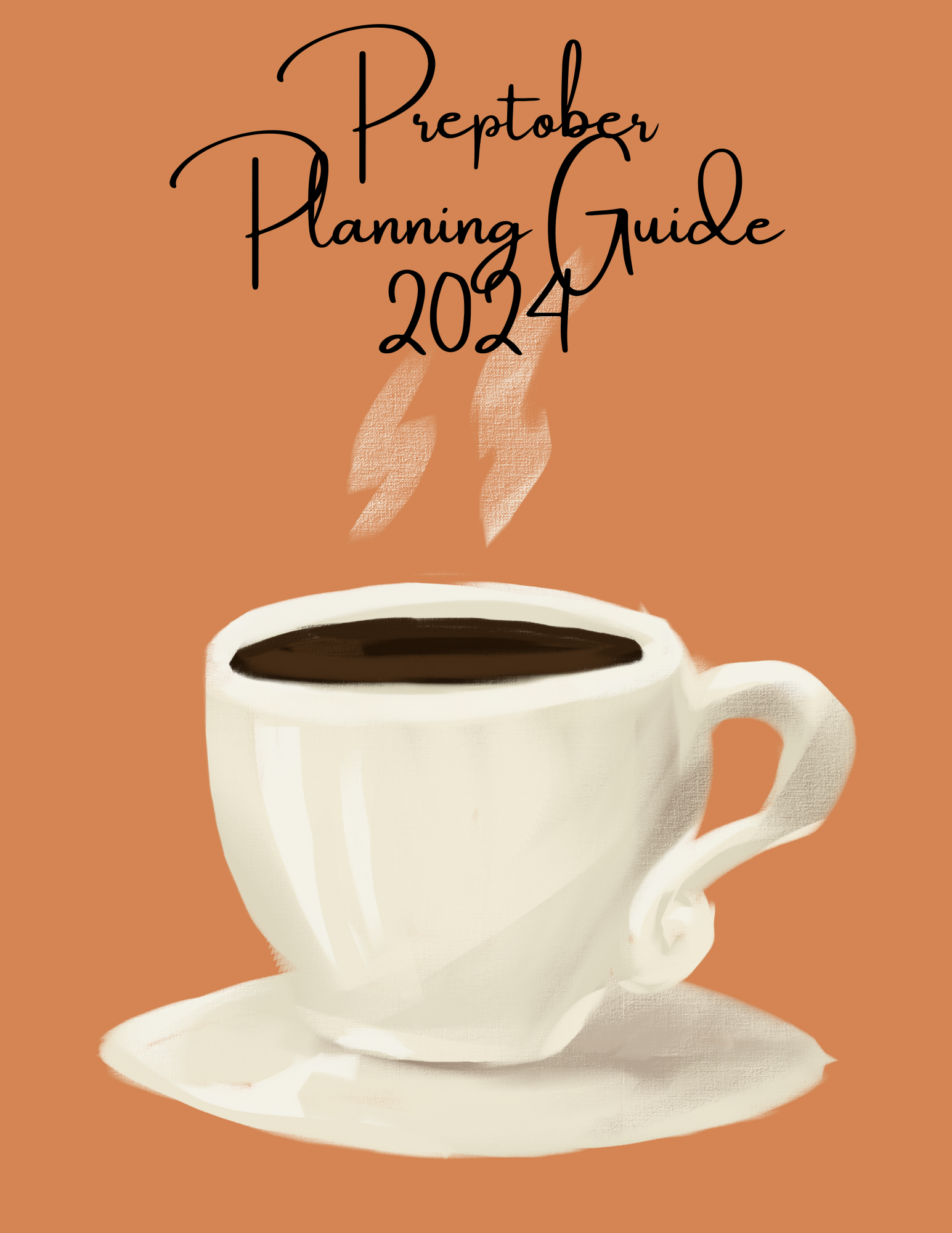
Preptober planner, 2024

August is now upon us. This is a liminal month here in Western PA, probably in other places. Signs of fall have started to pop up. Some leaves are beginning to turn, but most are still a vibrant green. The Steelers preseason is starting soon. Kids are going back to school. And while the days are still stifling hot, the nights are getting cooler. The days grow short, the nights grow long and my soul is coming alive.

Pumpkin spice is coming, my friends. Pumpkin spice is coming.

And while we’re all either soaking up the last weeks of summer or counting the days until chunky sweater weather, one thing remains the same. Nanowrimo will be with us before you realize it. And it’s time to get ready for Preptober. As such, I have updated my preptober planner for 2024.

This year’s version sports a new, darker color and updated coffee cups throughout the whole thing. More substantially, it includes two new planning pages.

Our first new page is a character injury page. I think we’ve all read or seen something in which a character is injured in one scene, only to be perfectly fine far too soon after. Was this done for convenience? Or did the author just forget about the injury?

The new planner page will help you avoid this. This includes a male and female presenting outline so that you can keep track of the bumps, bruises and breaks that your character suffers along the way.

Our second new page is a map page. I am a visual person. And it might surprise you to know that I often draw maps of my story locations so that I can keep track of things. Especially stories like Station 86, which included several levels of the space station that I needed to keep track of. I also had a map of the apartment building in Quiet Apocalypse so that I could remember who lived where and across from who.

These two pages bring us up to eleven total pages of planning goodness. You can print the planner out or just download it and write directly on the document. And while you could follow along with everyone planning on October, there is no reason you can’t get the planner now and begin your novel writing adventure.

I love this planner so much. Every year it gets better, in my humble opinion. You can get it right here now on Ko-fi for only $1.50.

Happy planning and happy writing everyone!
Preptober Week Four

It’s the last full week of October. This means that we’ve reached week four of Preptober.

This also means that next week is Halloween and the start of November which means any sitting down or breathing you plan to do you’d better get out of the way now.

Week four of Preptober is always my favorite week. Because it’s the week we start outlining our stories.

Hold your applause.

That’s right, we are outlining this week! Now, there are as many ways to outline as there are writers. But I thought it might help today to tell you the way I outline a rough draft. It might work for you, and it might not.

Step 1, Start with the big scenes

Whenever I start thinking about a story, some scenes just jump out at me. Or, if not a whole scene, an image. For the book I’m working on now, I have an image of an older woman in dress clothes, standing on a battlefield with a sword.

Start with the scenes you’re excited about. The scenes you know need to happen.

I like to write my scenes out on index cards. These can be moved around, erased, and thrown out if need be. This will be important later.

Step 2, Plot out the main storyline

Now that you’ve got the big scenes in place, we need to figure out how we’re getting to them. Figure out the plot points for the main story you want to tell.

Now, here’s where some people get caught in the weeds. And by some people, I mean me.

You don’t need to write down every single little that happens in this story when you’re outlining. For one thing, you probably don’t know everything that’s going to happen yet. That’s the joy of a rough draft. You’re still learning about the story. Just get down the points you’re pretty sure you want to hit.

Step 3, Layer in subplots by order of importance

Next, you’ll be outlining your subplots. I usually have too many of these, to be honest. But a good subplot adds to the main part of the story. It cannot generally be lifted out without requiring a change to the main storylines.

There’s no time or space here to go into the hows and whys and how nots of sub-plotting. But if you want, I could do a post about that at a later time. Let me know in the comments if that’s something you’re interested in. For now, it’s just important that your sub-plots come after your primary plot.

Step 4, Prepare for this to all go out the window when you start writing.

Writing a rough draft is a wonderful discovery process. You do not know everything you want to say in the book until you start writing the book. Which is, of course, the fun of writing a rough draft.

Yes, an outline is a great place to start, so you have some direction when you’re beginning your rough draft. But don’t get committed to it.

Give yourself the freedom to redo your entire outline. Let your story go off the rails if it seems better or more exciting. I usually redo my outline at least once before my rough draft is finished.

So that’s it for our Preptober series. I hope you’re eager to get into Nanowrimo next week, armed with a solid story foundation.

See you then.

If you want to support Paper Beats World, you can do so on Ko-fi.

Preptober 2023 Week three

We’ve made it to week three of Preptober. So far, we’ve made a writing plan and done some world-building.

Now, it’s time to start casting characters. For me, characters are always the most interesting part of any story. I want to know about the people.

I have for you two lists of questions. The first is for your main character or characters. I almost always have two main characters, but you can have just one or a full ensemble cast.

Main character questions

What is their full name and nickname?

What do they look like?

Why is this their story to tell?

What do they want at the start of the story?

What are they afraid of?

What don’t they like about themselves?

How are they going to change?

Do they fit into their world as it is?

How is the world going to change because of them?

Next, we’re going to consider our secondary characters and villains. A story’s main character shouldn’t be the only interesting person in the cast.

Your main character also shouldn’t have main character syndrome. Which is to say, they should be aware that the world doesn’t revolve around them. The rest of the cast should also be aware of this.

And don’t skip planning your villain. In fact, this might be the most important character. A good villain makes a story. Consider the Borg, Magnito, Ursula, Voldemort, The Other Mother, and Beetlejuice. These characters were way more interesting than their heroes.

Secondary characters and villains

What is their full name and nickname?

What do they look like?

Why are they the main characters in their own story?

What do they contribute to this story?

What do they want at the start of the story?

What are they afraid of?

What don’t they like about themselves?

How are they going to change?

Do they fit into their world as it is?

How is the world going to change because of them?

Join us again next week for week four of Preptober. And don’t forget, you can download the Preptober Planner now on my Ko-fi shop.

Preptober 2023 Week Two

It’s week two of Preptober, and time to start writing. How exciting is that?

This week our focus is world-building. I’ve compiled a list of questions to help you figure out your world and how people live in it.

But what if your story is set in the real world? You probably still want to fill this out. Things like food, clothing and culture vary wildly depending on where you’re from. And it never hurts to get things down on paper.

Besides, thinking of these details will help you step into the world of your story. It’ll get you thinking of those intimate details.

What is the weather like?

This is pretty straightforward, but no less important. There’s a reason one of the first things I do in the morning is check the weather.

Does it rain a lot? Is it sunny? Is this a place where the weather impacts travel and crops? Does any of this have anything to do with your story?

What do people wear?

Clothing tells us so much about a person. What do people usually wear in your world? Cloaks, jeans, sweaters? Are mink coats the style, or Foster Grants?

What do people eat?

This might largely be impacted by the first question, and where your story is taking place. An ocean-side city is going to eat a lot of fish. A more rural land is going to have a lot of farm food, like chicken and corn.

What’s the popular entertainment?

This is always a fun thing to consider. What are people doing to entertain themselves? Are plays popular entertainment? Do people gather at the local tavern to hear music? Or is this a more modern story where people prefer to stay home and stream a movie? No judgment.

Is there a magical structure? What are the rules?

Here’s where things get fun. What kind of magic exists in your world, if any? What rules does the magic have? What are its limitations? Because of course, magic isn’t fun when it doesn’t have limitations.

What is their technology like?

Even if you’re writing a fantasy novel, there’s still technology. It’s just that it’s going to look wildly different depending on when in time your story takes place. Do they have smartphones or water wheel power generators? Or, if you’re writing steampunk, maybe a fantastic combination of both?

What political structure do they have?

Politics might be frustrating, but it’s something that impacts us all. Whether it’s going to impact your story or not, you should know what political structure is. Even if it’s just a local sheriff and a disinterested mayor.

What cool element exists in this world that isn’t in ours, and how does that impact everyone?

Yes, this applies to every story, even if it’s set in the real world. This doesn’t have to be magical. It doesn’t have to be fantastic pieces of technology. Though of course, that’s fine if it is.

This can be an old mill, a fantastic coffee shop, or a stretch of road that has the habit of moving around on certain nights of the year.

So that’s it for this time. Don’t forget, you can download my Preptober Planner from my Ko-Fi shop and play along all month.

See you next week for week three.

Preptober Week One

Here we are, week one of October. And it’s, let me tell you, a busy week.

The first week of spooky season.

Banned Books Week, in case you missed my angry rant earlier today.

Fat Bears Week.

And, of course, it’s the first week of Preptober.

As promised, we’ll be walking through each page of my Preptober Planner together until we reach the big event in November. Because everything is better as a team.

Don’t forget, you can get my Preptober Planner on my Ko-fi store now to print out and play along all month.

Week one is all about making a plan. We’re going to answer some questions, make some lists, and get signed up on the Nanowrimo website.

First, some questions. Let’s make a plan for when you’re going to be writing, and how you’re going to make that time.

1. When are you going to write?

2. What projects do you need to wrap up before November to make space for writing a novel?

3. Are there any days I know I won’t be able to write? What days can I get in extra words to catch up?

4. What are the other obligations that you still need to meet like work, school, or home care?

Now, we’re going to consider the other people in your life. First, let’s make a list of the people who can help you this month. Who’s going to cheer you on? Who can pick up some extra work around your home? Who might bring you a coffee?

Now we’re going to make a second list of people. These are your fellow writers who are participating in Nanowrimo. Who are you writing with? Who can you meet up with for writing dates?

Next, we’re going to consider the physical things you’re going to need to write your novel.

Do you type or write on paper? Do you need index cards or post-its for organizing and brainstorming? How about a file folder for notes? Make a list, it’s time to go stationary shopping.

Finally, it’s time to go onto the Nanowrimo website and announce your project! It’s an exciting moment if you’ve never done it before.

That’s it for this week. We’re on our way to a successful month of writing together. Let us know in the comments what you’re going to be working on this November. And I’ll see you next week.

Preptober Planner 2023

A few months ago, I was talking with a writer friend of mine. Camp Nano was coming up, and so our discussion turned to the big event in November. Eventually the discussion came to the Preptober Planner that I created last year. She mentioned something about the character creation page.

Those of you who bought last years Preptober Planner might remember that there wasn’t a character creation page included. Which of course got me thinking. Why wasn’t there a character creation page? Or a world building page? 

Since I overdo things, this line of questions made me rethink my entire outlook on Preptober. And thus, the planner as well. 

I am thrilled to announce today the new and improved 2023 Preptober Planner. And with it, a completely new Preptober game plan that will go into more detail than ever before. 

I’ll also be doing some extra posts in October, to walk you through the new program week by week. As I intend to start a new Station 86 novel this November, we’ll all be working through it together. 

Yes, this will be book six. Yes, book five will be launching soon. Thank you all for your patience. I’m hoping the space between book five and book six won’t be as bloody long. 

The path to success is planning. Writing a novel takes a lot of planning. Let’s do it together. 

Click here to get your copy of the 2023 Preptober Planner

I made a planner for Preptober

It was the fourth of July. Then I blinked, and now it’s halfway through September. 

I love this time of year, and I hate how fast it seems to go. My to-do list right now is packed with tasks and events. Next week is Banned Books Week, the holidays are starting. We’re starting recordings for the next season of AA soon. It’s a busy time when all I want to do is warm up a pot of apple cider and read about cult leaders on my back porch.

And now, Preptober is in two weeks! Clearly, I need a plan if I’m going to get everything done.

So, I made a planner. And I thought you might like it too. So, I put it in my Ko-fi store for a dollar.

Preptober planner

The Preptober planner is six pages plus a cute cover page that will guide you through simple tasks each week. By the end of October, you’ll have a plan in place for how you’re going to write, when you’re going to write, and what you’re going to write. I’ll be printing out one for myself and getting in some planning time in October. 

Probably with some warm apple cider. 

I hope you’ll join me. It’s a great way to ensure you succeed in writing your novel, and it helps support Paper Beats World.

And I hope you’ll be here next week for Banned Books Week. We’ll have extra content galore because the stupidest thing anyone can ever do is ban a book. 

Preptober, Week Three

It’s week three of Preptober, and it’s finally time to start writing! 

I think I’ve mentioned this before, but I suggest a whole week at least of brainstorming before starting a novel. Maybe this is just my method. But my method’s gotten me four published books, so I guess it’s working for me.

That being said, how you chose to free write can vary dramatically based on your writing style and personality. Today I want to talk about some tips for making the most of your brainstorming Preptober week.

Freewriting is your best friend 

Being a student of Natalie Goldberg, I firmly believe that freewriting is the best way to get to the core of a project. So every day for the next seven days I encourage you to free write about your novel project.

Do it by time

A lot of people like to free write by time. This is pretty simple, you set a timer and write for that set time. I like doing this myself, among other methods.

Do it by number

That being said, I also love a numbered list. I’ll write lists titled 20 things that can happen in this book. Or, ten jobs my character might have. Twenty ways this character’s voice is different from the other character. Whatever I can think of.

Now is the time for writing exercises

I love a good writing exercise. And during the brainstorming session, I do a ton of them. It’s a way to understand my world better before I dive into it for 30 days. There are tons of different writing exercises if you’re interested. I would definitely suggest checking out the Writing Excuses podcast for some starters.

Don’t stop for an entire seven days

If you’re anything like me, you’re going to want to jump the gun. After about three or four days of freewriting and exercises, I’m feeling like I’m ready to start working on my outline. Maybe even dive into my rough draft.

Over the years I’ve learned to ignore those feelings and keep freewriting for the entire week. 

Yes, you probably have some great ideas. Yes, it’s exciting to start a new project. Yes, nothing feels like progress until it’s words on the page. 

Keep free writing anyway. 

The reason is simple. You are going to want as much raw thought on the page as you can get. When I’m writing I refer back to these freewriting notes often. Even better, I’ll surprise myself as I free write. As I dig further and further into the story, I uncover things I might never have thought of. It will benefit your book to give yourself as much time as possible to play on the page.

It doesn’t matter in the slightest if your ideas are bad

If you are going to be writing pages and pages of freewriting, some of your ideas are going to be bad. I know we often say there are no bad ideas, but I think we all know that’s bullshit. Saying there are no bad ideas is like saying there are no worms in any wild cherries.

Wild cherries are still worth picking and enjoying, still warm from the sun. 

So what if all your ideas are bad?

Spoiler, they’re not. We’re always our own worst critics. We are always going to be hard on our work, even if it’s good. Even if it’s great.

Trust me when I say that your ideas are worthwhile. Yes, some of them are going to be bad. But not all of them. Not even most of them. 

I hope you have fun during your week of freewriting. I know I will. Remember, writing is supposed to be fun. So have fun with it. And I’ll see you back here next week for the final task of Preptober. 

You can support Paper Beats World on Ko-fi

Preptober, Week Two

We’re one week into October, and one week into our Nanowrimo prep. If you missed last week, here’s a link to get you started. 

In week two, we once again have just two tasks.

1. Set up your project on the Nanowrimo website.

2. Make sure you have all the physical things you’ll need.

Okay, don’t freak out. Yes, I’m suggesting you announce your Nano project on the website this week. Note that I didn’t suggest that you know what your project is going to be. You don’t have to know the title, or even what genre you want to write in. 

You can literally label your project anything you want, and not be tied to it at all. You can just put untitled project number 69 if you want. It doesn’t matter.

So, if it doesn’t matter, why am I telling you to do this? Because it’s a concrete action that you’re taking towards your goal of writing a novel. You can see it right there on the screen, and so can everyone else. You are locked in now, you’re writing a novel. It’s on the internet.

Now, it’s time to consider some physical considerations. You don’t need a lot to be a writer. Just something to write on, and with. 

If you’ll be writing your novel on paper, consider what kind of paper you want. I like college-ruled notebooks and le pen felt tips.

You can of course type it. This is easier because you can check your word count without having to count the whole damned things. So if this is the way you’re writing, get yourself a word processor and play around with it a bit. I like Dabble, but there are tons of options.

Another thing you’ll want to consider is where you’ll be writing. Do you have somewhere at home to write? Do you need to go to a coffee shop or library? Do you need a desk, lap desk, or just a better chair? 

Think also about the little things you might need but not think of. I, for instance, like to outline things on index cards. Even if I’m typing my novel, which I’ll be doing this year, I still need pens to brainstorm on paper. 

I’m not saying these are all things you’ll need. But I am saying you should consider how you want to write, brainstorm, and do all the other things related to your project. Make a list, grab what you’ll need, and get ready to start writing. 

That’s it for this week. See you again next Friday when we get into some actual writing.

If you like this post, please consider buying me a cup of coffee, on Ko-fihttps://ko-fi.com/nicolecluttrell

Preptober, Week One

Alright, it’s the first day of October. And this month is dedicated to exactly two things in my house. Celebrating Halloween as hard as possible, and getting ready for Nanowrimo. 

So this year I’m going to take you along for the ride with me, in a four-week course that will let you hit the ground running on November first. I’ve done Nanowrimo or Nanoedmo every year for the last eight years. And I never lose.

Why don’t I ever lose? Because I plan my life and my project in such a way that failure is not possible. 

If you’re with me, we’re starting today. This week, you have two tasks. 

1. Make your plan of action.

2. Get your people together.

Let’s break these down.

Make your plan of action

Especially if you’re new to the whole novel-writing thing, you need to make a plan for how this is going to happen. Because it’s sure as hell not going to happen by accident. Especially if you have other responsibilities. Like, you know, a life.

So you’ll want to ask yourself these questions. 

When am I going to write?

What projects do I need to wrap up before November to make space for this?

Are there any days I know right now I won’t be able to write? What days will I work ahead or catch up?

What are the other obligations that I still need to meet like work, school, finals, or home care?

What I’m saying is this. You are going to have excuses aplenty to not write. Get rid of those excuses by planning for them, not succumbing to them.

Find your people

This is broken down into two groups. Who are you writing with, and who is supporting your writing?

Do you have any friends, online or IRL who want to write with you? Nanowrimo is always better when you have other people participating with you. Start talking to your buddies now, and see who’s going to join you.

More important even than that, though, is your in-person support team.

Who’s going to help you out during November? My support team is my husband, who will help me out with the house and give me space. My best friend, who will be there for emotional support. And my group of friends, always ready for weird questions at random moments. 

Make a list of your support team. Ask them if they’re ready for that. Let them know what you’ll need of them. Do you need your mother-in-law to watch the kids an extra hour a week? Do you need your wife to make dinner on a night that would normally be yours?

You need time to prep. Your support system does too. And if you’ve got to do something extra to support your loved ones in return, best to know that early. 

So that’s it for this time. You’ve got a week for these two tasks. I’ll see you back here next week for a new assignment. 

Like this post? You can buy me a cup of coffee on Ko-fi.

A WordPress.com Website.

Up ↑