World building questions to answer for a more realistic world

If you’re participating in Nanowrimo, you should have 16,670 words by today

Are you struggling with world building? That’s okay, we all are. It’s probably the most time-consuming part of the planning process.

But it doesn’t have to be. Unless you are really writing an epic story that is more about the world that you’ve created than the characters, you can answer a few simple questions and get to story writing. And if you haven’t done any world building at all, now’s the time to start. Even if you’re writing a modern-day story with no magic at all, you should still figure out the answers to these questions. The world details are what make the story real for your reader. And, believe it or not, someday people might want to know how we lived in 2017.

What’s your character eating?

On Station 86, people eat simulated food, or small amounts of naturally grown food from Earth or one of the other humanoid planets. Godfrey’s a cook and loves cooking Earth American food for his customers. Sennett, always busy, drinks something called Klav every morning for breakfast. It’s a rich drink, a juice from a fruit grown on Khloe.

This tells us a ton about the world. It’s cheaper and easier to simulate food than growing or raise the original thing. The inclusion of food from other worlds tells us that people on Station 86 are open to other cultures.

Godfrey and Sennett’s food choices are telling about who they are. Godfrey is very Southern. He shows affection with food, takes care of people by feeding them, reacts to stress by cooking. He loves the recipes from his childhood and is very rooted in his history.

Sennett’s not one to put too much thought into her food. But she loves klav, and Khloe food in general because it reminds her of the husband she lost.

What are they wearing?

Traditional clothing from different worlds and countries tell us a lot. Are men or women held to the same level of modesty? Do they favor wools and furs, or light cotton? Do certain colors represent anything?

What your character is wearing, especially in relation to what is expected of them in their society, is telling.

What are they listening to?

What sort of music is popular in the world of your characters? This is all about setting the scene. Are string instruments popular? Do people play winds? Do people sing?

What kind of relationships do they have?

How are marriages handled in your world? Are they handled by families or because someone falls in love? Do people raise their own children?

Who lives with whom? Do you have extended families living together, or just nuclear ones? Do men and women live separately?

This gives you all sorts of ways to tell about the culture and what they value.

What pets do they keep?

People who live hard by don’t keep useless pets. They don’t have fluffy cats or toy sized dogs. They don’t have any animal that doesn’t have a job.

Does your character have a hardy sheepdog or a Pekinese? Do they have a rat chasing ban cat or a pampered tabby? Have they perhaps gone to extremes and own a pet that they keep in a cage and does nothing?

Where do they live?

Houses that people make are suited to the locations that they build in. In Pennsylvania, we build thickly walled houses because it gets freaking cold. In the city, we build tall apartments because space is at a premium. In the south, they build sprawling mansions with lots of windows to let in the breeze.

What’s the weather like in your world? What kind of houses do they build?

What kind of money do they use?

Do they even use money? I mean, that’s the first thing you need to decide. Lots of societies don’t use money. But if they do, who’s on their money? In Station 86, paper and coin money is only used on planets. The stations use credit systems.

Think about how people use money in your society. Is your character well off or struggling? These things will all factor into your character and the world.

At what age is someone considered an adult?

This is a factor that a lot of people don’t consider, but it’s more important than you think. The longer someone is considered a child, the longer life spans tend to be. So if your character’s nineteen and still considered a child, that would tell us something about the world. If your character’s 47 and considered seasoned, people don’t really live that long.

Take some time and answer these questions. Your world will be richer and more realistic for it.
An American Writer’s Legacy

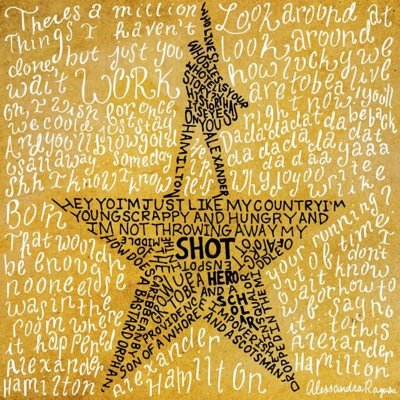
I’m a little late to the party with Hamilton. Fortunately, the party’s still going on so I’ve got time to play catchup. I mean, it’s not even coming to Pittsburgh until 2019! Until then, all I can do is play the soundtrack nonstop. (See what I did there?)

I understand why everyone is so in love with this musical. But I feel a personal attachment to Alexander Hamilton as an American writer. Songs like Eye of The Hurricane and Nonstop just stir my heart.

American writers have a rich and heavy legacy to uphold. Fitzgerald, Nelly Bly, Upton Sinclair. We write in their shadows, trying in our own ways to cause ripples in our societies. While the first call for a writer, at least a fiction writer, is to tell a story, many of us crave something more. We want to make changes, and for many of us, our writing is the way we do that.

And there’s a good reason for this.

We built this country on words. We may have fought a war to gain our freedom, but that wasn’t all of it. We had to convince people that war was worth fighting. Our founding fathers did that with essays and speeches, provoking our men and women to action. Common Sense is still read today, and the Constitution was a work of art. None of our battles would have even happened without them. We wrote our way to freedom. And that’s powerful!

We change this country with words, once we got it started. We wrote essays and stories that gave people the truth of situations that they might have preferred to ignore. We wrote fiction stories that had more truth to them than people realized. We revolutionized the food industry, the mental health industry. We cleaned house sometimes, when we needed to, with our words.

We should remember our heritage, as American writers. We’ve changed minds, changed lives, changed policies! Words have power, don’t ever forget that.

My favorite line from Hamilton is this: “America, you unfinished symphony. You sing for me!” These words, especially weighty after realizing how important his legacy was to Hamilton, rest on my mind. We, American Writers, are his legacy. When you think you’re too tired to write, you remember that. When you’re afraid that you might get backlash for something you’ve written, remember that.

Don’t throw away your shot.

I don’t do nanowrimo (but you probably should!)

If you’re doing Nano, you should have 5,001 words written by the end of today.

I hope those little updates don’t bother you because I’m going to keep doing them for every post the rest of the month. You know, to help you keep track.

I have the utmost respect for Nanowrimo. It inspires new writers to get started, helps them push through that ever-difficult beginning, and is just fun. It’s all about everyone reaching their own personal finish line.

That being said, I haven’t participated in Nano for several years now. I’ve done Nano Edmo for two years straight, but haven’t done Nanowrimo in a very long time. Here’s why I don’t, and why I think you probably should.

Why I don’t do Nano anymore

The years that I did Nanowrimo were quite difficult for me because I write longhand. That is crazy hard when you’re doing Nano because you can’t scan a page and put it into the word counter. And I can’t work on a computer for a rough draft, I just can’t do it. For one thing, I can’t carry a computer with me everywhere, and I find myself incapable of writing on a tablet. For another, I feel that my words don’t flow as well on a keyboard as in a notebook. And finally, I find that the act of typing in messy pages of text is the best and most in-depth way to do a second draft.

Nevertheless, I really tried to make it work for three years. I stopped trying when I looked at 50,000 words of Starting Chains rough draft, realized it was all shit, and threw it away to start from scratch. That was the last time I participated in Nanowrimo.

I understand that you don’t really have to use the official word counter. I get that I could just count my words every day and not officiate it. I think I’d rather cut my wrists than count every word I write, but I could do it. So the fact that I write longhand shouldn’t really stop me. Here’s the real reason why I don’t do Nano anymore. It doesn’t always mesh with my writing schedule.

Take this year, for instance. I’m working on a rough draft right now, of Station Central. (Station 86, book 4. Don’t forget, Book 3 starts on November 29th.) But I’ll actually be done with it pretty soon since I started in October.

Could I have waited for November first to start Station Central? Sure. But I’d have wasted all that time, and I didn’t really want to do that. I had an outline, and I was ready to go. Now, I’m almost ready to start on the second draft of Sandwashed. (The first of the new duality, set after the Woven Trilogy. The second of the Woven Trilogy, Starting Chains, is coming soon.) I don’t want to delay that or start it early so I can do Nanoedmo in full this month. I need to work on the project I’m ready to work on when I need to work on it. I can’t stop or start a project just because it’s November.

Why you should

Let’s be clear, I’m kind of weird. Most writers have no problem writing rough on a computer. (But if you do, it’s nothing to be ashamed of.) Most writers don’t feel itchy when they’re not working on a project. Some writers finish a book and then don’t start on another one right away if you can believe that. So, for lots of writers, Nanowrimo works just fine.

For instance, if you haven’t started your novel, but you want to, then Nanowrimo is right for you. It’s the magic of a deadline, and you’d be amazed how motivational that is. You need to get your outline done and get started! No more hem-hawing, no more maybe someday. Here is the day you’re starting, right now! And by that I mean, if you haven’t’ started on your novel on November first, start today. We are only three days in, you can catch up. Just start writing!

If you don’t know if you can really finish your novel, you should also do Nanowrimo. Maybe you’ve started rough drafting, and you have some notes. You have an idea of the character’s, maybe a vague idea of the ending. But you’re not really working on it like you should. You might take it out and play with it sometimes when you need to feel creative. Well, now’s the time to knock out 50,000 words of your little project. I imagine that you’ll find you want to keep going after that.

If you’re not really sure that you’re even a writer anyway, but you really want to give it a try, then I can’t suggest enough that you do Nanowrimo, right now! Trust me, if there are two things that will inspire you to write, it’s a deadline and other writers cheering you on! You will be inspired, you will be motivated! You will be a writer!

Here’s some good news

Just in case you’re still on the fence about this whole Nanowrimo thing, let me give you a piece of inspiration. You know that book I talk about all the time? Broken Patterns?

It started out as a Nanowrimo novel.

So if anyone tells you that its’ a waste of time, that Nanowrimo books don’t get published, you can tell them that they are dead wrong.

My 2017 Gratitude Experiment

It’s November, and we’re down to the wire for 2017. I’m feeling pretty good about the year, if I can be honest. I’ve done almost everything I wanted to do this year, and I’ve got the last few things scheduled. And November is going to be a lot of fun, if also a lot of work.

Controlling Your Life, the email course, will be starting on November 13th. Is November the best time to start actionable items that will give you a better handle on your day to day so that you have time to write? Of course it is! Because these are tips and habits that you can start right away to make your life run more smoothly. Click here if you haven’t signed up yet.

This is exciting for me, because I haven’t done an email course since the 30 Days, 30 Ideas event. I’ve taken way too long to come up with another one. (By the way, if you didn’t get to participate in 30 Days, 30 Ideas, don’t fear. I combined the whole challenge into a free ebook, that you can get by clicking here right now.)

Virus is starting on November 29th. This is the third installment of Station 86, and it’s where some serious questions are going to be answered. Why has Earth gone silent? What’s happening, now that April’s secret is out?

I’m excited to start getting Virus out. It’s the longest Station 86 book to date.

Obviously, Thanksgiving and Christmas are both happening in the next 60 days. And so is my husband’s birthday. I don’t think I need to explain how much of my time this is taking up.

For those of you doing Nano in November, my online scifan group will be doing all sorts of fun things. While I’m not competing this year, I am going to be spending some time cheerleading.

Oh, and one more thing, nothing major. Just that Starting Chains, Book Two of Woven, has been accepted by Solstice Publishing! I can’t begin to say how excited and humbled I am by this. I’ll be working with my editor to get everything just right over the next few months. And I’ll be sure to tell you as soon as I know when the launch date is.

November and December are going to be amazing, and I am so deeply thankful for everything that’s happened so far.

Speaking of gratitude, I’ve been doing something all year that I’d like to share with you today.

See, 2016 wasn’t a great year for almost anyone. In fact, it was a garbage fire kind of year. While my book, Broken Patterns, did get published, that was about the only good thing that happened.

I was not feeling the new year excitement when we started 2017. I wanted to feel okay, but I didn’t think there was enough good happening to make that happen.

I’ve known for a while that a lot of people practice daily gratitude. I’d tried to do this in the past, writing down at least one thing I was grateful for in my bullet journal. The problem was, I forgot. It was on a page that I didn’t necessarily flip to every day. So, I’d miss a day or two, get discouraged and stop trying.

Starting on January first, I decided that if there was one habit I was going to get down in 2017, it was a habit of daily gratitude for what I have. Because, especially in these times of fighting and unrest, I’ve got a lot to be thankful for. My children are strong and healthy. I have a loving husband and a roof over my head. The damn roof might leak, but it’s there. We have food in our house, even if it’s pasta more days than I’d like. (Pasta and chicken are cheap. So, they’re staples of our diet in my house.) I have a good job. I have a couple books published, and most months I even sell a few copies.

I started writing down two things I was grateful for the day before, in the side column of my Erin Condron Planner. They could be little things, or huge things, it didn’t matter. Maybe a bat got in the house and I got to pet it before we let it out. Maybe dinner was especially nice, or my mother in law sprung for takeout. Maybe I could get overtime, or found an extra dollar I didn’t know I had.

Whatever my day was like, I found that I could think of at least two bright spots in the darkness. Even on the bad days. Days I was fighting with my kids, hadn’t slept well, was down because of the news. Even as I was praying for Puerto Rico, Texas, Florida and Los Vegas. Even as I was increasingly frightened by what I heard on the news. I searched for those bright spots.

I had the extra money to donate. (And if you want to donate, click here.)

My best friend messaged me, just to say hi.

I found some chocolate dipped cookies that were cheap at Aldi

We went downtown today, and saw the community garden.

I finished a big project.

The kids didn’t fight today.

Rick and Morty is back.

I made pork chops in the crock pot and they were good.

I managed to keep this up every day this year. And by remembering the good from the day before, I made every day of 2017 a little bit brighter.

What are you thankful for this year? What good has come your way, big or small?

If you’re doing Nano, you should have 1,667 words written by now

Happy Halloween

Many years it rains on Halloween, here in Western PA. We parents have learned to plan costumes around the bad weather. When I was a kid, they had to be planned around snow suits, most years. But it doesn’t snow as much as it used to anymore.

My kids costumes are ready. One’s a zombie, the other is a vampire. Simple costumes this year, but that’s alright. There’s nothing wrong with the classics.Soon I’ll be fixing their makeup, and we’ll head out for trick or treating. It’s probably the last year they’ll want to go. They’re thirteen now. They might just hand out candy next year. Their turning into women, in that bitter-sweet way all children do.

No matter how old they get, though, they still watch It’s The Great Pumpkin, Charlie Brown. They’ll leave out candy so that The Great Pumpkin will leave them presents. We’ll watch Thriller and Rocky Horror Picture Show. We’ll watch Nightmare Before Christmas and all of the other horror movies we have time for.

Our pumpkins are out on the front porch for everyone to enjoy. They were carved with care, then the seeds were baked with salt and oil. They’d filled our house with the good, clean smell of fresh pumpkin. In a few days they’ll be in the garbage, but right now they’r eout there, grinning their wicked grin.

Happy Halloween, everyone.

Using weather to set the scene in your novel

One of the first things I do in the morning, after getting up and grouching at the day, is check the weather. It’s going to have an impact on my day, from what I’m getting dressed in, to where I’m writing after work.

Do you consider what the weather’s like in your book? I imagine that it’s not something that you want to go into too much detail, of course. The weather’s fodder for boring small talk, after all. It’s nothing that anyone wants to write about unless it’s deadly.

But then, what about the fact that it’s one of the first things we check up on in the morning? If it’s so boring, why do I check that before I check the Penguins score?

Because it has an impact on my day, that’s why. And it’ll have an impact on your characters day, too. At least, it probably should.

Setting the time of the year

As the season’s change, so do our lives. In the winter, we’re celebrating warmth. We bundle up, go skiing, watch movies at home and make stews. When it’s summer, we go camping and swimming. We eat lighter foods. We garden.

Your characters lives will be different depending on what time of year it is. Are they getting ready for a Winter holiday? Are they plotting to overthrow the king while preserving vegetables in the fall? Are they falling in love while planting in early spring? All of these things help give a sense of realism to your book.

Making things harder, or easier for your characters

If your character needs to get through a mountain pass, they’re not going to get too far in the winter. If they accidentally start a fire in the city, it’s going to cause more damage during a dry summer month.

You get the idea. The weather can be a mild irritation, a huge inconvenience, or downright deadly depending on what’s happening in your book.

You can absolutely use this to your advantage, especially if things are just a little too easy for your characters right now. (Things should never be easy for your characters.) So maybe your character needs to get errands done, and they’ve now got a flat tire. Maybe it should be raining while they have to change their tire. Just to make it a little worse, and kick them when they’re down.

Mirroring, or contrasting your characters emotional state

One of my favorite lines from the second Men In Black movies is when Kay (played by the amazing Tommy Lee Jones) says to the character we’re just now realizing is his daughter, says, “It rains because you’re sad, Baby.”

That line hits me, not just because of the one moment of human emotion in it. (I mean, I could write a whole post about that. It’s the one time in three movies we see Kay. We see his emotions falling out. Maybe we even see real regret, for this child that he didn’t ever get to know. That he now has to send away for the good of a planet he’ll never get to see. Is that why he never tried to raise her? Because he knew she’d have to leave and he’d never see her again? Those movies don’t get enough credit.)

Anyway, it makes rain something more than just water falling from the clouds. It becomes symbolic of tears, both those of Laura and her mother on the day that she died. Perhaps Kay’s as well.

But in Broken Patterns, Lenore and Victor share their first kiss in the pouring rain. She’s just tried to fire him because she can’t stand that she’s falling in love with him. Instead, he begs her not to send him away, and they share their first kiss, terrified and excited. In this scene, I used the rain as a misdirection. Hopefully, upon first reading it, a reader will believe that he’s about to leave her life.

Do you have to start every new scene with a description of the weather? Of course not. But it’s one of the many tools you have at your disposal. So you should learn to use it effectively.

How I’m improving my descriptions

As a writer, I’m always learning. We need to be, as writers and artists, always learning and trying new things.

Or, in some cases, you need to go back and learn how to do something sort of basic. Like writing descriptions.

I used to be really bad at writing descriptions, both of characters and of action scenes. Quite frankly, my description of the scenes needed some work too.

For a long time, I just avoided it as much as I could. But I realized that I couldn’t do that forever, and I needed to get these descriptions down if I wanted my books to get better. So here’s what I’ve been doing to improve my descriptions.

Freewriting practice

Here’s the freewriting practice I’ve been using to help my descriptions. I find a picture on google of either a place, building or person. Then, I describe them for ten minutes.

I might also sit somewhere public, and ‘sketch’ a stranger. This is a really fun thing for me to do, actually. I feel quite artistic.

I do this over and over, until describing things is almost automatic. Until I find my mind describing things without even thinking about it. That’s where I want to be so that when I’m describing something that only exists in my mind, I’m ready.

Eye color probably doesn’t matter

When I was first writing Broken Patterns, I sent a few chapters to a review site. It was the first few with Devon, in a chapter that didn’t end up making it into the book. He and the other young noblemen were practicing archery. I described them down the line with nothing more than their hair and eye color. It was kind of like in Sailor Moon, where all of the girls have the exact same shape and facial structure, with nothing to tell them apart but their outfits and hair.

Needless to say, I was politely informed that this was a dumb way to describe someone. And I mean, really, aside from your significant other and your children, do you really know anyone’s eye color? I know some characters eye colors, but that’s only if it’s a big point. I sure as hell know that Harry Potter’s eyes are green, like his mothers. But that’s about it.

What’s more interesting are the details that a character doesn’t share with a large number of the population. Visible scars, tattoos. Things that you notice first when you look at a person.

Reading action scenes more thoroughly

I have to confess, I don’t care for action scenes. I usually skip them in books and let my mind wander during them in movies.

Gee, I wonder why I had so much trouble writing them!

Over the last year or two, I’ve made a point of seeking out books that have more descriptive fight scenes, to see how other artists do things. To get a feel for what works, and pinpoint what kinds are the reason I skip scenes like that to start with.

In doing that, I’ve started developing an ear for such things. So I can tell better what’s working when I write it, and what’s not.

Researching actual medical responses to injuries

Recently my Pinterest board should be titled, “I’m not planning a mass murder, I’m a writer!” because it’s been full of shot and stab wound info. Also, there are detailed graphs explaining what happens to a body when it falls from a high distance, what certain poisons can do to a person and how long snake venoms take to kill someone.

I don’t want to write a fight scene or death scene only to find out that it’s totally unrealistic. That defeats the whole purpose. I want to write good scenes that are honest, not pretty scenes that don’t make sense.

This is where research even if you’re writing pure fiction comes in. Unless you’re writing totally non-humanoid characters, you need to understand a little bit about what our bodies realistically go through during a crisis. You’ll be better able to describe them if you, you know, know what you’re talking about.

Practice

The longer you write something, the more often you write a certain kind of scene, the better you’re going to be at it. That’s just all there is to it. So long as I hated writing descriptions, and therefore avoided them, my descriptions didn’t get any better. When I decided that I needed to get better at them, and started putting actual effort into them, they got better. Go figure.

My descriptions have always been the weakest part of my writing. I’m thankful that I’m finally seeing some progress in it. If it’s a problem with you, I hope that these suggestions help you as well.

What do you do to improve your descriptions? Let us know in the comments below.

My advice for self editing

If you’re serious about being a professional writer, you’ve got to get good at editing your own work. I actually run my own freelance business editing, and I can promise you one thing; editing starts with the writer. Otherwise, the editor isn’t going to be able to handle the job.

In addition to that, there are always going to be documents that you don’t want to send to an editor. I sure don’t have someone else edit every short story and blog post I write. (I don’t know that an editor could keep up with me.)

Here’s what you need to know about self-editing your work.

Give yourself some time

I actually have to be very careful as I write this, to not plagiarize anyone. Literally, everyone believes that this is the best piece of advice for writing. Write your story, be it a short story or novel, then put the damn thing away.

First off, you probably need a break. Go play cards with your kids, walk your dog, take a long bath.

This allows you to gain some perspective on the document. You can see it for what it really is, not for what you meant it to be. Because maybe it’s better than you meant it to be. Maybe it isn’t. But the fact of the matter is that your document is a living thing. It may have fallen short of what you wanted it to be or gone in a whole new direction. Either way, you’ll be able to tell better if you wait.

Don’t get too attached

Yeah, I know that I just called your document a living thin, but I didn’t mean the kind of living thing that you should get attached to. There are going to be parts of your story that you love but just don’t work. There are going to be lines that are brilliant, but just don’t go anywhere.

Cut it. If something is in your document that doesn’t add to the story, cut it. Save it, tell yourself you’ll use it some other way. Then cut it.

Print it out

I write my first draft out longhand, which forces me to type the whole damn second draft. This forces me to rethink every single part of it, rewriting all of it. Then, when I’m ready to do my third draft, I’ll print that out.

There’s something about having that draft that causes magic. I can find errors that I wouldn’t be able to if I just looked on a screen.

But in the final draft, I go over it right on the screen. So every draft is looked over on a different medium, which means every draft feels fresh.

Read it out loud

Want to write good dialog? Read it out loud. Want your descriptions to not overflow or sound unrealistic? Read it out loud.

Yes, you’ll feel a little silly at first. Sorry. But writers aren’t generally considered sane to start with. So accept it. Just do what you’ve got to do.

Don’t worry about grammar until you decide you’re keeping the chapter

When you first start editing, your grammar and spelling mistakes are going to be glaring. You’re going to want to fix them.

Don’t bother. You might not even keep this chapter! That’s why you’ve got to start with major issues. You’re going to write new chapters, cut whole paragraphs, move things around. Grammar is something you need to worry about later. Just worry about the big stuff first.

In fact, I usually don’t worry about grammar until the final draft. The second draft is for the really big issues. The third draft is to hone the story and fix anything I missed in the second draft. The final draft is when I worry about fixing grammar and spelling.

You want to give your editor as clean of a copy as possible. Don’t worry, they’ll still find things you missed. But the more you find, the more likely they’ll find the more confusing and difficult parts.

Controlling Your Life, The Email Course, comes to PBW

If you’re trying to find time to write, you know it can be a nightmare. Your time’s ususally devoted to your family and your day job.

At least, that’s how I used to be. I have kids and a family, and I always put them before my writing.

That was killing me. I’ve wanted to be a writer since I was thirteen. But it was constantly being put aside so that I could take care of what I thought that I should be doing.

Even when I finally did start writing again, it was a secondary thing. I still didn’t devote time to it, because I felt guilty. I was taking time away from my kids to write, ignoring them.

I don’t feel that way anymore. I finally realized that I was taking time from the wrong activities. That I spent most of my time on stuff like keeping up with the house and running errands. It wasn’t anythng meaningful, you see. I wasn’t not writing to listen to my kids tell me about their day. I was not writing so I could wash dishes and fold laundry!

I’ve learned to streamline my every day to create time to write. It’s taken time, learning and practice. It’s taken setting simple yet powerful habits in place.

I want to help you do the same thing. I want you to be able to have time in your day to write your book.

So, I’m sharing an email course to help you get control over your life, starting November 13th.

The course will help you get control over your household, your food, your obligations and your goals. It’ll come to you in five emails, from November 13th to the 22nd.

Click here to sign up.

If you’re already recieving the PBW Update, you’re already enrolled.

Brevity is the soul of horror

Brevity is the soul of wit. There’s a reason why everyone says this. It’s because it’s, duh, true. Good comedy works best when it’s brief. While some comedians do quite well with longer jokes, the best ones are always the quickest.

I poured spot remover on my dog, now he’s gone.

-Seven Wright

I often find that humor and horror have a lot in common. They both tend to have a bad reputation for catering to the lowest common denominator in our society. Critics hate them, considering them vulgar and not worth their time.

Obviously, I think anyone who looks down on an art genre as a whole is lost in their own elitism and wouldn’t know a good story if it bit them in the ass. (Sorry, is my vulgarity showing?)

But that’s not the debate I want to get into here. What I’m trying to say is that I believe that the horror genre, like the comedy genre, works best when it’s brief. Social media is flooded with these eerie little horror stories that I’ve become quite addicted to. Here’s one of my favorites.

A young girl is playing in her bedroom when she hears her mother call to her from the kitchen, so she runs downstairs to meet her mother.

As she’s running through the hallway, the door to the cupboard under the stairs opens, and a hand reaches out and pulls her in. It’s her mother. She whispers to her child, “Don’t go into the kitchen. I heard it too.”
-Not mine, but I couldn’t find anywhere who wrote it first. So here’s a link to the Creepypasta page I found it on originally. If anyone knows who wrote this, please tell me.
Here’s a link to a whole post about them from Thought Catalog. You can also read through Creepy Pasta to your heart’s content, or search #twitterhorrorstories. But the love of the brief horror story has existed for a long time before the internet. Think of the urban legend, the campfire stories. R.L Stein is the master of horror stories for kids, and not one of his books are over 100 pages.

You don’t need to build as much of the world

When you’re writing fantasy or science fiction, you’ve got to build that world up. You’ve got to create a world that feels different from the one we walk around in every day, and it needs to feel real. That requires your characters to eat things, look around at their surroundings and experience the ways their world is different than ours.

Most good horror is set in the real world. Unless you’re reading period horror, it’s set in current time. Except for some flashbacks and origin stories, at least.

There are pros and cons to setting your world too solidly in the present time. It will age and can make your book laughable later.

Or not. Stepford Wives is a classic horror, and it’s definitely a creation of its time.

The benefit of setting your horror story in real-world surroundings is simple; it makes it more believable. If I write a horror story about a man who is murdered after going to a Chinese restaurant, I bet you don’t order take out tonight. If I write about a young boy who’s possessed by a demon on his television and kills his whole family, it feels like something that might happen. Maybe not during the day in the sun, but after dark everything seems more believable.

So, since you can assume that you don’t have to really explain too much about your characters surroundings, other than to set the mood, you can save a whole lot of time.

Too much fluff will kill the mood

There’s something behind you. Can you feel it? It’s there, just past your line of vision, in that dead space your eyes can’t reach. You know, that place you can’t see unless you really turn around. And by the time you do that, the thing might have moved? That’s assuming you can even do it at all. I mean some people can’t really turn around that well.

Can you tell when that stopped being creepy? Right about the time I started way over explaining things!

You don’t need to explain as much in a horror story. In fact aside from the description of the big bad evil, I’d be as sparing on detail as possible while still making sense. For one thing, too many details will kill the mood. For another, it’s not a terrible thing for the reader of a horror story to be not fully aware of what’s going on.

Don’t forget, the scariest thing is always what we don’t know.

Suspense can only be sustained for so long

Think of it like tightening a string. You can only tighten it so long until it breaks.

This is the same for your story. It will only hold up to so much tension. You can only do so many awful things to one character. You can break them, sure. Strip them down to nothing, chase them alone through a nightmare scenario. Force them to do something horrific just to survive. Get them naked, covered in blood and guts, some of theirs and some of others.

It’s a horrific fact that you probably don’t have to do that much to your character to get them to that point.

It’s a less horrible fact that there’s only so much terror and gore one reader probably wants. There’s a fine line between terror and murder porn. It’s one that gets thicker and thicker for me as I get older. When I was a kid I loved gore. The more horrific the better. These days, I don’t have as much of a stomach for such things. Maybe it’s something about having kids, I don’t know. But I just don’t love it as much anymore, and most adults do go through that change.

Maybe it’s something about living in a world where a man can take somewhere around 26 automatic and semi-automatic guns into a hotel room and murder roughly 60 strangers in cold blood for no discernible reason. So I keep the blood flow and guts to a minimum.

As one last thought, on the genre of horror in general, let me leave you with a quote from Joss Whedon. I think it applies to all writing, but horror most.

Make it dark, make it grim, make it tough. But then, for the love of God, tell a joke.

A WordPress.com Website.

Up ↑