I was almost a Tradwife

I was raised to be a homemaker. I was raised in the Church of Jesus Christ of Latter Day Saints, where being a wife and mom is considered the highest calling a woman can have.

My mother wanted to be a homemaker. My grandmother was a homemaker. My great grandmother was a homemaker. I was not encouraged to go to college or prepare for a career. I thought for sure I was going to grow up, get married, and be a homemaker.

I had an image of what my life was going to be like. I’ve wanted to be a writer since I was thirteen. So I imagined that I’d get married, raise babies, and write stories. I had these lovely fantasies about bouncing children on my lap while I edited manuscripts. Writing poetry while the meatloaf baked. Submitting queries while the children were at school.

I suppose that would have been alright. That would have been a nice life.

But life happens. I was a full time homemaker for three years, until I couldn’t handle the abuse at the hands of my previous partner. After this, I discovered that I liked working far more than I liked homemaking. So when my Darling Husband and I moved in together, we decided together that he would be the homemaker and I would work. We did have discussions about this, and decided it was the best plan for our family.

When we got married, the Darling Husband had some health issues. But he was mostly fine. In the past ten years, his health has gone downhill.

Way down hill.

Last December, as you might know, he suffered from a hemmoradic stroke. One moment, he was sitting in our bedroom. The next, he was calling to me from help.

The next moment, he wasn’t able to form sentences. Or move. He was moments away from death.

Now, I’ve told you all that to tell you this. I despise Trad Wife Influencers. I think they prey upon women, selling them fantasies that are unrealistic and dangerous. Using our inherent guilt and years of bad traditions, Trad Wife Influencers tell women that not only should we all want to be homemakers, but that we can all do it. They post videos of themselves making bread from scratch, dressed in immaculant prarie dresses while carrying cherubic babies on their hips in gorgeous well lit kitchens. And they say that we can do it too.

These videos are lies. They’re staged, produced, lovely lies. These women are business owners, lying to you to make money off of you. And these lies can destroy you.

If I had still been a homemaker when the Darling Husband had his stroke, we’d have been cooked. I don’t know what we would have done. But this is just one example of what could go terribly wrong. Consider my mother. Through no fault of her own, she never found a partner and so failed to be a homemaker. Or my grandmother. She was a homemaker until all of her children moved out, but suffered through not one but two abusive marriages.

Marriages might not last. Healthy men don’t always stay healthy. The cost of living is getting more and more expensive, and a lot of families can’t afford to live on one income. Not all women want to be homemakers.

None of these things are failings. None of these things are wrong. In short, it’s not your fault if you’re not able or don’t want to be a trad wife.

I do not say any of this to shame homemakers. I have nothing but respect for them. I was one myself, my Darling Husband was one before his stroke. I would even suggest that I am still a homemaker, just not full time. I do, after all, keep my home. I cook. I clean. I mend clothes. I crotchet and knit. I care for my Darling Husband and our pets. I even bake things from scratch sometimes. These are all lovely things that I take pride in. I do none of these things perfectly. Even if I didn’t have a full time job, I probably still wouldn’t do any of these things perfectly.

It would be easy to say that I’m a failed homemaker. Even if I didn’t want to work, I’d have to work. And I am just over women attacking other women for not reaching unatainable goals. I am way over ‘traditional gender roles’. So let me leave you with some advice. If you, man or woman, want to be a homemaker, consider this.

Get financially smart. Just because you’re not making money doesn’t mean you shouldn’t be helping to manage money. Learn about long term savings accounts and low stakes investing. Learn about credit, and how to use it to your advantage. And build credit in your name. Having no credit score is worse than having bad credit. It seems like a cheat, but it’s true.

Find ways to keep your hand in with some sort of career. Massive gaps in your resume aren’t going to help you if you suddenly need to get a job. Have a plan in case you suddenly need to step into the work force.

Have money of your own. Money that you have control over. Maybe you babysit, recycle for profit or sell handcrafts on Etsy. Maybe you and your partner agree upon a certain amount of money that is yours to save, spend or invest how you see fit. Remember, your partner benifits from your hard work. Domestic labor is labor and you aren’t being selfish asking for a safty net. I have a savings account set up for my Darling Husband for this exact reason.

Yes, all of this advice is about money. But, while I hate this, we will starve and become homeless without money. You need to be able to care for yourself and your family if the worst should happen.

In short, homemaking is not for everyone. It’s not desirable for everyone, and it’s not realistic for everyone. Don’t let someone making sourdough on social media tell you that you’re less of a woman if you can’t or don’t want to do it full time. Live your life, do your best, and do what makes you happy.

I am not living the life I thought I would. I am not living the life I was raised to live. I am living a much better life. One that is full of unexpected joys and surprising adventures every day. I have worries. I have sorrows. But I’m satisfied in the work I do in my day job. I am proud of the writing that I do. My home is comfortable, if not always tidy. My life is full of friends, loved ones, art, good food and good coffee. And good books, of course. So many good books.

Paper Beats World is a labor of love. If you love what we do here, you can support us by liking and sharing this post. You can also support us financially on Ko-fi.

Missing Stitches is now available wide. Click here to check out all the places you can get it.

My thoughts on Nebula Con 2025

Last week I attended the 2025 Nebula conference virtually. And for something that only lasted two days, I am sure still recovering from it.

As always, I learned a lot. And while I was a little disappointed that there was only a day and a half of panels for online participants, it was still a worthwhile experience. And, for the first time, I moderated a panel!

Some of my recovery time might have been due to the social anxiety attack I had over that, but it was still fun.

Today I want to share with you some of the best lessons I learned this year. I never walk away from Nebula Con without learning something that uplifts me and helps me be a better writer. Hopefully, some of these lessons will help you as well.

Don’t take anything too seriously

Writing is a serious business that is populated by unserious people. Yes, working writers need to deal with dull and business-type things like marketing sales and pricing. Yes, to be a successful writer you have to treat the business side of things like a business. Like you have a product that you’re selling.

But you’re also making up stories about dragons, ghosts and spaceships. You’re still playing make-believe and putting it on paper. It should still be fun.

This is something that’s never forgotten at Nebula Con. If you’ve ever attended, then you know the running joke that we are, in fact, on a spaceship that we’re sharing with several fantastical creatures. For instance, space wombats.

It is a wonderful reminder that writing is supposed to be a little bit fun. Most of us started writing because we were voracious readers. Reading was the most fun thing we could think of doing. I spent a good part of my childhood, some might say too much, between the pages of one book or another. I was having fun. And I have fun when I’m writing. Even when it’s hard. It’s still supposed to be fun hard.

Writers are still some of the most fantastic people I’ve ever met

You know how sometimes you meet someone and you just click right away? That’s how I am with just about everyone I meet at Nebula Con. And I might be biased. Hell, I know I’m biased. But when you meet someone who speaks the same strange language you do, you feel like you’re a little bit more at home than you did before.

I was introduced to this queen

During the event, I attended a two-hour panel about career longevity. It was hosted by Becca Syme, author and career coach. And the things she said blew my mind.

Look, I’ve been around a bit. For someone to say something truly revolutionary for me is impressive. Because I’ve heard all the self-help and inspirational quotes before. Nothing’s been as motivational as her talk.

I don’t want to jack all her material, because you really should go check her out. I will only say that Loki comes into the conversation and it is life-changing. I now need to read all of her books and listen to all of her podcasts.

If you want to do something, go for it

Now, this is the main thing I wanted to talk about today.

I was invited to moderate a panel about cozy horror. To put it mildly, I was not prepared for this. I had never participated in a panel. Moderating the panel is like being the host. I was in charge of coming up with questions and controlling the flow of conversation. And most importantly, ensuring that we ended on time. All of this, and have my face on camera the whole time!

I don’t know if you’ve noticed, but I put out a lot of content that does not include my face.

So I was terrified. This was dramatically out of my comfort zone. But it was also something that sounded like a good experience.

It should be no surprise at all that it was, in fact, a great experience. The people on the panel were kind, funny and very talented writers. I had a fantastic time.

So if you have the opportunity, get out of your comfort zone. Do something you’re scared to do. Prepare for it, learn what you need, and do it. And if you don’t have the opportunity, make one.

Also, if you’ve never been to Nebula Con before, consider checking it out if you can. I, and the space wombats, will see you there.

If you like Paper Beats World and want to support us, you can do so by liking and this post and sharing it. You can also support us financially on Ko-fi.

Missing Stitches is going wide on June 27th! Check out all the places it will be available here.

Care Giving

In December my darling husband had a brain bleed stroke. He spent two months in the hospital and then rehab before regaining the health he needed to come home.

But he wasn’t whole, or healthy. He came home and needed a lot of care. And while he’s improved, he still needs me more than ever.

Thank God I work from home.

In addition to some cognitive issues, he’s mostly paralyzed on his right side. His movement is coming back, but slowly. And so I find myself in another season of caregiving.

Nothing he needs is difficult. It’s only that the requirements are numerous. During the day I might be called from my desk to help him perform some basic functions. Or fix the TV. Or let in the many therapists that come into our home weekly.

He cannot cook for himself, so I cook for all of us. I am managing his medication and his insulin. I am managing as well his doctors’ appointments.

This isn’t the first time I’ve been called into a caretaker position. I took care of my mother as a teenager when she became chronically ill. I cared for my grandmother for a time after surgery. I cared for my mother-in-law as well for years when a simple back surgery led to one complication after another.

Caring for him is not easy. I’m not naturally patient or particularly nurturing. And while nothing I need to do is overly difficult, there are constantly things that need to be done.

Days feel so long sometimes. And it often feels like my brain is full of fiberglass, slowly yet constantly scratching and cutting me.

Two things can be true at the same time. I am frustrated with caregiving. But I am also so thankful that he’s home and alive. Because that was not a given when this shitshow started.

But we’re not here today for me to air my grievances or even rejoice in the fact that he’s still alive. I’m here because I’ve learned a lot about caregiving. And while I’ve spoken before about being a writer while also being a caregiver, I’ve never talked about specific caregiving advice. So, since that’s what’s filling up my days right now, that’s what we’re going to talk about today.

So here are some lessons I’ve learned in caregiving.

You’re gonna mess up

I have messed up so, so many times while caring for my husband. I’ve forgotten to give him his meds. I’ve accidentally tipped him out of his wheelchair. I’ve lost my temper badly enough that I needed to leave the house for a bit to calm down.

None of us are perfect. And when we’re caring for a loved one at home, we’re basically on call for a job we did not sign up for and are not getting paid for around the clock. So yes, we are going to make mistakes. But honestly, most of the mistakes are liveable. We learn, we correct, and we apologize when we need to. And we go on to make different mistakes the next day.

So long as no one’s bleeding and everyone’s breathing, we can try again the next day.

You’re gonna need help

This has not been a solo project on my part. The husband’s parents have helped when they can. We’ve had physical and occupational therapists in, helping him heal and teaching me how to care for him. His doctor has helped. And my friends have been a constant well of support.

Don’t be afraid to ask for help when you’re trying to care for someone. It’s a massive job, and no one should be expected to do it alone. You might need some extra cash, or someone to come help clean up the house a little. Even just someone to listen to you while you lose your mind a little. Lean on the people you have to lean on. Otherwise, you’re going to crumble.

You’re gonna have to let some things go

Sadly, a lot of my writing has gone on the back burner. Some days I get to it. Most days I don’t.

I don’t usually cook dinner. I get a lot of frozen meals, and we’ve been eating out a lot. I’ve also just straight-up made tuna sandwiches when I didn’t even have the energy to Doordash something.

Fed is best.

But my house has been messy, my writing’s been ignored. And sadly, I’ve had to say no to some opportunities I wanted to take part in.

Right now, I have to prioritize my mental health and his overall health. Everything else is debatable. Everything else can be put off for another day.

Don’t forget that ‘care’ is the first part of this

This was the hardest lesson I’ve learned. And it was one of the things I messed up a lot at first.

There are a lot of things that need to be done every day. The cleaning and cooking and caring for things like medicine and baths. The laundry is a constant battle. The dishes snicker at me when I walk past. At least two plants have died.

But the most important thing about caretaking is caring for this person. Making sure they’re okay emotionally. Sometimes that means just sitting with them, and letting them talk about their problems. Sometimes it means having patience to let them try to do things when it would be so much easier to do the thing for them. Sometimes it means holding a heating pad in place, or bringing another cool washcloth, or just assuring them that you’re right there, and you’re going to be right there, for as long as it takes.

At first, I was impatient with this part. I had things to do, important things that I had to do to keep us all alive. I didn’t have time to sit down and hold his hand through this. I needed to make sure he had something to eat and was clean, and doing his exercises, and a thousand other little things.

But none of that matters as much as the real caretaking work. The caring enough to slow down, and help the person you love process what the world looks like to them during this time.

Overall, the biggest lesson I’ve learned is this. He and I, we’re on this journey together. We’re healing together. And when I look at the situation that way, things are more manageable. It’s easier to keep everything in perspective when I see us as a team.

If you want to support Paper Beats World, you can like or share this post. You can also support us financially on Ko-fi

Starting Chains is going wide on May 30th. Check out all the places you can get it here.

The End of Haunted MTL

The publishing world is ever changing. What was a thriving online market yesterday could well be bankrupt tomorrow. A publishing company that was an unquestioned pillar can crumble. A beloved author can seemingly go out of her way to destroy her reputation.

And a beloved horror review site can shutter.

Sadly, Haunted MTL is no more. And, I might as well rip this band-aid off now, there will not be another season of AA.

I might write the story in book form, if anyone is interested. I was certainly going somewhere with the story.

I started working for Haunted MTL in 2019. I’d already published several novels by this time, but this was something different. This was an actual writing job.

I loved my time writing for Haunted MTL. I met so many amazing writers and made friends with several. There is nothing better than writing friends. I got to see horror movies that I might never have seen. Some I wish had never assaulted my eyeballs, like Antichrist. Some I loved very much, like Silent Night and Pooka. I conducted live tweet events during American Horror Story and Dexter, and got to talk to fellow fans all around the world.

Being a critic was a fantastic experience. If you want to be a good writer, one important exercise is to dissect a piece of work that you have strong opinions about, good or bad, and consider why it either works or doesn’t work. As a critic, that was exactly what I did twice a week. And I even got paid for it.

I was also invited to participate in several charity anthologies, which is always great. We conducted storytelling events through the years, writing short stories together. Including several years of Christmas and holiday horrors.

We did podcasts. We did events. We once read A Christmas Carol together and posted it. It was a laugh.

It was too good, maybe, to last.

I will miss Haunted MTL. I will miss the sense of writing camaraderie. Of being on staff. Of being part of a team.

But even as I mourn, I know it’s time to move on. As I said at the top, the publishing world is ever changing. And so even as this spooky door closes, another will open.

If you find yourself in this sort of situation, I’m so sorry. But remember, setbacks like this don’t necessarily reflect on you. Sometimes projects don’t work. We are artists, and art is subjective. Sometimes we’re going to do our level best and still not succeed. All there is for us then is to dust ourselves off, have a little cry, and write another story.

Then another, and another.

Paper Beats World is a labor of love. If you love what we do here, you can support us by liking or sharing this post. You can also support us financially on Ko-fi.

Starting Chains is going wide! Check out all the places it will be available here.

My local bookstore closed

For my entire life, there’s been a bookstore on my local Main Street. It was called Book Nook. And, being who I am and doing what I do, I loved that place.

It had old-fashioned wood-paneled walls. Shelves that smelled more like an old library than a shop. As a child, my favorite part of the store was the spinning rack of bookmarks.

Did anyone else have this weird bookmark obsession as a child? Fancy bookmarks were everything I wanted in this world. These days I just use any nearby scrap of paper. That’s a little sad.

Man, that place never changed. I used to beg my mom to take me there anytime we were on Main Street. At the time, Main Street was a place we were a lot. She worked at several different restaurants over the years. We lived in three different apartments tucked above stores. There was a little five and dime where I marveled at the fancy pens that looked like crystal. We ate at Burger Hut and the Hot Dog Shoppe. We used to have Woolworths until it burned down when I was a child, but I remember sitting at the counter and having milkshakes.

I remember the fire, too. The way the smoke coughed upwards in the sky and terrified me. I worried that it would come for us as well. I think I’m still a little afraid of that.

The five and dime is gone. The Woolworths is gone. Any number of other little shops are gone. The Unicorn Gift Shop, several antique stores whose names I’ve forgotten, a frozen yogurt place. There used to be a classy little bar where I watched presidential debates during the first Obama campaign, drinking Long Island ice teas with the campaign director in my town. Now it’s the classy little wine bar where I go to enjoy a glass of chocolate-flavored wine and read. Life moves on, tearing itself down, burning itself out, building new days and lives and stores upon the memories and ashes.

But not Book Nook. Man, that place never changes.

As a kid, I went there to buy Goosebumps and Babysitters Club books, series I loved equally. As a young woman, I waited outside the door for them to open the day the last Harry Potter book came out. The storekeeper there that morning was both confused and, I think, annoyed to have some overly excited woman in her early twenties waiting at her door. Apparently, this was a new experience for her.

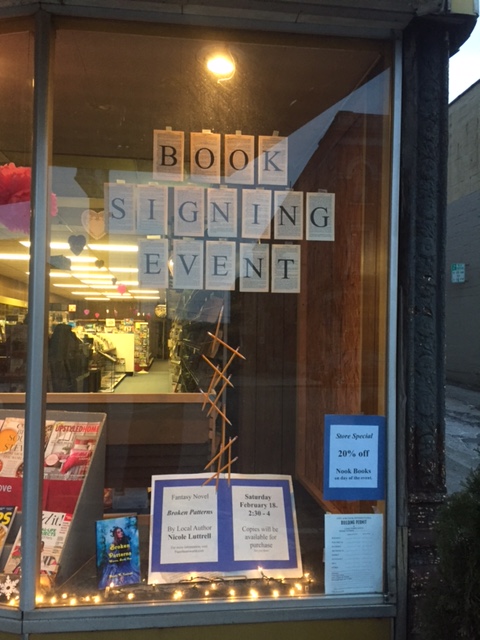
I had my first book signing there when Broken Patterns came out. A copy of the book sat in the front window for months. They even hung up a poster from Starting Chains.

For months. To the point that it faded.

That place never changed.

That was a great experience. A young mom came in, clearly with just barely enough money to get her daughter a book. I gave her a copy of mine and she was thrilled.

I hope she’s doing alright.

I’d pop in from time to time. Sometimes I’d find great things. The author’s extended version of The Stand and American Gods. I impulsively bought some hardcover books that I still love to this day. Strange The Dreamer and An Absolutely Remarkable Thing.

But I didn’t get the sequel to either book there. They never seemed to get them in.

As other stores came and went, Book Nook stayed. Its new releases dwindled. Its stationary options did too, until they went away entirely. So did the bookmarks.

There were no cute impulse buys at the counter. The same counter with the same register that had always been there. Instead, there was a display of lottery tickets. And they clearly made money from the lottery tickets. Once during a book signing, I watched an elderly woman come in and proceed to purchase a scratch-off ticket. She scratched it with no joy, then bought another and another. She kept going for quite some time, scratching tickets with absolutely no emotion on her face.

It became a place that wasn’t fun to be in. Where I rarely if ever found new books I was interested in reading. The hours were erratic, so even if there was something there I wanted, I had a hard time coming in.

And it never changed.

Earlier this year, I received an email from the manager, telling me they were going to close and that I needed to come pick up my books.

Losing my local bookstore has left me with mixed emotions. They survived so much, hanging on through decades of Amazon encroachment and even the pandemic. But they never, ever changed. They never grew with the times. They did nothing to offer readers and buyers a better experience. They simply existed.

And now, they don’t.

I do not blame the store entirely. But neither do I blame competition entirely. Neither do I blame consumers entirely. But all three share a bit of the blame.

Myself included.

I could have been more patient and asked them to order the books I wanted. I could have scheduled more events there, even though the reason I stopped was that no one showed up to them.

But in the end, the issue lies with all three. We should shop small when we can. Big corporations should stop using such predatory practices. They won’t, but they should. And small businesses should put in the effort to grow and change with the times.

In the end, though, I don’t write this to blame anyone. I write this to mourn. No matter the reasons, my local bookstore is closing. The store I shopped in as a child is gone. And I hate that. So I just wanted to hold space for it today.

I don’t remember who said this, or even where I first heard it. But someone somewhere said that every piece of writing is a love letter or a eulogy. This was both.

If you love what we do here, you can show your support by liking, sharing or subscribing. You can also support Paper Beats World financially on Ko-fi.

Broken Patterns is going wide on April 25th. You can preorder it now by clicking on the image below.

My thoughts after Pathfinders Writing Collective’s March Madness

I got an email on Monday that maybe you got too. It was from the Nanowrimo organization, explaining that they are shutting down.

I have mixed feelings about this. I posted months ago about why I was stepping away from Nanowrimo. But it’s an organization that inspired millions of writers over the years. It gave me the inspiration and courage to write my first published novel.

This one. Available now on Amazon and going wide as of April 25th.

And yet, I also feel we are seeing the writing community’s response to AI writing. We will not support any organization that gives quarter and comfort to AI platforms that steal our work and produce flat and soulless stories flooding our markets.

There is one part of the letter that I agree with, though. Interim executive director Kilby Blades said, “Many alternatives to NaNoWriMo popped up this year, and people did find each other.”

And this is true. We found each other. And this past month I participated in a writing challenge that does just this. The Pathfinding Writers Collective March Madness event. And it was a fantastic experience. Even though my team lost. If we’re being fair, I personally lost twice.

Let me explain.

My personal goal for the month was to write for 31 hours in March. One hour a day. And that sounds easy until we remember that I’m caring for a husband who had a hemorrhagic stroke. He needs an incredible amount of hands-on care. So there were a lot of days where an hour of writing was a delightful daydream.

But this was still an incredible success for me. Let me explain.

I still wrote more than I had been writing

As mentioned, this is a busy season of my life. And for much of February my writing took a back seat. Hell, it wasn’t even in the back seat. It wasn’t in the trunk. It was in the attached trailer behind the damn car. Most days I couldn’t even think of looking at my writing.

But in March, I wrote twenty days out of thirty-one. I made the time. I tried to write an hour, but sometimes made only 15 minutes. Sometimes I only made 10. But that’s still more than what I had been doing. I didn’t make a ton of progress, but I made more than the month before.

There was this incentive, you know. This desire to make sure I had some numbers to put on the board, even if it was a small number. Because any number, any number at all, was better than zero.

I kind of love time-based writing goals

Writing goals work for me. I like having numbers to work towards. For most of my writing career, my goals were word-count based. But I’m realizing that this sort of goal isn’t conducive to actual writing. It doesn’t take into consideration all of the work that goes into writing that isn’t putting words on the page. I was ignoring the time I spent researching, freewriting, outlining and planning. Those are all vital parts of writing that need time and space. They need to not be rushed.

I also find that my writing goes faster when I devote that time, unrushed, to the brainstorming process. It’s as if by giving my mind time to mull over the story without a keyboard under my fingers, it has more space to breathe and is already written when I am ready to write.

Having a community is awesome

We’ve talked about this before, so I’m not going to devote much time to this. But that doesn’t mean it isn’t important!

It is, if I’m being honest, the most important part of challenges like this. It’s what made Nanowrimo so special.

Writing is solitary. Its deadlines are often self-imposed. I have no boss asking me for updates. I have no co-workers to bounce ideas off of. I have no external pressure to create. Which is both a blessing and a curse.

For one thing, it’s lonely. For another, it makes it so much easier to push off tasks I don’t want to do because, after all, there are no repercussions.

But when I have a team of people I’m working with, there is some good pressure. When I don’t want to let my team down, I’m inspired to get my ass in my chair and write. On days when I might not have written at all, I wrote. On days I needed inspiration, I had the rest of my team. And that made all the difference.

I didn’t take as much advantage of the challenge as I wanted to. I could have done more. I could have attended more writing sprints. I could have chatted more and made more friends. But for where I am, I think I did the best I could. And I saw so many writers reach so much farther than they thought they could. I saw this wonderful community of writers cheering each other on, supporting each other, and inspiring each other. I don’t want to give out names that aren’t mine to give, but one writer in my group wrote through 249 hours in one month. Girl, how?!

But whether we wrote almost 250 hours or thirteen hours, we all came together to reach a goal. We all made progress on our stories. And we need stories now more than ever.

So the question is, will I be participating in more Pathfinder Writing Collective events? Absolutely. I cannot wait.

Paper Beats World is a labor of love. If you want to support us, you can do so by liking and sharing this post. You can also support us financially on Ko-fi.

Broken Patterns is going wide! You can preorder it now everywhere.

To write a long novel

If a book is well written, I always find it too short.

-Jane Austen

Let’s hear it for the long novel. There is just something about a big, hefty book that feels delicious.

Of course, I am a fan of Stephen King. I’ve read The Stand no less than seven times. I loved Strange The Dreamer by Laini Taylor. And Phillipa Gregory isn’t exactly short-winded either. Then of course there’s the holy grail of my childhood fantasy reading, Mists of Avalon.

A long novel is what you write when you want to explore sweeping expansive descriptions. When you want your readers to see the jeweled beetle sitting on the windowsill. In short (rim shot) writing a long novel takes a much different skill set than a short one.

Rich descriptions

If a short novel is like a sketch, a long novel is a wall-sized oil painting. The details in long novels are rich.

Consider a long novel you’ve read. I bet you feel like you could step into some of the most iconic rooms. You might be able to see the bedspreads or picture the garden bench.

Not everyone loves this sort of description, but some fans eat it up. I personally think it’s a great place to flex a more literary style of writing. This is a great place to get symbolic and poetic.

Large cast

Wheel of Time, Game of Thrones, Harry Potter. All of these have massive casts that span far beyond the main character. And most of those characters are fully formed. They have likes, dislikes, families, desires. We can see how changes in the world will impact these different characters in different ways.

This is a fantastic way to expand the world. To show different points of view that might challenge your main characters.

And yes, large books often have more than one main character.

Having the space to explore your world from multiple points of view is one of the benefits of writing a long book. It’s not an easy task. It’s difficult to juggle a large cast with their varying details and desires. So you’ll probably want to start a book bible as soon as possible.

Worldbuilding

Writing a large novel gives you space to really explore the world. If you enjoy creating different countries and communities, this is ideal for you.

Especially if you’re incorporating a large cast, you can establish as many communities as your heart desires and the story will support.

However, here’s a word of warning. Don’t get so lost in building your world that you forget to tell your story. Because the most beautifully crafted world can only hold someone’s interest so far. Remember, the story comes first. Everything else is just a stage setting.

Subplots aplenty

In a long novel, there is space to tell many stories. There can be subplots. There can be side quests. There can be love stories between secondary characters.

And that kind of feels more real, doesn’t it? There’s rarely a time when your life is just revolving around one thing. Even at the height of my husband’s stroke recovery, we were still dealing with other things. It’s never just one thing, is it?

Take my book, Station 86. While the characters are dealing with the Hollow Suits, they’re also falling in and out of love. They’re working on their careers and businesses. They’re trying to keep peace and keep food on the table. They’re running for office. They are living complex, complicated, messy, wonderful, horrible, realistic lives.

In the end, a large novel is all about space. It’s having space to stretch out and make sweeping and grand stories that are an investment of time. But that’s not going to deter people if you’ve done you’re job right. In fact, it might well be a great selling point.

If you like what I do here, you can support this site on Ko-fi.

Is all writing art?

I’ve been busy recently. My darling husband is home, finally. And I am overjoyed. But a stroke is a serious thing and it takes a lot of work and care to recover. It’s a team effort. So it’s been a little hard for me to spend time on my writing.

We all go through these times. It’s nothing new. Right now I’m spending a lot less time writing and a lot more time cleaning and caretaking. Since my time is limited, I’m focusing on things that have actual deadlines. Sometimes, that means that all the writing I’m doing is reviews, blog posts and my daily freewriting.

That’s, um, not a lot. At least not compared to what I’m used to. And the writing I’m doing isn’t what I consider super artistic.

At least, it’s not the sort of writing most people would consider to be particularly artistic.

When you think of artistic writing, what do you think of? Everyone’s going to have a different list, but here’s mine.

Poetry

Songwriting

Short stories of all lengths

Novels and novellas

Now, I don’t write music. But I usually write all those other things. Even if I don’t always share the poetry, this is the writing that makes me feel like a real writer. A real artist!

But of course, there’s lots of writing that is, in fact, artistic writing. Let me give you a list of writing that counts as art.

All writing. All writing can be art.

No, I don’t think there’s an exception. I’ve written ad copy that is art. I’ve ghostwritten blog posts that were art. Everything I post here is art. Even my reviews of horror content on Haunted MTL are art.

If you’re creating something new, you’re making art.

If you’re writing something that gives you joy to write, you’re making art.

If you’re pouring your heart into your writing, you’re making art.

I believe that a lot of the rules some people have about art are bullshit. It tends to be quite elitist, relying on having the approval of the right people. But that has many issues. First off, art is subjective. What I consider art and what you consider art is going to be completely different. Visual artists have been poking fun at this forever. Consider the banana taped to a wall that sold for just so, so much money. I consider this art, not because the banana itself is somehow valuable. It’s art because its existence says something. Thought went into that piece. Intention went into that piece.

You get to decide what counts as art for you. Don’t worry about if anyone else agrees with you. People have also been misinterpreting art forever. Consider the heartbreaking story behind Portrait of Ross in LA, by Felix Gonzalez-Torres. If you haven’t heard of this piece, it looks different every time. It’s a pile of candy. People are invited to take a piece of candy, or even a few.

This piece represents the life and death of a man named Ross, who was the artist’s lover. He wasted away and died due to AIDS. This art piece represents the sweetness of his life wasting away. It’s beautiful and sad and meaningful. It captures the honest and raw emotion of a man who lost his person. We are gifted a glimpse of that pain in the pile of sweets that slowly diminishes. It is art.

What is art to you? To me, it’s a piece of work that’s created with joy. It’s something that is crafted with care. It’s creative work that we make to share with others, or just to take our own emotions and memories out of ourselves and into ink or paint or scraps of paper put together in a collage. Take this post. I wrote this for you, and I wrote it for me. I wrote it to share something with you that’s been making me feel better. I took care with the words I used, bringing some poetry to my prose. I put thought into it. It brought me joy to write. I hope that it brings you joy to read. My reviews of slasher flicks and gory anthology TV shows are also a joy to write. I hope that they’re a joy to read and that they help you find good stories about things that slither in the night.

Art is subjective. But don’t let yourself think that you’re not creating art. It’s a big tent, and all kinds of writing are welcome.

What I learned launching four books in four months

Last year, I launched four books in four months. It was a massive project that took the better part of a year to do. But it’s done now. Well, at least it’s mostly done. We’ll get to that in a bit.

Launching one book is a project. Launching four in four months is something I will probably not do again.

And then, of course, while I was just at the tail end of this marathon of launches, the unthinkable happened.

Was it a success? Well, the books are out, and they’re selling, so I guess so. Could I have done more? The answer is always yes. The answer is also always no. So, let’s talk about what I learned during this marathon of launches.

It’s going to take so much more time than you think it will

This is the most crucial thing to keep in mind before you even start. Everything, and I do mean everything, is going to take more time than you think it will. At no point during this past year did I think, wow, I’m ahead of schedule and everything is going smoothly. Promoting takes time. Writing additional content takes time. All the little minute details of launching take time. And all of it is going to take more time than you think it will. Especially if you’ve never done this before. Keep this in mind for the next part.

Plan everything out ahead of time

When I decided to relaunch Woven, the first thing I did was sit down and make a plan. And, being the anxious person that I am, I planned everything down to the day. When was I going to make promo material? When was I going to write and post? What sort of blog posts was I going to write that had something to do with Woven so I’d get the right audience to look at the book? When was I ordering covers? When was I announcing covers? When would the presale go up?

Most importantly, when was I going to need to take breaks? When was I going to be busy with family stuff and holiday stuff and not be able to full steam ahead on this massive project? Remember, I work a full-time job. And I had decided to launch these books during the holiday season. Now, if I ever do this again, I’ll certainly plan to do it earlier. But as I had the glorious idea of having all four books available for holiday gifts, my path was sort of set already. So I needed to make sure I had some time blocked out for family and holiday time.

This includes promotional planning

I of course had a promotional calendar ready. Before I announced a launch, I had a five-month promotional calendar set up which included what books I’d be promoting and how during which times. Even if this just meant what book I’d be posting about on Instagram, I knew.

This was important to me because I tend to suffer from decision fatigue. And when I’m already thinking of a hundred things that need to be done, need decided on and need attention right now, little things get lost. So having a written plan of action I could just follow took a few decisions off my mind. And there were days I needed that.

The work starts long before you even announce a launch date

As I mentioned before, the work to relaunch Woven started much earlier in the year. Remember, I actually launched five books last year, including Nova. The work for this marathon year started in December of the year before. I was already planning and working on the material and details. So if you’re planning to do something like this, plan for it to be a long-term project. Rapid releases only look rapid to those outside. To you, it’s going to be a long, slow process.

Plan for the unexpected

I’ll be the first to say that my launches went surprisingly smoothly. There were no issues with Amazon. The covers came back on time and looked great. There were no technical issues at all.

But that doesn’t mean things went to plan. As you might already know, my husband suffered a severe stroke in December. He was hospitalized for a month before he could be released to a rehab facility. As I write this on February 4th, he is only coming home today. And so a lot of the things I’d planned to do, like be on podcasts and do guest blogs and a bunch of other fun promotional stuff got put on the back burner.

Thanks to all of the heavy lifting I’d done at the start of the project, I was still able to release all four books. Because by the time the stroke happened, everything was pretty much set up on autopilot. I didn’t have to think about whether the book would come out on time or the sale prices would go up because I’d already seen to that.

The point is, to be ready for things to go wrong. Because really, anything could happen. This is why it’s important to plan far in advance and don’t announce a launch date until everything, and I mean everything, is ready to go.

The work doesn’t end when the books are out

Finally, I’m still working on this launch. Because this is, again, a huge project. While I delayed a lot of outreach promotions, I didn’t cancel them. And, of course, there’ll be some buzz when the books go wide. (Spoiler, that’s starting sometime soon)

Promoting and selling a book doesn’t stop once it’s out. It’s kind of a long term thing. Which in a way is a huge relief. I don’t need to rush. I don’t need to feel like I messed up my launch by not being on ten podcasts last month. I can streatch out. I can get to things when I get to them.

I can go at my own pace, and so can you.

So now I want to hear what you think. Would you ever consider doing a rapid release? Let me know in the comments.

If you want to support Paper Beats World, or get some exclusive stories and writing planners, you can do so on Ko-fi.

You can also get my Novel Planner! Make a plan and get writing with this thirteen page planner.

Stories Save Us

This is a speech I gave during the Stories We Share Event at the Butler Library event on December 27th. Several lovely people suggested that I publish it. So, here you are.

Hi there. My name is Nicole. I write stories about dragons, ghosts and spaceships. Sometimes I write about the ghosts of dragons on spaceships. And, like most people who are at least mildly funny, I have been through some hard life events.

Don’t worry, this isn’t all depressing, I promise.

I was raised by a mother with a lot of chronic health issues. This meant I spent more time in my childhood than I should have in waiting rooms, doctor’s offices, or just keeping myself occupied quietly so my mom could rest.

I passed the time by reading. Chronicles of Narnia, Goosebumps, Laura Ingells, Babysitter’s Club. These stories kept me company in dark places. I escaped into Secret Gardens and attic rooms enhabited by Little Princesses.

As an adult, I fell in love with and married a man who also has chronic health issues. Because of course, right? And again, books have come to my rescue. Stephen King, Philippa Gregory, Tamora Pierce, Kiersten White and Grady Hendrix keep me company through scary days.

Now I do more than read these stories, I write my own. And in the past few years, while almost everyone has fallen on hard times, it’s sometimes felt foolish to keep writing fiction. Indulgent, and insensitive even. A writer I’m very fond of named Matt Wallace, who wrote the Savage Rebellion series, said that marketing right now feels like standing outside of a burning building and yelling at the people coming out, “Hey, you wanna buy a book?”

But the answer is yes, yes I actually do want to buy a book and read it. I want stories.

Stories can save us. And they do this in two ways. The first is of course that they’re entertaining. It’s fun to read. And while you can’t run away from your problems, you can take a break from them. Maybe you need some time in Narnia, or a haunted house, or a world where sewing is magic. Because after we take that time, take that break in a book, we come out a little bit stronger. Maybe that gives us the clearer eyes we need to look for the helpers that Mr. Rodgers told us about. Maybe it even gives us the strength and courage to be the helpers.

Here’s the other thing that stories do for us. They tell us that we are not alone. Fear can make us feel like we’re the only ones suffering. That no one else understands the pain we’re going through. But that’s not true. We’ve all had those seasons in life where we’ve gotten a scary diagnosis, tried to leave a dangerous relationship, fought an addiction, moved far away from everything familiar, or worried about how we’re going to pay rent and get groceries, and keep the electric on. We’ve all said goodbye to people we never wanted to say goodbye to, or had something violent and terrible happen to us that we neither deserved or saw coming.

Neil Gaiman said this about writing Coraline. “Fairy tales are more than true: not because they tell us that dragons exist, but because they tell us that dragons can be beaten.” But we knew this before Gaiman. The author of Beowulf knew this and wrote about monsters and dragons that the great hero faced. These stories comforted and guided our first ancestors. They helped them cope, heal, and find the courage they needed.

We are not going to fight literal dragons. We aren’t going to face Voldemort, or a sentient haunted house, or a series of unfortunate events orchestrated by a school friend of our dead parents. But we are going to fight our own dragons. And a lot of the time we win, and live to see brighter days.

What worries me, is how many people can’t remember the last time they read something for pleasure. Most of us spend a lot more time doom-scrolling than resting our hearts in fiction. If that’s you, find a book you want to read today. We are standing in a library right now. Find a book to take home with you. Take half an hour, ten minutes, hell five minutes, and read a story you love. Maybe it’s something you read as a child, or maybe it’s a new book. Maybe it’s wildly out of your age range. Look, when I’m stressed I reach right for Beverly Cleary so I’m not going to judge.

Make the space for you to have joy, no matter how bad your day is going. Because we all need to remember that dragons can be beaten.

A WordPress.com Website.

Up ↑