Using Journalistic Structure to Outline Your Novel

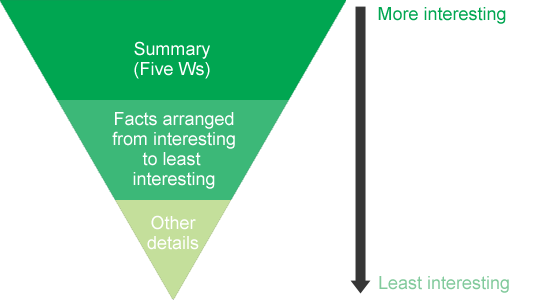
When you write for a newspaper, your stories have to fall under a specific structure. You take all of the information that you need to add into a story, and you list it from most important to least. It’s referred to as the inverted pyramid. Here’s an example.

30-03_inverted_pyramid_for_about_page

We do this for obvious reasons; the editor might have to trim the end of your story to save room, and the reader is likely only going to read the first paragraph anyway. So, that first paragraph, usually only one sentence, includes all of the important details. It must answer the who, what, where, when, why and maybe the how of the story. Example;

A crayfish faked it’s own death yesterday in my living room to avoid the unwanted affection of a 12 year old girl.

That’s the whole story. Is there more to tell? Yes, of course. But if you know that, you’ve got the basics. The rest of the story, how I came downstairs to find the dumb thing lying on it’s back, and how my kid poked it with a pencil and it jumped back to life like the little faker that it is, can all go below, in order of importance.

Obviously that’s not how we write creatively. That’s cut, dry, space saving, and would make for a terrible novel.

But it makes for a pretty great outline when you’re brainstorming!

Especially if you’re like me. I tend to have a lot of rough details when I’m in planning mode for a novel. This character is going to go do this, and this one will have that happen to them, an this whole list of people are going to die. All of that is important, but I need to get some other stuff in order first.

Who

Who is this book going to be about? There’s a whole cast, but I need to know who’s story we’re telling.

What

What’s happening? I mean the main, overlaying plot. Are there side plots? There are always side plots! But I need the basic, what is happening in this story.

Where

This one shouldn’t take a lot of explaining. What is our setting? Where is this story taking place?

When

The time, duh. Is your story set in the past, the future, the present? In some cases this is going to be dictated by your genre, but not necessarily.

Why

In journalism the why isn’t quite as important. In creative writing, of course, the why is essential. Why is any of this happening? What’s the point? Is it all just a series of random events that don’t have any meaning at all?

Once you have all that down, you can list all of your other details below in order of importance.

So, how about some homework. Take your favorite novel, and write down the five W’s.

Paper Beats World is taking poetry submissions

That’s not a typo above, we are the market this week

I’m celebrating National Poetry Month this year all sorts of ways. First, I’m writing a poem a day. Second, I’m sharing my poetry with you here on Paper Beats World instead of my short stories.

Third, for the first time ever, I’m opening Paper Beats World to you! Send me your poem, and I’ll share it here!

I’m sorry to say that, as I’m broke, I can’t pay you. But the best poem, voted on by all of you, will win it’s author a free copy of Days and Other Stories.

Some simple guidelines- Please don’t send anything over a page. Sexy is fine, graphic sex is not. The deadline is April 30. Voting will take place the first week of May.

Please send all submissions to NicoleCLuttrell86@Gmail.com.

I can’t wait to see what you guys come up with.


When I studied journalism in school, I had two teachers. The first was a woman who I loved while I was in her class. In the interest of her privacy, I’ll call her Miss because she was younger when I was in her class than I am now. Let me tell you how old that makes me feel.

At any rate, Miss and I had a really good relationship, which should have been my first tip off that A. I was a huge kiss ass and B. she was a little too comfortable with her students.

Learning journalism wasn’t like anything else I’d experienced in my short fifteen years. While it was, essentially the same, learn by practice, the only real way to practice it was to run our own school paper. Which is what we did. So, instead of having journalism as an elective, it was just another class. Just a class that we, most of the time, were writing and editing instead of listening while the teacher taught. As you can imagine, I learned a lot. And not just about journalism.

When I get comfortable, I have no kind of filter

And this was new to me, because as an introvert, it takes me a long time to get comfortable. So, I’d never really gotten to the point where I was comfortable before. So some of the things that came out of my mouth while we were having ‘current event discussions’. For instance, mine was the first class to have metal detectors. I had, on several occasions, had something on my person that made the damn thing go off. If you set off the detector, security guards went through your bag, often by taking everything ‘out’ of your bag. I was 15. Sometimes, they were taking tampons out of my bag. That was humiliating to a 15 year old girl. When we were discussing pros and cons of the metal detectors in class, that seemed like one hell of a con to me. Apparently that was inappropriate. Personally I thought then, as I think now, that if it’s too inappropriate to talk about in school, it shouldn’t be happening in school.

The world is a dark and scary place

If you do the math, you’ll know that I was 15 in 2001. I was, like so many of my contemporaries, sitting in a locked down school on September 11th, sharing rumors. The teachers were forbidden to talk to us about what was happening. My journalism teacher decided to forgo that rule. She turned the tv on, and we watched the news. Then we talked about what had happened. When Daniel Pearl was murdered, we talked about that, too. And at that age, with no adult in my life willing to discuss things like this with me, I learned that there was a lot to be afraid of.

Newspapers think we’re illiterate

Do you know that the majority of newspapers are written to a fifth grade reading level? That means that any vocabulary that would be too advanced for a fifth grader is not permitted. That’s, apparently all that can be expected of the American people. For my opinion of that, please see the above comment about the world being a scary place.

Sometimes editors are saints, and sometimes they are overly political assholes

This is the truth. I’m with Stephen King on this one, there is nothing that will teach you more than the first time an editor takes a red pen to your work and just marks it the hell up. (He didn’t phrase it that way, but he did talk about this in On Writing. If you haven’t read it, read it.) An editor who knows what s/he is doing will cut and tighten your writing in such a way to make it sing.

A bad editor will rip your piece a new one if they have ‘issues’ with it. I ran into this the same day that I found out that Miss and I didn’t fully agree on everything. Like whether we ought to have been at war. Shame.

The world is full of some amazing people, and I was privileged to go to school with some of them

I met two women in my class that I want to tell you about. The first was a very religious girl who always wore turtleneck sweaters with a small gold cross hanging out. She was incredibly conservative, like frighteningly so. She was also the first to help out when someone was having trouble with their edits and got straight A’s all year. The second girl was Gothic, atheist, sexually active at 16, frighteningly liberal, and possibly the coolest person I have ever met. Taught me all sorts of fun stuff my mother wished I didn’t know. She was also the first to speak out against any inequality in our school. Both of these girls were smart, kind, selfless people. They were funny, and their writing was thought provoking. They also, by the way, liked each other fine, despite pulling no punches during debates in class.

If two teenage girls as different as that can discuss the big issues in our country like wars, abortion, welfare, sexual discrimination and security after 9/11 without fistfights, we all can. I wish I’d met more people like that in my life. I hope that I’m like them in that one way.

There are some great people walking this world with us. It helps, know that they’re there when we’ve got so much scary stuff to face.

KISS, and Creative Writing

Creative writing and journalistic writing are two very different animals. If you’re accustomed to one, the other can be jarring at first.

Journalism works on strict deadlines. You are expected to get your piece done by that deadline, or it doesn’t go up. Miss the deadline too many times, and you my friend don’t work for that paper anymore.

Journalists are expected to turn out massive amounts of work, but at the same time, each of those pieces are expected to be a short and to the point as possible. The smaller your piece is, the more ad space the paper can sell. Scratch that, the paper’s already sold that ad space, and they’ll cut your piece if they have to/decide to.

Because of the constant deadlines and need for as slim copy as possible, journalists develop horrible alcohol addictions, I mean write by a code.

K.I.S.S

Maybe you’ve heard of it. It stands for Keep It Simple, Stupid. Journalists are also kind of assholes. It’s all the stress.

Yes, creative writers do live with deadlines and word count limitations, too. But think of our limitations as a bathtub. Journalists are working with shot glasses.

Here, then, are some of the ways I use the quick, tight, KISS style writing I learned in journalism to improve my creative writing.

Research

For one thing, journalists do a lot more of this than we do. I’m out there learning about Russian swearwords, a journalist is finding out how often Russian diplomats cuss out visiting dignitaries. I haven’t interviewed anyone since I worked on my school paper, when I did it literally for every article I wrote.

I started by writing down a list of questions I needed the answer for. Then, I wrote down all the things I thought I knew, so that I could fact check them. (That’s the other thing about journalism. If we’re wrong on a fact, it might not even matter that much unless you’re writing creative nonfiction. If they’re wrong, they’re gonna cause all sorts of hell. And by that I mean it could embarrass their publication, and potentially get them fired.)

Then I get to work. I need reputable sources, people that other people trust. And they can’t be other news establishments, that’s terrible form.

Then I would set up appointments for the people I wanted to interview. The time I had in between the first interview and right then was the time I had to research. I was looking for the answers to the questions I had in front of me. If I found something fascinating that I could add, I’d write it down. But I wasn’t looking for inspiration, I was looking for answers.

Next, I was double checking the answers, and making sure I kept track of my sources. (Which, by the way, is another thing we creative writers should work harder on.)

The interviews came next. I always hated that part a little bit, it was the skill that took me longest to master. At first I was pretty much reading my notes off cards. I learned, though. Some people are really good at talking to other people. Some of us hate talking to people we don’t know, let alone having to ask a whole bunch of what might be awkward questions. Yes, you can learn all sorts of tricks to make interviewing easier and more efficient. But at the end of the day, you’re going to have to practice a lot to get comfortable.

Now that you’ve got everything together, it’s time to actually write.

Omit Needless Words

If you haven’t read Elements of Style, by William Strunk, put this down right now and go do it. The words above are right from it, and they are words I live by in my writing. This is pretty simple to explain, even if it’s not easy in practice. If a word isn’t doing something useful, providing information, setting a scene or giving depth to a character. We don’t need to know about the drapes unless the drapes tell us something we need to know.

As creative writers, we need to take this two steps further.

Let’s talk about side plots. As a fantasy writer, this is kind of hard for me. I have a big cast, and because I put a ton of time into character development, they all have their stories to tell. It makes it worse that in the first draft, I throw everything in. You should, too, because there should be no filter in your first draft. You just don’t know what sort of awesome stuff you can come up with if you don’t have a filter.

Even so, I can’t tell them all, and that makes me sad. But telling too many stories is distracting. Not just for the reader, for you as well.

Fortunately, my second draft often weeds the weaker side stories out. It’s the easiest way to handle weak side plots, in my opinion. Once you’re down to just the strong ones, keep just the ones that perform double duty. Does your side plot deepen your main one, tell us something about an important character, or expand the reader’s understanding of your world? If not, maybe you should stash that story away for later.

Finally, let’s talk about your cast. Again, remember to KISS. If a character can be cut, she probably should be. Simple as that.

In closing, just remember, keep it simple, because you’re not stupid.


Black Static

That name just got me, it’s so classy and dark!

This one’s pretty straight forward. I did like one clever thing in the submissions list. They say right off the bat that you shouldn’t be offended by a form rejection letter, because it just means that they’re really busy. I can relate.

Genre- New Horror and Dark Fantasy

Word count- Up to 10,000 words.

Payout- Not listed

Here’s a link to the full submission guidelines.


Journalism and Creative Writing

I’ve been writing Paper Beats World for awhile now, and it occurred to me that I’ve overlooked a pretty serious piece of information about myself.

When I was in high school I didn’t want to be a creative writer, I wanted to be a journalist. To that point, I took three years of journalism. In my first year, I won an award called a Keystone for a piece I wrote. In my last year, I was the editorials editor. That’s right, I ran the whole page. I loved and hated it at the same time.

I loved being on the school paper. It was completely student run, which meant we even did things like calling local businesses for advertising. And I learned so much.

I was introduced to a different way of writing than I’d experienced before. In English class we focused on writing a certain amount of words to fill a space. Everything was neat, with double spaces at the end of every sentence. We talked about our emotions in English, and how a piece made us feel.

There was no time for any of that shit in Journalism. We wrote the facts, in a very specific order. We didn’t add our feelings into what we were writing about unless we were writing an editorial piece. And we used as little room as possible!

I learned so much from studying journalism. Now, we’re going to talk about a lot of them this month, but here’s something that I don’t think I’ll get around to saying anywhere else. It’s something that, if you’ve never been told before, you should hear now.

An editor that is not afraid of hurting your feelings and will just honestly edit your work is worth everything.

Don’t ever be offended, don’t ever get mad. They are helping you more than you can ever imagine. In fact, if you can learn to self edit your work, you’ll go a long way.

Of course, that’s hardly the only thing our brothers and sisters in journalism have to teach us. Not only will we be talking about how journalism can help your writing improve this month, I’ll be talking a little bit about my experiences on both papers.

Should be fun.


The Wolf and The Unicorn

I have a thing for twisted fairy tales. Here’s one of mine. Hope you like it.

Once upon a time there was a little girl named Gretchen who lived in a cottage in the woods with her mother and father. She was a lovely girl with dark curls and soft brown eyes.

Gretchen’s father had work that caused him to leave their cottage for weeks at a time. When he left, he always said to them, “You must both watch over each other while I’m away.” Gretchen knew her father really meant for her mother to watch over her. She couldn’t think of any reason why she would have to watch over her mother.

One morning Gretchen woke to find her mother in bed, burning up with a terrible fever.     “Oh, Gretchen, I don’t feel well,” her mother said. “I’m afraid of what might happen if my fever doesn’t break. I wouldn’t ask you if it wasn’t important, but I need you to go to the village and get some medicine. I’ll write down the name for you.”

“But the village is on the other side of the forest,” Gretchen said. “You told me never to go into the forest because of the evil witch and her wolf.”

“I know,” her mother said, looking sad. “I wouldn’t ask you to do this if I thought there was any other way. You just have to keep a careful eye out.”

Gretchen knew that she had to go. And so she took the paper with the medicine’s name written on it, and tucked it into her wicker basket under a cloth napkin for safekeeping. Then she pulled on her red cloak and, keeping her father’s words in mind, started toward the village.

Gretchen kept a sharp lookout as she got farther and farther away from the cottage. She’d never been in the forest alone.

She hadn’t gone far when she spotted a pair of eyes watching her from the bushes. She gasped. It was the wolf that belonged to the witch.

The wolf stepped out into the path in between Gretchen and the way home. She screamed and ran the other direction.

Blinded by her terror, Gretchen soon ran off of the path. She could hear the heavy footfalls of the wolf behind her. She looked back. The wolf was easily twice the size of the wolves her father hunted around their cottage.

Gretchen ran until she could no longer hear the wolf behind her. When she risked another glance she found that it was gone.

Gretchen dropped to the ground, panting. She looked around her, and found that she was in a clearing full of rabbits and birds. The rabbits gave her an appraising look, and then went back to munching grass and clover.

She could hear a stream nearby and realized how thirsty she was. She pulled herself onto legs still wobbly from her run, and made her way towards the sound.

The stream was cold and clear. Gretchen knelt on a bed of soft moss to drink. Once her thirst was satisfied she realized how comfortable the moss was. She stretched out, setting her basket beside her, and fell fast asleep.

Gretchen wasn’t sure how long she slept in the sun, lulled by the gentle sound of the stream. When she woke the first thing she saw was a shadow of a large animal standing over her. She gasped, thinking it was the wolf again.

It wasn’t. It was a silver, glittering unicorn.

“How beautiful,” Gretchen murmured, rubbing her eyes.

The unicorn tossed its head, making its silken mane flow and sparkle in the sunlight. Then it lowered its horn, and stabbed towards Gretchen.

She moved just in time to get no more than a grazing blow on her arm. Before the unicorn could attack again she scooped up her basket and ran back towards the woods.

As she ran through the meadow the rabbits that had seemed so sweet and peaceful before now seemed like they were trying to trip her. They jumped in front of her feet, forcing her to jump over them.

The unicorn was catching up to her. She tried to duck into the trees, thinking that she would be able to lose it the way she’d lost the wolf. But it kept coming, dodging through the trees with dexterity that was surprising in such a large animal.

Looking over her shoulder, Gretchen didn’t see the tree root jutting out of the ground. It caught her foot and she fell, her basket bouncing away from her down the path.

The unicorn was on her before she could get up, standing back on its back legs, pawing at the air and crying out in apparent fury. It lowered its head, and Gretchen knew that this time she wouldn’t be able to get away.

A snarl filled the air as out of the brush came the great wolf. It slammed into the unicorn, forcing it away from Gretchen.

The unicorn stabbed wildly at the wolf, but it wasn’t able to land a blow. It finally managed to get to its feet, but just then a green bolt of lightning came from behind Gretchen to strike it. She jumped to her feet and turned to see an old woman hobbling towards her. Her walking stick was raised, and pointed towards the unicorn.

“Get out of the way, girl!” the woman cried. Gretchen ducked behind a tree as the woman hurried to help the wolf. Together, they finished the unicorn off.

Gretchen came from behind her tree to collect her basket as the old woman hobbled over to her. “What are you doing out in the woods by yourself?” she asked. “It’s not a safe place with these beasts running around, especially not for little girls. They eat virgin’s hearts; doesn’t anybody pay attention to these things?”

“You’re the witch!” Gretchen said. “But you saved me.”

“You have no idea how tired I am of that sort of reaction,” the witch said with a sigh. Her wolf trotted to her side, his face covered in unicorn blood. “I sent Brutus here to watch over you, and you lose him in the forest. Now you’re questioning my intentions? If you were my child, I’d give you such a paddling!” She shook her walking stick at Gretchen.

“I am so sorry,” Gretchen said.

“Well, you should be,” the witch replied. “Just because I’m a witch doesn’t mean I’m a wicked witch, after all. What are you doing playing about in the woods, anyway?”

“My mother’s very sick,” Gretchen said. “She needs me to go to the village to get medicine for her.”

“What kind of medicine?” the witch asked.

Gretchen took the piece of paper from her basket, and handed it to her. The witch looked at it and said, “That’s a powerful fever potion, that is. Your mother must be very sick.”

“And my father said that we must look out for each other while he’s away,” Gretchen said.

“Of course,” the witch replied. She seemed less angry than she had. “I’ve got something in my bag that will help your mother, I think. And with a fever, the sooner you can break it, the better.” She went back into the woods the way she’d come, and soon returned with a large bag. From it she took an envelope full of herbs, and handed it to Gretchen. “This will do it,” she said. “Brew one tablespoon full every two hours. Make sure she drinks it all.”

“Thank you,” Gretchen said, tucking the envelope into her basket.

“Now, if you don’t run off on Brutus, he’ll see you safely home. Those damn unicorns are all through these woods, and they can smell little girls. I’ll check on your mother the day after tomorrow. Witches are good for something, you know.”

Brutus came to stand beside Gretchen, his tongue hanging from his mouth like a panting dog. He was so large that his shoulder was even with her own. Now that he’d saved her from the murderous unicorn, that seemed a great comfort.

And so, with a parting farewell to the witch, Gretchen set her hand on the wolf’s back, and they started back towards her cottage home.

If you liked this, please consider purchasing Days and Other Stories from Amazon, Istore or Gumroad.

Thirty Things I’ve learned in (Almost) Thirty Years

I didn’t mean to plagiarize Jenna Marbles on this one, sorry. Here’s a link to her video that inspired my post, then I forgot that it inspired me.

I’m hitting a milestone birthday this year, I’m turning 30. It’s kind of a big deal.

I’m looking behind me, at all the places I’ve been in my 20’s. I’m looking ahead to, at all the great things I want to do in my 3o’s too, but that’s another post for another day.

I never thought I’d be where I am today, but I guess that shouldn’t surprise me. I turned out to be a lot cooler than I thought I was going to be.

You know I’ve never been shy about my past. It wasn’t a happy place. When I was twenty, I had a two year old daughter that I couldn’t control. I wasn’t a writer yet, I didn’t have a job, and I had nothing like a support system. In fact, I was surrounded by people who told me all the time that I was bad and wrong. I had ‘sinned’, and my family had no intention of letting me forget it. I was in an abusive relationship, and I thought that was all the more I deserved. I was a republican who had read all of Ann Coulter’s books, and thought that women should stay home and care for our children. (But I still didn’t vote for Bush.)

Flash forward to today. I have two smart, funny monsters that become more and more like the great women I know they’ll be one day. I have a day job that I like, and I’m proud of what I do. I’m surrounded by people who love me, exactly as I am. I am married to a wonderful man who makes me laugh every day. I am a steadfast Democrat Feminist. I am, and forever will be, a writer.

Needless to say, a transformation like that took time. I learned a lot, and realized that the way I saw the world was limited to the way I’d been raised. When I saw more of the world, I grew and I changed. And I learned.

Here then, is a list of 30 things I’ve learned in my (almost) 30 years. Some of them are personal to me, but I hope you might find something here to help you.

  1. I am not an inconvenience. You are not an inconvenience, and anyone who tells you otherwise is someone you don’t need in your life. Even if it’s your family.
  2. Taking steps to organize my life has helped my anxiety a ton. It’s still there, but a lot more manageable.
  3. I like very sweet red wine, and good spiced rum. Most other alcohol tastes nasty to me. It’s worth it to find this out early.
  4. You might come to realize that, even if your family is terrible, you might find that there is something good inside you that you can trace back there. I can lay claim to just that good, and give up the bad. I get my work ethic from my mother, my love of things nerdy from my grandma and my desire to make people feel good about themselves from my aunt.
  5. There are a lot of things you shouldn’t buy cheap. Make up, shoes, jeans, booze, hair products, art supplies, chocolate, bras and electronics just to name a few.
  6. There are also things you shouldn’t invest a ton in. Underwear, shirts, raw cooking ingredients and anything you’re going to get tired of soon anyway.
  7. You should try new food any time you can. Have you ever heard of lassi? It’s an Indian drink that’s made of yogurt and rose water and it’s amazing. How would I ever have found that out if I hadn’t gone to a random little Indian place while we were in Pittsburgh?
  8. I used to be a big horror fan. I’m not anymore. It’s not that I’ve lost my stomach for gore, though that’s part of it. The stories just seem juvenile anymore.
  9. I had a great English teacher once that told me that when you’ve read and watched enough stories, you’ll be able to guess the ending of any book or movie. He said he hadn’t seen a movie ending that had shocked him in years. Man, was he ever right.
  10. Ten years ago, I didn’t know what an introvert was, or that I was one. Or that it was okay to be one. But I am and it is.
  11. You should always carry cash.
  12. Drinking a good cup of coffee or tea can make your whole day better, even when that doesn’t make any sense.
  13. I don’t remember where I heard this, but it’s served me well. Talk to grownups like children and children like grown ups. Probably not your spouse, but just about anyone else.
  14. Not everyone is on my learning curve. I learn fast, especially with technology. There are lots of people that learn faster than me, and lots of people that learn as fast of me. Some people don’t learn as fast as me, but that doesn’t make them any less smart than me. Despite my newfound love for my own intelligence, I shouldn’t treat others like they’re dumb just because they don’t get things as quickly as I do.
  15. Done is better than perfect, in almost any situation.
  16. You have to at least like what you do for a living. You don’t have to love it, though you should try for that if you can get it. But you shouldn’t hate it. Most of us spend half our waking time at work. You shouldn’t hate it, and if you do hate it, you should find a different job.
  17. Even if you work every day at it, writing a whole book and doing it right is going to take a long freaking time. Get used to it.
  18. What we deserve in life and what we get is sometimes going to be different. Sometimes you’re just not going to get what you deserve. Sometimes assholes are also not going to get what they deserve either. That’s going to suck a whole bunch, but it’s still a fact. You’re going to be happier if you accept it.
  19. Some people are meant to be homemakers. Some people are great parents, but meant to be breadwinners. Your gender has nothing to do with this.
  20. Meditation helps, even when you think it isn’t doing shit.
  21. You’re not supposed to wash your hair every day. It’s bad for it.
  22. You, all by yourself, are probably a pretty cool person.
  23. The system doesn’t always work, and just because someone in a position of authority is going to be wrong, or lie to me.
  24. It’s worth it to take time to draw, paint or create art, even if I have no intention of doing it professionally.
  25. Stand up is the perfect form of entertainment.
  26. I should really have some money put aside for emergencies. Like when I thought our dog’s neutering was going to be covered by the adoption agency, and it turns out they only intend to reimburse me.
  27. It’s usually worth it to learn something I thought would be too hard. For instance, I used to know very little about computers.
  28. I’m going to not be able to drink as much as you could last year. Every single year.
  29. It really is worth it to just dress how I want to dress. Because anyone who’s judging me by how I  dress isn’t someone I want to hang out with anyway.
  30. And finally, I am smarter than I was raised to believe. That one took awhile, but it finally sunk in. You, you there reading, you probably are too.

A WordPress.com Website.

Up ↑