As you might have noticed, we’re more than halfway through 2021. And I, gasp, haven’t launched a book yet.
For those of you keeping track, I’ve launched a book every year for the past five years. Often, more than one.
Well, I have some bad news and some good news, you guys. The bad news is, I’m not launching a book in 2021.
The good news is, I’m launching a podcast instead. The even better news? It’s based on my most popular short story ever.
You guys, Haunted MTL is launching a podcast that I wrote called AA on September second.
Yeah, that’s happening.
When Josey moves to a new town, she finds that she can’t escape her demons. She needs a meeting. But the one she finds isn’t the one she was looking for.
She discovers a community of aliens, hiding in plain sight. Josey is thankful to find a group of people who accept her, including a new roommate and a cute guy.
But the community isn’t without its darkness. And they have their enemies. Josey soon finds herself caught in a war that she barely understands, but can’t help but join.
During this war, Josey learns that the alien community is hardly the only thing unexpected in her new home. She stumbles into one dark place after another, realizing that small towns hold more secrets than outsiders could ever imagine.
I originally published AA as a standalone short story with Solstice Publishing. And I’m pretty proud to say it had a good reception. I even had one delightful commenter on Amazon say they thought this would be a great tv series. I don’t know who this person is, but I will love them for the rest of my life. And yes, this did inspire this idea.
AA includes some amazing voice talent. I play a few characters, of course. But you’ll also hear the voice of my talented and amazing co-star of Off The Bone, J.M. Brannyk.
Along with us, you’ll hear Jim Phonix, Ev, Jennifer Weigel, and Kal Scarlett. This is such an awesome group of voice actors that I was blessed to work with. They’re also great writers, artists, and critics who share amazing content every day on Haunted MTL.
AA is creepy fun. It’s about addiction. It’s about being new in a small town. It’s about the dark shadows in hometowns that we all know but don’t talk about. It’s about all of those things and more, and I think you’re going to love it.
Stay tuned for more info as we get closer to the release date. I can’t wait to introduce you all to the world of AA.
I have this problem. It’s a little embarrassing, but I want to get better. And I thought maybe it might be a problem some of you have too.
I have a weird problem taking advice from people younger than me. It makes me feel uncomfortable, as though I’m failing somehow.
Yes, I’m aware this is incredibly narrow-minded of me. Especially because I’ve been on the receiving end of the abuse that kind of mindset can cause.
Back when I first started this blog, I was the manager of a shoe store. And I had an assistant manager who was a bit older than me. She was in her forties and I was in my twenties. She got hired a few days before me, as a part-timer when I was hired as an assistant. When I became manager, she was my obvious choice for assistant.
Well, she wasn’t really. I shouldn’t have done that. Because she never missed a chance to make me feel like I was screwing everything up.
Spoiler, I wasn’t. I had the job because I had years of retail experience and management experience by then. I was qualified for the job, she wasn’t. But that wasn’t enough to knock that chip off her shoulder.
Alright, I didn’t tell you all that just to complain. I did it mainly to point out that I should know better. And if I don’t learn from the experiences in my youth then I’m a garbage person.
I don’t want to be a garbage person. So, here are four reasons why I’m trying to listen to younger people.
So many young artists are just killing it
I follow several people younger than me on Youtube. Caitlin’s Corner, Amanda Rachel Lee and Temi. They are all inspiring, upbeat, helpful women who are creating great content. They also happen to all be younger than me.
This doesn’t stop their videos from being a bright spot in my week. And they’re far from the only ones. Artists, writers, singers, online business people are all out there doing great work in their twenties. And I don’t want to miss out on that work.
They have different life experience
Let’s go back to my example from the shoe store. I was qualified to be the manager over my older assistant because I had led a different life and made different decisions. Those decisions meant that, despite my age, I was more qualified for the job.
What kind of asshole would I have to be to not realize that other people have that same experience? While I was working retail and writing books, Amanda Rachel Lee was learning to design bullet journals. Of course, she can teach me a thing or thirty-seven about them. Temi was devoting herself to improving her art. She can draw like no one I’ve ever seen.
We have got to value the experiences of others and the lessons they’ve learned from them. That’s why it’s so great that we’re all different. I can learn from them, and others can learn from me and all the effort I’ve poured into being a writer.
They have the experience of their elders to build on
Let me tell you another story. When I was growing up my grandma was good with computers. I mean, for the time. She taught me to use her old pc. She taught me to go online, access things in DOS, all that. So, when I started using computers myself, I had that foundation to build on. I didn’t need to learn it all again, so I could go steps farther.
Every generation has the experiences and lessons of the ones who have gone before them. There are lessons they don’t have to learn. I didn’t have to sort out how to use DOS, I was told how. So, I could put that time into going further.
The same can be said for younger people. They don’t have to reinvent the wheel, they’ve got it. They have time to discover and tackle new problems. Then, reach back and help us with those.
I wanted to be listened to when I was younger
Scratch that. I want to be listened to right now. I’m only thirty-four, turning thirty-five in June. I think I have things to teach people older than me. And I know for sure that I did when I was younger. So, of course, other people can teach me. And if I want to be a better person, as I always do, I need to be willing to learn.
So what do you think? What lessons have you learned from people younger than you? Let us know in the comments.
You can support Paper Beats World on Patreon and Ko-fi.
Money is something most writers have a sticky relationship with. We’re artists, we don’t do this for the money. But we need money to, you know, live. We have day jobs until we make enough money writing to sustain us full-time. If we ever make enough money writing.
Then, there’s spending money on writing itself. Now, you don’t need to spend much money at all to write. But to get projects finished, published or in front of people’s faces might be a very different situation.
The problem is that money spent on writing is like money spent on anything else. Some things are a good investment, and some are little better than setting your precious dollar bills on fire.
Today I’m going to go over some of the best and worst ways I’ve spent money on my writing. This is a personal list based on my own experiences. What worked for me might not for you, and vice versa. If you’ve had different experiences, please let us know in the comments.
The worst ways I’ve spent money on writing
Let’s start with the obvious item. Unless you enjoy pretty stationary, you don’t need to buy it to write. I’d caution you against buying a pretty notebook for your rough drafts. Your rough draft is going to be just that, rough. It’s not going to help you write freely of garbage if you’re doing it in a plush leather-bound notebook. I might be biased, though, since I’ve literally burned rough drafts before.
Another thing I don’t spend money on anymore is contest fees. This might be up for debate, but I just don’t do it. At least, not yet. It’s a And if you’re going to pay to be in a contest, make sure you do your research. Some, like the ones hosted by Writer’s Digest, are perfectly legit. Some are run by heaps of steaming trash masquerading as people who are only there to steal your hard-earned money. Even if they are legit, though, paying for a contest is kind of like buying a lottery ticket.
Here’s something that I thought would be a bigger help than it was. It’s something that sadly ate up a ton of money throughout my career. It’s advertising. I have tried to advertise my books on Facebook, Twitter, Pinterest and Amazon. None of these have ever produced enough sales to make them worth my time and money. Can’t say I didn’t try.
Finally, I have a complex one. I put a ton of physical copies of my books, thinking I’d be able to hand-sell them. Then, I didn’t. I had a bunch of events lined up. Then I had to cancel them. Then covid happened and now I don’t know when I’ll ever be able to schedule any more events. So that’s a lot of money sitting in my house staring at me. Don’t order copies of your book unless you know what the hell you’re going to do with them.
The best ways I’ve spent money on writing
I’d like to start here with something that I pay for every single month, my Dabble subscription. This isn’t sponsored, I just love them. Dabble is my word processing software. It’s the one I’m working on right now. It’s not so important that you subscribe to this exact software. It’s just important that you have one that you enjoy and that fits your needs. Good writing software has been worth every penny to me.
Another thing I spend money on that I consider worth it is my WordPress site. It allows me to do a lot more fine-tuning, get ad info, and all sorts of fun things. It also gives me options to personalize the look of my site. I plan to do a full website remodel later this year. I’ll consider this upgrade invaluable then.
One thing I’ve put a decent amount of money into is having my self-published works edited. My goodness, this is expensive. But it’s a must if you’re not going with a publisher. Even if you have to save up a while before you get this done, don’t publish without it. You just don’t know how much better your work will be afterwords.
Despite my feelings about fancy notebooks, I do invest money in tools I use and I love. Like the felt tip pens that I write with. Actually, it’s just those. I can use any old notebook to write rough drafts (so long as it’s college ruled). But these pens are a must, even if they’re a dollar a pen. Having something that I can hold comfortably and that works so well for me is worth it.
Finally, I cannot emphasize enough that I’ve never bought a book about writing that I regretted. On Writing, Dase Macabre, Save the Cat. Everything that Natalie Goldberg has ever written. Every one of them taught me something different and I value all of them. I honestly never think a book is a bad investment.
Except maybe Twilight.
You can support Paper Beats World on Patreon or Ko-fi.
Beverly Cleary died yesterday and a part of my childhood died with her.
Cleary was the author of some of the greatest books for children ever written. She wrote Socks, a book I used to read, finish, then start reading again. She wrote the Mouse and The Motorcycle trilogy, featuring Ralph. If you’ve never read them, they’re a fun time.
Most importantly, though, for me, was Ramona. Beverly Cleary wrote Ramona, and in doing so she changed how I saw the world.
Ramona is a scrappy kid. She’s always done her own thing, and her thing isn’t always the best. She had stringy brown hair, like me. She had scuffed-up knees and stains on her school dresses. The worst thing in her life was having to wear ugly second-hand rain boots. When her dad lost his job and decides to go back to school, her mom goes to work.
Ramona wasn’t anything like the characters in other kids’ books and shows. But she was very much like me.
Much like Ramona, I was a stringy-haired little girl who didn’t always get the world. When Ramona draws cattails on her Q’s, I remember getting in trouble for doodling loops all along my practice papers. When she squeezes out all the toothpaste in the tube or takes just one bite out of every apple in a bin, I want to do those things. Even though as an adult who understands money, those things make me want to cringe. Wasting a whole tube of toothpaste, when they’re not cheap!
Ramona was awkward, messy, loud, selfish. She was a pain in the ass. But so was I as a kid. We all are. And too often as kids we’re left wondering what it was we did that has everyone so mad.
There are a million real moments in these books. Some are awful but relatable. Like when Henry’s grandmother is fine taking the money to watch Ramona but doesn’t seem to care for actually watching her. These sorts of moments make the good times all the better. Like when Ramona finally learns to ride her bike, with the ribbon laced through the spokes to create a bright red circle when she rides.
One scene that comes back to me over and over is this. Ramona’s had a hard day. When she gets home, she finds that her mother’s had one too. Her mother says they should go out for burgers for dinner. This is the light at the end of the tunnel for Ramona. She has a vision of sitting in a snug booth with her family, enjoying hot fries and bubbly soda.
Then her dad comes home, and he’s been laid off.
There’s no way the family can go out for burgers. So, instead, the parents make do and make pancakes.
And you know what? I’ve been there. I’ve been there as a kid who has to settle for pancakes after a hard day. And I’ve been there as the adult who’s just happy they were able to scrape together some kind of dinner after a hard day. It’s life.
What Ramona did was tell me I wasn’t alone. I wasn’t bad, or wrong. I was just human. We’re all just humans.
Thank you for that, Ms. Cleary. Thank you for giving me books full of struggles and joys that I could see myself reflected in. Thank you for brightening my childhood and giving me the tools to handle adulthood. Thank you for giving the world Ramona, Ralph, Socks, Henry Huggins and Ribsy. Thank you for every time I found one of your books in a second-hand store, battered but whole. Thank you for every moment I spent reading them laying out on the grass, or in my childhood bedrooms.
At over 100 years old, we couldn’t have asked you to stay. You’ve earned your rest. May we carry your torch.
A little while ago I shared a list of my favorite bullet journal collections to keep my sanity and my plants. When I did so, I also promised a list of my everyday pages. Pages that I set up for the month and week that allow me to keep track of my projects, due dates, house and everything else I need to keep track of.
Well, folks, today is that day. We’re going to be looking at my monthly pages, what function they serve, and what sort of planning goes into them.
They’re not pretty, and most of them aren’t unique. But they are lifesavers. I know I lived before I had a bullet journal. I just don’t know how.
The first thing I put in is a cover page. It is 100% not necessary and serves no other purpose but designating the start of the month. I just happen to think they’re nice. And, since part of the reason I bullet journal is to have fun with drawing and scrapbooking, this is one place for it to shine.
Next comes the calendar. Now, a lot of bullet journalers like to use a layout that resembles a full monthly calendar. I like the traditional vertical layout with one line per day. This gives me plenty of space to write down any appointments or events for the day. I can also put in big satisfying lines for things like vacations. Finally, I keep track of the days of the week on one side, and the moon cycles on the other. Everything I need to know about a month is in one place.
Next, I have a three-month overview. This is nothing big. It’s just a mini calendar with a little list of appointments and events happening that month. On the far right of that page, I write down a rough idea of things I think I’ll be working on that month. This is in no way set in stone, just an estimate.
Next comes my social media tracker. If you’re not an online business person or content provider, you might not need these. But if you are, you do. I keep track of all the social media places I post and check off if I’ve posted that day. I use the same page to track when I’m posting anything anywhere. This includes blog posts here, on Patreon, on Haunted MTL, any episodes of Off The Bone, guest posts. If I have a piece coming out anytime that month, it’s on this page.
After that, I have a space for check-in dates. This is a half-page spread because it’s just a few questions. How much money did I make this week? How much did I spend? What’s my overall number for the month? Easy enough.
The other half of the page I use for blog post ideas. As I think of things I want to write about, I write them down. So when I’m making the next month’s social media page and I’m stuck for a post idea, I’ve got a well of them.
Next comes my mood tracker. This is the same as any other mood tracker you’ve seen all over the internet. I have some bit of blank artwork that is slowly filled in as the month progresses. I think it helps to see how my emotions are fluctuating. And it makes me take a moment and think about them. I tend to be very in the moment and not contemplate how I felt about something. So this makes me question how I felt, overall, in a day.
After that comes the monthly goal page. Pretty self-explanatory. This is where I write down all my goals for the month. At the bottom, I like to write a little motivational quote. But that’s not necessary.
Now, here’s a fun one. I set up a best moments and wins page. This is where I’ll record moments or drawings that represent things that happened during the month that were just awesome. For instance, in March my mother-in-law got her covid vaccine, I sold two short stories, we went to Phipps Conservatory, and I made some personal tea blends. Below you can see how I memorialized each of these things. I love building this page every month. It also helps to remind me that even hard months have good moments.
Now, it’s time to talk about money. First up, we have the abundance tracker. I keep track of how much money I made in every way that I make money. It helps me see where my abundance is coming from.
Now, let’s talk about where it’s going. The next spread is an envelope budget one. It’s not a pure envelope budget because I don’t take out cash. But I do separate my money into specific categories and try to keep spending to those categories within that budget.
At the start of the month, I make a budget based on my paycheck and bill due dates. This helps me figure out what paycheck is going to be bill heavy, and which one I can save a little more from.
Finally, I track my savings goals. I like to do a good old-fashioned bar graph for each goal.
Once the month is set up, it’s time for a weekly spread. There are lots of ways to do this, but I like to keep it pretty simple. I just list out each day of the week, any events I have planned, and a to-do list. I also like to keep a list of things I can make for dinner with what’s in the house.
So that’s it. That’s all the pages I used in my monthly setup. What about you? Do you use any I didn’t have on the list? Let us know in the comments.
(A note about the graphics used in this post. I love making all my bullet journal pages look like a scrapbook. But you don’t need to do that for bullet journals to be a great tool. Please don’t let the artwork overshadow the planning. Also, all of these photos have been highly edited. )
If you spend any time online, you’ve seen an ad for Skillshare. Every Youtuber I watch is working with them. And all that pitching got to me. I’ve had a subscription to Skillshare for almost a year now.
I’m not working with them. I’m not an affiliate, and I’m getting no money for this post. But I know that I’ve found myself subscribed to one service or another with little to no idea what I was supposed to do to it.
If you as well have subscribed to Skillshare and are now a little daunted by the selections, I’ve got you. I’ve done a lot of the classes on the platform. So today I want to share with you the five best Skillshare classes that I’ve taken.
Write an Irresistible Query Letter, Blair Thornburgh
I’ve struggled with query letters. I think all professional writers have that one part of the submission process that they just hate. It’s a toss-up for me, whether it’s query letters or blurbs.
Now that I’ve taken this class, blurbs are my least favorite. It made me think about my novel in a different way. And, even better, it gave me an easy-to-follow template to create a query letter that doesn’t feel like it was written from a template.
Writing Suspense: How to write stories that thrill in any genre, Benjamin Percy
Suspense isn’t a genre I write. But it’s an aspect of every well-written story. And this class, man, was so good. The exercises and explanations are just so helpful. I learned so much about story structure and giving clues through a story.
5 Techniques to Generate Creative Writing Ideas, Alison Stein
This class, my goodness. I wrote out so many pages of ideas for this class. And if I need new ideas, I go back to it. The class was entertaining, inspiring, and left me with a ton of blog posts. At least one of which I recently sold.
Writing Flash Fiction, Hannah Lee Kidder
I love writing little flash pieces. They take little time and are easy to share on social media. Plus, they can be an emotional gut-punch when done well.
This class helped me do them well. If you’ve read a flash piece of mine and you liked it, thank this class. If you want to write flash pieces, take this class.
Instagram Poetry, Alison Malee
Finally, this class was a ton of fun. I’m always looking for interesting new ways to show my art. And blending poetry with visual art is rewarding. It’s something that I like doing on a day off or in the evening while watching tv. Again, this class inspired me to do more of it. It also, I hope, helped me do it better.
So those are my top five Skillshare classes. What do you think? What’s the best class you’ve taken? Let us know in the comments below.
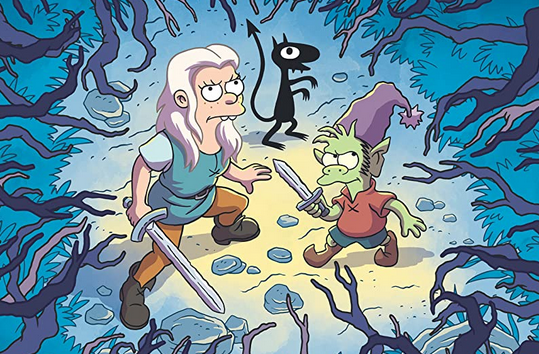
Often when I’m talking about why a show works, I find myself pointing out one strength over and over. The stories I love the most are the ones with the best characters.
That being said, instead of breaking down all of the reasons why Disenchantment season three works, I thought I’d focus on just this one element.
We’re not going to go into all of the characters in this season. There was a lot, and most of them were good. We’re just going to look at the five main characters, and what made them so well written.
Elfo
Elfo was one of the most sickeningly nice characters for the first two seasons. The only nice one. And he got shit on, constantly. Bean took him for granted, Luci actively tortured him. And this season he’s just done with it.
Good for him.
But instead of handling this responsibly, Elfo’s lashing out in every and any direction. He’s looking for love in some self-destructive places. He’s having a hard time keeping his emotions under any kind of control. While this is obnoxious, it’s also realistic. People don’t have mature and level responses to things all the time, neither do elves. It makes Elfo a more realistic character that he’s being kind of an oversensitive prick this season.
Luci
Originally tasked with being Bean’s personal demon, Luci has decided that he doesn’t care to live his life for another. Even if he’s living his life to mess with another. He’s decided to branch out and take care of his needs. He bought a bar and seems to enjoy running it. That being said, he’s still around when his friends need him. Or when he wants to express his love for them by torturing them.
Luci also finds himself growing attached to King Zog in his illness, which we’ll discuss later. At first, he resents being treated like an emotional support pet for a crazy person. But in the end, he wants to be helpful. He wants to help take care of the people he cares about, despite his selfish instincts.
He’s still a demon, but he’s not a very good one.
King Zog
Some hard stuff has happened to King Zog. Like really hard. His first wife tried to kill him, a couple of times. His second wife finally had enough of him and ran off to be a pirate. He was briefly in love with a bear. On top of that, his daughter is a rebellious handful, his closest advisors are plotting against him, and he was trapped alive in a coffin for a while.
Rather than just having him shrug all this off with a cliche ‘I’m getting too old for this shit’, he has a psychotic episode. He starts making weird quacking sounds, can’t make decisions. He’s scared of everything. He can’t feed himself.
This is kind of funny. But it’s also kind of what a realistic physic break might look like. I appreciated that.
I also appreciated that, even though Zog’s a meathead and selfish, he’s ready to do what he needs to for his people. I don’t want to spoil things. So I’ll just say that he shows humility, and does something that we don’t see a lot of characters with power do.
He gives it up.
Queen Oona
Queen Oona was the biggest surprise in this season. I wasn’t expecting to see her much. It kind of felt last season like they put her on a bus. Or in this case, a pirate ship.
Instead, she comes in with her brand of support for Bean. She’s there when she’s needed, but she’s not there to take on the whole situation.
And it’s not for the sorts of reasons we usually see. She’s not leaving Bean to take care of things herself because Bean needs to be strong. She’s doing it because she’s got her own life to live. This is still her family, but she’s got her own thing going on. Her own badass pirate thing. The evolution of this character from a walking joke to a feminist badass has been really fun to watch. It’s an example of how you do character evolution well.
Bean
Finally, we get to the main character, Bean.
Bean is what I would call a flawlessly flawed character. She drinks, she’s selfish, she’s a pain in everyone’s ass. I don’t know why anyone thought she needed a personal demon. She does well enough getting into trouble on her own.
But it’s not just pain in the ass behavior with no purpose. Bean doesn’t want to care about anything, but she does. She isn’t just selfish and then starts caring about others. She seems as though she pretends not to care. She is trying to numb herself to a world she didn’t feel qualified or able to fix. When allowed to change things, to fight for things, she does it.
It’s amazing what someone can do when they think they might make a change. And what sort of debauchery they’ll get into when they care but feel helpless.
So what do you think? Have you seen the latest season of Disenchantment? Let us know in the comments.
It’s the fourth and final week of our life audit. By this time your home, your habits and your mind should be a little less cluttered.
Not the whole way, I’m sure. It’s a process, becoming who we want to be. Every day we make progress. And anytime you want to revisit the questions or prompts, you can do so. I made a pretty printable of the whole life audit. It’s available now on Patreon.
Today’s post is different. It’s for those of you, like me, who have a creative business.
Mind you, this isn’t a business plan. There are so many creative business plans available online. I’ve pinned a few on my Pinterest board if you’re interested.
No, this is a check-in. An in-depth look at what’s working and what’s not. I do this audit at the end of each quarter since creative businesses change so much faster than traditional ones. So grab a cup of coffee or tea, and let’s take a look at some cold, hard, creative numbers.
Question one. What products or services do you have available right now?
Let’s start easy. What are you currently selling? Books, courses, jade carvings? Make a list of everything you have available for sale.
Now that you’ve got it all down, you should be able to see a few things. Are some of your products or services outdated? Have you forgotten about one product and just not talked about it for a while? (I did this.) Was there a product you meant to have a follow-up to and just never got around to it? Write it all down.
Question two. Where do I make money?
Start by writing down all of the platforms you make money on. Amazon, Smash words, Etsy, directly from clients. Wherever it is people pay you, get it down.
Now, take a look at your income for the last twelve months. Write down how much money you made on every platform.
What ones are doing well, and what ones aren’t? For the ones that aren’t are they not doing well because they’re not a good fit or because they need more effort?
This can be eye-opening. I realized that I made more money from this little blog than I did from sales of Station 86 books in the last twelve months. I don’t know how to feel about that. But at least now I know.
Question three. Where do I spend money?
Every business costs money. Maybe a little, maybe a lot. Write down all the money you spent on your business in the last twelve months, and where it went.
This is crucial information to have. Are you spending your money in smart ways? Are you getting things for your business that you don’t need, or could be bought cheaper? Are you subscribed to any services that aren’t serving you anymore? These are questions only you can answer. And you can’t answer them without the raw data.
Question four. What are my three highest sources of income?
Do you sell just a ton of bangle bracelets off Etsy? Are you killing it with clients?
Knowing where you shine helps you work to your strengths. It also helps you see what’s not working, and what might be best to cut loose.
Question five. What projects are you going to be working on for the next 3/6/12 months?
This is where the fun starts. At least I think it’s fun.
Take a look at your schedule, and make a rough list of what projects you’ll be working on for the next three months. Then, the next six months. And finally, the next twelve.
Mind you, this is not set in stone, so don’t get too freaked out by this. The point of this exercise is just to get an idea of what you’ll be working on. And the farther away it is, the less set in stone it will be.
Question six. What are you putting out in the next 3/6/12 months?
Take a look at your project list, and see what might reasonably ready in the next year. Because hear me, you need to start advertising ASAP. I mean, I have a true-crime podcast coming out on February first, and I’ve been making ads and talking it up on social media for weeks now. As soon as you know something is going to be ready and can reasonably set a launch date, do it. Then, you can start working backward from that and make a launch plan.
Question seven. What are your financial goals for the next 3/6/12 months?
I know, money. We creatives don’t like to talk about money. But we have to. If we want to have more time to create, we need to make money on our creations.
Everyone has different goals, but here are some things to consider.
How much money did you make last year?
Are you coming out with anything new?
How much money are you going to need to spend?
Here’s the trick to set money goals. You need to be reasonable without being pessimistic. If you set a goal too high, you’ll not reach it and get discouraged. If it’s too low, then you’re not going to feel as challenged. It’s a tight line to walk, and it’s personal. But if you take the time to understand what you’ve done so far, you’ll be able to figure it out.
Question eight. What platforms am I on?
Spoiler: You’re probably on too many. Think about it. If you’re on Instagram, Facebook, Twitter, Pinterest, Twitch and Youtube, when do you have time to create content for each of those platforms? If you’re creating consistent content for each of those platforms, when are you creating your work? When are you sleeping, eating, hanging out with your loved ones, taking a shower?
I used to be on a lot more platforms than I am now. I’ve got it paired down to ones that I genuinely use, enjoy, and would be on even if I wasn’t an indie writer.
Let’s look beyond social media when we consider your platform, though. Let’s consider everywhere you show up online. For example, when I make this list it includes Ko-fi, Patreon, Amazon, Smashwords, and right here on this humble little blog.
Question nine. How can you show up better on each platform?
Here’s where we get to the real auditing part of the audit comes in.
Look at each platform you work with. How are you showing up there? What can you do to make it better? Can you make some nifty graphics to share on Twitter? Take more pictures? Comment on other people’s posts more?
Make a list. Then, get started making these changes, big or small. Do just one at a time, and track your results.
Alright, that was a lot. But I hope it helps you have a better understanding of where you are in your creative business. And what you can do to get to the next level.
There’s one more thing I’d like to suggest. When you’re done with the business audit, mark it in your calendar the next time you’ll be doing one. Make a work date with yourself that you’ll keep like it was a date with your best friend.
You can support Paper Beats World on Ko-fi and Patreon.
Welcome to week three of our life audit. How did week two go for you guys? If you have any before or after pictures, I’d love to see them. If you just have any great stories, I’d love to hear them.
For now, let’s move on to week three.
Menu planning
Stick with me, here. I don’t do a ton of menu planning. I am not a meal prepper. I do like cooking, though. I also like eating. And I cannot be the only person who sits down to write a shopping list, only to forget every meal she’s ever cooked in her life.
Here’s what I do. I wrote out a list of every dinner I like to make in Trello. I separated them by protein. Then, when I’m making my shopping list, I pull up that menu. Once I’ve made the thing, I put a checkmark next to it so I know I made it recently.
Aside from that, the only meal prepping I do is to double a recipe if it’s something that freezes well. Like meatballs, for instance. That’s something that’s sort of a pain to make, but can be used in at least two different kinds of meals if I have them in the freezer.
Your lifestyle and family might require more meal planning. But I can’t imagine any less than what I do will be too helpful.
Papers
Oh my goodness, papers. I love paper so much that it’s literally the name of my blog. But when it comes to the paperwork of life, it’s not my valentine.
Given that more and more things are virtual I look forward to the day this mountain of paper no longer lives in my house. But until that day comes, let’s sort through this stuff. I spread this project out over the space of two days because it was so daunting. I used a large binder, a three-hole punch, several manilla envelopes, a season of Rick and Morty and a bottle of red wine.
My routine is simple. I hole punch things and put them in the binder with some plastic dividers. Anything that can’t be hole-punched goes into a folder with hole punches.
The biggest question I always have is how long to keep something. Here’s a handy chart I found on The Soccer Mom Blog.
Keep for one year- Bills, monthly bank statements, monthly investment or retirement statements, pay stubs and credit card bills.
Keep for three years- statements or receipts for your business, medical bills.
Keep for seven years- Anything to do with your taxes.
Keep forever- Loan documents, warranties, vehicle titles and personal identification records like your birth certificate.
Subscriptions
For this one, I’d start by gathering together everyone in the household. Then, make a list of every single subscription service you have. Webkinz, Door Dash, Netflix, Jelly of the month.
Now, do you enjoy those subscriptions? Do you use them? Or are you just paying for something you never use because you forgot about it?
Budget
This is another one that might take some time and family involvement.
There are hundreds of different ways to budget, and I’m not going to tell you which one you should use. The only bit of advice I’d give is this. If you haven’t already written down your bill due dates in your calendar or planner, do it now. Especially if they’re automatically deducted.
I enjoyed the book Broke Millennial by Erin Lowry. If you want money advice, go there. This girl has got you.
Desk or home office area
Okay, there’s a good chance your whole home needs a full declutter and reorganization. But aside from the kitchen, there’s no more important place to have in shape than your home office space. Especially if you started working from home this past year.
I can’t advise more using the Marie Kondo method. Get rid of everything from this space that doesn’t spark joy. Keep only things that are useful or beautiful. If they can be both, so much the better.
If you don’t have a home office area and don’t think you need one, let me give you some advice. This, again, comes straight from The Flylady. Grab yourself a trapper keeper. Put all your bills and budget info in there. Throw in a calendar, your checkbook, stamps, envelopes. Add in some paper and maybe a planner too. Anything you need to make a to-do list, grocery list, or write out a bill. Include some pens that make you smile. Then stick it somewhere you’ll be able to find it when you need it. Check-in with it once a week, if not once a day. If you can get that together, you’ll be in good shape for the rest of your planning projects.
Goal setting
Now that we’ve cleared away most of the mess, physically and metaphorically, let’s start looking forward.
I might honestly do a whole multi-part post on goal setting. But for right now, making a goal comes down to two things.
What do you want?
How will you get it?
There are as many goal setting strategies as there are online gurus. But I’ll tell you what works for me. And it comes from a Disney song. Specifically, a song from Frozen II.
Just do the next right thing.
Say you want to write a book. I feel for you. But that’s a giant project.
You can sit down and map out the whole project if you want. Some people are really into that. Or, you can ask yourself, what’s the next right thing to do to make this happen?
In the case of a book, you might start with carving out fifteen minutes a day to brainstorm.
When that’s done, what’s the next right thing? Well, you might want to then write an outline or write about your characters.
Then what’s the next right thing after that? Set yourself a goal to write a certain amount of words or pages every week.
Then what’s the next right thing after that?
This works for literally any goal, big or small.
So that’s it for this week. Honestly, it was a lot. But it feels so good to get all of this stuff under control. I mean, most of the world is not under control right now. But at least we can find our gas bill when we need it.
Next week, we’re going to talk about auditing your side hustle. See you then.
Podcasts are a pretty big deal for me. My hands are often busy, my eyes even more so. So podcasts are my default form of entertainment.
Another default entertainment for me is true crime. I have no idea why this fascinates me so, but it does.
So this shouldn’t come as a shock.
I’m launching a true-crime podcast with J.M. Brannyk called Off The Bone.
It’s true crime with a twist. Every week we’ll talk about a murder or unsolved mystery. Then, we’ll talk about the fiction that this horror-inspired.
In the first season, we’ll be talking about people like HH Holms, Elizabeth Bathory, The Axeman of New Orleans and the horrific Keddie Cabin murders, just to name a few.
As a word of warning, this show is not for the faint of heart. We are talking about gruesome deaths, murder and torture. There will be swearing and drinking.
JM is amazing if you’re not familiar with them. They’re hilarious, smart, and this never would have happened without them.
The first episode will be available on Haunted MTL on February first. But you can check out a pilot right now by clicking here.
I can’t wait to share this spooky, gory podcast with all of you. See you then.









 Paper Beats World
Recent Comments