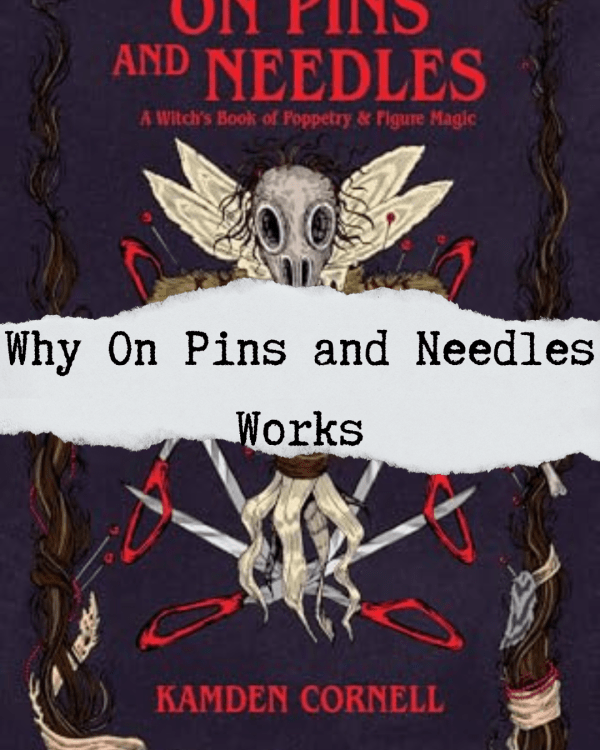
Why On Pins and Needles Works

Launching on April 7th, On Pins and Needles by Kamden Cornell is possibly the most thorough dive into magical poppetry I’ve ever read.

I received an arc of this book from the publisher, and I am very glad I did. It was a fascinating read. If you’ve ever wanted to know more about making poppets for witchcraft or magical work, it’s a great book.

So today, let’s talk about why it works. If you’re a witch like me, I hope you add it to your TBR. If you’re writing a nonfiction book, let’s break this one down and talk about why it works.

Thorough overview

The first thing I like about On Pins and Needles is how thorough it was. Not so much in one part of poppetry, but in the practice as a whole.

The book contained a brief history of the craft. Though honestly, several books could be written just on the history alone. It talked about the many different supplies that can be used, from stuffing to scissors. It talked about the creation, the magic, the intention, and all the many ways this sort of working can be used.

This really gave a wide picture of poppet work, rather than diving down into the weeds with one specific part. Which is why this is such a good place for beginners to start.

Non judgemental explination of some dark material

This part might get a little touchy. But that’s why we’re talking about it.

Poppet work can be used for all sorts of magic. Healing, luck, love, prosperity, protection. They are so much more than the ‘evil voodoo doll’ people not in the know tend to picture.

Boy howdy, is that a shitty and racist stereotype, by the way.

However, like any magic, poppetry can be used for baneful magic. Now, I’m not going to openly admit to or discuss cursing anyone on the internet. But you’ll get no judgment from me if you choose to do so. And, you’ll get no judgment from Cornell, either. Instead, what you’ll find is a frank and open discussion of how to make a poppet for curses or baneful work, and some safety tips along the way. That was especially nice to see.

I really appreciated the lack of judgment on a subject that tends to get the ‘light and love’ crowd up in arms.

Inspiration!

Another thing I loved about On Pins and Needles was the examples of amazing creativity that can go into poppet work. Because honestly, you can use just about anything to make a poppet.

This is where craft supply hoarders like me shine! Want to make a paper doll? Go for it. Have a bunch of scrap fabric lying around? Use it! Do you like carving? Carve a doll! Got a bunch of those gems from a forgotten diamond painting? Use them to make a face on your doll!

This book had me itching to make a doll. Or, like twenty. I kept putting the book down to write out ideas. And honestly, that’s my favorite sort of nonfiction book. The sort that has me inspired to dive into the subject myself, and leaves me with a ton of new knowledge to do that with.

Real-life understanding

Finally, I want to shine a light on Cornell’s work with dolls. They make it clear through this book that they have done the work. They’ve made dolls, researched the topic, and seen results from it.

First-hand knowledge is always the best source for nonfiction work. Especially when it’s more of a how-to sort of book. And it’s clear that this author had that in spades.

Overall, I learned so much from On Pins and Needles. It was entertaining, creative, and bursting with inspiration. If you’re interested in all in poppet work, I cannot recommend it enough.
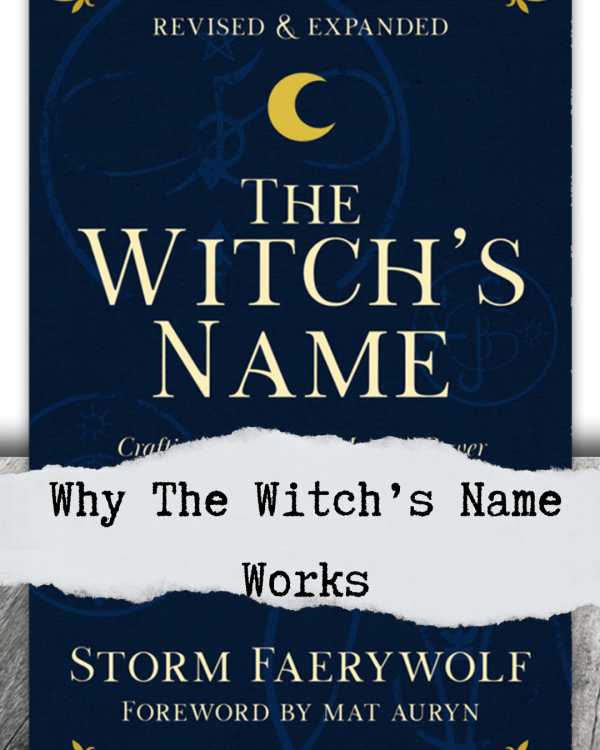
Why The Witch’s Name Works

Recently, I received an ARC (Advanced reader copy) of the revised The Witch’s Name, by Storm Faerywolf. Originally published in March of 2022, the revised edition is launching on March 10th.

A name is something that we writers will think a lot about when it comes to our characters. But what about our own name? It’s not something we’re given a lot of say over. What if we got to choose our own?

Now, I understand that a lot of you are not here for witchcraft content. But stick with me. For one thing, The Witch’s Name is a great example of a well-written nonfiction book. But it’s also a topic that I think more people should consider, whether your life is mundane or magical.

Let’s discuss.

Passion for the subject

Let’s start with Storm’s writing voice. It’s clear in reading this book that the topic of chosen names is one that is of great importance to him.

Which makes sense. It’s an important subject to me as well. It feels like it should be an important subject for a lot of people.

If you’re going to write a work of nonfiction, it needs to be about something that really matters to you. Something that you really, really care about.

Writing a book takes a long time. We know this. And in order to come to the page every day, you need passion. You need discipline, sure, but discipline and passion work best when they work together.

Of course, it isn’t just about getting a book done. Passion shines through in writing. It makes any subject more interesting if the person telling you about it is passionate.

Research heavy

The Witch’s Name is a well-researched book. There is so much information in here about the history of names from different cultures. About the many different ways a name might change according to different faiths and disciplines. Then, of course, there’s the in-depth information about many famous witchy names.

(I’d add to this information that Mormons are given new names when they’re married in the Temple. But it’s very impersonal and chosen at random.)

Let me tell you, I love to see a witchcraft book that is so amazingly researched! I love to see fellow practitioners putting in the work!

Part of being a witch, for many of us, is indulging in a lifetime of study and learning. We need to understand the why of something. The when, the how.

I was fascinated by the different ways people may come to choose their own name or change their name. I was also fascinated by the many different ways we might come to find our own names. I was fascinated by the history of famous names. I learned so much. For instance, did you know there was a Roman goddess of door hinges? And that there were three total gods or goddesses of the doorway, making a doorwat trinity? That was so cool to learn!

Accessible tools!

It should surprise no one that I read quite a few witchcraft books. I also read magazines and blogs, and listen to podcasts. And one thing bothers me more than anything else when I’m consuming witchcraft content.

Here’s a hint: it’s the same thing that irritates me when I’m looking for recipes online.

I hate when a spell, ritual, or recipe calls for an ingredient or tool that I do not have and don’t know how to get. And so often this ingredient is just tossed out like everyone’s got it in the back of their spice rack.

“Here’s a quick and easy spell/recipe that you can do right now, with things you probably already have at home. Just grab some dill, a peacock feather, some ground flaxseed, distilled water from the Dead Sea, shards of non-lab-grown diamonds, the blood of a three-hundred-year-old man, and a large mixing bowl.”

There is nothing like this in The Witch’s Name. Every single ritual or spell requires simple things that are easy to come by. Candles of various colors. Simple rocks. A journal and a pen. And I am here for accessible tools!

Spicy therapy

Now, here’s where we get to the real reason I loved The Witch’s Name.

A lot of witchcraft is really just spicy therapy. Actually, a lot of the best witchcraft is spicy therapy.

Do I believe that witchcraft can influence the universe and tilt things in our favor? Yes. Do I also believe that the most powerful magic you’ll ever work is the magic you do on yourself? For sure.

The Wich’s Name is about so much more than choosing a name. It is about figuring out who you are. Or at least starting on the path to figuring out who you are, because that can be a lifelong journey.

Who are you? Not what do you do for a living. Not what are your hobbies or passions. Not who are you in relation to other people. Not what religion you are. Not what nationality you are.

Who are you?

This is a question I think we should all seek an answer to. Because everything else can be taken away. There may be a time in my life when I am not a wife, roommate, co worker, American. There might even be a day when I am not a Christian, writer or witch. And if all of those external descriptions were striped from me, who would I be then? At thirty-nine, I don’t know. But if you’d asked me before I read this book, I would have told you I did.

Why are we revising this so fast?

The Witch’s Name was fantastic. I really only had one concern.

Why did it get revised so fast?

The original text came out in 2022. That’s not that long ago.

I didn’t read the original version. So if you already have that book, I don’t know whether you should get this one or not. Personally, I always like to have the latest versions.

But if you didn’t read the original, I do recommend this one with my whole chest. I learned so much reading The Witch’s Name. And as I practice the rituals again, I think I’ll learn even more.

Now, I’m sure that as we close this out, you probably have one remaining question for me. Do I have a witch name? I do. And I highly encourage you to seek out your own. It’s incredibly empowering.

No, I’ll not be sharing mine. Names have power, after all.

If you want your own copy of The Witch’s Name, click here. This is not an affiliate link, nor was I paid for this review. I just had an arc thoughtfully gifted to me.

If you love what we do here and want to support Paper Beats World, please like and share this post. You can also support us financially on Ko-fi.

Want to start of the year with a free book? Check out Seeming, book one of Station 86.

A WordPress.com Website.

Up ↑