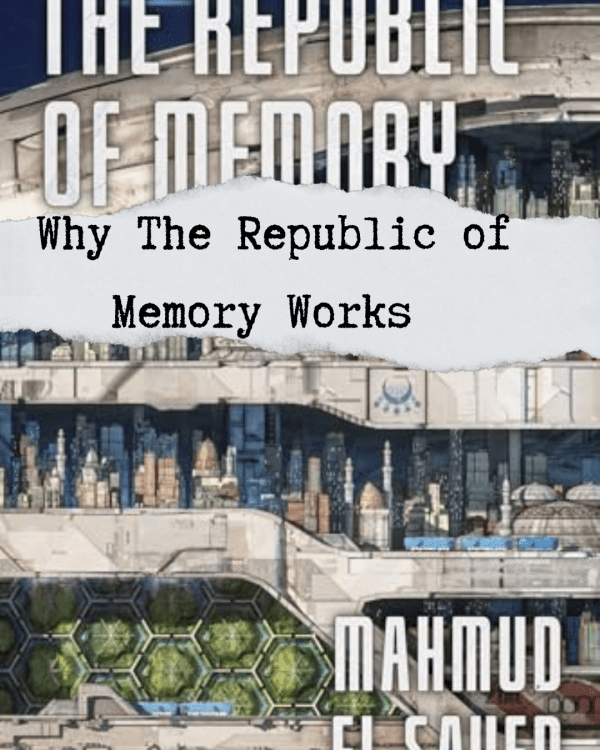
Why The Republic of Memory works

Launching on May 5th, Republic of Memory by Mahmud El Sayed was sent to me as an ARC by the publisher. And I am so thankful they did. I’m also furious they did. Because once again, I’m now waiting for the sequel to a book that hasn’t even been released yet.

The Republic of Memory is about a generational ship that 200 years through its 500-year trek to a new planet. The people living aboard the ship are all descendants of Ancestors who have been in cryo-sleep since leaving Earth. Each ‘crew member’ understands that their main goal in life is to keep the ship running until they reach their destination, so that their descendants and the original ancestors can have a chance at a new life.

To that end, everyone’s life is strictly controlled by Admin. Anyone who wants to get married or have children has to apply to do so. And those applications can absolutely be refused for any number of reasons. People are greatly limited in the jobs they can take. Every decision that everyone makes must have one goal. Keep the city ship Safina moving forward.

Is it any wonder that the people revolt?

Today, let’s break apart The Republic of Memory and see why it works. Because boy howdy, does it work.

An event this large couldn’t be told from just one pov

The story starts with a man named Iskander. He’s a translator on the city/ship Safina. And that seems like a decent gig. He’s got some political aspirations and a family that’s fairly privileged, but not excessively so.

But of course, the story of a revolution can’t be told by just one person. Throughout the course of the book, we’re introduced to people from almost every walk of life. Gangsters, detectives, and academy students. Each character has their own unique point of view. Their own passions and place in this story.

Languages! Also, writing what you know

I always say that write what you know is a phrase to be taken extremely loosely. But there are times to take it a little more literally.

Mahmud El Sayed has worked as a translator. He’s obviously a language nerd. Aren’t we all, as writers, though? I don’t know a single writer who isn’t interested in the etymology of words. In the way we fit them together to mean different things, so many things. How the same word, used in different contexts or with inflections, can mean wildly different things. And how across languages, continents, politics, and religions, we all have words for the same emotions. We all have the same feelings that are so strong, we just have to name them.

Clearly, I am also a word nerd. But that’s kind of the point. Write about what you know, and what you love. Other people love that same thing, I promise.

I don’t know who to trust

Even after finishing this book, I’m not sure who to trust. There are so many factions with different loyalties and goals. The only thing I know for sure is that I don’t trust the character Badreddine. He has serious Fagin vibes, and I don’t like it.

I think everyone who reads this is going to have a different character they’re rooting for, based on how they see the world. People who hate incrementalism will certainly have opinions, as well as those who aren’t big on protests and revolutionary actions. Some will see Damietta as a brave artist. Some will see her as a stupid kid who has no idea what she’s gotten herself into.

In this way, this book acts as a mirror. You might realize a little bit about yourself and the way you see the world, based on who you’re rooting for. And maybe you’ll find that uncomfortable. But we’ll talk more about that soon.

I have no idea what’s really going on

Now, maybe I’m thinking too hard about this. Maybe I’m just a technowitch who sees magic in gears and ghosts in machines. But, after finishing The Republic of Memory, I’m left wondering if there isn’t some fantasy in this science fiction.

Now, I personally think there’s a bit of fantasy in all sci-fi. But there’s a part in the book where we suddenly take a hard turn from pretty believable science fiction to wild fantasy and magic. And, I honestly love it.

Trust me, you’ll know what I’m talking about when you get there.

This sets the scene for the next book. Or the rest of the series? I’m not sure, I only know this is book one.

But this is a question that’s going to drive me. It caused me to follow this author on Amazon, Goodreads, Bookbub, and Instagram, so I know the moment he announces book two.

And that’s the sort of fan you want to encourage! You want someone who checks monthly for news about your new releases. (I’m still rough-drafting, I’m very sorry. I’m going to probably be rough-drafting for the rest of the year.)

How did this book inspire this level of fandom in me? The answer is very simple, but also very hard. I don’t know what’s going on, but I deeply, deeply need to know. And I can’t even tell you the questions I have, because it will spoil things for you.

Let’s talk about the hard topics

Finally, The Republic of Memory is talking about some hard topics. Feeling betrayed by your government. Feeling powerless, unvalued, unprotected. Feeling like you’re giving more to your country than you’re getting back.

These are just a few big feelings I had while reading this. And that’s why we love fiction so much, isn’t it? We get a story, and it’s a good story. Isn’t that one of the first things we learn to ask for as children? Tell me a story before bed. Read to me. Let me watch a cartoon that will tell me a story.

But wrapped in that story is a heavy conversation. One that is weighing on a lot of people in these unsettling times. How long are we going to be taken advantage of by our government, and how are we going to fix it when we’ve finally had enough?

All in all, The Republic of Memory was a fantastic book. I highly suggest picking it up when it launches on May 5th, or pre-ordering it now. Then you can join me in waiting for our next trip to the city ship Safina.

Paper Beats World is a labor of love. You can support us by liking this post, sharing it and commenting. You can also support us on Ko-fi.
In defense of fanfic

In March, I wrote a post about writers being self-indulgent in their writing. It was inspired, let’s say, by a post from a rather popular Booktuber who I won’t be naming. Suffice to say, I don’t watch her and only found out about the dreck she was spouting through the endlessly educational and uplifting Micky Adkins.

At the time, I mentioned that this very long video actually inspired two blog post ideas. Along with several furious rants, only heard by the people in my house who can’t escape me. I am nothing if not a woman of my word, and I am here today with part two.

Click here if you want to read part one of this conversation.

I did mention before that I am not out to shame the original booktuber. And I want to repeat this. We, as a writing community, do not need to tear each other down. I just happen to disagree vehemently with the argument that this person is making, and I want to offer a rebuttal.

Today, we’re going to talk about fanfiction and why I personally think it’s a great way to learn to write.

Fanfic is the closest thing we can get to an apprenticeship in fictional writing

Consider the apprenticeship. What does an apprentice do? They follow around their teacher, learning their style and technique. They learn the basics of a craft bit by bit, with a learned elder by their side.

When we write fan fiction, we are doing something similar. We are not coming to a blank page with nothing to fill it. We have a set world. A series of parameters. We’re not building something from scratch, but building onto something that already exists.

Through this, we start to learn the fundamentals of writing that are never taught in English classes. Character interactions, pacing, and dialogue. These are all valid skills that can be taught when writing fanfic.

Now, I will say that some skills can’t be taught this way. The biggest example of course is world-building. The world’s already been built, after all. The characters have already been created for you, unless you’re adding a character of your own creation. But there are other ways to learn world-building. And that’s another skill you can master in addition to what you’re learning by writing fanfic.

It encourages creativity

Writing fan fiction can turn a passive experience like watching a movie or reading a book into an active, creative exercise. It becomes a game.

Let’s use Lord of The Rings as an example. Because God knows there’s a metric ton of fanfiction about LOTR. So you’re watching Return of The King for, if we’re being honest, the twentieth time. And you start thinking about a character you made up to fit in this world. What are they doing in this scene? Who are they talking to? How are they fighting? Would their special skill wrap something up here, or are they completely useless right now? How are they feeling about the person who’s bleeding out right now?

These are writer questions. These are character-building questions. When you’re writing any scene, you do have to think about how every individual character is responding to the action or conversation at hand, even if they aren’t the main character. And this is a great way to sneak in a little practice during family movie night.

Sometimes you can end up writing those characters for real

I was recently obsessed with a book called The End of The World As We Know It. It is a collection of short stories set in the world of Stephen King’s The Stand. As a writer, I’m insanely jealous that I didn’t get to participate. As a reader, I’m insanely grateful that the book exists.

You can read my full review on Weird Wyrlds.

But guess what. That’s fanfic. That’s fans of King writing their own stories in his world.

So many writers that I love have gotten to write stories in the Star Wars universe. Or the Star Trek universe. And the comic book characters! My God, the comic book characters. Every month, we see a new show, book, movie, mini-series, comic, or podcast spinning off from beloved franchises. And yes, they’re all looking for writers.

The chances of getting one of those jobs are slim, but not zero. I mean, the competition is fierce. But thousands of writers are, right now, writing fiction about characters they were huge fans of.

I wrote some truly terrible fanfic as a teenager, and it helped me learn to write better

Of course I did. You saw this coming, right? As a kid, I wrote some seriously terrible fanfic about X-Men and Sailor Moon. No, I will not be sharing it. Thank God, I was a teen before Wattpad was a thing, so all these stories were written out long form with pencil and paper. And they are now long decomposed in some landfill somewhere.

You know what? It taught me to be a better writer. It taught me the passion of sitting down and putting a story on the page. It taught me about descriptions and dialogue. I used to write some of this with a friend of mine, and we learned a whole lot by yes-anding each other. It also taught me what characters I was passionate about. What sort of characters I want to write. And yes, some of my published works were inspired by writing I did during my fanfic days.

No, I won’t tell you which ones.

But if you’ve read something I wrote and liked it, you can thank my fanfic writing. If for no other reason than that I got a lot of bad writing out of the way.

This is not the only writing we’re doing

While I was writing my X-Men fanfiction, I was also writing original stories. I know, crazy, right? This was when I was in junior high and middle school, so I actually spent a lot of time writing. On any random weekday, I might bang out an essay for English, play around with some fanfic, write a truly terrible poem about a kitten poster I had hanging up, then write a few pages in my moody gothic vampire novel. It was all bad writing, but it was writing.

And that’s the thing. Just because someone’s writing fanfic doesn’t mean that’s the only writing they’re doing. Or the only writing they’ll ever do. Justina Ireland writes a shit ton of Star Wars books, but she also writes novels purely of her own creation. And they’re fantastic! Looking down one’s nose at a person who writes fanfic is like suggesting that because someone drank a Coke, they’re going to die of dehydration. Surely they can’t also be drinking water.

It’s just fun to write

Finally, the biggest argument I’ll ever have in defense of writing is that it’s fun. Writing is fun. And it’s supposed to be fun.

To be a writer is to be passionately in love with writing. It gives us something that we can’t get anywhere else. And if writing fanfiction is fun for you, then do it!

I think we forget sometimes that not all writers are writing to be Novelists. I mean, I am. But some people just want to write as a hobby. And yes, I have made fun of that in the past. But there is honestly no shame in it.

I like drawing, painting, mixing my own teas, and crocheting. All of these things give me pleasure. They make life good. And I will never do any of them professionally. Why can’t writing be the same for someone?

So if you write fanfic, or you’ve ever written fanfic, don’t despair. It’s a valid form of writing that can teach you to be a better writer or just bring some joy to your life. Embrace it.

Paper Beats World is a labor of love. You can support us by liking this post, sharing it and commenting. You can also support us on Ko-fi.
My 2026 Spring reading list

Every season, I like to share with you a list of books I intend to read during that time. I have a whole list planned out. It’s a good list.

And then, things happen. Life happens. Shiny new books happen. Recently, I’ve been gifted several arcs that I am very excited about and grateful for. Long story short, I end up reading half of what I planned to read if I’m lucky.

But damn it! All of the books I wanted to read are still books I want to read! However, while I catch up on my ever-growing TBR pile, I don’t want to write about the same books every quarter. You don’t want to read about the same books every quarter. So going forward, we’re going to do things a little differently. If I’ve talked about a book in the last year, even if I’m still planning to read it this season, it’s not going on the list. I’m only going to talk about new books. It’s going to be a shorter list, but at least it’ll be all new info. And probably new releases.

And of course, you can always follow along with everything I’m reading on Goodreads.

The Caretaker by Marcus Kliewer

When I read the last book by Kliewer, We Used To Live Here, I added him to my instant buy list.

This one is about a caretaker who needs to follow specific rituals when looking after an old cabin. And, from the description on Goodreads, it appears that Kliewer hasn’t lost his love of Morris code.

Dead But Dreaming of Electric Sheep by Paul Tremblay

This is an amazing-looking story about a man trapped in a vegetative AI limbo, and a woman desperately trying to survive. As a lover of dark scifi, I can’t wait to dig into this one. And that cover!

The Republic of Memory by Mahmud El Sayed

I’m already part of the way through this one. And yes, I already love it.

This book is about a generational ship, where people are starting to question why they’re spending their entire lives working to preserve ancestors whom none of them have even met.

Look for a full review soon.

Rainshadow Orphans by Naomi Ishiguro

This appears to be a beautiful, sprawling urban fantasy about magic and found families. There are dragons. There are magic pearls. There are gang wars. I am very excited about reading this.

We Hexed The Moon by Mollyhall Seeley

Remember a couple of years ago when the Witchtok girlies decided to hex the moon. This was quite a funny concept to me, as a witch who really, really likes the moon. But, whereas I had a good laugh and moved on, Seeley asked a question I’d never even considered.

What if it worked?

I can’t wait to find out the answer.

I Know A Place by Nat Cassidy

Finally, this book popped up as a recommendation on Amazon. The cover caught my attention, the description even more.

This seems to be a road trip to several dark and twisted places that I’d quite like to visit. At least, on the page. And since I’ll probably not be road tripping this Summer, this book might be my vacation.

A very dark and eerie vacation from the sound of it.

So those are the new books I’m planning to read this Spring. I hope you’ll add some of these to your own TBR list. And if there’s a book you think I should check out, please let me know about it in the comments.

Paper Beats World is a labor of love. You can support us by liking this post, sharing it and commenting. You can also support us on Ko-fi.
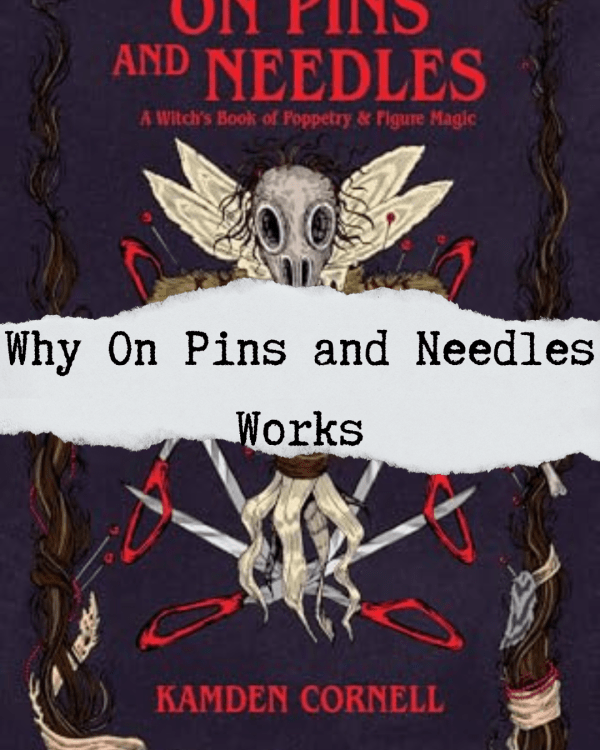
Why On Pins and Needles Works

Launching on April 7th, On Pins and Needles by Kamden Cornell is possibly the most thorough dive into magical poppetry I’ve ever read.

I received an arc of this book from the publisher, and I am very glad I did. It was a fascinating read. If you’ve ever wanted to know more about making poppets for witchcraft or magical work, it’s a great book.

So today, let’s talk about why it works. If you’re a witch like me, I hope you add it to your TBR. If you’re writing a nonfiction book, let’s break this one down and talk about why it works.

Thorough overview

The first thing I like about On Pins and Needles is how thorough it was. Not so much in one part of poppetry, but in the practice as a whole.

The book contained a brief history of the craft. Though honestly, several books could be written just on the history alone. It talked about the many different supplies that can be used, from stuffing to scissors. It talked about the creation, the magic, the intention, and all the many ways this sort of working can be used.

This really gave a wide picture of poppet work, rather than diving down into the weeds with one specific part. Which is why this is such a good place for beginners to start.

Non judgemental explination of some dark material

This part might get a little touchy. But that’s why we’re talking about it.

Poppet work can be used for all sorts of magic. Healing, luck, love, prosperity, protection. They are so much more than the ‘evil voodoo doll’ people not in the know tend to picture.

Boy howdy, is that a shitty and racist stereotype, by the way.

However, like any magic, poppetry can be used for baneful magic. Now, I’m not going to openly admit to or discuss cursing anyone on the internet. But you’ll get no judgment from me if you choose to do so. And, you’ll get no judgment from Cornell, either. Instead, what you’ll find is a frank and open discussion of how to make a poppet for curses or baneful work, and some safety tips along the way. That was especially nice to see.

I really appreciated the lack of judgment on a subject that tends to get the ‘light and love’ crowd up in arms.

Inspiration!

Another thing I loved about On Pins and Needles was the examples of amazing creativity that can go into poppet work. Because honestly, you can use just about anything to make a poppet.

This is where craft supply hoarders like me shine! Want to make a paper doll? Go for it. Have a bunch of scrap fabric lying around? Use it! Do you like carving? Carve a doll! Got a bunch of those gems from a forgotten diamond painting? Use them to make a face on your doll!

This book had me itching to make a doll. Or, like twenty. I kept putting the book down to write out ideas. And honestly, that’s my favorite sort of nonfiction book. The sort that has me inspired to dive into the subject myself, and leaves me with a ton of new knowledge to do that with.

Real-life understanding

Finally, I want to shine a light on Cornell’s work with dolls. They make it clear through this book that they have done the work. They’ve made dolls, researched the topic, and seen results from it.

First-hand knowledge is always the best source for nonfiction work. Especially when it’s more of a how-to sort of book. And it’s clear that this author had that in spades.

Overall, I learned so much from On Pins and Needles. It was entertaining, creative, and bursting with inspiration. If you’re interested in all in poppet work, I cannot recommend it enough.

A WordPress.com Website.

Up ↑