Devon Mestonie had lived in the palace of his uncle the king for most of his life. His father had a castle and lands of his own, of course. But in all of his fourteen years Devon didn’t think he’d spent more than a handful of months there. His papa said it was because there was a lot of work to do in the capital, and he was needed. His mamma, Lorna, said it was because Samuel and Issac were too close to stand being parted for very long.
In all that time, Devon and his brother Octavian had shared a room in their cousin Michael’s suite of rooms, as royal cousins and first in his court. Now, Octavian was being moved into Michael’s room. But he wasn’t going without making noise.
“Michael’s been dead for only two weeks, and we just can’t wait to shove all of his things aside and move on, can we?” Octavian cried at the head manservant, Peter, as he oversaw the move. Lighting was crackling along his shoulders, a sign that he was losing control of his magic right along with his temper.
“Prince Michael has gone to the arms of The Creator, and your father has been ordained king,” Peter said with a sigh. “That means that you, sir, are the new heir. This was never Prince Michael’s bedroom, it was the bedroom belonging to the heir of Septa, our next ruler. That is you. If you don’t like it, go and speak to your father the king.”
That, Devon decided, was the bit that was bothering him most. “Your father the king.” It had always been your uncle the king before. That left his father just to be papa. To Devon, it felt like their father didn’t belong to them as much as he had before.
Deciding that he wanted none of the fight that was brewing between Peter and Octavian, Devon ducked out into the hall. Sadly, there didn’t seem to be a single quiet place to be found in the whole palace.
He went first to the training rooms, to play with the bows. There he found Dennis Synthia and Oliver Castille, two of the noble boys of the court. Dennis was Lord David’s son, and he looked like it, being the tallest of the court, with the biggest nose. Oliver was, in Devon’s opinion, too pretty for his own good, with hair that he was too fond of caring for.
Devon selected a bow, and started to fit an arrow to the string. “Bet your papa wants you to take up sword work now,” Oliver said.
“Bugger that,” Devon replied. “I’m terrible with a sword.”
“But it’s more princely,” Dennis said, firing his bow.
“I’m not,” Devon replied.
The indoor range was near the conference chamber. The lords and ambassadors were there, apparently having another argument.
“What are they on about now?” Devon asked, listening to the men’s voices rising and falling.
“That man that stayed from the Montelair soldiers,” Oliver said. “My papa thinks that he’s a spy, and he wants him hung.”
“Lord Lewis thinks we ought to march on Montelair,” Dennis said. “He said that we’re taking the word of someone we know nothing about that this wasn’t an act of war on King Kurtis’s part.”
“Except when he said it, there was a lot more swearing,” Oliver said.
Devon fired his bow, sinking the arrow into the very edge of the red target in the center of the butt. “I was hoping for a bit of quiet,” he said.
“Then don’t go out to the outside range,” Dennis said, “Hank and Howard are out there, sparring.”
“Oh, Creator defend us, I wish they’d stop that,” Devon said. “They only get started fighting, and Hank gets mad if Howard uses his magic, even though he knows he’s got no control over it.”
The door to the conference room opened, and the ambassador from Coveline came out. She was a large dragon, thin in body and green in color.
“I don’t think I’ll ever get used to dragons in the palace,” Dennis whispered.
“Does Ambassador Lau look different from that language master she brought with her?” Oliver asked. “Isn’t she shorter, and fatter?”
“Of course she does,” Devon said. “Ambassador Lau’s a Vondrai dragon. They’re the ruling class. Mistress Risus is a Monnor. They’re more common.”
“Probably shouldn’t call her fat, though,” Oliver laughed.
“I’m going to go find Lenore,” Devon said
“Think she’s in the tower,” Dennis replied.
“How d’you know that?” Oliver asked, smirking.
“Because she’s with Hannah, and Papa likes me to know where my sister is, arse!” Dennis replied, blushing a little.
“Right, I’ll see you later, then,” Devon said. He set the practice bow back in place, and nearly ran to the tower workroom set aside for the thread mages in the palace.
It was Devon’s favorite room. It was circular and huge, with two great fireplaces to keep the cold away in the winter. Every available bit of wall space was covered with hooks that held thread and yarn in all different colors and weights. Great chests were placed beneath them for even more yarn and thread. Comfortable chairs were set around the room for the mages to sit. As his mamma had been the highest ranking thread mage in the palace since their grandmother died, this room did not change hands, and looked just the same as it always had.
Lenore was there, along with Hannah, Ramona, and Victor. Hannah was a heavier girl, with a thick braid tucked over her shoulder. She sat next to Lenore, stitching a bright green vest.
Ramona was the head of the royal nursery. She was an older woman, with a stern face. She knelt before a loom, weaving a tapestry that showed birds flying across a blue sky. Thanks to her magic, the birds were moving.
Lenore sat in the sunlight near a window, spinning the light into her thread.
Victor’s appearance had changed a lot since the first time Devon had seen him. His hair had been cropped short and neat, his facial hair shaved. He dressed as most other men of Septa did, the same sort of cloths that Devon wore, with a jacket, undershirt, and breeches, with high polished leather boots. He stood next to Lenore’s chair, watching her spin with a look of fascination that amused Devon.
“Hello, Prince,” Ramona said when she saw Devon.
“Please, don’t call me that,” Devon replied. He came to her side, and sat next to her on the floor.
“But that’s what we are now, prince and princess,” Lenore said with a grimace. “As though it does us any good. Octavian will be king, and you’ll be his adviser, I’m sure. But I’ll just have more of the lords after me for their sons. Disgusting, as though I’m nothing more than a means to an end.”
“Oh, stop,” Hannah said. “Being a noblewoman is an important calling. We’ve got lands to run, and families to look after. It’s not like you’ll ever be bored.”
“One can be busy and bored at the same time, if the thing one is doing is boring,” Lenore replied.
“Nurse, can I use your hand loom?” Devon asked.
“Sure,” Ramona said.
“You weave?” Victor asked. “Boys do not weave in my country.”
“Boys don’t weave here, either,” Lenore replied. “Just my little brother. And I wouldn’t allow it, but he’s not bad. You just cannot tell Papa.”
“And how am I to avoid telling him anything, being sworn to him and all?” Victor asked. “A man is not a man if he does not take his vows seriously.”
“Well, I don’t think he’ll ask you direct,” Ramona said. She set the loom in front of Devon, and he started to set it with base yarn. “Besides, a talent is a talent, even if it’s unusual.”
Devon smiled at her. “Thank you, Nurse.”
The five of them sat in silence for a while. Victor wandered around the room, glancing out of windows and looking bored, but otherwise everyone stayed still. With the rest of the palace in such a rush with the funerals and Samuel’s coronation, this was a mercy.
Devon’s fingers started to itch while he wove. He stopped to rub his fingers on his breeches, then went back to work.
“Does the king know a group of Montelarians are coming up to the palace?” Victor asked, looking out the window.
“I don’t know,” Devon said.
“He does, and he said so yesterday,” Lenore said with a sigh. “Honestly, Devon, you are so hopeless. Papa sent a messenger up to Kurtis about the attack, and this will be the answer.”
Devon was pulling colors from Ramona’s rag bag at random. He looked at the fabric strip he was making, which should have been a simple striped pattern. Instead, it looked vaguely like a crossbow bolt, black with a thin arrow head and wooden fetches at the back in place of feathered ones. Around it was a pattern of flames.
“How did I do that?” he whispered.
Ramona looked down at his loom. “Well,” she said, “that is a clever little pattern.”
Lenore and Hannah bent over to see as well. “That is a manly thing to weave, I suppose,” Victor said.
“That is good,” Lenore said. “Well, if you can’t sword fight, and you aren’t a mage, at least you are good at something, little brother.”
“Wish my brother did something quiet,” Hannah said.
“Let’s go down and see the people from Montelair,” Lenore said, putting her spinning away. “Maybe Papa will let us sit in on the meeting.”
“Why would you want to do a thing like that?” Lorna asked. “They will only talk about boring matters of state. Surely you would be more interested in going to visit the hounds?”
“I am tired of hearing things secondhand,” Lenore said. “Besides, I’m sure Victor will want to know what’s going to happen.”
“I would like to know later, when the nobility of Montelair cannot see me and have me gutted,” Victor muttered.
“Come on,” Lenore said. Devon shoved his loom back into Ramona’s bag, and followed after her and Hannah.
“Here,” Hannah said, offering Lenore a bit of fabric. “I stitched that, so I’ll be able to hear anyone who talks into it. They’ll probably let you sit closer than me.”
“You ladies really are interested in politics?” Victor asked.
“This is history in the making. How is that not fascinating?” Hannah asked.
“I just want to know what’s going on,” Lenore said. “Men are always making all these decisions and they act like it’s not going to concern us poor little girls at all.”
Samuel and his lords were coming from the conference room as Devon and the others came around the corner. “Papa, may we come meet the delegates from Montelair with you?” Lenore asked.
“Oh, Bug, you’ll be frightfully bored,” Samuel said. “Devon, I didn’t think you had any interest in this sort of thing.”
“I do, Papa,” Devon said.
“And so do I,” Lenore said.
“You may come, but you may not speak,” Samuel said. “Montelair has a different opinion of ladies, and I can’t trust them to act like gentlemen to you, dear.”
“I won’t say a word, Papa,” Lenore said.
They fell into step behind the lords. “How do men treat women in Montelair?” Devon asked Victor.
“Not very well,” Victor replied. “I have not lived here long, but I am already seeing that men are more gentle with women here. You would not like Montelair, I think. We are not gentle with many things.”
The gondola holding the Montelair group was pulling up next to the boardwalk in front of the castle. “I will never get used to not having proper roads here, instead of all these canals,” Victor said.
“I can’t imagine living any other way,” Lenore replied.
“Thought we discussed no talking,” Samuel said.
A man was getting out of the gondola. He looked as different from Victor and the other Montelarians Devon had seen as it was possible to be. He was thin, and so pale that his veins could be seen on his face and neck. His eyes were watery. He wore a red velvet coat, and a large decorative velvet hat, encrusted with gold along the rim.
“What’s the matter with him?” Hannah asked.
“He’s inbred, like all the other aristocracy,” Victor whispered. “Stupid kuo i, weakening their whole line because they think their own people to be inferior.”
“What does that word mean, ‘kuo i?’” Lenore asked.
“It is a not so nice word, Princess,” Victor replied. “I believe in Septa, you would say ‘ass.’”
The man looked around. Devon was sure he’d heard Victor. If he had, though, he made no mention. “I am Vitaly, official ambassador sent by King Kurtis of Montelair,” he said.
“I am Samuel Mestonie,” Samuel said. “I welcome you to our land, and I hope that we can move past the hostilities of the past to a better future for both of our countries.”
Vitaly smiled, “I hope so as well. I see that you’ve contained one of the Broken Chain men for us. Thank you. I’ve brought guards, we will take him into custody.”
Victor hissed. “Should have known I wasn’t getting off so easy,” he muttered.
“I have no idea what you are talking about,” Samuel said. “That man is my daughter’s bodyguard. He’s working off a debt to the family.”
“Ah,” Vitaly said. “In the interest of friendship, King Samuel, I want to caution against that. These commoners, they are like stray dogs. They will wag their tails for a meal, and happily sleep at the foot of your bed. But in the end, they will always belong to the person who feeds them best.”
“Well, also in the interest of friendship,” Samuel said, crossing his arms over his chest, “let me tell you that Victor knelt under my blade and swore fealty to my family. I don’t know what that means in Montelair, but in Septa we take a man at his word. That’s a Septa man you’re insulting right now, and if you want this conversation to remain ‘friendly’, I’d advise you to stop.”
Vitaly gave the king a gentle wave of his hand. “Of course. No offense meant, I assure you. My apologies.”
Devon’s attention was drawn to the wall. There was movement there, beyond the rhythmic back and forth of the guards marching. One of them had stopped, and was holding a crossbow. It was aimed at Vitaly.
“Papa!” Devon cried, pointing towards the man. Everyone looked up, just as the guard fired.
Samuel’s sword was out in a moment and he swung, throwing a wave of fire at the arrow. It caught, and fell to the ground in cinders. Victor was pulling Devon and Lenore back, as the guards on the wall grabbed the attacker. They pulled his helmet away, to reveal long blond hair.
“That’s one of the men that attacked us,” Lenore cried.
Vitaly’s guards were steadying him, and helping him to brush the ash from his cloths. “That was some very fast magic work, Sire,” he said, with a shaky laugh.
“I think we found your rabid dogs,” Samuel said. “It’s my turn to apologize, I thought we’d swept the palace before your arrival. Come inside, we’ll get you settled with a nice brandy.”
“Yes, that does sound like a good idea,” Vitaly said with a nod.
The king led Vitaly inside, a hand on his shoulder. The others followed, Lenore falling into step beside Devon.
“An arrow,” she said, looking at him sideways.
“What of it?” Devon asked.
“An arrow surrounded by flame,” Hannah added.
“That nice little picture you made, Prince,” Victor said. “Rather prophetic, don’t you think?”
Copyright © 2024 by Nicole C. Luttrell
All rights reserved.
No portion of this book may be reproduced in any form without written permission from the publisher or author, except as permitted by U.S. copyright law.
If you love the story and want to support Paper Beats World, you can do so on Ko-fi.
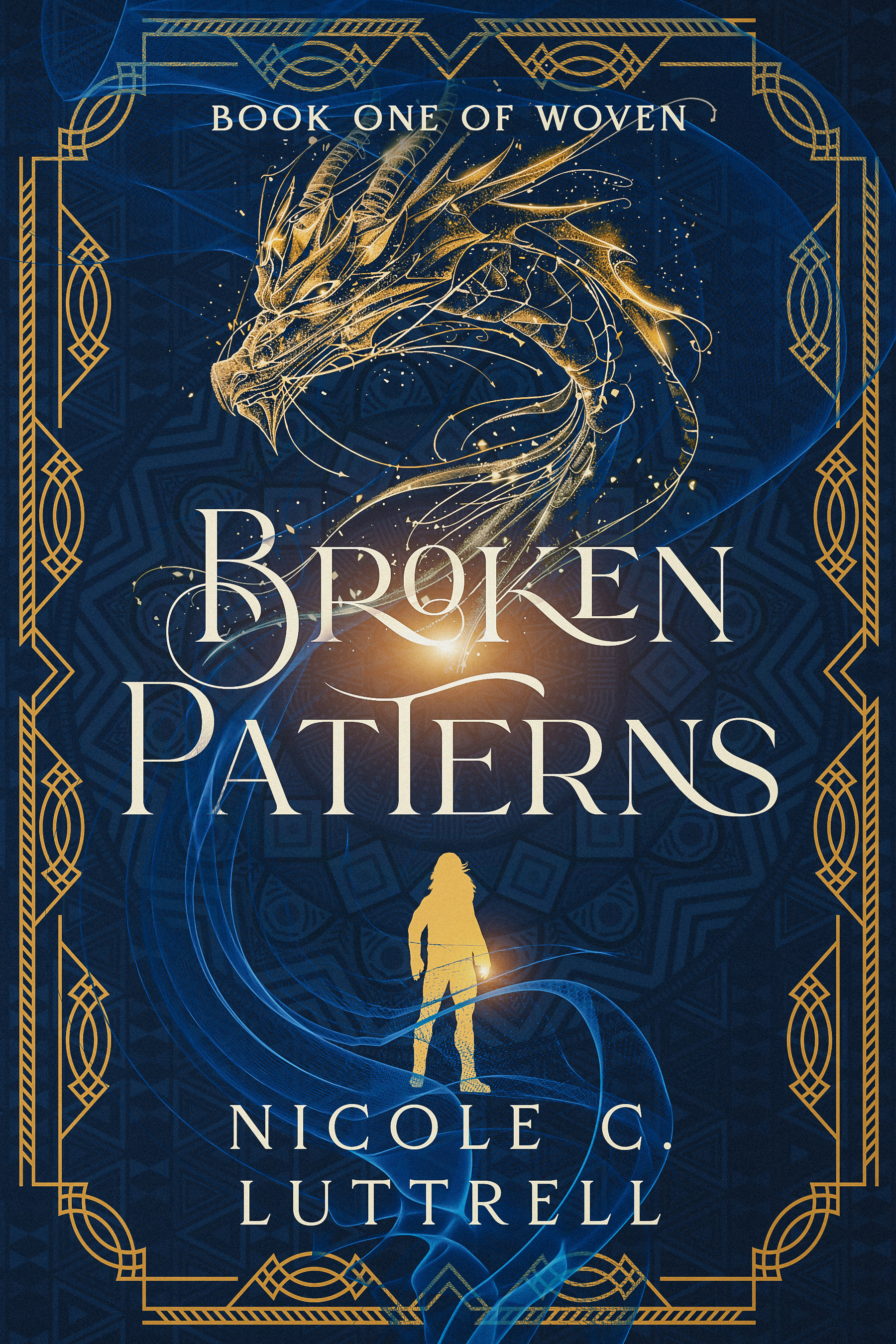
You can preorder Broken Patterns right now on Amazon.








Recent Comments