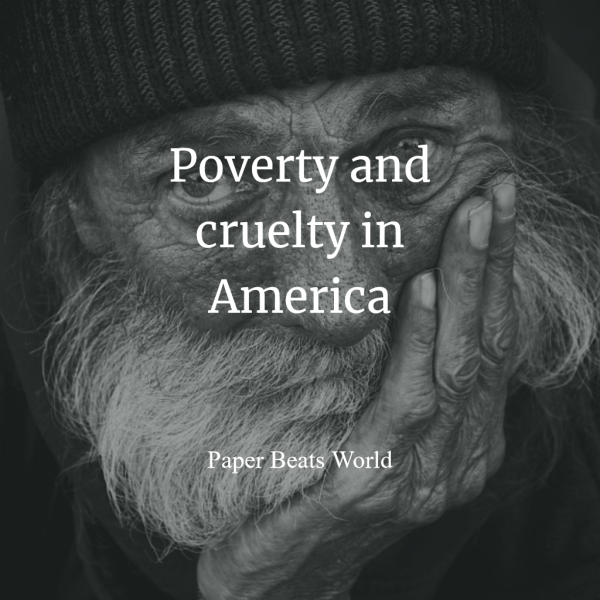
Poverty and cruelty in America

Let’s talk about poverty today. Let’s talk about want, hunger, need, and hatred.

Because in America, we hate our poor.

Recently, a suggestion was made by President Trump that instead of giving food stamps to families who are in need of aid, we should send government issued food packs. I wonder what those will look like.

I can’t set too much blame on his shoulders, though. He’s not the first person to suggest it. And he’s certainly not the first person to behave as though those who receive food stamp or cash assistance benefits are screwing the rest of us over. I’m sure you’ve heard comments about people on food stamps being lazy, drug addicts. The rumors of people using food stamps to buy steak and lobster abound. People buying expensive jewelry, having nice cars or nice bags, having smartphones or nice computers while still qualifying for food stamps.

It’s almost as though we expect poor people to adhere to a certain level of poverty and lack to make us feel better. It’s almost like we’re angry that someone we perceive as less deserving than we are has something that we want. And it’s almost like people forget that an American Eagle pair of jeans can be had at a second-hand store if one looks hard enough and gets lucky.

Really, it’s as though we need someone to be sufficiently pitiful so that we can think ourselves above them. Only then do they deserve our help.

Here’s some information you might not be aware of about food stamps. The majority of people (58%) who receive food stamps, or SNAP benefits, have a job when they sign up for them. The vast majority of people (87%) who receive SNAP have a job within the first year of qualifying for them. 70% of the people who benefit from SNAP are disabled, elderly, or families with small children. Here’s a link to my source. You can also read how little money you need to make before you qualify, how they enforce a work requirement, and who is not eligible no matter how poor a person is. So please, go on and tell me again how the people on SNAP are lazy and not working.

Okay, so the majority of people on food stamps are either working, disabled, elderly, or have small children which makes it freaking hard to have a job. But there has to be a reason they are that way, right? I mean, single moms didn’t make those kids themselves, right? (wink wink, nudge nudge. People who say this are calling single moms whores if you didn’t get it.) So they didn’t go to college, or they got themselves knocked up. Maybe they had a drinking problem, right?

No, not right. Anyone might end up in a situation where they have to rely on food stamps, cash assistance, public housing or even soup kitchens. Yes, even you.

You might get sick, or get into an accident and not be able to work anymore.

Your home might burn down.

Your company might go under.

You might have an elderly relative get sick and have to take on the cost of caring for them.

Your spouse might die.

You might be in an abusive relationship and have to leave to protect yourself and your children.

Or maybe things are just too expensive. Maybe you’re just working really hard, but your bills keep going up and up. Food is more and more expensive. Your heating bill is just killing you and sometimes you just can’t keep up with everything.

This is a fundamental truth. Everyone is just one bad day from the breadline. You’re not immune. And that scares the shit out of some people! We’re afraid, and our fear makes us cruel.

We don’t want to believe that it’s true. We want to believe that we’re immune. We work hard, we take care of ourselves. The people who are getting food stamps have to be at fault because if they aren’t we have to come to grips with the fact that we can be there next week.

Now, I have something to say to anyone who would complain about immigrants getting food stamps. Actually, I have a lot of things I want to say to them, but they’re mostly four letters. So how about I just leave this here.

Not like the brazen giant of Greek fame,
With conquering limbs astride from land to land;
Here at our sea-washed, sunset gates shall stand
A mighty woman with a torch, whose flame
Is the imprisoned lightning, and her name
Mother of Exiles. From her beacon-hand
Glows world-wide welcome; her mild eyes command
The air-bridged harbor that twin cities frame.
“Keep, ancient lands, your storied pomp!” cries she
With silent lips. “Give me your tired, your poor,
Your huddled masses yearning to breathe free,
The wretched refuse of your teeming shore.
Send these, the homeless, tempest-tossed to me,
I lift my lamp beside the golden door!”

So, you know, go argue with the Statue of Liberty if you don’t want poor immigrants moving here.

Now I’m going to get really honest with you. I’ve been honest with all of you that my daughter was born when I was seventeen. I moved out of my mother’s house and into an apartment with my ex. He was working, and I was keeping home like a good Mormon girl is supposed to be.

Then, my ex lost his job. We ended up living in public housing, depending on food stamps and cash assistance to survive. I’d been taught by my family to have faith in God and my husband, or boyfriend in this case. So I kept home, I took care of the baby and had faith in God and my boyfriend.

Fortunately, it only took me three years to have faith in God and myself instead. I had a shitty job where I sorted garbage at a waste management plant. I worked hard, long hours. I received food stamps and paid my mother to watch my daughter.

I worked at a health food store, then in retail, then in retail management. Through all of this, my family and I have struggled to keep food in the house and the bills paid. We have benefited from food stamps, and without them, we would not have had money to both eat and pay our bills.

I could be called a lot of things. Bleeding heart hippy liberal feminist, if you like. But I doubt anyone would call me lazy or stupid. I was stuck in a bad situation and needed help to get out of it.

Just like anyone could be. Please keep that in mind when you hear people talk badly about people who receive food stamps or cash assistance.
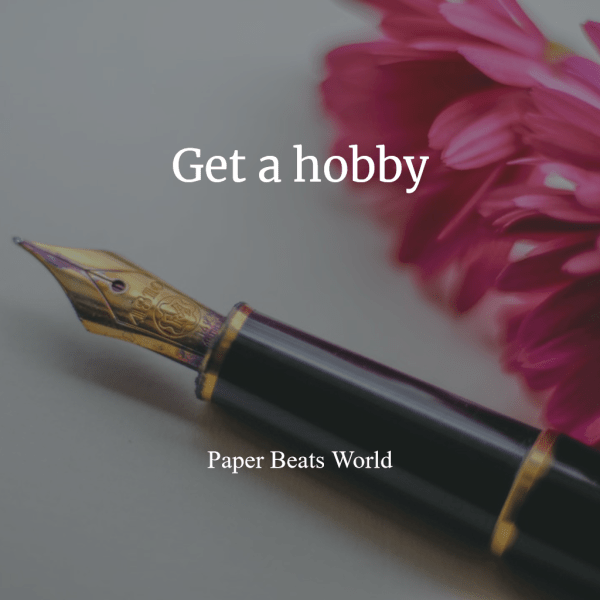
Get a hobby

If you follow me on Instagram, you know that I recently got a fountain pen. I’ve been practicing calligraphy as a new and exciting hobby. Well, a new hobby, at least. I got this nice ink in a bunch of fancy colors and I’ve been writing out poetry.

I also crochet, knit, make fancy coffees and do makeup. For someone who’s as busy as I am, I have a lot of hobbies.

As we’ve discussed before, writing is not my hobby. It’s my passion, my purpose and my reason for living. But I am realistic. I understand that some people see writing as a hobby. They’re not good people, but they are around.

To make an argument for their side, though, one reason people have a hobby is to have a creative outlet. I already have a creative outlet. So, why then do I need one hobby, much less four? Because I don’t want to lose my damn mind, that’s why.

Here are four good reasons why I still have hobbies as a writer.

It’s relaxing

Writing is not relaxing, man. It’s work. It’s the best work, the most fulfilling work. But to sit down and craft a plot, give voice to characters and create a world is not relaxing. My hobbies, on the other hand, are super relaxing. When my brain is fried from writing, I can relax and write some calligraphy. If my day is over and I would like to unwind, I can crochet while I watch tv. If I need a day away from the writing, I can amuse myself making a macchiato at home.

No pressure

Because I’m trying to make a living from my writing there’s pressure to be, you know, good at it. People look at my writing (theoretically) and judge it. I want my writing to be good, I need my writing to be good.

There’s pressure there, is what I’m saying.

When I’m doing calligraphy, there’s no pressure. Which is good, because I kind of suck at it. That doesn’t matter, I’m having fun! I’m not worried about whether critics will like it, or if my mother will read it and think it’s about her (it’s not). Or whether it will sell well. I can just enjoy the process from start to finish.

Learning new things is good.

When I pick up a new hobby, there are new things to learn. And if you’ll remember, my word of the year is learn. I’m learning about different pen nibs and the different ways they write. I’m learning about the care of pens, and how I should properly clean them. I’m learning to take my time and write nicely. I’m sure I don’t need to tell you how important learning new things is to your brain. Especially if you’re in your thirties, like me.

Everything feeds your art anyway

I’m writing out poems to practice my calligraphy. That means that I’m not just reading the poetry, I’m kind of absorbing it. I’m focusing on every single word, as I write them down slowly. I can see how all the words fit together to make the poem work. I’m studying poetry from Maya Angelou, Robert Frost, Bill Waterson, Langston Hughes, Emily Dickenson and Rudyard Kipling. These are the masters of their field, and I’m just soaking in the mechanics of their poetry. If you’ve been around for a while, you know that I consider myself a poor poet. I give it a good shot every April and post some of my shitty poetry. This year, I feel like I might have some decent poetry to share with you, after studying at the feet of these masters.

It’s just fun.

I have fun with all of my hobbies. I love playing with makeup, making coffee, crocheting a blanket and writing out calligraphy. I really enjoy doing these things. When I do them, I’m happy. Writing also makes me happy, of course, it does. But when I cannot write anymore, or if I need a break from the writing, then I have other things to do with my time that also make me happy.

Here’s an actionable item for you today. Get a hobby. Find something that you enjoy doing that puts no pressure on you. Now do it for a little bit of time every day. See how much better you feel, after doing something fun that’s just for you.

My non lent lent goals.

As you’re reading this, it’s March 5th. So, we’re about two and a half weeks into Lent. I imagine that some of you are quite sick of going without whatever you gave up for Lent. And we’ve got almost a whole month to go.

Now, I’m not Catholic. I’m not a member of any faith that observes Lent. I’m Unitarian actually and was raised Mormon. Both of my great grandmothers were Catholic. Both went to church on Ash Wednesday and walked around with the ash on their foreheads. But I’ll repeat, I am not Catholic and do not actively practice Lent.

So, I didn’t really make a sacrifice for Lent. Here’s what I’m doing, to be clear.

I’m not eating any sugary snacks between now and Easter. I may have something sweet for breakfast, like a granola bar or a doughnut. I may have a cup of coffee in the morning. I may have a soda or a mixed drink (aka rum and coke) with dinner. I may not have candy, cookies, extra sodas, extra coffees, ice cream, baked goods or things like that.

I’m not doing this for any religious reasons. I’m not doing it because I don’t like how I look. I’m not doing it because I’m obsessed with my weight.

I’m doing it because I’ve been overindulging in sweets recently and I need to reign that shit in. And, because I have zero energy right now. Both of these things are probably due to the amount of stress I’ve been under and the work I’ve been doing. That’s no excuse, though, and I need to get this under control. (Seriously, in one day I ate two chocolate bars and a cupcake.)

I’m not telling you this because I think you should give up sweets. I’m telling you this because I think this goal has all of the trademarks of an attainable goal, so I’m using it as an example for you today. It’s a Smart goal. You remember what a Smart goal is, right? Specific, Measurable, Achievable, Relevant and Time Limited.

Specific- I know exactly what I’m not eating.

Measurable- I can easily tell if I’ve eaten something I shouldn’t.

Achievable- I’m not cutting out sweets altogether. Just cutting out the mindless sugar snacking all day long.

Relevant- I want to make this change for healthy reasons. I want to have more energy and not consume so much sugar.

Time Limited- It’s just until Easter.

I’m also telling you this because there’s never a bad time of the year to set a new goal. If you’ve fallen off the writing wagon, now’s a good time to get back on it. Take some time today, set a SMART goal, and get to it. See what you can do in between now and Easter.

How we (and our characters) talk

So, I finally got around to reading Writing Down The Bones by Natalie Goldberg. And I do mean, finally. I’ve been intending to read this damn book for years. It’s considered required reading for writers for a reason! It taught me a ton about writing, as I expected it would. But it also taught me about other things, as a good book always will.

Writing should never detract from your life, it should always only add to it. And a good writing book, written by a well-rounded author that walks and breaths in the real world will always tell you about living as much as about writing.

One thing that was discussed in Writing Down The Bones was something that I’ve noticed before, but never really gotten around to thinking about. I have so many other things I think about on a daily basis. This one gets pushed to the back.

It’s about how women talk to other people.

I’m not going to get into how we talk to ourselves. That’s a whole other issue that I, quite frankly, don’t have the energy to pursue right now. So we’ll put that aside for another day.

No, I just want to talk about two things that women do in their speech that I’ve noticed. And while this is something that both Ms. Goldberg and I both noticed I do have to add the disclaimer that this is purely anecdotal. I have no idea if this is something that all women and no men do. It might be that you’re a woman who doesn’t do these things or a man who does. I am a woman, and I do these things. I have almost always heard women do these things and not men. So that’s what I know.

We say ‘I’m sorry’ when we should say ‘thank you’.

We say I’m sorry too much, and often not for the things we should really say sorry for. We really cheapen the word, apologizing for everything.

“I’m sorry you had to wait for me.”

“I’m sorry, I look like such a mess!”

“I’m sorry the house is a disaster.”

“I’m sorry my kid just did that unspeakable thing.”

Stop, just stop. First off, if you’re apologizing for how you or your house looks, let that go right now. You don’t owe beauty to anyone, and you don’t owe a neat house to anyone but yourself.

Okay, maybe if you’re habitually late you should apologize. Or maybe you should just correct that behavior. It’s just inconsiderate.

And you don’t owe an apology for the actions of another, even your child unless you were being negligent. As an example, if your little kid knocks over my coffee in public, you owe me an apology. (And a new coffee.) If your kid is sick and behaving like a sick kid, that’s all good. My older daughter once threw up all over me, my coat, two seats and the carpet of the bus station. This is the joy of parenting.

I don’t remember the first place I heard this great suggestion but I’m not in any way taking credit for it. The next time you feel the need to say ‘sorry,’ change it to ‘thank you’.

“Thank you for waiting for me. I was getting a bird out of my basement. No, it didn’t peck me.” (This is an actual discussion I had with my doctor one time when I was late for an appointment.)

“Thank you for loving me for who I am, and understanding that I won’t always look beautiful.”

“Thank you for coming into my home, and I hope you’re comfortable even though it’s cluttered.”

“Thank you for accepting my child as they are, and understanding that sometimes horrible things come out of little bodies.”

Now, I do encourage you to genuinely apologize for things that are actually your fault. But, as they say, the best apology is always corrected behavior.

Asking others to agree with our opinions.

We all do this, don’t we?

Yeah, that. We don’t just say what we mean to say. We say it, then make it a question. I am so bad about this, and I’m sure a lot of you are too. Now that I’ve become more aware of what I’m doing, I hear it for what it really is.

“I feel this way, but I’m afraid. I’m afraid that I’m wrong, or that you’ll think I’m wrong and hate me because of it. And really, your opinion of me is worth more than my opinion about this matter, no matter what we’re talking about.”

Stop doing this!

Using this to show us about your character.

Okay, so we know that we should strike these two things from our daily vocabulary. But that doesn’t mean we should take these telling little language cues from a character.

Language is a huge tool in showing us a character’s, well, character. Let me show you with these two passages of dialog.

“I’m so sorry I’m late. I was waiting in line at the coffee shop, and it was so long! I can’t stand waiting, can you? And I forgot my tablet, so I had nothing to do. Don’t you hate that?”

“Thanks for waiting for me. The like at the coffee shop was insane! I hate waiting forever for my coffee but the barista was so nice. Have you tried that place?”

Now, let’s see what we can infer from these two bits of dialog. What do you think of the first person? Does she seem like she’s all together? Does it seem like she’s very confident? Does she seem a little selfish, even? Do you want to follow her to a haunted house? Maybe so they get her first and you can haul ass out of there.

What about the second woman? Does she seem frazzled or confident? Does she seem like a nice person? Does it seem like you’re going to have a good time talking to her?

How you talk will tell someone so much more than just what you’re saying. Learn to speak with confidence. But learn to let your character show everyone exactly who they are with the way they talk.

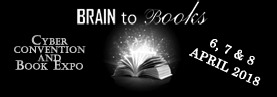
B2B Cycon, 2018

Hey, guys. Bonus post time!

I just wanted to let you all know that the Brains 2 Book Cycon is scheduled and ready to roll! You know what I love? Conventions. You know what I love more? Conventions I don’t have to leave my house for.

I’ll be participating in the con in a few different ways. Here’s where you can find me.

Just Read- The first chapter of Broken Patterns will be available, as will the first episode of Seeming. If you’ve been curious about either one of my series but not yet ready to shell out the cash for the book, this is the place to start.

Cover Wars- I submitted the cover for You Can’t Trust The AI in the cover wars! Please go vote for it.

Book Expo- I have two booths in the book expo. One for Station 86 and one for Woven.

My e-books will all have special discount prices. I’ll probably have some other fancy stuff and events going on, so stay tuned.

Here’s a link to get signed up.


Don’t turn off the news

Have you ever read V for Vendetta? I don’t mean, have you seen the movie. The movie was awful. Have you read the graphic novel?

You should. And if you can, you should get ahold of the collection that has a forward by the author. Because there’s a story there that once upon a time changed how I see the world. I’ll paraphrase it for you.

Alan Moore was sitting in a pub having a meal and some drinks. The news was on, and he was sort of watching it peripherally. The owner of the pub was there, doing pub owner things. Eventually, the owner’s wife came in for the dinner rush. She turned changed the news station over to some game show or another. She explained that the news was too depressing. He goes on to say that V for Vendetta is dedicated to the people who don’t turn off the news.

I get that, you know. There are days that it’s hard to watch the news. There is so much horror in the world, so much pain. Tragedies and human cruelty. Monsters and liars, and terrible things that are just out of our control.

I read the news online, I don’t watch it. And there are days that it’s just sickening. I don’t want to know what’s happening sometimes because it makes me feel so damn helpless! Sometimes I feel like I just can’t ever do enough.

But I can do some. I can donate to worthy causes, not just my money but my time. I can use this platform to inform people about things we all need to know about. I can share things on social media.

And I can vote. I can make damn sure that I vote.

At very least, I can make sure that I know what’s going on. I can look into situations, check multiple sources. I can educate myself. And so can you.

Look, I know that it’s hard. But it’s not going to get easier, it’s not going to get better until we are all educated enough to do something about it. We should take breaks, we have to. We should understand that we can’t do something about everything. But we should do what is in our power to do.

Don’t turn off the news. Don’t shut out what’s happening, please. Do whatever you can.

Use the simple

I love The Simpsons, at least the first 20 seasons. Honestly, I’m not prepared to say that the show’s out of ideas, but I do think that the older the episode is, the better. That could be because the new ones aren’t as good, but it’s more likely that it’s because I view older episodes through the crappy lenses of nostalgia that makes everything look better.

Are you familiar with the Mr. Plow episode? It was Season 4, episode 9. The storyline was simple, Homer wanted to start a plow company because he bought a truck that he couldn’t afford. He makes up a little jingle to advertise his new business.

Mr. Plow, that’s my name. That name again is Mr. Plow.”

It’s simple, it’s short, and it gets stuck in my head like nothing else. If you’ve heard the song, I bet it’s stuck in your head too. Sorry, not sorry.

Now, I’m not telling you all of this just because I’m a Simpson’s fan and I want you to be too. I’m telling you because I think this is one of the main reasons why The Simpsons is successful. It’s simple. The storylines are straightforward, on the surface. They’re simple.

I think that sometimes we, as writers, want to write complex things. We want to write great, deep things that mean something. We don’t want to talk about making toast and coffee for breakfast, or going to the store.

We want to talk about war, and hate, and the deep wonders of life. And there’s nothing wrong with that! I write speculative fiction because I want to write about dragons, space stations, and creatures that infest the darkest corners of the world!

To do that, we often use the biggest words, the wildest settings. We try to go all out, and make things bigger and bigger and bigger!

But sometimes the best and most lasting way to talk about the big things is to write them in the simple ways.

A husband doing the shopping, because his wife was killed by a suicide bomber. He’s shifting through the avocados, and can’t remember how to tell if they’re ripe.

A woman is washing the dishes, and she’s thinking about her mother. How her mother was so damned critical of her, of everything she did. How nothing had ever been right, especially not the dishes. Her mind is filled with hatred as she scrubs at her sink.

A girl sits in her car, waiting for a traffic light to turn green. The car, how had she managed to get it? How had that money found its way under her door?

The best way to write a big thing is to start small, start simple. The shoes sitting next to the door that means someone is at your home that shouldn’t be. How your mother always left lipstick stains on her coffee cups and cigarettes. The lingering smell of bleach that could mean routine cleaning and could mean the cleanup of a murder scene.

Use the simple, like the Mr. Plow song. That’s what gets stuck in our heads, in our hearts, and in our nightmares.

Stake your space

I have a desk at my day job. It’s a nice, wraparound desk with lots of space to stick things up on the walls. I have all sorts of lovely things to decorate the desk. Pictures of my kids, Snoopy cartoons, inspirational postcards from Erin Condron and Van Goh prints. On my desk are toys. Stuffed animals, a little plastic grim reaper cat and a jar of colored pencils.

Recently, I had to take everything down because we were going to move to a different part of the building. I packed all my unnecessary crap and left just my calendar up on the wall. Then, I had to wait for a day before my new workspace was ready for me.

It felt as though I was sitting in a box. A highly boring box. Even though nothing I needed was packed away, I felt like I couldn’t work. Slowly, my toys started coming back out of the box, just because I was lonely without them. Once I could get everything set up on my new desk, I felt at home almost at once.

I think this is why I could never be a minimalist. I take great stock in the comfort of physical things. Which isn’t to say I’m materialistic. Each thing on my desk means something to me.

The toys were all gifts, from beloved friends or my children. Pictures of my family remind me why I need a job in tough moments. The Van Goh pictures make me feel peaceful. And Snoopy at the typewriter never fails to remind me that I am a writer.

At home, I have a desk. It’s a hand-painted little piece of crap, to be honest. It’s falling apart.

But it’s also covered with little toys that make me happy. It’s got enough room for my computer and an open notebook. It was my grandmother’s before it was mine, and it became mine when I was fourteen.

I’ve talked before about writing everywhere. I write in doctors waiting rooms, on public transportation, at the library, in diners. Wherever I am, I can and do write.

But there is something about my desk, my space, that makes the writing easier. Maybe it’s the physical things that represent the love of the people around me. Maybe it’s the habit, this is where I go to write. Maybe it’s that I have this room, my office, set up just to my liking. I guess it could be all three of these things.

I know that you might not have the room to have a whole office. Maybe you don’t even have a desk. But I would encourage you to find some space to write in that is your own. Maybe it’s just a lap desk at a certain time of the day. Maybe it’s your kitchen table or counters for half an hour before the kids get up. But make that space your own. Put up something inspirational or beautiful. Stake your claim, stake your space.

Sit up straight!

A long time ago, when I was in fifth grade, I had a terrific teacher. I mentioned her in a recent blog post about things I learned in school that had nothing to do with what I was supposed to be learning. She was an elderly lady with an honest to God beehive hairdo. I don’t think she’d ever married. Sadly, I can’t remember her name.

She was an old school teacher, who believed that students needed discipline and rules, not friends. She wasn’t wrong, I think. She taught us all to speak up when talking and would bring a trash basket back to you if you were chewing gum.

She also didn’t believe in slouching. She made every single student in her class sit up straight and never let us prop our chins up in our hands. If a student was caught in such a state, perhaps after lunch when the afternoon sleepies tend to attack, she would tell us, “I’m an old lady, and I can hold my head up just fine. You young things shouldn’t have any problems.”

As a student, I was a people pleaser, and so I did my best to sit up straight through her class. It was a habit that I lost, sadly, when I didn’t have her to remind me.

These days, I have back problems. My back hurts almost every day. Some days, the muscles in my hands and wrists hurt as well. These are all pretty simple pains, caused by spending too much time slouched over a keyboard both at home and at the day job. Eye fatigue is another issue, but I have solved that for the most party by switching to a blue light on my tablet and getting some non-glare lenses in my glasses.

And so I find myself doing something that I often do as an adult; relearn a lesson someone tried to teach me as a kid.

Sit up straight and pull your shoulders away from your ears. Don’t prop your chin up in your hand. It leads to chin acne anyway.

This dumb thing that I should have been doing anyway has helped my back issues. It’s also helped my energy level after lunch when the sleepies still come for me. Even the pain in my wrists has gone away.

This is a short post because it’s a short piece of advice. But it can mean a world of difference for back weary writers. Sit up, and pull your shoulders away from your ears!

Don’t wish away the bad times.

I don’t often talk about my day job, for a lot of reasons. I like my job and I have a lot of respect for the company that I work for. But I try to keep a wall between my writing life and my day job life. I’m only going to touch on it a little bit today.

I’ll be working an extra half day for the next two months. That means that I’ll be working six days a week for the next two months.

I volunteered for this because it’s needed. I also like money.

But I also know that working six days a week for two months is going to suck!

I found myself wishing it was already April so that this time of extra work would be behind me. But then I realized something.

That’s a crazy amount of time to wish away!

Think about this. I was wishing away two months of my life. Think about what’s going to happen in those months.

Evenings with my family, full of dinner and watching X-Files.

Crocheting time.

Helping my girls make their blankets for their hope chests.

Writing time.

Reading time.

Waking up in the morning early and making a good cup of coffee.

Going on walks with the family as the weather gets better.

Gossiping and joking with my coworkers.

Lunch breaks full of reading funny things on Instagram.

Celebrating Chinese New Year with my family.

Celebrating the start of Spring.

I think we forget sometimes how much life we live, even on work days. There are so many happy moments, no matter what obligations you have.

So take my advice. Don’t wish away your days, any of your days. Because there is so much good in life that you’ll miss out by waiting for better times.

A WordPress.com Website.

Up ↑