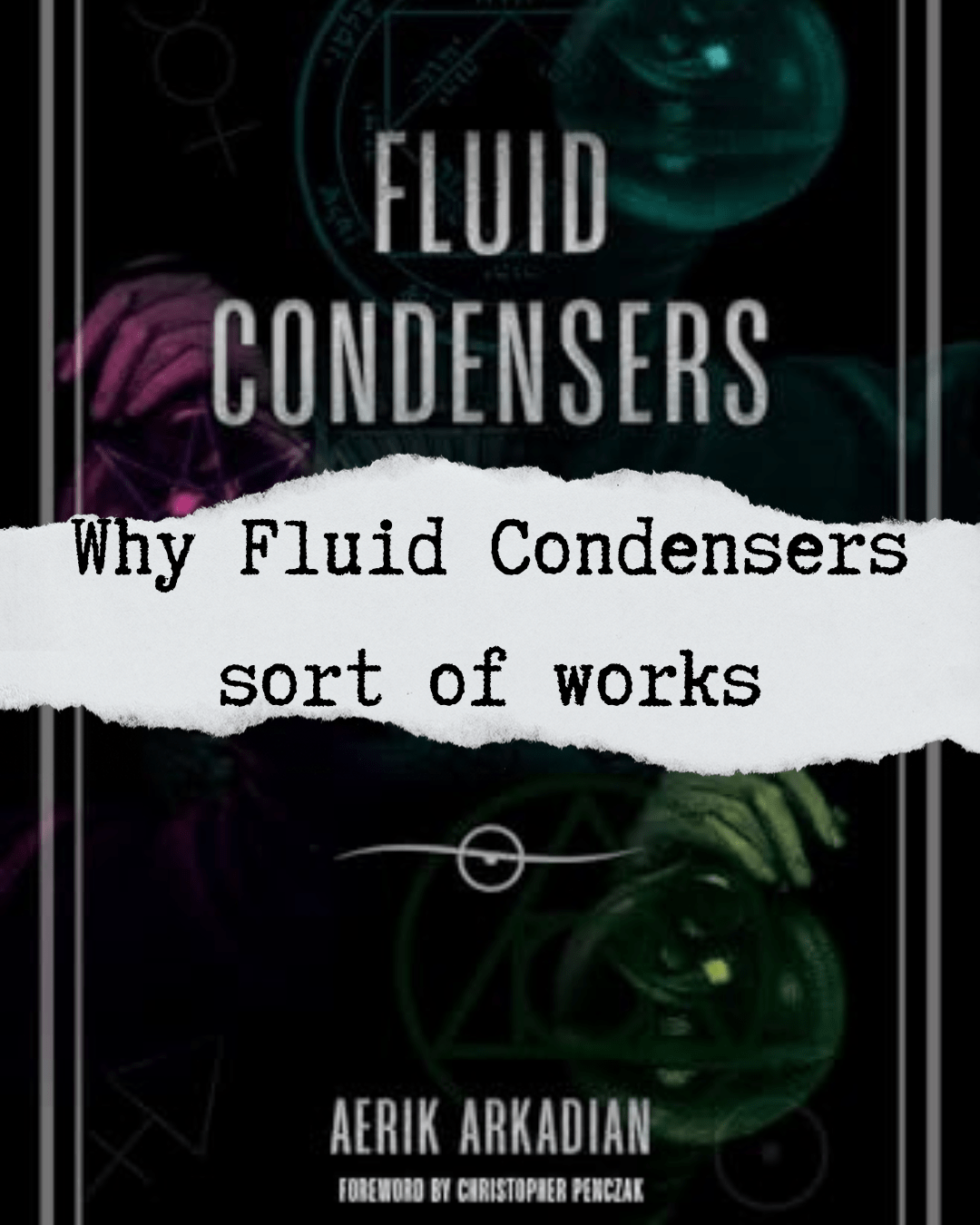
Launching on March 31st, Fluid Condensers is a nonfiction debut work from author Aerik Arkadian. It’s about a form of magic that is perhaps overlooked, but one that practitioners might realize they’re using on a regular basis.
I received an ARC copy from the publisher, Crossed Crow Books. What follows will be an honest review of what I liked about this book and what I didn’t. If you’re a witch like me, maybe you’ll want to check it out. If you’re a writer like me, you might learn something about writing a nonfiction book that people can’t put down.
(As an aside for my witchy followers, the forward for this book is from Christopher Penczak. He wrote one of my favorite witchcraft books, called City Magick. If you’re a witch like me who prefers city lights to a cabin in the woods, that book’s a must-read.)
The information is clear and understandable
Let’s start with the basics. The first reason to read a nonfiction book is usually to learn something. So the main goal for a nonfiction writer is to teach. To instruct. And in that sense, Fluid Condensers did a great job. It was incredibly informative about the topic at hand.
The topic, by the way, is the process of collecting and storing energy in a concoction that includes gold in some form. It’s alchemy, for those who don’t know.
Now, I am not an alchemist. So, this was a branch of magic I knew little to nothing about. But the information in this book was easy to understand. It was easy to follow, even from a novice’s perspective.
I learned things that I didn’t know, as a practicing witch of many years
And on this topic, I am, in fact, a novice. Even though I’ve been a practicing witch for years now, there are so many things I don’t know. Especially about the more alchemical aspects of magic making.
And this, in and of itself, is great. As I get older, it’s more and more rare to find something I know nothing about, literally.
This is something that, if you want to write a nonfiction book, you should strive for. Which I know can be difficult. There’s nothing new under the sun. But finding a niche topic that you’re knowledgeable about is a great thing. Not just for you, but for your readers as well.
We all want to learn something new.
This might not be the sort of book for you
All that being said, I didn’t love this book.
That’s largely on me. Witchcraft is a large tent, with so many different people interested in so many different branches and disciplines. And we all have our own fascinations.
I’m not, as I mentioned, an alchemist. I’m more of a ‘talks to trees, has tea with her ancestors, draws sigils on everything, lights too many candles, and makes friends with the Hat Man’ sort of witch. This is not that sort of witchcraft. It’s the sort that might be seen as more chemistry than charms. And that is some people’s catnip. Just not mine. So if you’re considering reading this book, keep that in mind.
This is also a good thing to remember for writers. Some people, even with the best of intentions, are not going to like your book. And it’s not necessarily because of anything you’ve done wrong. I could write the most fascinating book about the history of zombie fiction in Western PA, and if you aren’t interested in zombies, you aren’t going to give a shit about my book. Don’t take it personally.
It was rather dull
That being said, this wasn’t the most riveting book I’ve ever read. It was actually rather dull.
This, unfortunately, is on the part of the writer. This was not a provocatively written book. There was nothing in the word usage or topic that really caught my attention. It wasn’t overly engaging.
The writing was charming, don’t get me wrong. But, um, not at first. The writing at first was actually quite dry and dull.
And that’s a shame! Because as you get further into the book, Arkadian’s charm shines through. He is clearly a huge nerd. He is fascinated by the process of alchemy. He goes to music festivals and feels inspired to make alchemical concoctions that grab the amazing feelings that sort of events inspire.
Where was that inspired writing in the first few chapters? Why did this intro need to be so static, so devoid of personality?
Look, lots of people find alchemy boring. As far as magic is concerned, it’s rather a dull topic. What sells a nonfiction book about a less-than-riveting topic is the personality of the person who feels passionate about it. So a writer needs to sell us that personality right out of the gate. On the very first page, I need to know why this writer is so passionate about this specific topic.
The organization was poor, and that led to a rough read
That brings me to the biggest issue I had with this book. The organization was not great.
There are some interesting chapters in this book. I, personally, was fascinated by the history of gold. That was the part of the book that I ate up. It should have been earlier in the book. I would have been more invested.
A nonfiction book is not an obligatory read. We’re not in school anymore; nothing should feel like required reading. And, as people, we are first and foremost interested in people. So starting with the personality of the author is a good way to hook a reader. Then, explaining why the topic at hand is important to the author.
For instance, if I were writing a book about zombies in Western PA, I would start by explaining my love of George Romero. I would explain that he and I share a passion for Pittsburgh, even though neither of us was born here. This ties me emotionally to the subject at hand.
There was no sort of emotional connection in this book. And perhaps it’s just me, but that sort of connection hooks me. It makes everything else come alive.
So, in short, if you’re writing nonfiction, put more of yourself into the book. If by chance the author reads this, please don’t give up. Write more, write personally.
And if you’re interested in alchemy, check out Fluid Condensers. You’ll certainly learn a lot.
mjnnnnnnnnnnnnnnnnnnLaunching on March 31st, Fluid Condensers is a nonfiction debut work from author Aerik Arkadian. It’s about a form of magic that is perhaps overlooked, but one that practitioners might realize they’re using on a regular basis.
I received an ARC copy from the publisher, Crossed Crow Books. What follows will be an honest review of what I liked about this book and what I didn’t. If you’re a witch like me, maybe you’ll want to check it out. If you’re a writer like me, you might learn something about writing a nonfiction book that people can’t put down.
(As an aside for my witchy followers, the forward for this book is from Christopher Penczak. He wrote one of my favorite witchcraft books, called City Magick. If you’re a witch like me who prefers city lights to a cabin in the woods, that book’s a must-read.)
The information is clear and understandable
Let’s start with the basics. The first reason to read a nonfiction book is usually to learn something. So the main goal for a nonfiction writer is to teach. To instruct. And in that sense, Fluid Condensers did a great job. It was incredibly informative about the topic at hand.
The topic, by the way, is the process of collecting and storing energy in a concoction that includes gold in some form. It’s alchemy, for those who don’t know.
Now, I am not an alchemist. So, this was a branch of magic I knew little to nothing about. But the information in this book was easy to understand. It was easy to follow, even from a novice’s perspective.
I learned things that I didn’t know, as a practicing witch of many years
And on this topic, I am, in fact, a novice. Even though I’ve been a practicing witch for years now, there are so many things I don’t know. Especially about the more alchemical aspects of magic making.
And this, in and of itself, is great. As I get older, it’s more and more rare to find something I know nothing about, literally.
This is something that, if you want to write a nonfiction book, you should strive for. Which I know can be difficult. There’s nothing new under the sun. But finding a niche topic that you’re knowledgeable about is a great thing. Not just for you, but for your readers as well.
We all want to learn something new.
This might not be the sort of book for you
All that being said, I didn’t love this book.
That’s largely on me. Witchcraft is a large tent, with so many different people interested in so many different branches and disciplines. And we all have our own fascinations.
I’m not, as I mentioned, an alchemist. I’m more of a ‘talks to trees, has tea with her ancestors, draws sigils on everything, lights too many candles, and makes friends with the Hat Man’ sort of witch. This is not that sort of witchcraft. It’s the sort that might be seen as more chemistry than charms. And that is some people’s catnip. Just not mine. So if you’re considering reading this book, keep that in mind.
This is also a good thing to remember for writers. Some people, even with the best of intentions, are not going to like your book. And it’s not necessarily because of anything you’ve done wrong. I could write the most fascinating book about the history of zombie fiction in Western PA, and if you aren’t interested in zombies, you aren’t going to give a shit about my book. Don’t take it personally.
It was rather dull
That being said, this wasn’t the most riveting book I’ve ever read. It was actually rather dull.
This, unfortunately, is on the part of the writer. This was not a provocatively written book. There was nothing in the word usage or topic that really caught my attention. It wasn’t overly engaging.
The writing was charming, don’t get me wrong. But, um, not at first. The writing at first was actually quite dry and dull.
And that’s a shame! Because as you get further into the book, Arkadian’s charm shines through. He is clearly a huge nerd. He is fascinated by the process of alchemy. He goes to music festivals and feels inspired to make alchemical concoctions that grab the amazing feelings that sort of events inspire.
Where was that inspired writing in the first few chapters? Why did this intro need to be so static, so devoid of personality?
Look, lots of people find alchemy boring. As far as magic is concerned, it’s rather a dull topic. What sells a nonfiction book about a less-than-riveting topic is the personality of the person who feels passionate about it. So a writer needs to sell us that personality right out of the gate. On the very first page, I need to know why this writer is so passionate about this specific topic.
The organization was poor, and that led to a rough read
That brings me to the biggest issue I had with this book. The organization was not great.
There are some interesting chapters in this book. I, personally, was fascinated by the history of gold. That was the part of the book that I ate up. It should have been earlier in the book. I would have been more invested.
A nonfiction book is not an obligatory read. We’re not in school anymore; nothing should feel like required reading. And, as people, we are first and foremost interested in people. So starting with the personality of the author is a good way to hook a reader. Then, explaining why the topic at hand is important to the author.
For instance, if I were writing a book about zombies in Western PA, I would start by explaining my love of George Romero. I would explain that he and I share a passion for Pittsburgh, even though neither of us was born here. This ties me emotionally to the subject at hand.
There was no sort of emotional connection in this book. And perhaps it’s just me, but that sort of connection hooks me. It makes everything else come alive.
So, in short, if you’re writing nonfiction, put more of yourself into the book. If by chance the author reads this, please don’t give up. Write more, write personally.
And if you’re interested in alchemy, check out Fluid Condensers. You’ll certainly learn a lot.
I launched a new website! If you like horror in all forms, check out Weird Wyrlds.



 Paper Beats World
Leave a comment