Bloggers Hold The Future of The Fourth Estate

Yes, I am going to kiss ass a little today. I’m also going to be a little vain. Not very vain, though, because while I am a blogger I’m not blogging about news.

You know what site does blog about the news? Buzzfeed. Recently they did a great series of photos where they asked Trump and Sanders supporters what questions they would ask of each other. I really enjoyed the post, and here’s a link so that you can enjoy it too. But what struck me is this; while Buzzfeed does have a very strong liberal slant, the Trump supporters were not made out to be ignorant or hateful. Some of their signs were misspelled, but so were some of the Sanders supporters signs. It showed the best possible examples, instead of showing highly intelligent Sanders supporters and moronic Trump supporters.

And this was Buzzfeed! Their other big accomplishment this month was blowing up a watermelon with rubber bands. Here’s a link to that, too. While I love Buzzfeed, they sure didn’t start out as someone you’d consider a reputable news source. But they kind of are now, and they’re not the only ones.

Here are just a few of the reasons why I think we, as bloggers, should embrace this.

We aren’t bound by advertisers, for the most part

Actually, a lot of blogs do have ads. And some bloggers do sponsored posts. But we also tell you beforehand, “Hey, I got paid for this.” And most of us aren’t making so much money from an advertiser that we’ll cry a river if they leave us. So if an ad partner doesn’t like something we’ve written, that’s sad and all. But we don’t really mind.

We aren’t getting paid

The vast majority of us, anyway, are making no money from blogging. Many blogs that do make money don’t make enough to be a sole source of income. And even the bloggers that do blog full time are usually also producing products like e-books and educational courses.

Since our blogs aren’t money driven, we’re free to be honest. If I tell you about something in the news, my only motivation is that I want you to know. I might want you to feel a certain way about it, because it’s the way I feel, but mostly I just want you to have the information.

We are able to say, ‘this is my own opinion.’

This is a big one. Outside of editorialists, journalists aren’t supposed to outright say, “This is how I feel about this thing.” They’re supposed to tell you the who, what, where, when, why and how. Bloggers are free to say, “This happened, and I think it’s great.” Or, “This is going on right now, and we need to damn well do something about it.”

By expressing our opinions, we are being totally honest with our readers. If I tell you that I support Bernie Sanders, then you will read what I have to say understanding that I have an honest bias. You’ll weigh my words differently, as you should. Everyone has a bias, after all. Mine, and most other bloggers, are just honest.

People already understand that we’re not professionals, so they’re more willing to look into what we tell them.

And boy do people love to tell bloggers they’re wrong. Read comment sections if you don’t believe me. (Not so much mine, though. All of you have been nothing but sweet and supportive in your comments, and thank you for that.) But if you read a blog post about something, you’re more likely to say, “Prove it.”

My husband and I play a game with this. “Source, or it didn’t happen.” This means that if one of us finds some outlandish story online, we have to find at least two other sources of information that tell the same thing, or we don’t believe it really happened. Or one of us will say, “Did you read that off someone’s blog?”

No deadlines

As much as I might admire the productivity of a journalist, constant deadlines can lead to sloppy work. Not all the time, but sometimes. Bloggers don’t have that restriction. You know I attempt to publish three to four times a week, getting my posts up by six in the morning. But sometimes it doesn’t happen, and they go up late. No great loss, they’re still up there. If I feel like a piece needs more work, I’ll give it that time. This is a luxury we have, not being beholden to anyone. We’ve got all the time we need to get the story right.

 

I Hate Mainstream Media

I have a never ending love of the news. I read several papers, watch it on tv, and pretty much irritate everyone around me with information they don’t care about.

With this being the case, it might surprise you to read that I have a deep seeded hatred for many news organizations. Or maybe it won’t. Maybe you’re a news glutton like me, and you’ve noticed these things too.

Every news organization is biased.

They’re not all Fox, but they all let their bias show. Look, I love MSNBC, and I watch Rachel Maddow every night. But I take even her with a grain of salt. It is just too easy to show the story from whatever point of view makes your point best.

A good story is a good story, no matter who it hurts

I feel as though this one is self explanatory, but I’ll expand upon it a little anyway. Sometimes a story that doesn’t directly impact our lives is still important. For instance, if it will change how we might buy a product, view an organization or vote. An example of this is what companies are for or against gay rights, or what politician did (insert gross scandalous thing here) after demonizing single mothers for being whores. An example of what we don’t need to hear about is the whole Lance Armstrong thing. Yeah, what he did was bad, and yeah he was a hero to a lot of people. But unless you are a cyclist or a member of his family, it didn’t impact you or the way you interact with the world. It’s just gossip. And most news sources don’t care.

Ratings drive content

I don’t blame the journalists who are guilty of either of these things, though. Yes, the first rule of journalism is that it’s supposed to be unbiased. But most American’s don’t want that. We want well dressed people who agree with what we already think. We make our viewing decisions based on that, and journalists who cater to that have jobs.

Keep in mind, I say we because I am guilty of this, too. Yes, I do my best to keep an open mind and inform myself of the actual facts of a situation or election. I try to learn what is actually going on, and I also try to to look into a situation before I get all indignant about it. But I still watch Rachel Maddow every night. The only thing I’ll say is that, in my case at least, it’s mostly for entertainment value.

If I could ask one thing of you, it would be this; consider what you’re learning when you watch the news. How much of it is actual fact, and how much of it is a media bias for or against a certain political party? Learn to strip a story down to just facts, and see how you, personally, feel about a situation before you’re told how to feel. I think if we could all do this, then journalists could start doing what they’re supposed to do; informing us of what’s going on in the world around us.

Deadlines and Productivity

If creative writing lacks something, it’s accountability. If I don’t write short stories, no one cares much. If I miss a contest deadline, I don’t get to enter that contest, but that’s about the end of it. Pretty much, unless you’re under contract, your motivation is all carrot and a really small stick.

That’s not how journalists live their lives. Writing is not their art, their side gig. It’s their damned job. They have an editor who is on a deadline and writers who can’t meet that deadline consistently don’t have jobs anymore. There are days I almost wish I had an angry editor freaking out that my work wasn’t done on time.

But I don’t and likely neither do you.

What we do have is our own determination to get stuff done. I’ve mentioned some of my own productivity tips before, using the Pomodoro method and things like that. But here are some things I did, as a student with way too much to do in addition to my journalism responsibility, that have continued to help me today. I’ve also included some things here that I’ve learned as a creative writer to help me keep myself accountable, just as if I did have a daily publishing responsibility. I’ll also tell you one thing that journalists do that I would not advise.

  • Journalists are organized. They know where their notes are, they know what their schedule looks like and they know what time they’ll be devoting to actual writing. I know there is this great fairy tale thought of journalists dropping everything to run off and cover a fantastic story that’s ‘breaking right now’. It doesn’t happen as often as you’d think. Let’s be honest, most journalists aren’t working for Will McAvoy, rushing off to cover bombings.
  • Journalist are time management superstars. When I was on the paper, I was also a Junior in high school and a page editor. This meant that, in the busiest high school year I not only had to write my own pieces but I also had to edit other people’s pieces and set up the page. I did, at one point, tell someone that if they didn’t get their piece to me by the beginning of the next class, it just wasn’t going in this issue and I didn’t care of they did get a zero. There are about a thousand blog posts about time management on the internet, and most of them tell you to get off of the internet. So, we’ll not dive into that.
  • Journalists know the truth behind done is better than perfect. I’m not saying that you should half ass your writing, but you do need to know when to let it go.
  • Journalists also understand that, despite not being time management superstars, life is going to happen. And sometimes you are going to have to write when you don’t feel like writing.

As I said, though, journalists have someone putting external pressure on them. So how do we, as basically self employed people, get that? Here’s how.

  • Set writing time like you set work hours. It doesn’t matter when it is, it doesn’t matter how much it is. Set hours and honor them like you would honor time you have to be at your day job.
  • You have to hold yourself accountable. This is probably the point of growuping that we all fail at the most, myself way included. I have a really big problem, and here it is. I’ll tell myself I can’t go to my local coffee shop unless I get X done. Then, when X doesn’t get done, I get coffee anyway. Terrible adulting, terrible. Would I let me kids get away with that? Hell no.
  • Make actual deadlines that are realistic. For instance, right now it is unrealistic to assume that I can get more than 7,000 words typed in a day. That takes me about an hour and a half, editing included. That’s realistic for me at the place I am in my life right now, so I can give myself a realistic deadline for finishing Starting Chains.
  • Get other people to hold you accountable. This is one of the things I do on Paper Beats World. I know you all know when my posts are coming out. Maybe you’d all be too polite to say anything if they were late, but I know you’d know. This is one reason why it’s great to be a part of a writing group, too, by the way. Other writing friends keep you accountable.

Now, the one big thing journalists do that creative writers shouldn’t. Even if it slows down our process and kills our productivity. Journalists don’t sweat word craft. They think about it a little, and opinion writers do more than that, but a beat journalist will concern herself only with the facts, in as concise of a way as possible.

We shouldn’t do that!

Yes, the story matters more. Yes, most of us are genre writers and not literary writers. But there is a magic to word craft. Even creative non fiction is artistic in this way. Great word craft is the difference between a good story and a great reading experience.

Productivity can take a backseat to that.

Some really bad poetry

Please, be gentle. But it’s national poetry month, so I thought I’d share some of my own poetry this month in place of prose.

Don’t forget, I’m still taking your poetry submissions all month long.

I wake and you’re not there

triolet

I wake and you’re not there

And now the year is turning

The quiet is a weight to bear

I wake and you’re not there

Holidays come, but I can’t care

Though I reach for you, my heart burning

I wake and you’re not there

and now the year is turning

My town

Tanka

my roots run deep here

In this backwards little town

though few of my blood

are still left to call it home

my family still, is here

Responsibilities

triolet

My list of responsibilities

Grows longer by the hour

Makes it hard for me to nap with ease

My list of responsibilities

multiplying like leaves on trees

pulling out my energy, and my power

My list of responsibilities

Grows longer by the hour

What I Learned from My Second Journalism Class

I have an instant distrust of anyone who calls their time in high school their ‘glory days’. My time in high school was when I was the dumbest, hated myself the most and took care of myself the least. I don’t consider any of that glorious.

But there was one moment in high school that I was particularly proud of.

I was onto my second journalism teacher. Because I loved, respected and learned so very much from him, I’ll call him Captain. Also because Dead Poet’s Society is a fantastic freaking movie.

Now, let me give you a little back ground. I was in school during the clusterfuck that was No Child Left Behind. Every teacher reading this just broke something. Surprise, students didn’t like it either. Mostly it meant boring assemblies and crappy busywork. It meant a focus on just one path, college, excluding things like technical schools and just hopping right into the work force as ‘lesser options’. It meant that talented students who worked hard, like me, were held back so that other students could keep up. It meant money taken from things like art and music to go into ‘college preparation’.

I didn’t like it.

But then, I realized something. I could say something about it, and I could do it in print!

I decided that my own complaining, IE an editorial, wasn’t going to make my point. So I opted for writing a feature piece. I wanted to find out what people thought of the programs. The response was overwhelming. The piece ended up being quote after quote from students, talking about how much they thought this was a waste of time. I tried, oh so very hard, to find someone who liked it so that I could show the ‘other side’. You know, be ‘fair and balance’. I found no one who had anything good to say about it.

Captain had to run my story by the principal, who was less than thrilled. So much so that he threatened to fire Captain if he didn’t print my story with a note saying that it ‘was not balanced’. One of the other reporters had to write a story praising the program the issue after. She was not thrilled, and had just one student comment. I’ll never forget it, it was, “I’m sure it must help someone.”

The story got out, and students I’d quoted rallied to my defense. Even better, teachers found me, and quietly told me I’d done a good job. It was the first time I’d gotten such a great response from something I’d written.

Nothing was changed, we still wasted money and time on a system that didn’t work. In the end, students and teachers are powerless when it comes to what some politicians who went to private schools think is best for public schools. I lost this fight, and I kind of feel like my whole generation did.

If there is a lesson, and I’m not sure there is one, it’s that sometimes you can win and lose at the same time. I was right, and everyone knew I was right, but it didn’t matter. At the same time, no one got in trouble so I guess you can call it a wash.

And yet I am proud. Why? Because it was the first time I remember feeling like something was bullshit, and saying something about it. And when I didn’t win, I kept calling bullshit anyway. And if I want you to take anything away from this month devoted to journalism, it’s this.

Keep pointing out the wrongs in this world. Even in fiction, even if no one listens, even if you’re the only one. Call bullshit when it needs called.

Poetry Month, Week One

Here is the first installment of Paper Beats World Poetry Month. An awesome poem, (way better than the stuff I’m going to bore you all with on Wednesday) by Lyndal Outram


 BLOOD LIT MOON

Beautiful Autumn night
The moon hangs
Dangling above the midnight ocean.
Suspended by a few golden stars,
All aglow, a shade of unearthly red,
And singing itself to sleep.

By Lyndal Outram
B

Be sure to check Lyndal out on her blog, Deliawrites.wordpress.com

If you’d like to see your poem here, send it to NicoleCLuttrell86@Gmail.com. I’ll be taking submissions until April 30. For full details, check out the submission info here.

Using Journalistic Structure to Outline Your Novel

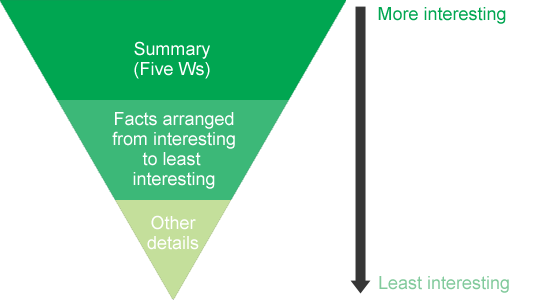
When you write for a newspaper, your stories have to fall under a specific structure. You take all of the information that you need to add into a story, and you list it from most important to least. It’s referred to as the inverted pyramid. Here’s an example.

30-03_inverted_pyramid_for_about_page

We do this for obvious reasons; the editor might have to trim the end of your story to save room, and the reader is likely only going to read the first paragraph anyway. So, that first paragraph, usually only one sentence, includes all of the important details. It must answer the who, what, where, when, why and maybe the how of the story. Example;

A crayfish faked it’s own death yesterday in my living room to avoid the unwanted affection of a 12 year old girl.

That’s the whole story. Is there more to tell? Yes, of course. But if you know that, you’ve got the basics. The rest of the story, how I came downstairs to find the dumb thing lying on it’s back, and how my kid poked it with a pencil and it jumped back to life like the little faker that it is, can all go below, in order of importance.

Obviously that’s not how we write creatively. That’s cut, dry, space saving, and would make for a terrible novel.

But it makes for a pretty great outline when you’re brainstorming!

Especially if you’re like me. I tend to have a lot of rough details when I’m in planning mode for a novel. This character is going to go do this, and this one will have that happen to them, an this whole list of people are going to die. All of that is important, but I need to get some other stuff in order first.

Who

Who is this book going to be about? There’s a whole cast, but I need to know who’s story we’re telling.

What

What’s happening? I mean the main, overlaying plot. Are there side plots? There are always side plots! But I need the basic, what is happening in this story.

Where

This one shouldn’t take a lot of explaining. What is our setting? Where is this story taking place?

When

The time, duh. Is your story set in the past, the future, the present? In some cases this is going to be dictated by your genre, but not necessarily.

Why

In journalism the why isn’t quite as important. In creative writing, of course, the why is essential. Why is any of this happening? What’s the point? Is it all just a series of random events that don’t have any meaning at all?

Once you have all that down, you can list all of your other details below in order of importance.

So, how about some homework. Take your favorite novel, and write down the five W’s.

A WordPress.com Website.

Up ↑