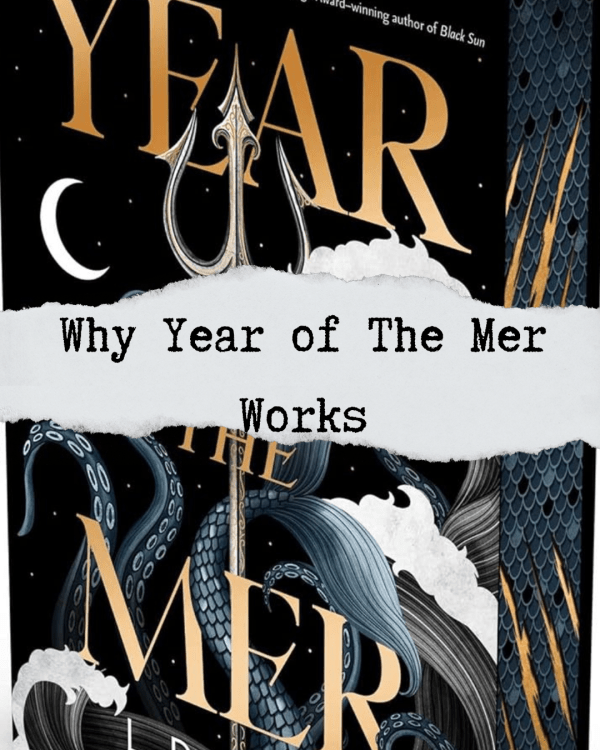
Why Year of The Mer works

I received an ARC copy of Year of The Mer by L.D Lewis. And when I read the description, I was hooked almost at once. A dark retelling of The Little Mermaid that is bloody and saphic? Yes, please. The Little Mermaid was my favorite Disney movie growing up. And, you know, bloody horror is kind of my jam.

Now that I’ve read it, I can honestly say that it surpassed even my high expectations. I feel confident comparing it to the work of Tamora Pierce. If you’ve been around here for any length of time, you know the sort of compliment that is. And yes, we need to talk about why it works.

What happens after happily ever after?

We all love a good fairy tale. But often we’re left with so many questions. Because, of course, life doesn’t end at happily ever after.

In the Disney version of Ariel, she and Prince Eric get their happily ever after. However, their lives go on after that. And I don’t know how much you know about royal marriages, but they’re not just for love. A marriage in which someone is going to inherit a throne, and in which someone else is going to abdicate their throne, has impacts for other people besides the two exchanging vows.

Especially when one of those two people is a totally different species and is considered a deity by half the population. It’s gonna make shit weird.

The fallout from this situation is where our main character, Yemaya Blackgate, finds herself. She’s the granddaughter of Ariel (Spelled Arielle in the book) and Eric, though I don’t think he’s ever mentioned by name.

Yemi’s parents spent their lives leading their country, Ixia, in war. Many of her people blame these wars on Yemi’s mother’s mer ancestry. And she has no relationship with her mer family at all. Given all that, she’s filled with rage.

The royal people actually love each other

It’s easy to see why royalty often has a reputation for not loving their family members. However, I feel like the whole Knives Out approach to family is a bit played out. (Maybe I read too much Phillipa Gregory.) So it’s wonderful in this book to see royal family members who actually love each other. Yemi misses her father; she’s scared of losing her mother. Yemi and Nova, who are engaged, love each other. There is none of the ‘I am raising you to be royalty, so I’m not going to show you any affection’ sort of bullshit. Just people who genuinely love each other, warts and all.

The story wasn’t about being gay

Our two main characters, Yemi and Nova, are gay. They are in a gay relationship. That’s not what this story is about.

Almost all of the characters are also Black. That’s also not what this story is about.

Now, a story about being gay in this very straight world is a great thing. So is a story about being Black in societies that are very, very white. But people who are gay and Black have stories that are not about being those things.

I can’t speak for the Black community, as I am very, very white. But I am part of the LGBTQ+ community. And yeah, it’s sort of exhausting that every gay character’s story tends to be about them being gay.

This was honestly a breath of fresh air. The characters simply are gay. It’s not a crucial plot point. They can just be. Just exist.

Yemi

Finally, I am thrilled with the main character, Yemi. She feels dangerous.

Yemi loves the people she loves fiercely. She wants to be a good person. She wants to take care of her people.

But she also wants to lead. Not because she thinks she is the best person for the role, but because she feels the throne is hers. That this is something that has been taken from her when a coup takes place.

This is a dangerous sort of person. Someone who believes they’re owed obedience, power, and respect. All of this means that Yemi is the protagonist, but not necessarily the good guy.

Which, of course, made her an incredibly fun character to read.

Overall, there was only one thing I didn’t like about reading Year of The Mer. It ended on a hell of a cliffhanger. And, since I read the book before it even came out, I have no idea when book two will be released!

Year of The Mer launches on April 7th. I highly suggest you preorder it right now. Then you can join me in waiting (in)patiently for the sequel.

Why House of Quiet Works

Released in September of this year, House of Quiet is the latest novel by Kiersten White. This is the same author who brought us Mister Magic, Lucy Undying, The Dark Decent of Elizabeth Frankenstein, and Hide. Which is to say, the author of some of the best books I’ve read in the past few years.

House of Quiet is about a young woman named Birdie. She’s spent the last several years trying to find her little sister Magpie, who vanished after undergoing the mysterious Procedure. Birdie poses as a maid to get into the mysterious house of quiet. But what she finds there is a group of children who need to be rescued.

Today, we’re going to break it down and see why it works. Because there’s a lot that can be learned from this wonderfully dark, sweet tale.

Just jump in

The story starts in the middle of things. It starts with a mysterious woman wandering around the House of Quiet with a candle, bemoaning how loud it was.

We then jump to Birdie, heading to the house of quiet, thinking of all of the shady things she had to do to get there.

As we follow along, we only get an idea of the world she lives in and what she’s doing. We know that she’s grown up in crippling poverty. We know that she’s never speaking to her parents again. And that’s about it.

But that’s okay, because we’re going up to the house. We’re meeting the other new maids. We’re being drugged with tea. There is stuff going on, and there will be time to explain later. The important thing is that we’re not slowing down the start of our story. We are jumping right in.

Don’t over-explain

I spent a lot of this book trying to figure out what in the hell was going on. I wanted to know what happened to Magpie. I wanted to know what the procedure was. I wanted to know what had happened to Birdie’s friends. I wanted to know why Minnow was acting so strange.

And never once was any of this simply out and out explained.

No, the story was moving too fast for that sort of thing.

This was infuriating, but in a good way. Because everything is answered, eventually. It’s just that we have to piece things together as we go. Or, we find out as the characters do.

House of Quiet brought the ‘show don’t tell’ rule almost to its breaking point, but not quite. At no point did I feel so lost I thought I’d never catch up. But it wasn’t until near the end that I really felt like I knew what was happening.

This is a hard line to walk, giving just enough information for the reader to barely understand. But, I think the easiest way to do this is to have faith in your reader. Don’t feel like you’ve got to spell everything out for them. Leave some spaces for them to fill in the blanks themselves.

Anything can be used to world build

One of the most charming things about House of Quiet was the naming structure of the characters. People raised in poverty have animal names like Minnow, Magpie, and Birdie. People from the upper class have names like River or Forest.

This is a super quick and efficient way to give us information about a character with the fewest words possible. We know the character’s name, and we know what class the character is from. And in a book that is all about class warfare, that’s vital information.

This is a great example of using every element you can to world-build. Names, clothes, jewelry. Think about how all of these things impact our real world. And yes, you should be using any of these to show your world, rather than telling us about it.

Now, all this being said, this book wasn’t perfect. My biggest complaint, I think, is the relationship between the characters. They were, in my opinion, a little too sweet. They came together too quickly. They were too kind to each other. But, of course, this is a book for young adults. So maybe that’s why.

This was not enough to ruin the story for me. House of Quiet was a fun, heartwarming tale, and I enjoyed it greatly. If you haven’t read it yet, do it today.

Paper Beats World is a labor of love. If you love what I do here, please consider liking and sharing this post and leaving a comment. You can also support me financially on Ko-fi.

And while you’re there, you can pick up a copy of my Novel Planner.

Writing a novel is a journey! Here is your roadmap.
The Novel Planner takes you through four weeks of planning to help you successfully write a novel. Includes twelve pages to plan your time, your team and your life.
Also included are some useful pages to keep track of your wip, like a map page and an injury tracking chart.

How to start writing dark fantasy

Dark fantasy is certainly having a moment. Shows like Witcher and Wheel of Time, both of which I talked about on Haunted MTL, have gotten more fantasy fans interested in the creepier, more sinister side of the genre. And I love it. Not that I don’t enjoy the lighter side of fantasy. I wrote a whole series that could hardly be considered dark. Honestly, that’s just because I haven’t gotten to it yet. 

Yes, fantasy that is all about magic and adventure and dragon friends is awesome! But there is so much more that we can do with the genre if we’re willing to explore the shadowy side. 

Just in case you’re not sure what I mean by dark fantasy, another great example is the Spiderwick Chronicles. In here we see much of what I’d consider dark fantasy. We see the fai acting with malicious intent. We see dark magic slipping a young woman into a coma. We see characters who are menaced, rather than enchanted, by the fantasy world. There’s a lot more monster-slaying than finding fairy rings, is what I’m saying.

If you want to write some dark fantasy, here are some suggestions.

Details and world-building

A cornerstone of good fantasy is good world-building. And a dark fantasy is no different. But of course, the details of a dark fantasy world are going to be a bit different. We’ll see more danger, of course. More places our characters fear to tread. More people you don’t want to come across. Think of Miss Peregrine’s School for Peculiar Children. Yes, at the start the children are in a magical place frozen in time. But soon enough they find themselves mucking through dark allies, filled with monsters and men who want nothing more than to crush their heads against the pavement.

Don’t shy away from the gore

Speaking of pavement head crushing, any good horror story is going to have some moments of gore. That’s just a hallmark of the genre. 

I don’t love stories that rely on it. If there’s not an underlying terror, then all the blood and broken bones in the world aren’t going to do more than turn my stomach. But I do expect to see a little bloodshed. 

The best horror is based on reality

Horror that revolves around otherworldly creatures is great. I love a haunted house story, and I love a sentient demonic house even more. But the best horror story is the one that has a basis in real life.

Carrie was about more than a killer prom queen. It was about a young woman bullied at school and suffering abuse at home. Amityville Horror is about a house set on killing its inhabitants. It’s also about a family with money worries. These are things we can relate to, which makes the horror that much more satisfying. 

This can be a little trickier with dark fantasy, which is by definition not based on reality. But remember that characters are people. And people are generally scared by the same things. As Stephen King put it, we’re scared of the Bad Death. That’s pretty well universal, even if you are an elf. 

Anything that can befriend you can also kill you

I’d like to take this moment to point out something in fantasy that has always bothered me. Fairies are often seen as whimsical little friends, who might play a little prank on us from time to time but have our best interests at heart.

If you know anything about fai lore, you know that’s bullshit. They might be befriended, but they’re more likely to steal you away, take your babies, poison you, or otherwise mess up your day. 

The same can be said for mermaids. 

Any creature has a dark side. Any creature can be seen as either benevolent or malevolent. Think of fantasy creatures as dogs. Most of the time they’re our great little companions who sleep at our feet and keep us company while we type blog posts. But under the right circumstances, they’ll take a hand. 

If the good creatures exist, so do the dangerous ones

Finally, there is this. Fantasy creatures we like tend to get a lot of attention. But if they exist in your fantasy world, so do their darker counterparts. So do the banshees, the evil magic users, the werewolves, wendigos and vampires. Light casts a shadow, and you don’t get one without the other. So when creating your fantasy world, remember to write in the shadows as well. 

Fantasy and horror complement each other in many ways. A touch of one can make the other stronger, and often is unavoidable. How much you decide to let the darkness in is, of course, depended on how gruesome you want your fantasy story to be. 

What is your favorite dark fantasy? Let us know in the comments. 

If you would like to support Paper Beats World, you can do so on Ko-fi. 

A WordPress.com Website.

Up ↑