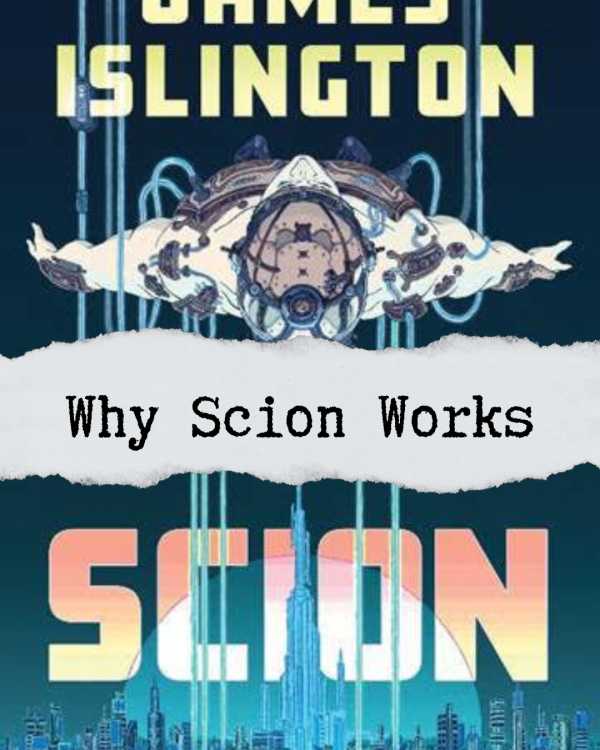
Why Scion Works

Is this post actually going to be on time? Oh my heavens, I don’t know who I am anymore!

Launching on September first, Scion is the latest novel by James Islington. He’s probably best known for his Hierarchy series, and this is his first science fiction book. I received an ARC from Saga Press. And it was a fantastic read.

Our main character is an assassin named Azure. He lives in a dystopian future where people have discovered how to live forever. Of course, that comes at a premium cost. So, rather than outlawing the practice, the people vote to make it legal to assassinate ‘Lifers’.

The allure of crowdfunding the legal assassination of a wealthy asshole is almost enough to make this book not so dystopian after all.

Azure is one such legal assassin. He’s one of the best at what he does, thanks in part to his extensive body modifications. So he’s surprised when he’s assigned instead to protect someone from assassination. He soon learns the reason he was selected for this task. And it’s life-altering.

So let’s break down Scion today, and see why it works.

The first scene is a masterclass

A scene should accomplish something. Maybe it’s to move the story along, give important information, or show us something about a character. The best scenes do multiple things at once. And the first scene in Scion is a perfect example.

We start right in with Azure penetrating the defenses of a target’s magnificent home. He’s face to face with a bioengineered monster and fighting for his life.

This is a great way to get the reader’s attention. It also introduces the reader to some of the advanced tech in this world. On top of that, it introduces us to Azure, his remarkable abilities, and his delightfully sarcastic personality.

Well done, all around.

The world is vast

We only see so much of Azure’s world. In fact, it feels like we’re just looking through a keyhole into a limitless universe. You just can’t see everything there is to see.

There is so much wild technology. So much culture, music, food, drugs, and people! And we just don’t get a lot of details about any of it.

The detail we do get is astounding. It alludes to a deeper, more complex world.

I love when authors do this. It’s something I’m trying to learn. You don’t have to give all the details when you’re worldbuilding. I mean, you can if you want to. Some writers really love that sort of thing. But if you give just enough detail, the reader’s imagination will usually fill in the rest.

The main character was likable.

I liked Azure. He was bitingly sarcastic, professional, and weirdly respectful.

All of this was strange for an assassin. But then, assassinations are legal. So maybe that helps.

I love that he’s kind and respectful, even when murdering someone. I love how well he stands up for his boundaries. He clearly cares about the people in his life, even if distantly. And he always wants to do the right thing.

Even if he’s murdering people.

I think it’s important for a character to have a set of moral standards they adhere to. Even if they aren’t exactly ones we agree to. And Azure has those moral standards. They make sense for the world he lives in and his place in it.

Well done.

The ending!

Finally, I want to talk about the ending, without giving it away. Because it’s interesting.

At the end of the story, Azure is faced with a choice. I think that readers might disagree as to which choice he should make.

I know which choice I would make. But, well, it isn’t as simple as that, is it?

It’s an ending that leaves the reader with questions. But good ones. It also leaves this world open. If Islington chose to write more in this world, I think he easily could. I also think he should. I’d certainly read it.

Overall, Scion was a fast-paced story that invites readers to play along and fill in the blanks themselves. It’s witty and fun. I’d certainly recommend checking it out when it releases on September first.

As though we need another reason to count down the days to September.

Paper Beats World is a labor of love. You can support us by liking this post, sharing it and commenting. You can also support us on Ko-fi.

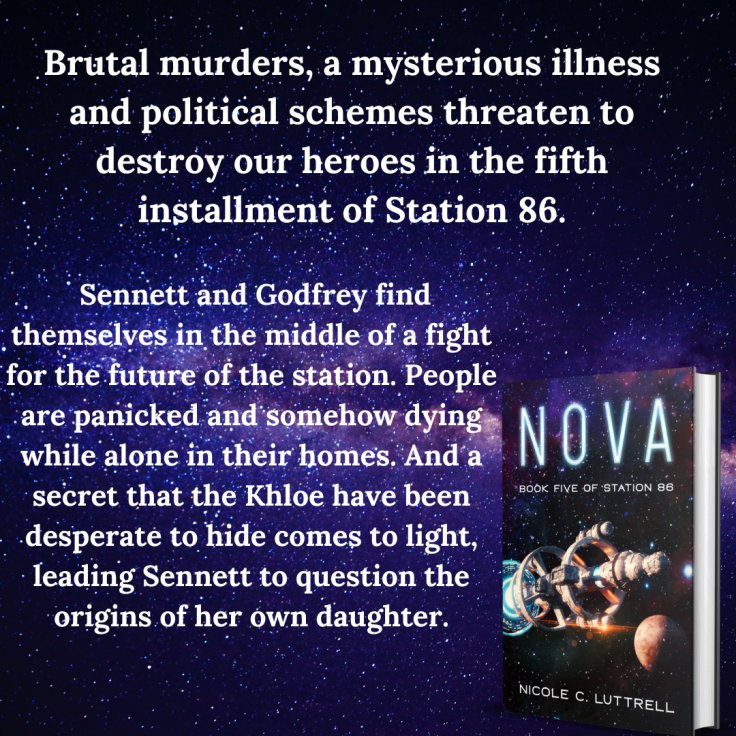
Station 86 Volume 1 is coming! You can get your very own copy on October Second.
Books are books

Books are my favorite thing. I guess that isn’t a huge reveal. I love books. I love reading them, writing them.

Smelling them.

I love having a physical book to read, then display on a shelf like a trophy. Honestly, right now my favorite thing is swinging in my hammock and reading my way through my Summer reading list.

Recently, someone on Instagram said that they love cat people. Because cat people don’t just love their cat to death. They love your cat to death. They love street cats to death. They love all cats to death. That’s how I feel about books, and avid readers. (And cats.) I love everyone who reads. I love all books. But, apparently, this isn’t a universal opinion. I’ve seen far too much infighting among my book peers about things that, honestly, shouldn’t be argued about. So today I want to let you know where I stand in the literary world. I don’t think anything I’m about to say is a hot take. But it’s the internet, after all. Let’s see what happens.

Ebooks are books

My preferred method for reading is a physical book. That being said, I have read e-books and will continue to do so. Sometimes it’s easier. Sometimes the book isn’t available in print yet. Sometimes I don’t want to take several books on vacation. Sometimes the book came out, I forgot to preorder it, and I have to read it right now. Either way is valid. It’s still a book, on screen or on paper. It’s just like preferring mint toothpaste to cinnamon. Your teeth still get clean.

Audiobooks are books

This is another thing I am shocked I have to argue. Listening to an audiobook is still reading a book. I don’t know about you, but I want to read a lot of books. And I have shit to do that requires my hands. So if I can listen to a Grady Hendrix book while doing the dishes, weeding, or formatting a damned paperback, then I’d like to do so.

I’ve seen people putting down audiobook readers online. And it’s got to stop. We don’t all have the time to read as much as we want. Some of us (hi) are reading for work as well as recreation, and we need to get through some pages. And there are people with disabilities for whom physical reading is a challenge. There should be no barriers to enjoying a good story.

Comic books are books

I have always had a rather advanced vocabulary. This started when I read Calvin and Hobbs as a child. This led me to fall in love with comic strips. And I still love them. Snoopy, Cathy, Garfield, Girls With SlingShots, Squid Row. Comics were one of my first passions.

I do not understand why people will look down on comics as being cheap kids’ entertainment. They’re a great introduction to the fact that, hey, reading is supposed to be fun. There are heavy graphic novels, like Maus. There are fantastic adventures, like Bone or Wonderland. These are good stories. They promote literacy and a passion for reading. Also, they’re just fun.

Nonfiction and fiction are books

I read fiction and nonfiction. I do not understand people who read only one or the other. What, you don’t want to learn something? You don’t want to experience a good story? And even if you have a particular preference, why would you enforce that on everyone else?

Honestly, if you find that you read a lot of one or the other, I would encourage you to branch out a bit. My reading list has been really fiction-heavy this year. I need to fit some nonfiction in.

Genre books are books, and so are literary books

This one’s similar to the last two, if we’re being honest.

If you’ve read On Writing, then you know that Stephen King was once asked by a teacher why he wanted to write trash. By trash, she meant a ‘novelized’ version of a movie he’d seen. The answer didn’t come to him then, and he says there’s still a little part of him ashamed of it.

Genre fiction tends to be frowned upon by literary snobs. At the same time, literary fiction tends to be frowned upon by people like me, who believe in telling an entertaining story that damned well goes somewhere.

I kid. Actually, I enjoy writing some literary short pieces, just playing around with words. Evoking emotion, creating art. It’s fun.

But if you don’t think that genre writing can feel like literary writing, you’re not reading the right kind of books.

Books I don’t like are still books

There are lots of people in this world who enjoy some truly terrible books. Just awful. And there’s just no accounting for taste. I have DNF’d books that got glowing five-star reviews. I’ve devoured books that others couldn’t stomach. Honestly, there are whole genres I can’t stand. For instance, I’ll never be a romance girlie. But that doesn’t mean I’m going to talk shit about the romance girlies. Those are still books, and they still give people joy.

So here’s the main point. Books are books. It doesn’t matter how someone is reading. Reading is always worth it. It’s always a good choice.

Live and let read, everyone.

The best books of 2026 so far

It’s July, and the year is half over. The days already grow shorter, the nights (slightly) colder. So it’s a good time to stop, take a beat, and see where we are for 2026.

Because it’s been a hell of a year already, hasn’t it?

2026 has brought with it some surprises. Most of which have been bad, but a few have been good. One thing I didn’t plan for was the influx of new (to me) writers that I would discover. People who were not on my radar or my insta buy list before this year, but are working their way there now.

A lot of my reading this year has been horror. You can read my reviews of many of these books over on Weird Wyrlds. But, for the first time, a book of poetry snuck its way into the top ten.

So let’s get into it. Here are the top ten books I’ve read so far in 2026, rated from 10 to one. As always, I’m not going to go into a ton of detail, because I’ve already reviewed all of these books.

The Fox and The Devil by Kiersten White

This was the sapphic vampire murder mystery love story I didn’t know I needed. But my goodness, reading this book while sipping red wine was one of the highlights of my year.

Rainshadow Orphans by Naomi Ishiguro

This was such a cute book. Okay, it was a cute book about political uprising, dark magic, gruesome murders, and class warfare. But it also had bubble tea, cats, and sun spirits. So, overall a super cute read. Even better, it’s the start of a trilogy. So please join me in waiting for the next one.

The End of the World As We Know It by misc authors

Have you ever read The Stand by Stephen King and thought, man, this book could easily have been 800 pages longer? No, just me? Well, for the first time, King opened up one of his worlds for other authors to play in. This book is a collection of stories in the world of The Stand by some fantastic writers. Go check it out. And avoid the Walking Dude.

Can You Sign My Tentacle by Brandon O’Brien

I heard one of O’Brien’s poems read by the man himself at a Nebula conference. And it was fantastic. I’d never read a whole book of speculative poetry before. But now, I’m hooked.

Year of The Mur by L.D. Lewis

For someone like me who loved The Little Mermaid as a child and now realizes how dumb Ariel was as an adult, this book was fantastic. And, again, it’s the first of two.

The Caretaker by Marcus Kliewer

Imagine being broke. Well, chances are you don’t really have to imagine that. But imagine being offered a house-sitting gig for the weekend for an exorbitant amount of money. But it comes with weird rules.

This book is a textbook example of actual obsessive-compulsive disorder. To say it was unsettling is an understatement.

The October Film Haunt by Michael Wehunt

The past always catches up with us. Part slasher thriller, part paranormal mind fuck, this book had me looking over my damned shoulder.

The Republic of Memory by Mahmud El Sayed

This is a fantastic political story, told from various points of view as a generational ship has to ask whether their living citizens are more important than those in cryostasis. The question is complicated, and so is the book.

I know a place by Nat Cassidy

This was a collection of short stories. And every one was better than the last. One, Laughlines, has stuck with me the most. Ugh, the visuals in that one. It will haunt you in the best way possible.

The Reformatory by Tananarive Due

This is the best book I’ve read all year by far. It’s the kind of book that you read and then have to sit with. I mean, I was bawling.

This is a historical fiction about a twelve-year-old Black boy who’s sent to a reform school after kicking the son of a wealthy landowner. He soon finds out that the school is haunted by boys who never left. The ghosts are fiction. The abuse described in the book is accurate.

Read this one in the Summer heat. It’s a whole experience.

Alright, now it’s your turn. What are the best books you’ve read so far this year? Let us know in the comments.

Paper Beats World is a labor of love. You can support us by liking this post, sharing it and commenting. You can also support us on Ko-fi.

My 2026 Summer reading list

I am really trying so hard to get into Summer this year. I got a pool and a hammock. I made a Summer playlist. I’m making ribs and pasta salad for Litha. I’m really, honestly, super excited to experience the next 73 days.

Yes, I’m counting.

But alright, we’re here. It’s Summer. And since I can’t speed it up, I’m going to do what I do best.

Read. In as many places as possible.

So, of course, I’m starting the season out by sharing my reading list. Some of these are coming out this summer. Some are nostalgic re-reads. Some I just found out about during Nebula Con. All of them should help me enjoy the sunny season.

Dead But Dreaming of Electric Sheep By Paul Tremblay

I know, this one was on my Spring reading list. But that’s because I somehow didn’t realize it launched on June 30, not May 30th. And it still looks awesome! Digging into the morality of bodily autonomy in a dark science fiction novel? Of course, I want to read that.

The Intrigue By Sylvia Moreno-Garcia

I’ll be honest, I didn’t even read the description of this one before I pre-ordered it. That’s because Moreno-Garcia is on my Insta Buy list. And this one is about a Casanova thief who’s apparently going to run into some supernatural trouble. I can’t wait.

Also, I love that her books come out so regularly that they’re basically a Summer staple for me.

Deadly Little Lessons By Danielle Valentine

Another author you’ve probably heard me sing the praises of. I’ve yet to read a book of hers that isn’t fantastic.

This one is about a girl who ends up in a school where most of the students won’t survive the classes. So, fun!

The Reformatory By Tananarive Due

I found out about this book, and the next one on the list, during a Nebula Con panel about horror writing as resistance. I ordered these two books before the panel was even over.

The Reformatory is about a young boy named Robbie who’s put in a correctional facility for doing something that sounds like it needed to be done. Of course, the facility turns out to be terribly haunted.

The Curse of Hester Gardens By Tamika Thompson

The second book purchase, inspired by the panel, The Curse of Hester Gardens, is about a neighborhood haunted by gang violence, drugs, and the unquiet dead. It’s about a mother trying to protect her children, who may have made a terrible decision.

Fright Time Books by various authors

Alright, this one might sound strange. But Fright Time books were a big favorite of mine as a child. I recently did a whole nostalgic review of Shivers over at Weird Wyrlds, and thought it might be fun to do the same for Fright Time.

It’s also just a great reason to revisit some of my horror roots.

Not With A Bang By Temi Oh

This is an arc I’m expecting from Saga Press. It’s a fascinating-sounding book about the end of the world and how people respond to it. I am super excited to get my hands on it and tell you all about it.

SCION By James Islington

Another Saga Press arc, this one is about an assassin who’s never had any qualms about their job, until this most recent one. And, of course, he lives in a world where the rich can literally live forever.

Small detail.

The Children By Melissa Albert

Funny story. This is a late addition to this list, because I literally learned about it while checking Goodreads for book information.

Thanks, Goodreads.

This book is about a woman and her brother who had their childhoods kind of ruined by their mom’s invasive storytelling. Now, there’s something dark and terrible haunting them. The cover doesn’t seem to reflect the horrors that the reviews promise.

I need like five more sets of eyes to read all the books I want to right now. But I also want to hear from you! What are you reading this Summer? Are you loving the Summer weather or counting the days to fall like me? Let me know in the comments.

Paper Beats World is a labor of love. You can support us by liking this post, sharing it and commenting. You can also support us on Ko-fi.

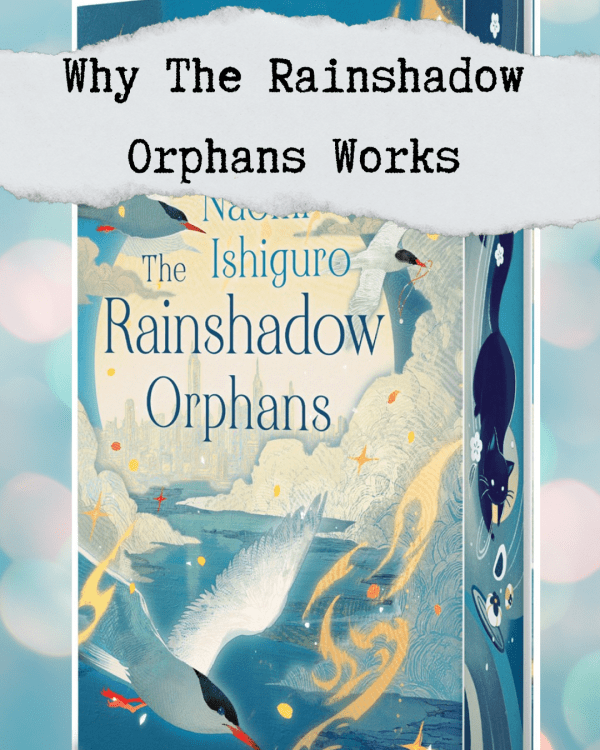
Why The Rainshadow Orphans Works

Written by Naomi Ishiguro and coming out on May 26th, Rainshadow Orphans was sent to me as an arc by the publisher. And honestly, I just speed read two really dark and disturbing horror novels. While they were fantastic, they were heavy! I for sure needed something light and fun. Thankfully, Rainshadow Orphans was there.

(If you want to read my reviews of these very dark books, check out Weird Wyrlds)

The story starts with Toshiko. She and her adopted siblings, Mei and Jun, live in Rainshadow City. Their goal is to seek revenge against the Lucky Crows, the gang that killed their Aunt Reiko. In the meantime, they want to steal enough from the elite of Rainshadow City to live a comfortable life that would otherwise be denied to them. But when Toshiko steals a dragon pearl from the Lucky Crows, she sets the whole city on its head.

This was an incredibly fun book to read that left me feeling lighter and craving bubble tea. So let’s break it down today and talk about why it works.

Excessively fun on purpose

Remember when you read young adult and children’s books, and they were fun? When the writer included characters or elements that were just for the fun of it? Why don’t adult writers do that more?

There are so many elements in Rainshadow Orphans that are just there for fun. Mochi, the family cat coming along on heists. Sun spirits who turn into squirrels to interact with the young prince Haru. And a machine that can make literally any kind of bubble tea you can imagine.

These are all fun elements. They bring levity to what could otherwise be a pretty dark story. I mean, this is a story about a corrupt city so bent on progress that the leaders don’t care about the lives of the people living there. That could be pretty messed up. It could also be the same shit we hear in the news every day. But adding joyful elements helps with the heaviness.

For such a chunky book, it’s a fast read

I mean, not that fast. This post is late, after all. But the pacing of the story goes fast. There’s always something happening. There’s not a lot of downtime. The characters are always off doing something dangerous, even if it’s just getting cake at a cafe.

Early in the book, it’s established that Toshiko and her family don’t really have a right to live in the city. They’re not citizens. So literally anytime they’re out in public, there’s an element of danger. Then, their faces are plastered all over the Lucky Crow’s most wanted list. This made the tension of the book sky high and thrilling. It makes you want to keep right on flipping pages.

All the characters are so endearing

I loved Toshiko from the start. I loved how much she, Mei, and Jun love each other. I especially loved Mei, with her cat, snacks, and full face of makeup, even when she’s not leaving the house.

I also loved Haru. He could have come off as a spoiled kid, but it’s made pretty clear pretty fast that his life is so lonely.

Every character in this book is endearing in their own way. You want to see everyone succeed, everyone be happy. Ishiguro manages this by showing not just each characters quirks, but how they interact with other people. How much they love other people, or seek to be loved by them.

This is something that shows each character’s real, well, character. How much they care about each other. How far they’ll go not just to protect each other, but to bring joy to each other.

Just when you think you know what’s going on

There were several moments early in the book where I was sure I knew the ending. Oh, I know what the robots are. Oh, these characters are going to fall in love. Oh, I know the plan for the city. And most of those times, I was right.

I found that out about two pages afterwards, because those weren’t the big reveals. They were small reveals that led us along a path to an ever more twisting tale. So if you start thinking you’re smarter than the author while reading this, hold up. I can promise you that Ishiguro knew exactly what she was doing. And she did it very well.

Rainshadow Orphans reminds us that even in the darkest times, we can thrive, not just survive. We can have our bubble tea and wintermelon cake, and stand up against all powerful regimes. We can see the magic in the world while fighting the darkness. It reminds us that yes, there are terrible and powerful people. There are fights to fight. But there are also grumpy cats, neighbors who help each other, and snacks. This is a lesson that we all need right now.

And thankfully, there’s more to come. Because Rainshadow Orphans was just book one in a trilogy. Personally, I can’t wait for the next one to come out, so I can travel again to Rainshadow City.

Paper Beats World is a labor of love. You can support us by liking this post, sharing it and commenting. You can also support us on Ko-fi.

Why House of Quiet Works

Released in September of this year, House of Quiet is the latest novel by Kiersten White. This is the same author who brought us Mister Magic, Lucy Undying, The Dark Decent of Elizabeth Frankenstein, and Hide. Which is to say, the author of some of the best books I’ve read in the past few years.

House of Quiet is about a young woman named Birdie. She’s spent the last several years trying to find her little sister Magpie, who vanished after undergoing the mysterious Procedure. Birdie poses as a maid to get into the mysterious house of quiet. But what she finds there is a group of children who need to be rescued.

Today, we’re going to break it down and see why it works. Because there’s a lot that can be learned from this wonderfully dark, sweet tale.

Just jump in

The story starts in the middle of things. It starts with a mysterious woman wandering around the House of Quiet with a candle, bemoaning how loud it was.

We then jump to Birdie, heading to the house of quiet, thinking of all of the shady things she had to do to get there.

As we follow along, we only get an idea of the world she lives in and what she’s doing. We know that she’s grown up in crippling poverty. We know that she’s never speaking to her parents again. And that’s about it.

But that’s okay, because we’re going up to the house. We’re meeting the other new maids. We’re being drugged with tea. There is stuff going on, and there will be time to explain later. The important thing is that we’re not slowing down the start of our story. We are jumping right in.

Don’t over-explain

I spent a lot of this book trying to figure out what in the hell was going on. I wanted to know what happened to Magpie. I wanted to know what the procedure was. I wanted to know what had happened to Birdie’s friends. I wanted to know why Minnow was acting so strange.

And never once was any of this simply out and out explained.

No, the story was moving too fast for that sort of thing.

This was infuriating, but in a good way. Because everything is answered, eventually. It’s just that we have to piece things together as we go. Or, we find out as the characters do.

House of Quiet brought the ‘show don’t tell’ rule almost to its breaking point, but not quite. At no point did I feel so lost I thought I’d never catch up. But it wasn’t until near the end that I really felt like I knew what was happening.

This is a hard line to walk, giving just enough information for the reader to barely understand. But, I think the easiest way to do this is to have faith in your reader. Don’t feel like you’ve got to spell everything out for them. Leave some spaces for them to fill in the blanks themselves.

Anything can be used to world build

One of the most charming things about House of Quiet was the naming structure of the characters. People raised in poverty have animal names like Minnow, Magpie, and Birdie. People from the upper class have names like River or Forest.

This is a super quick and efficient way to give us information about a character with the fewest words possible. We know the character’s name, and we know what class the character is from. And in a book that is all about class warfare, that’s vital information.

This is a great example of using every element you can to world-build. Names, clothes, jewelry. Think about how all of these things impact our real world. And yes, you should be using any of these to show your world, rather than telling us about it.

Now, all this being said, this book wasn’t perfect. My biggest complaint, I think, is the relationship between the characters. They were, in my opinion, a little too sweet. They came together too quickly. They were too kind to each other. But, of course, this is a book for young adults. So maybe that’s why.

This was not enough to ruin the story for me. House of Quiet was a fun, heartwarming tale, and I enjoyed it greatly. If you haven’t read it yet, do it today.

Paper Beats World is a labor of love. If you love what I do here, please consider liking and sharing this post and leaving a comment. You can also support me financially on Ko-fi.

And while you’re there, you can pick up a copy of my Novel Planner.

Writing a novel is a journey! Here is your roadmap.
The Novel Planner takes you through four weeks of planning to help you successfully write a novel. Includes twelve pages to plan your time, your team and your life.
Also included are some useful pages to keep track of your wip, like a map page and an injury tracking chart.

Banned Books Week 2025

Did you know that Stephen King was recently acknowledged as the most-banned author in America? Way to go!

It’s Banned Books Week once again. And every year this week feels more and more important. Because every year it feels like America takes another goosestep towards fascism.

But we are still here, damn it! We can still protest. We can still fight in our own ways. And we can do our part this Banned Books Week to help fight off censorship.

Here is a list of things I’ll be doing, both this week and going forward.

(As always, Banned Books Week is an event hosted by the American Library Association.)

Share banned books

I’ll be sharing some of my favorite banned books on social media, using the hashtags #BannedBooksWeek and #Censorshipisso1984. Get the word out far and wide.

Read banned books

This one might be obvious. But what the hell, I’ll put it on here in case. The best way to support banned books is to read banned books.

This year, I’ll be reading Chains by Laurie Halse Anderson. I’m reading this because it’s the book suggested for the Right To Read events being held all over America this week. If you’re close to one, you should consider attending.

Start a little free library

This might be a project. I’m certainly not expecting to get this one done in a week. But now that we’ve moved and I have a yard again, I’m going to put in a little free library. And I’m going to stock it with banned books. I already have some ordered.

The top ten banned books every year are going right in that box.

Support the ALA

The American Library Association needs our help. They need support, financially and politically. Here’s a link if you want to check them out and see all the work they do all year, not just during Banned Books Week.

Show up for libraries

If you can, show up at town halls and community nights where your local library is being discussed. Make it clear that you oppose censorship. Make it clear to your local politicians, too.

Elections are a month away

Speaking of your local representatives, make sure you’re registered to vote. I know I say this a lot. I also know that there’s someone reading this right now who’s been meaning to register and keeps forgetting.

Get it done.

Go vote. Make a plan now. Know your local politicians and know who’s supporting freedom. And who’s not.

So now it’s your turn. What are you reading for Banned Books Week? Do you have a little library or know of one in your neighborhood? Let us know in the comments.

My local bookstore closed

For my entire life, there’s been a bookstore on my local Main Street. It was called Book Nook. And, being who I am and doing what I do, I loved that place.

It had old-fashioned wood-paneled walls. Shelves that smelled more like an old library than a shop. As a child, my favorite part of the store was the spinning rack of bookmarks.

Did anyone else have this weird bookmark obsession as a child? Fancy bookmarks were everything I wanted in this world. These days I just use any nearby scrap of paper. That’s a little sad.

Man, that place never changed. I used to beg my mom to take me there anytime we were on Main Street. At the time, Main Street was a place we were a lot. She worked at several different restaurants over the years. We lived in three different apartments tucked above stores. There was a little five and dime where I marveled at the fancy pens that looked like crystal. We ate at Burger Hut and the Hot Dog Shoppe. We used to have Woolworths until it burned down when I was a child, but I remember sitting at the counter and having milkshakes.

I remember the fire, too. The way the smoke coughed upwards in the sky and terrified me. I worried that it would come for us as well. I think I’m still a little afraid of that.

The five and dime is gone. The Woolworths is gone. Any number of other little shops are gone. The Unicorn Gift Shop, several antique stores whose names I’ve forgotten, a frozen yogurt place. There used to be a classy little bar where I watched presidential debates during the first Obama campaign, drinking Long Island ice teas with the campaign director in my town. Now it’s the classy little wine bar where I go to enjoy a glass of chocolate-flavored wine and read. Life moves on, tearing itself down, burning itself out, building new days and lives and stores upon the memories and ashes.

But not Book Nook. Man, that place never changes.

As a kid, I went there to buy Goosebumps and Babysitters Club books, series I loved equally. As a young woman, I waited outside the door for them to open the day the last Harry Potter book came out. The storekeeper there that morning was both confused and, I think, annoyed to have some overly excited woman in her early twenties waiting at her door. Apparently, this was a new experience for her.

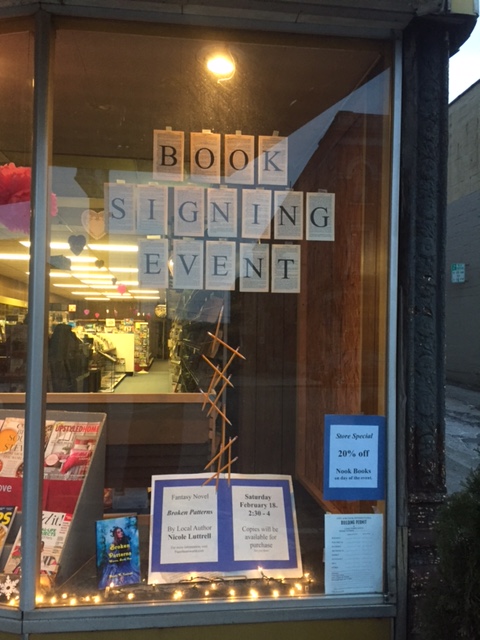
I had my first book signing there when Broken Patterns came out. A copy of the book sat in the front window for months. They even hung up a poster from Starting Chains.

For months. To the point that it faded.

That place never changed.

That was a great experience. A young mom came in, clearly with just barely enough money to get her daughter a book. I gave her a copy of mine and she was thrilled.

I hope she’s doing alright.

I’d pop in from time to time. Sometimes I’d find great things. The author’s extended version of The Stand and American Gods. I impulsively bought some hardcover books that I still love to this day. Strange The Dreamer and An Absolutely Remarkable Thing.

But I didn’t get the sequel to either book there. They never seemed to get them in.

As other stores came and went, Book Nook stayed. Its new releases dwindled. Its stationary options did too, until they went away entirely. So did the bookmarks.

There were no cute impulse buys at the counter. The same counter with the same register that had always been there. Instead, there was a display of lottery tickets. And they clearly made money from the lottery tickets. Once during a book signing, I watched an elderly woman come in and proceed to purchase a scratch-off ticket. She scratched it with no joy, then bought another and another. She kept going for quite some time, scratching tickets with absolutely no emotion on her face.

It became a place that wasn’t fun to be in. Where I rarely if ever found new books I was interested in reading. The hours were erratic, so even if there was something there I wanted, I had a hard time coming in.

And it never changed.

Earlier this year, I received an email from the manager, telling me they were going to close and that I needed to come pick up my books.

Losing my local bookstore has left me with mixed emotions. They survived so much, hanging on through decades of Amazon encroachment and even the pandemic. But they never, ever changed. They never grew with the times. They did nothing to offer readers and buyers a better experience. They simply existed.

And now, they don’t.

I do not blame the store entirely. But neither do I blame competition entirely. Neither do I blame consumers entirely. But all three share a bit of the blame.

Myself included.

I could have been more patient and asked them to order the books I wanted. I could have scheduled more events there, even though the reason I stopped was that no one showed up to them.

But in the end, the issue lies with all three. We should shop small when we can. Big corporations should stop using such predatory practices. They won’t, but they should. And small businesses should put in the effort to grow and change with the times.

In the end, though, I don’t write this to blame anyone. I write this to mourn. No matter the reasons, my local bookstore is closing. The store I shopped in as a child is gone. And I hate that. So I just wanted to hold space for it today.

I don’t remember who said this, or even where I first heard it. But someone somewhere said that every piece of writing is a love letter or a eulogy. This was both.

If you love what we do here, you can show your support by liking, sharing or subscribing. You can also support Paper Beats World financially on Ko-fi.

Broken Patterns is going wide on April 25th. You can preorder it now by clicking on the image below.

Stories Save Us

This is a speech I gave during the Stories We Share Event at the Butler Library event on December 27th. Several lovely people suggested that I publish it. So, here you are.

Hi there. My name is Nicole. I write stories about dragons, ghosts and spaceships. Sometimes I write about the ghosts of dragons on spaceships. And, like most people who are at least mildly funny, I have been through some hard life events.

Don’t worry, this isn’t all depressing, I promise.

I was raised by a mother with a lot of chronic health issues. This meant I spent more time in my childhood than I should have in waiting rooms, doctor’s offices, or just keeping myself occupied quietly so my mom could rest.

I passed the time by reading. Chronicles of Narnia, Goosebumps, Laura Ingells, Babysitter’s Club. These stories kept me company in dark places. I escaped into Secret Gardens and attic rooms enhabited by Little Princesses.

As an adult, I fell in love with and married a man who also has chronic health issues. Because of course, right? And again, books have come to my rescue. Stephen King, Philippa Gregory, Tamora Pierce, Kiersten White and Grady Hendrix keep me company through scary days.

Now I do more than read these stories, I write my own. And in the past few years, while almost everyone has fallen on hard times, it’s sometimes felt foolish to keep writing fiction. Indulgent, and insensitive even. A writer I’m very fond of named Matt Wallace, who wrote the Savage Rebellion series, said that marketing right now feels like standing outside of a burning building and yelling at the people coming out, “Hey, you wanna buy a book?”

But the answer is yes, yes I actually do want to buy a book and read it. I want stories.

Stories can save us. And they do this in two ways. The first is of course that they’re entertaining. It’s fun to read. And while you can’t run away from your problems, you can take a break from them. Maybe you need some time in Narnia, or a haunted house, or a world where sewing is magic. Because after we take that time, take that break in a book, we come out a little bit stronger. Maybe that gives us the clearer eyes we need to look for the helpers that Mr. Rodgers told us about. Maybe it even gives us the strength and courage to be the helpers.

Here’s the other thing that stories do for us. They tell us that we are not alone. Fear can make us feel like we’re the only ones suffering. That no one else understands the pain we’re going through. But that’s not true. We’ve all had those seasons in life where we’ve gotten a scary diagnosis, tried to leave a dangerous relationship, fought an addiction, moved far away from everything familiar, or worried about how we’re going to pay rent and get groceries, and keep the electric on. We’ve all said goodbye to people we never wanted to say goodbye to, or had something violent and terrible happen to us that we neither deserved or saw coming.

Neil Gaiman said this about writing Coraline. “Fairy tales are more than true: not because they tell us that dragons exist, but because they tell us that dragons can be beaten.” But we knew this before Gaiman. The author of Beowulf knew this and wrote about monsters and dragons that the great hero faced. These stories comforted and guided our first ancestors. They helped them cope, heal, and find the courage they needed.

We are not going to fight literal dragons. We aren’t going to face Voldemort, or a sentient haunted house, or a series of unfortunate events orchestrated by a school friend of our dead parents. But we are going to fight our own dragons. And a lot of the time we win, and live to see brighter days.

What worries me, is how many people can’t remember the last time they read something for pleasure. Most of us spend a lot more time doom-scrolling than resting our hearts in fiction. If that’s you, find a book you want to read today. We are standing in a library right now. Find a book to take home with you. Take half an hour, ten minutes, hell five minutes, and read a story you love. Maybe it’s something you read as a child, or maybe it’s a new book. Maybe it’s wildly out of your age range. Look, when I’m stressed I reach right for Beverly Cleary so I’m not going to judge.

Make the space for you to have joy, no matter how bad your day is going. Because we all need to remember that dragons can be beaten.

The insidious truth behind book bans

Banned Books Week is nearly over. But the fight isn’t. It’s an election year, which means politicians will want to look like they stand for something.

Seems to me that with over 50 school shootings so far this year with 24 fatalities, gun reform would be something they’d stand for. Especially since there have been (checks notes) no deaths related to literature this year. But what do I know?

Book banning is one of the most hypocritical, insidious things we’re dealing with in our country. It’s not the worst thing, of course. But it’s something that feeds into most of the other problems we have. Poverty, racism, classism, they’re all fed by book bans.

Let me explain.

It’s another barrier for people without money

So far, no one is talking about banning books outright. They just want to ban books from public and school libraries. If you want to read a book, you can just buy it, right?

I don’t like that argument. It’s the same sort of thing people with money always say, forgetting that there are people who don’t have money.

Books are expensive. Right now I’m reading William by Mason Coile, and it is $24.30. $14.99 for the e-book. I paid nothing to read it because I borrowed it from my local library.

Now, I’m not digging at Coile here. Nova is $14.00 for the paperback. Broken Patterns is $13.00. Books are expensive. Most of that money doesn’t go to the writers. And even if it did, I wouldn’t want you to buy my book if it meant you were going to struggle to buy groceries that week. That’s why they’re all slowly being added to Hoopla.

Libraries give people with limited means access to books. So no, we cannot just go out and buy books if they’re banned from the library. And the freedom to read what we like shouldn’t be one more thing in our society with a financial barrier.

It demonizes books that don’t discuss a very specific worldview

If you look back at the list of books most often banned, you’ll notice that a lot of them are about people in the LGBTQ+ community. Of course, that’s not the reason given by people who want to ban these books. They argue that the books are sexual. But they consider anything to do with the LGBTQ+ community to be sexual.

At least, that’s what they’d like people to believe.

The truth is that most book bans are meant to keep a certain kind of book off the shelf. Specifically, any book that isn’t about a straight person experiencing a story that doesn’t make America look bad. Anything that steps out of that narrow view is in danger.

This effectively closes off a powerful avenue of acceptance for people who don’t exist in that narrow view. Which is to say, most of us. It’s easy to feel like there’s something wrong with you when no one around you understands what you’re experiencing. Books can be one way to find out that you’re not alone. There’s nothing wrong with you, and how you’re feeling is normal.

But of course, some don’t want LGBTQ+ people to feel normal. Some don’t want questioning our sometimes dark and bloody history to feel normal.

It erases hard stories that need to be told

Some books are really hard to read. Maus, I Know Why The Caged Bird Sings, The Giver, 1984, Handmaid’s Tale. None of those books made me feel good.

Several of them made me feel seen. Most of them made me see the world in a way I hadn’t before, and understand better burdens that weren’t mine. All of them taught me something.

Yes, some books are hard. Yes, some books talk about stuff we don’t want to hear about. Sometimes those are the books we need to read. Because life is hard. Life is scary in ways we don’t all understand.

But if we want to change the world, if we want to make it less scary and more bright, we start by understanding. We start by seeing the shadows.

Don’t stop the fight just because Banned Books Week is done. Because the people who want to fight for censorship sure aren’t stopping.

So, what are you reading?

If you love this content and want to support Paper Beats World, you can do so on Ko-fi.

And if you’re looking for new books to add to your Fall reading list, don’t forget that Starting Chains is coming out on October 4. Broken Patterns is already available on Amazon.

A WordPress.com Website.

Up ↑